Posted by: Jack Henry | April 17, 2014

Editor’s Corner: Social Media Vocabulary – G

Here are more social media terms from Building Brand Character plus a couple of extra terms for fun.

· Geo-location: Term used to track the physical location of people or objects. Typically used in mobile applications and services such as Foursquare.

· Geo-tagging: When you add location-based data to a photo, video, or tweet to identify where the content was posted.

· Google Authorship Markup: Allows your picture to show up next to your link in search results, authenticating your content and potentially increasing the click-through rate on your search result.

· Google Bomb: The combined effort of multiple webmasters to change Google search results, usually for humorous effect. The “greatest living American” Steven Colbert Google bomb is a famous example.

· Google+: Google’s new social network. [KC – It was actually launched in 2011, so it’s not that new.] It differs in that it promotes social sharing that is more similar to how people share in real life by providing features such as one that limits who you are talking to, creating 1-on-1 conversation.

· Google+ Local: This is the listing that shows up within local search results and is tied to the business’s Google+ business page.

· Googlebot: Google’s spider program

· Grey Hat: A Search Engine Optimization (SEO)strategy that is not completely natural without crossing the line into Black Hat territory. This is the method that most SEO consultants use, because it is effective without being unethical, but still goes against the search engine’s best practices guidelines.

· GYM: Google – Yahoo – Microsoft, the big three search engine companies

And here are two I’d like to add:

· The Google: When asked if he ever used Google to look things up, former President George W. Bush responded: “Occasionally. One of the things I’ve used on the Google is to pull up maps. It’s very interesting to see—I’ve forgot the name of the program—but you get the satellite, and you can—like, I kinda like to look at the ranch. It reminds me of where I wanna be sometimes.” For a brief parody on “The Google,” see The Onion (link does not work well in Internet Explorer, try pasting this into Chrome: http://www.theonion.com/articles/google-launches-the-google-for-older-adults,5850/).

· goo·gle (from Merriam-Webster)

transitive verb, often capitalized ˈgü-gəl

goo·gled, goo·gling -g(ə-)liŋ

to use the Google search engine to obtain information about (as a person) on the World Wide Web [KC – Yes, it’s in the dictionary, but please don’t refer to “googling” in your technical documentation. We want to appear unbiased toward a particular brand.
J]

Kara Church

Technical Editor, Advisory

619-542-6773 | Ext: 766773

www.symitar.com

NOTICE: This electronic mail message and any files transmitted with it are intended
exclusively for the individual or entity to which it is addressed. The message,
together with any attachment, may contain confidential and/or privileged information.
Any unauthorized review, use, printing, saving, copying, disclosure or distribution
is strictly prohibited. If you have received this message in error, please
immediately advise the sender by reply email and delete all copies.

Posted by: Jack Henry | April 16, 2014

Editor’s Corner: May you please…

Dear Editrix,

I have a co-worker who uses the term “may you please” when she is asking me if I will do something or if I can do something. I really don’t know what to tell her besides, “That’s incorrect!” Here are some examples of things she might write:

· “I am attaching the file; may you please confirm that you received it?”

· “May you please send the information to this address?”

Sincerely, Flummoxed in Freemont

Dear Flummoxed,

I have never heard anyone use that phrasing, but my first thought is that the person’s first language is something other than English. My second thought is that they are trying to be polite.

After doing a little research, it seems that this is a common mistake for people learning English. As most of us do when we are learning a language, we try to identify patterns. When it comes to modal verbs (such as can, may, might, shall, will, etc.), some of those patterns go out of the window.

To start with, modal (or auxiliary) verbs deal with things such as possibility, permission, and obligation, which can be difficult on a language level and on a social level. For example, compare the level of formality among these phrases:

· Would you like to play a game?

· Shall we play a game?

· Do you want to play a game?

· Might we play a game?

They are all grammatically correct, but they all have a different “flavor.” If someone came at you with the verb “shall,” you might think he or she was getting a bit fancy. J

Additionally, as Wikipedia describes modal verbs, “They can be distinguished from other verbs by their defectiveness (they do not have participle or infinitive forms)…” That’s right: there’s no such thing as “to can,” “to will,” or “to may,” like there is with other verbs (e.g., to write, to be, to bark).

That said, imagine the individual hearing people ask “Could you please leave the door open?” or “Would you like a cupcake?” or “May I take your coat?” or “Will you be staying for dinner?” It might seem logical to them to ask a question like “May you answer my question?”

The answer could also be simpler than that. A lot of people confuse “can” and “may” in certain situations. You’ve probably heard a conversation like this before:

Jimmy: “Mrs. Crabtree, can I drink Kool-Aid from the pitcher?”

Mrs. Crabtree: “I don’t know Jimmy, can you? I think you meant to ask ‘May I drink Kool-Aid from the pitcher?’”

Jimmy: “Okay, Mrs. Crabtree.”

Jimmy: “Mrs. Crabtree, may I drink Kool-Aid from the pitcher?”

Mrs. Crabtree: “No, you may not!”

In this case, Flummoxed, your friend needs to remember that “can” generally means “to be able to”; “may” expresses the possibility of doing something or the permission to do something. Perhaps there is a gentle way to suggest that your friend use the word “can” when requesting that someone else do something?

Good luck!

Editrix

NOTICE: This electronic mail message and any files transmitted with it are intended
exclusively for the individual or entity to which it is addressed. The message,
together with any attachment, may contain confidential and/or privileged information.
Any unauthorized review, use, printing, saving, copying, disclosure or distribution
is strictly prohibited. If you have received this message in error, please
immediately advise the sender by reply email and delete all copies.

Posted by: Jack Henry | April 15, 2014

Editor’s Corner: Social Media Vocabulary – F

Hello, folks!

After covering Facebook terms the other day, here are some other social media “F words” from Building Brand Character and Constant Contact:

· Flickr: A picture-sharing social media site that allows users to upload and share photos with friends, family, or anyone.

· forum: An online discussion site that is also commonly known as a message board. Communities of like-minded individuals with similar interests can start topics and respond to posts from others.

· Follow Friday: (#ff) A trend that utilizes the hashtag, #ff, to recommend other users or Twitter accounts to their friends and followers. See also, #throwbackthursday.

· Foursquare: A social network where users can check in to businesses or places, upload photos, and share on other social media sites.

o Foursquare
A geo-location service that allows users to check in at businesses and other locations, earning badges and other virtual rewards along the way. Businesses can use Foursquare to see who their regular customers are and offer special deals to them. [KC – A popular game that offers real rewards, like being king or queen of the playground.]

o Badge
A fun virtual "token" that Foursquare awards its users for certain behaviors, or for attending certain events. For example, users can unlock the "Bender" badge if they check in four nights in a row. Businesses can also sponsor badges for those attending special events.

o Check in
The act of saying "I’m here" on geo-location services like Foursquare and Gowalla.

o Mayor
The person who checks in at a given location the most on Foursquare is deemed the "Mayor." This can entitle the person to special deals and discounts, if the business has established them. Other Foursquare users can "oust" the Mayor and claim the title simply by checking in one more time.

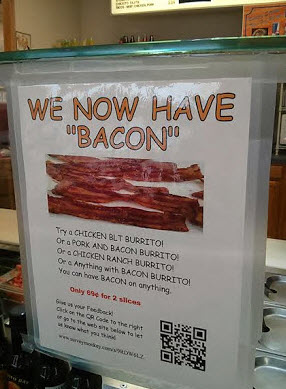
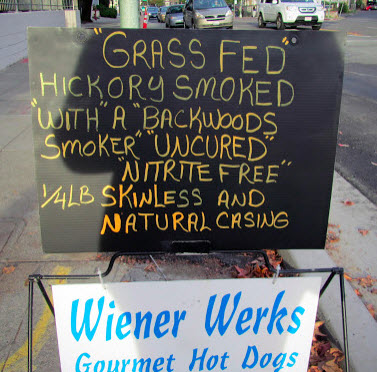
And two more signs from the “Blog” of “Unnecessary” Quotation Marks:

Kara Church

Senior Technical Editor

Posted by: Jack Henry | April 14, 2014

Editor’s Corner: CMOS Q&A (hyphens and numbers)

Good morning folks. It’s been a long time since I’ve given you anything from the Chicago Manual of Style Q&A, but this month has a juicy question about hyphens and numbers, two topics that confuse a lot of us. For the question, answer, usage examples, the description of a giant house, and your reading pleasure, see below:

Q. I am editing a magazine article related to real estate and am struggling with how to hyphenate the descriptions. “With seven bedrooms, four full and two half bathrooms, this home has 6,000 square feet of living space.” Also, “This is a 2,000 square foot, fully renovated four bedroom, three and a half bathroom home.” What does CMOS suggest?

A. Thank you for asking! Reading real estate ads can be painful for us. Your first sentence is passable; the second one needs a lot of hyphens. If a compound phrase (number + noun) serves as an adjective and comes before the noun it modifies, it usually needs hyphens:

· a three-and-a-half-bathroom home

· a four-bedroom townhouse

· a 600-square-foot studio

· a 2,000-square-foot, fully renovated four-bedroom, three-and-a-half-bathroom home

If the compound phrase (number + noun) serves as a noun itself and does not modify a noun that follows, it does not need hyphens:

· a home with three and a half bathrooms

· a townhouse with four bedrooms

· a studio of 600 square feet

· a home with seven bedrooms, four full and two half bathrooms, and 6,000 square feet of living space

Kara Church

Senior Technical Editor

619-542-6773 | Ext: 766773

www.symitar.com

NOTICE: This electronic mail message and any files transmitted with it are intended
exclusively for the individual or entity to which it is addressed. The message,
together with any attachment, may contain confidential and/or privileged information.
Any unauthorized review, use, printing, saving, copying, disclosure or distribution
is strictly prohibited. If you have received this message in error, please
immediately advise the sender by reply email and delete all copies.

Posted by: Jack Henry | April 11, 2014

Editor’s Corner: Henceforth, no more Ms. Fancy-Pants!

The other day someone sent me an excerpt of an email she received. It said “Hereunto attached is the file I’ll be referencing in our conversation later today.” My response to her was, “You’re kidding me, right?”

Here are a few reasons that sentence is, well, horrible:

· Hereunto is pompous, archaic legalese

· Hereunto means “to this” (So, the writer is saying “To this attached is the file…” That may be okay for Yoda, but it is not acceptable for our business email.)

· The entire sentence is far too wordy. (How about: “I’ve attached the file I’ll be referencing later”? That is straight and to the point.)

The highfalutin, overly formal language the writer chose often backfires. Rather than seeming fancy and well-educated, the overall message is masked with the misuse of a term that throws the reader off from the start. Our job is to make things clear to our audience, not hide the message in awkward phrasing.

Here are a few terms you should avoid unless you are a lawyer:

Archaic Word Alternate Wording
aforementioned mentioned previously
foregoing preceding
forthwith immediately
henceforth (henceforward) from this point on
hereafter after this; from now on; in the future
hereinafter in the following part (of this note, letter, document)
heretofore until this time; before now
hereunto to this
herewith with this (included with a note, letter, document)
hitherto until now; before this time
thereafter after that
therewith with that
whatsoever whatever
wherein in what; in what way
whereinto into which
whereof with; by which
Whereon on what; on which
wheresoever wherever
whosoever whoever

Alternate wording courtesy of the Merriam-Webster dictionary.

Happy Friday!

Kara Church

Senior Technical Editor

619-542-6773 | Ext: 766773

www.symitar.com

NOTICE: This electronic mail message and any files transmitted with it are intended
exclusively for the individual or entity to which it is addressed. The message,
together with any attachment, may contain confidential and/or privileged information.
Any unauthorized review, use, printing, saving, copying, disclosure or distribution
is strictly prohibited. If you have received this message in error, please
immediately advise the sender by reply email and delete all copies.

Posted by: Jack Henry | April 10, 2014

Editor’s Corner: Social Media’s Big Daddy – Facebook

Today’s social media entry is dedicated to one site: Facebook. The following vocabulary and definitions are from the glossary at the aptly named Constant Contact website. It is this feeling of constant contact that drives me away from Facebook. While it is nice to see what old friends are up to and what amazing things my relatives are doing, I don’t like being saddled with the chore of keeping up-to-date on yet another app every day. If someone wants to know what’s going on with me, they can sign up for Editor’s Corner, right? Otherwise, you won’t see my vacation photos, pictures of my dinner, or anything else of much interest on my wall. For many, Facebook is a godsend, however; so here’s some terminology to help you navigate.

Note: The excessive capitalization in the following definitions is greatly frowned upon by yours truly; however, to let the article flow, I will refrain from adding [sic] to all of the common nouns that are capitalized.

Facebook

The largest of the social networks (it boasts more than 500 million active users), Facebook has become a favorite destination for people, businesses, and organizations to connect and share information because of its easy-to-use interface and interactive features. It’s the most multimedia-friendly of the big three networks as members can post text, pictures, audio, and video. It also offers tons of applications and widgets that can make your Facebook Page engaging and fun.

Commenting

Just about everything posted to Facebook has a comment field below it for you, Friends, and fans to post a response and facilitate a conversation. When comments are left on personal profile updates, the owner gets an email notification. However, Page comments do not have email alerts associated with them, so it’s vital to check back regularly to see if customers are leaving comments and to respond appropriately. Alternatively, you can sign up for a free NutshellMail account, to receive a daily update of new comments and activity posted to your Facebook Page.

Friend

When you want to connect with someone on Facebook through a personal profile, you "friend" them. The friend connection is two-way, meaning both parties have to agree before the connection is made. (See also "unfriending.")

Like

The "Like" button is now ubiquitous on Facebook (and off). The Like button provides a simple way for Facebook users to share their approval or endorsement with their network of friends. Users can Like a Page as a way of providing a recommendation or they can simply Like an individual post, picture, or video to provide a virtual thumbs up. You may have noticed Like buttons on non-Facebook websites. This is a great way to get visitors to your website or blog to recommend your business or an individual post with their Facebook network. (You can learn how to add a "Like" button to your website here: http://www.facebook.com/badges).

Message

Messages are private notes sent between users. They’re only viewable to the sender and recipients. It’s pretty much like sending an email but with an address book that is limited to your Facebook friends.

News Feed

What Facebook calls all the items that your friends and the businesses/organizations you Like have posted. Users have two ways to view this content: You can see "Most Recent" items (i.e., everything that’s been posted) or "Top News" items (i.e., those that have been most commented on).

Page

A Page (previously referred to as a Fan or Business Page) is the recommended platform for your business or organization to connect with new people and engage with your existing customers in an open dialog. The benefit of a Page is that customers can follow it by hitting the "Like" button without the connection having to be reciprocated. When you post a comment to your Page, it will show up in your fans’ news feed, for all their friends to read and share. You can create an incredible network effect by posting interesting and valuable content and promotions to your Page.

Personal Profile

Any individual who is on Facebook has a personal profile: it’s the focal point for the entire network. Your profile page contains all your pertinent information and is how others find and connect with you on Facebook. Through your profile, you can share status updates, photos, videos, links, and other content. Plus, friends can comment on your posts. Businesses, organizations, and celebrities are recommended to create a Page rather than a personal profile.

Places

Facebook’s geo-location feature allows users to check in wherever they are. As opposed to similar services like Foursquare and Gowalla, Facebook Places allows users to tag their friends who are also at a location, giving businesses and organization an even better indication of who is visiting their establishment or attending their event. Note: Facebook users can choose to block themselves from being tagged if they wouldn’t want that kind of information to be revealed.

Privacy Settings

Facebook has a myriad of privacy settings that you can use to control who sees what. Note that Facebook changes the range of settings and their defaults from time to time. It’s good to keep an eye on any changes to Facebook’s Terms of Service.

Share

Sharing is synonymous with posting or publishing. You can publish text, links, photos, videos, and events on Facebook using the share box at the top of your profile (it says, "What’s on your mind?" inside the box). After entering your text, you have the option to upload a photo, video, or insert a link. When sharing a link, Facebook will automatically include the title, description, and an image (if available) from the page you’re linking to. If there are multiple images on the page, you have the option to select which image you want to use as the thumbnail. You can also change the specific text that is displayed by clicking on it. In addition, when you share content to your Wall, your fans and friends can then Like, comment on, or share the content with their friends. The share feature is what makes publishing content to Facebook so powerful. By sharing great content, you can encourage your friends and fans to syndicate your message, creating a powerful network effect.

Tabs

Along the top of a Facebook profile or page, tabs separate out areas of content. Customers can add additional tabs using pre-built applications or by building their own.

Tag

You can tag friends in pictures, places, videos, and in text, which places a link from the item to their profile. Tagging a person’s face in one of your own photos will allow that person’s friends to see your photo, depending on the tagged person’s privacy settings.

Unfriending

Disconnecting with someone on Facebook. When you unfriend someone, the person does not get notice that you have done so.

Wall

This is your own profile page and the updates it contains. People can write updates on your wall that are viewable by all your friends.

Wall to Wall

Notes written between you and someone else that are viewable to anyone who is connected to you and the other friend. Think of it as being able to eavesdrop on a public conversation; writing on someone else’s wall means that anyone you’re connected to can read what you wrote.

Thanks to the Editor’s Corner’s best friend, Keith Slayton, for the graphic!

Kara Church

Senior Technical Editor

Posted by: Jack Henry | April 9, 2014

Editor’s Corner: Calques

Today I have some interesting information for you about calques (also called loan translations). According to Merriam-Webster a calque is “a compound, derivative, or phrase that is introduced into a language through translation of the constituents of a term in another language (as superman from German Übermensch).”

The word calque comes from French and means “copy” or “trace.” Here are some more calques from Daily Writing Tips:

From German:

hang glider from Hängegleiter
flamethrower from Flammenwerfer
gummy bear from the product name Gummibärchen (little gummy bear)
loanword from Lehnwort
Intelligence Quotient (I.Q.) from Intelligenzquotient
Rainforest from Regenwald
Watershed from Wasserscheide
World war from Weltkrieg

Note: In Nietzschean thought, the übermensch is the ideal superior man of the future who transcends conventional Christian morality to create and impose his own values. The German word werfer (“thrower”) is used in sports to refer to the bowler in cricket and the pitcher in baseball.

Here are some calques from the French:

deaf-mute from sourd-muet
free verse from vers libre
rhinestone from caillou du Rhin

Note: The historical term deaf-mute, “unable to hear or speak,” is now considered by some to be insensitive or derogatory; a replacement term is “hearing- and speech-impaired.” German also has Rheinkiesel which, like caillou du Rhin, means “Rhine-pebble.”

Latin calques:

Milky Way (the galaxy that contains Earth’s solar system) from via lactea
“Rest in Peace” from requiescat in pace
“in a nutshell” from in nuce

Calquing goes both ways. Computing terms coined in English have been calqued into other languages. For example, French disque dur, carte mère, souris, and en ligne for English hard disk, motherboard, mouse, and online.

Click here for another article on calques.

And more from the department of unnecessary quotation marks and bad advertising:

Kara Church

Senior Technical Editor

Posted by: Jack Henry | April 8, 2014

Editor’s Corner: D is for Delcious.com

I have a delightful tidbit selected particularly with German-speakers in mind, but you will have to wait until tomorrow for that. Until then, I have the D and E social media terms from the Building Brand Character & Constant Contact glossaries.

D

· Delicious.com: An online bookmarking service that lets users save website addresses publicly and privately online so they can be accessed from any device connected to the internet and shared with friends. [KC – It sounds a little dirty, but I checked the web page and it is safe for work. Not as delicious as chocolate cake, but it may be enjoyable to some of you.]

· Duplicate Content: Content that is duplicated entirely or partially from either another website or within your own. This is a negative ranking factor and can cause a site to be buried in the rankings.

E

· EBook: An electronic version of a book, typically in a PDF file format.

· Ecommerce Site: A website devoted to retail sales where users can purchase products online.

· EdgeRank: Similar to PageRank, this is Facebook’s algorithm to determine popularity and trust among other (proprietary) factors.

· Engagement: Users who interact with a company or website online, particularly through social media channels. High engagement is a positive sign, as it indicates the target audience is interested in what a brand has to say.

· Embedding: The act of adding code to a website so that a video or photo can be displayed on that site while being hosted by another. For example, YouTube provides a simple snippet of HTML code that can be used to embed a copy of any video on a website or blog. The video will play inside a YouTube-branded player.

· Engaged: People who interact with a business or organization or an individual (on social networks, in email, etc.) by posting comments and sharing content are said to be engaged.

As a juvenile (Type I) diabetic, this cracked me up. Let the cage matches begin!

Kara Church

Senior Technical Editor
Posted by: Jack Henry | April 4, 2014

Editor’s Corner: Social Media Vocabulary – C

It’s a great Friday today! With the addition of the iPay Payment Operations department, we have passed the 1,000 subscriber mark and then some! Editor’s Corner now has 1,027 readers and I want to thank all of you for your curiosity, questions, and submissions over the last few years. It is great to have you along as we try to learn a little more each day about this language we share. Hip hip hooray!

And now for social media terms from the Building Brand Character & Constant Contact glossaries. Today we’re covering the letter C. I also have a couple pictures for you from a blog of unnecessary quotation marks. Have a good weekend!

· Check in

Used by sites like Facebook, Foursquare, and Yelp, it’s a method of virtually checking in to a location, letting others know you’re there.

· Citation

Any site that lists a business’s name, address, and phone number, and is crawlable by search engines. Citations are an incredibly important aspect for local businesses looking to rank high in search results.

· Citation Source

A site that provides a citation, such as a directory.

· Click Fraud

Non-legitimate clicks on a pay-per-click ad, generally performed by a website owner or their employees, in an effort to increase the amount they’re paid.

· CMS

(Content Management System) Programs such as WordPress that allow users to create websites without knowledge of hard coding.

· Comment Spam

Posting comments on blogs for the sole reason of acquiring a link back to a site. Many bloggers disable or review comments because of this tactic.

· Comments

Many social media sites encourage readers and viewers to leave comments on what has been posted, whether it’s a quick status message, a video, an article, or a picture. Some sites, like Facebook, use the number of comments to determine how a post is included in a person’s news feed. On YouTube, video "owners" have the ability to turn off comments for an individual video.

· Content

(text, copy) Content is one of the most valuable aspects of SEO [KC – Search Engine Optimization]. A page’s content should be unique and informative to the user.

· Conversion

(goal) A quantifiable goal of a website. These can be downloads, purchases, or newsletter signups.

· Conversion Rate

The rate at which users on a site convert into customers. This is determined by taking the number of conversions and dividing it by the number of total visits.

· CPC

(cost per click) Describes the average amount of money spent on an ad campaign on a per click basis. This is determined by taking the number of clicks and dividing it by the overall ad budget.

· Crawler

A program that performs a task more or less autonomously. [KC – See definition under “bot” from the other day at:
https://episystechpubs.com/2014/04/02/editors-corner-social-media-vocabulary-b/
.]

· Crowdsource

The practice of asking a collection of individuals online for opinions, suggestions, or submissions. For example, you might not be able to choose between two newsletter articles, so you’d ask the people who “Like” you on Facebook or are following you on Twitter which one you should include. Or you can simply post both stories to Facebook and Twitter and discover which one resonates most based on the number of “Likes,” shares, comments, or retweets. Crowdsourcing can also be helpful if you’re planning an event and can’t decide on a date or location, or if you’re looking for suggestions for a vendor.

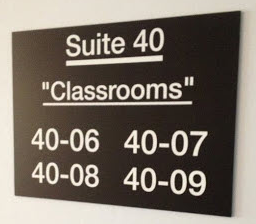
Hmm…with the quotation marks I have to ask: Does this mean ‘possum and skunk?

If by “Classrooms” they mean rooms set aside for illegal poker games, then by all means they’ve used the correct punctuation!

Kara Church

Senior Technical Editor
Posted by: Jack Henry | April 3, 2014

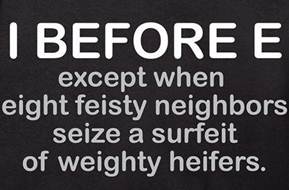
Editor’s Corner: Weighty Heifers

As promised, today I have some helpful information on that “I before E, except after C” guideline that many of us learned in grade school. Most people complain that this is a useless rule in English. One of our co-workers told me she relives the trauma of a spelling bee lost after using this rule, every time she hears it. Another co-worker has embraced the guideline as his own, with the version: “I before E, except in Keith.” Until I saw the rhyme in its entirety, I agreed that it seemed useless.

I thought this article from Maeve Maddox at Daily Writing Tips was very helpful, so I am including a big chunk of the article for your reading and learning pleasure. Here it is, starting with the full rhyme:

I before E,
Except after C,
And when sounded as A
As in neighbor and weigh.

Let’s see how far this rule will take us with common words.

I before E
achieve
believe
belief
brief
chief
die
field
fierce
friend
lie
lingerie
niece
pie
piece
pierce
prairie
priest
siege

Except after C
ceiling
conceit
conceive
deceive
receipt
receive
perceive

And when sounded as A,
as in neighbor and weigh
heir
neighbor
reign
rein
skein
surveillance
their
veil
vein
weigh

Exceptions to the Rule
caffeine
counterfeit
either
forfeit
foreign
heifer
leisure
neither
sovereign
seized
weird

This list of 46 words is by no means exhaustive, but it’s a fair gauge of how far the old jingle can take you in spelling the ie/ei words you are most likely to want to write.

(Thanks for the graphic, Mr. Hooper!)

Kara Church

Senior Technical Editor

« Newer Posts - Older Posts »

Categories