Posted by: Jack Henry | November 20, 2014

Nifty Nugget: How Many Spaces After a Period?

First, I want to inform you that this is the last official Nifty Nuggets article you’ll receive. But don’t worry! Nifty Nuggets is not going away, it is merging with Editor’s Corner. So, you can still receive information about JHA styles, correct word usage, tips to improve your writing, and lots of other fun language-related shenanigans. Kara Church usually writes the Editor’s Corner, but all of the editors will occasionally fill in. If you’re not already signed up for the Editor’s Corner, just send an email to kchurch.

And now for your nugget:

Lately, a few people have asked me about how many spaces they should put after a period. Is it one or two? Believe it or not, this issue has been hotly debated (maybe not as hotly as, say, Lady Gaga’s meat dress, but we grammar geeks got red in the face and nearly raised our voices over it).

So here’s what you need to know: the JHA Style Guide clearly states, “Use a single space after a period between sentences.” The same is true for all end punctuation, such as question marks and exclamation points—they are all followed by only one space.

And in case you’re wondering, almost all style guides agree—one space is all you need (well, you also need water, food, shelter, and love; but that’s a different kind of nugget—that’s more of a Daily Affirmation Nugget).

Donna Bradley Burcher | Technical Editor, Adv. | Symitar®

8985 Balboa Ave. | San Diego, CA 92123 | Ph. 619.278.0432 | Ext: 765432

Posted by: Jack Henry | November 19, 2014

Editor’s Corner: Pilot

I received a call from my brother yesterday, who started his call with an apology. He didnt drunk dial, but hed been riding his motorcycle in the frosty northwest air and said his brain was frozen. He began musing about the word pilot, because hed been driving behind a Honda Pilot. What an odd looking word, he said. I was wondering what the etymology could be since there are so many ways we use the wordpilots fly, there are pilot screws, pilot lights. And what about Pontius Pilate? What the heck is that all about?

This Editors Corner is for my dear brother, Fritz. You may be getting a dictionary for Christmas. J

From Merriam-Webster:

pilot (noun)

1. a: one employed to steer a ship
b: a person who is duly qualified and usually licensed to conduct a ship into and out of a port or in special waters, often for fixed fees and who while in charge has the whole conduct of her navigation
c: a book giving detailed navigational information of a body of water and the adjacent coastline

2. a guide who leads along a difficult or unknown course: one who takes charge during dangerous or unsettled times: a leader who inspires

3. Menominee whitefish

4. a: an inclined triangular frame on the front of a railroad locomotive for removing obstacles from the track also called a cowcatcher
b: a locomotive engineer assigned to assist in operating a train over track with which the regular engineer is unfamiliar

5. one who flies or is qualified to fly an airplane

6. a: a cylindrical projection at the end of a tool (as a counterbore, countersink, boring rod) to guide it
b: a bar or simple element acting as a guide or relay for another mechanical element
c: an auxiliary mechanism that actuates, energizes, governs, or regulates another mechanism <a pilot-operated sliding disk valve>

7. the relatively small heading or excavation first made in the driving of a larger tunnel

8. the manager of a baseball team

9. a television show produced as a sample of a proposed series

10. pilot light: a small permanent flame used to ignite gas at a burner

Origin of PILOT

Middle French pilote, from Italian pilota, alteration of pedota, from (assumed) Middle Greek pdts, from Greek pda steering oars, rudder, plural of pdon oar

And additional etymological information from the Online Etymology Dictionary:

pilot (n.)

1510s, "one who steers a ship," from Middle French pillote (16c.), from Italian piloto, supposed to be an alteration of Old Italian pedoto, which usually is said to be from Medieval Greek *pedotes "rudder, helmsman," from Greek pedon "steering oar," related to pous (genitive podos) "foot" (see foot (n.)). Change of -d- to -l- in Latin ("Sabine -l-") parallels that in odor/olfactory; see lachrymose.

Sense extended 1848 to "one who controls a balloon," and 1907 to "one who flies an airplane." As an adjective, 1788 as "pertaining to a pilot;" from 1928 as "serving as a prototype." Thus the noun pilot meaning "pilot episode" (etc.), attested from 1962. Pilot light is from 1890.

pilot (v.)

1640s, "to guide, lead;" 1690s, "to conduct as a pilot," from pilot (n.) or from French piloter. Related: Piloted; piloting.

pilot-fish (n.)

1630s, from pilot (n.) + fish (n.). So called because they were thought to lead sharks to prey.

Kara Church

Technical Editor, Advisory

619-542-6773 | Ext: 766773

www.symitar.com

NOTICE: This electronic mail message and any files transmitted with it are intended
exclusively for the individual or entity to which it is addressed. The message,
together with any attachment, may contain confidential and/or privileged information.
Any unauthorized review, use, printing, saving, copying, disclosure or distribution
is strictly prohibited. If you have received this message in error, please
immediately advise the sender by reply email and delete all copies.

Posted by: Jack Henry | November 18, 2014

Nifty Nuggets: Do Not Use Verbs as Nouns

Good morning, folks.

I just got in to work. I just stepped up on my soapbox, and here I go.

I have noticed an ugly habit in our technical community: people are haphazardly turning verbs into nouns.

For instance, I have heard and read statements similar to these:

· The module will be added during the install.

· Changing this parameter could cause a mass delete.

In the sentences above, both install and delete are verbs that are being used as nouns. You can install software and you can delete a record, but you cannot (grammatically speaking) have, or perform, an install or a delete.

What confuses me, is that we already have perfectly good nouns that we should be using: installation and deletion.

· The module will be added during the installation.

· Changing this parameter could cause a mass deletion of the record.

Granted, the correct words are three syllables long rather than one; but have we really gotten that lazy? Is it worth saving the nanosecond it takes to say or the millisecond it takes to type the longer word?

Oh my gosh, I sound like my fourth grade teacher, Mrs. Forbrag. No one liked her. Let’s not tell Jackie what a downer I can be. She may not let me guest host anymore.

Enjoy your day!

Donna Bradley Burcher | Technical Editor, Adv. | Symitar®

8985 Balboa Ave. | San Diego, CA 92123 | Ph. 619.278.0432 | Extension: 765432

NOTICE: This electronic mail message and any files transmitted with it are intended
exclusively for the individual or entity to which it is addressed. The message,
together with any attachment, may contain confidential and/or privileged information.
Any unauthorized review, use, printing, saving, copying, disclosure or distribution
is strictly prohibited. If you have received this message in error, please
immediately advise the sender by reply email and delete all copies.
Posted by: Jack Henry | November 18, 2014

Editor’s Corner: Proofreading Tips

Today’s topic is one I’ve covered before, but hopefully it will serve as a good reminder and provide some helpful suggestions. These are some of the tips and tricks I learned in a copyediting course, along with my comments. For the original list and Mignon Fogarty’s comments, see her webpage: Grammar Girl.

1. Have someone else read your work.
KC – We live by this rule here in Editing. Yes, we miss things now and then, but luckily, not too often. Donna has saved me from embarrassment countless times. (I love you, Donna.)

2. When you’re writing on your computer, use the auto-correct feature.

3. Run your work through your computer’s spell-checking tool.
KC – It doesn’t help if you type “manger” instead of “manager,” or “turkey” instead of “turn-key,” but it can catch some of the errors.

4. Print your work.
KC – If we lived in a world of endless resources I might agree. Yes, it may help you edit, but it will also cost money, and Mother Earth will frown upon you. In most cases, I disagree with this step.

5. Give yourself some time.
KC – Ha ha! Grammar Girl must also live in a world without deadlines or speedy turnarounds. Again, in an ideal world this is fantastic advice: write something, leave it, and then proofread it.

6. Read your work aloud.
KC – As editors, we have to read things out loud on occasion to figure out if they really make sense. You can do this, too. Just remember, use your library voice when you talk to yourself (I mean when you read out loud) in the office.

7. Force yourself to view each word.
KC – Definitely do this. The times when we are speeding along are the times we miss “the the” or “of of” and that sort of typo in our text.

8. Read your work backward, starting with the last sentence and working your way in reverse order to the beginning.
KC – This is one of those things you learn in copyediting class. Then you go to the real world where there’s no time, at least not in the JHA arena. If you have the time when you write, go for it.

9. Separate proofreading tasks.
KC – We do this all of the time, though we have to group several tasks together when we edit. Read your work through, concentrating on the spelling and punctuation. On a second reading, check the grammar and flow. On a third reading, check the formatting or coding (in html or xml). It sounds like a lot of work, but you will be a better writer for it.

10. Print your work in a different font with different margins.
KC – Rather than printing your work, try applying different margins and fonts. By changing the look of your materials, you might see errors that weren’t clear to you before.

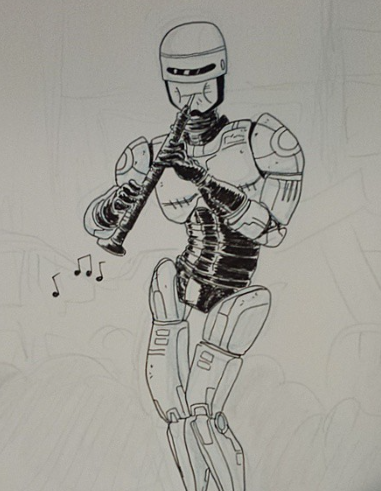
This artist, Austin Light, made the best of some movie typos by illustrating them. Click “Oboe Cop” (below) to see some of his other drawings.

Oboe Cop – by Justin Light

Kara Church

Technical Editor, Advisory

Posted by: Jack Henry | November 14, 2014

Editor’s Corner: Crazy Train

Is it really Friday already? We all know what Friday means! It’s time for mondegreens! Today’s selection of misheard song lyrics is brought to you by Hit Me with Your Pet Shark: Misheard Lyrics of the 1980s, by Charles Grosvenor Jr.

Song Title Artist/Group Mondegreen Actual Lyrics
A Little More Love Olivia Newton-John It gets me nowhere,
With an Italian nose
It gets me nowhere,

To tell you no

Your Love The Outfield Josie has a PlayStation far away Josie’s on a vacation far away
Crazy Train Ozzy Osbourne I’m going out with Ray and his crazy friends I’m going off the rails on a crazy train
Hit Me with Your Best Shot Pat Benatar Hit me with your pet shark Hit me with your best shot
Love Is a Battlefield Pat Benatar Octopus glowing
Love is a battlefield
Both of us knowing

Love is a battlefield

Shadows of the Night Pat Benatar We’re riding with our saddles on tonight We’re running with the shadows of the night
Domino Dancing Pet Shop Boys Olé, olé

Watch the world fall down

All day, all day

Watch them all fall down

Shock the Monkey Peter Gabriel Choco-monkey Shock the monkey
Sledgehammer Peter Gabriel I’ve kicked the rabbit

Shaved my skin

I’ve kicked the habit
Shed my skin
Against All Odds Phil Collins You’re the Obi-Wan, who really knew me at all You’re the only one, who really knew me at all
Another Brick in the Wall, Part II Pink Floyd No “Dukes of Hazzard” in the classroom No dark sarcasm in the classroom
Comfortably Numb Pink Floyd I have a cold

Comfort me, Mum

I have become

Comfortably numb

Kara Church

Technical Editor, Advisory

619-542-6773 | Ext: 766773

www.symitar.com

NOTICE: This electronic mail message and any files transmitted with it are intended
exclusively for the individual or entity to which it is addressed. The message,
together with any attachment, may contain confidential and/or privileged information.
Any unauthorized review, use, printing, saving, copying, disclosure or distribution
is strictly prohibited. If you have received this message in error, please
immediately advise the sender by reply email and delete all copies.

Posted by: Jack Henry | November 13, 2014

Nifty Nuggets: The Serial Comma

Hi folks. Jackie has asked me to temporarily assume Nifty Nugget duty. I thought we’d start with a simple punctuation rule that causes a lot of confusion and controversy.

Today’s topic is the serial comma, which is also known as the Oxford comma. But don’t let its name intimidate you; this is an easy comma to figure out how to use.

Use the serial comma at the end of a list or series, just before the final conjunction (examples of conjunctions are and, but, and or). Here are a few examples with the serial comma and the conjunction highlighted.

· My favorite animals are dogs, elephants, and anacondas.

· I have to vacuum my car, wipe off the dashboard, clean out the trunk, and wash the windows before my mom will ride in it.

· You can buy candy by the piece, by the bag, or by the pound.

There are differing opinions about whether or not to use this comma. Some folks argue that it’s not necessary. However, most grammarians and most style guides opt to use it because it often eliminates ambiguity. Our JHA Style Guide clearly states: “In a series of three or more items, always use a comma to separate all elements.”

Be on the right side of the law. Use the serial comma.

Donna Bradley Burcher | Technical Editor, Adv. | Symitar®

8985 Balboa Ave. | San Diego, CA 92123 | Ph. 619.278.0432 | Ext: 765432

Posted by: Jack Henry | November 13, 2014

Editor’s Corner: Answers and Explanations

Good morning! Here are the answers to yesterday’s quiz and the reasons behind the answers. Go ahead and pat yourself on the back for mastering the pleonasm!

1. Original: Usually it was her custom to eat a chocolate cake on her birthday.
Correct: It was her custom to eat a chocolate cake on her birthday.

The word custom contains the meaning of usual or habitual.

2. Original: This beautiful waterfront park is the result of the joint collaboration of the Balboa Park Rose Garden and the Waterfront Association.
Correct: This beautiful waterfront park is the result of the collaboration of the Balboa Park Rose Garden and the Waterfront Association.

The word collaboration contains the meaning of cooperation between two or more agencies. You don’t need to add the word joint.

3. Original: Her wedding dress was marred by a tiny speck of black ink on the bodice.
Correct: Her wedding dress was marred by a speck of black ink on the bodice.

The word speck contains the meaning of tiny. A speck is a tiny particle.

4. Original: Johnny “Little Fingers” La Motta was sent to prison for life: the verdict was totally and completely unanimous.
Correct: Johnny “Little Fingers” La Motta was sent to prison for life: the verdict was unanimous.

The word unanimous contains the meaning of “lack of disagreement.” Totally and completely are redundant.

5. Original: I’m sorry, but the color intensity of this painting is not sufficient enough to qualify for the auction.
Correct: I’m sorry, but the color intensity of this painting is not sufficient to qualify for the auction.

The word sufficient means enough or adequate.

Kara Church

Technical Editor, Advisory

619-542-6773 | Ext: 766773

www.symitar.com

NOTICE: This electronic mail message and any files transmitted with it are intended
exclusively for the individual or entity to which it is addressed. The message,
together with any attachment, may contain confidential and/or privileged information.
Any unauthorized review, use, printing, saving, copying, disclosure or distribution
is strictly prohibited. If you have received this message in error, please
immediately advise the sender by reply email and delete all copies.

Posted by: Jack Henry | November 12, 2014

Editor’s Corner: Pleonasm Lesson & Quiz

Today Im going to bring back an old tradition of Editors Corner: the quiz. For this to work, you have to follow the directions carefully.

1. Today I will provide you with a brief lesson and an exercise.

2. Complete the exercise on your own. Please, do not send me your answers.

3. On Thursday (tomorrow), I will send you the answers and a brief explanation behind them.

This is not intended to freak you out or cause anxiety, nor is it graded or mandatory.

Todays topic is the literary device called the pleonasm (not neoplasm). According to Merriam-Webster, a pleonasm is defined as:

1a: iteration or repetition in speaking or in writing: the use of more words than those necessary to denote mere sense (as the man he said, saw with his own eyes, true fact); especially: the coincident use of a word and its substitute for the same grammatical function: redundancy, tautology

Origin of PLEONASM

Late Latin pleonasmus, from Greek pleonasmas, from pleonazein to be more, to be in excess, to be redundant, from pleon, neuter of plein, plen more

Some additional examples of pleonasms are:

army soldier

return back

burning fire

black darkness

Since our goal in technical documentation is to be thorough but concise, we do our best to avoid pleonasms (and neoplasms). Your exercise, should you choose to accept it, is to edit these sentences and remove the unnecessary words.

Note: The key is to remove the redundancies, not rewrite the sentences for the great American novel.

1. Usually it was her custom to eat a chocolate cake on her birthday.

2. This beautiful waterfront park is the result of the joint collaboration of the Balboa Park Rose Garden and the Waterfront Association.

3. Her wedding dress was marred by a tiny speck of black ink on the bodice.

4. Johnny Little Fingers La Motta was sent to prison for life: the verdict was totally and completely unanimous.

5. Im sorry, but the color intensity of this painting is not sufficient enough to qualify for the auction.

Kara Church

Technical Editor, Advisory

619-542-6773 | Ext: 766773

www.symitar.com

NOTICE: This electronic mail message and any files transmitted with it are intended
exclusively for the individual or entity to which it is addressed. The message,
together with any attachment, may contain confidential and/or privileged information.
Any unauthorized review, use, printing, saving, copying, disclosure or distribution
is strictly prohibited. If you have received this message in error, please
immediately advise the sender by reply email and delete all copies.

Posted by: Jack Henry | November 10, 2014

Nifty Nuggets: Jargon and Terminology

Hello! Congratulations to David Romano, the winner of a $25 Amazon gift card.

Today I am going to talk about jargon and terminology. A new coworker asked me what the phrase excepts out means. I explained that except out means that Episys creates an exception for something. Then I provided my coworker with an example of when a transaction does not post to a member’s account and I showed her how the account shows up on an exception report.

That conversation made me think about all of the different types of jargon and terminology we use in the workplace and in our writing. These terms may be clear to us; however, they may not be clear to new employees or to the users of our products and services. Avoid using jargon in your writing unless it is appropriate for the audience and no other words fit the situation.

Is “glazed yeast rings“ jargon for donuts?

Note: My co-worker, Donna Bradley Burcher, will be writing nuggets for a bit, so stay tuned for her informative emails.

Jackie Solano | Technical Editor | Symitar®

8985 Balboa Ave. | San Diego, CA 92123 | Ph. 619.542.6711 | Extension: 766711

Posted by: Jack Henry | November 10, 2014

Editor’s Corner: Contest and Consonants

Hello, dear readers!

Let’s start the day by congratulating Adelle Witzke Schumaker for being a new subscriber to Editor’s Corner and winning the $25 Amazon gift card! Woo hoo!

Today I’m addressing a question about spelling. Several of you have noticed some inconsistencies in our products and documentation when it comes to the words canceled (cancelled) and travelers (travellers). The question is always “Which spelling is correct?” For us here in America, the answer is that the version with the single consonant l is correct.

US British
canceled cancelled
counselor counsellor
cruelest cruellest
labeled labelled
modeling modelling
quarreled quarrelled
signaling signalling
traveler traveller
traveling travelling
equaling equalling
initialed initialled
fueling fuelling
dialed dialled
woolen woollen
caliper calliper
jewelry jewellery

For more information on spelling differences between American and British English, see these previous Editor’s Corner articles, or check out Wikipedia.

· Editor’s Corner: BBC America

· Editor’s Corner: Dr. Who

I hope you have a great day!

Kara Church

Technical Editor, Advisory

« Newer Posts - Older Posts »

Categories