Posted by: Jack Henry | December 4, 2014

Editor’s Corner: Overwhelm, underwhelm, and whelm

I’m not sure if the holiday season pressure starts in October when the stores start displaying Christmas themes—or if it is after Thanksgiving when people start mauling each other in stores to get the last Elsa doll, and when party invitations and community activities pile on at breakneck speed. Whatever holiday you celebrate, whichever yule log you dance around, and whatever you do to ring in the new year, there is bound to be a little bit of the following: overwhelming, underwhelming, and whelming.

The following information is based on a lengthy Q&A from the Grammarphobia blog, but these definitions are from Merriam-Webster.

overwhelm

1: Overthrow, overturn, upset

2a: to cover over completely (as by a great wave): overflow and bury beneath: engulf

b: to overcome by great superiority of force or numbers: bring to ruin: destroy, overpower

c: to overpower in thought or feeling: subject to the grip of an overpowering emotion

3: to project over threateningly or dominatingly

First Known Use: 14th century (sense 1)

underwhelm

: to fail to impress or stimulate

First Known Use: 1948

whelm

1a dialectal, England: to turn (as a dish or vessel) upside down usually to cover something

b: to throw or place (an object) upon something so as to engulf or crush it <whelms his hat down over his eyes>

2a: to cover or engulf completely usually so as to wreck or destroy: bury, submerge <the avalanche whelms the mountain village in tons of snow>

b: to engulf or overcome in the manner of a storm or flood with usually disastrous effect <winter darkness whelms the woods>

c: to overcome in thought or feeling : overwhelm <drawn into overmastering passion, whelmed with a rush of joy and triumph — G. A. Wagner>

Middle English whelmen, perhaps alteration (influenced by helmen to helm) of whelven to turn upside down — more at helm, whelve

First Known Use: 14th century (sense 1a)

NOTICE: This electronic mail message and any files transmitted with it are intended
exclusively for the individual or entity to which it is addressed. The message,
together with any attachment, may contain confidential and/or privileged information.
Any unauthorized review, use, printing, saving, copying, disclosure or distribution
is strictly prohibited. If you have received this message in error, please
immediately advise the sender by reply email and delete all copies.

Posted by: Jack Henry | December 3, 2014

Editor’s Corner: December CMOS

Good morning, folks!

I hope you had a fantastic Thanksgiving holiday. Thank you, Donna, for standing in and delighting everyone with your Editor’s Corner selections so that I could enjoy a very chilly holiday in Oregon. Today I have a tiny Q&A from the Chicago Manual of Style, where apparently they did not have a great holiday because they are quite snarky. If you’d like to see the more helpful Q&A items for December, click here.

Q. What does The Chicago Manual of Style recommend for the usage of make vs. makes?

A. We recommend using one or the other.

Kara Church

Technical Editor, Advisory

619-542-6773 | Ext: 766773

www.symitar.com

NOTICE: This electronic mail message and any files transmitted with it are intended
exclusively for the individual or entity to which it is addressed. The message,
together with any attachment, may contain confidential and/or privileged information.
Any unauthorized review, use, printing, saving, copying, disclosure or distribution
is strictly prohibited. If you have received this message in error, please
immediately advise the sender by reply email and delete all copies.
Posted by: Jack Henry | December 2, 2014

Editor’s Corner: Word Game Answer

It’s answer time!

What do the following words have in common?

· Baobab

· Dachshund

· Hopscotch

· Youngberry

· Dumbfounded

Answer: All six words begin and end with the same letter.

This riddle brought to you by dictionary.com. Thanks for playing!

Donna Bradley Burcher | Technical Editor, Adv. | Symitar®

8985 Balboa Ave. | San Diego, CA 92123 | Ph. 619.278.0432 | Extension: 765432

NOTICE: This electronic mail message and any files transmitted with it are intended
exclusively for the individual or entity to which it is addressed. The message,
together with any attachment, may contain confidential and/or privileged information.
Any unauthorized review, use, printing, saving, copying, disclosure or distribution
is strictly prohibited. If you have received this message in error, please
immediately advise the sender by reply email and delete all copies.

Posted by: Jack Henry | December 2, 2014

Editor’s Corner: Word Game

Today is a fine day for a word game. Are you feeling clever?

I’m going to give you a list of five words and their brief definitions. All you have to do is figure out what the words have in common. It couldn’t be easier.

There’s only one rule: please do not send your answer to me.

To make it easy for everyone, I’ll send the answer to you at noon (PT), so you can see how you fared. Here are the words and their definitions:

· Baobab: a tree, also known as the upside-down tree; the fruit is sometimes known as monkey bread

· Dachshund: a short-legged dog known for hunting badgers; also called a wiener dog

· Hopscotch: a popular children’s playground game

· Youngberry: a hybrid of blackberries, raspberries, and dewberries

· Dumbfounded: confused, bewildered, amazed

Ready, set, go!

Donna Bradley Burcher | Technical Editor, Adv. | Symitar®

8985 Balboa Ave. | San Diego, CA 92123 | Ph. 619.278.0432 | Extension: 765432

NOTICE: This electronic mail message and any files transmitted with it are intended
exclusively for the individual or entity to which it is addressed. The message,
together with any attachment, may contain confidential and/or privileged information.
Any unauthorized review, use, printing, saving, copying, disclosure or distribution
is strictly prohibited. If you have received this message in error, please
immediately advise the sender by reply email and delete all copies.

Posted by: Jack Henry | December 1, 2014

Editor’s Corner: Bear or Bare with Me?

Good morning.

I don’t know about you, but I have to stop and think whenever I write the term bear with me. I can never immediately remember which word I should use: bearor bare.

Then, the other day I received an email from Daily Writing Tips that helped to set things straight for me. Maeve Maddox says:

Commonly seen on the Web is the misspelled phrase “bare with me.” The correct expression is “bear with me.” It means, “be patient with me.”

One of the many meanings of the verb “to bear” is “to tolerate.” The verb bare, on the other hand, means “to reveal” or “to uncover.” For example, “Do not bare your navel in public.”

The information above lets us know that we should use the word bear; but how do we remember?

It might help to bear in mind that the word bare always means lacking. You could be bare naked. You could be a college student who lives in a bare dorm room. You could be surviving the recession with only the bare necessities. But in all those cases, you are lacking something.

On the other hand, the word bear has several unique meanings. It refers to the big growly animal (or a big furry man). It can also mean to carry, as in to bear a burden. And, as in the phrase that started this whole conversation, it can mean to be patient.

So here’s how I’m going to remember. I’m only going to use the word bare to talk about someone or something being naked. Otherwise, I know I should use the word bear.

Donna Bradley Burcher | Technical Editor, Adv. | Symitar®

8985 Balboa Ave. | San Diego, CA 92123 | Ph. 619.278.0432 | Ext: 765432

Posted by: Jack Henry | November 28, 2014

Editor’s Corner: Fun with Words

It’s a quiet day. A lot of people have the day off, but we don’t want to feel sorry for ourselves. Instead, let’s have a little fun with words. I’m going to share seven wacky words that originated in the USA. Before seeing this post on dictionary.com, I had heard all but one of these words, but I didn’t know what some of them meant. See how many you know:

· Lollapalooza: an extraordinary thing, person, or event [dbb – This word perfectly describes the Thanksgiving celebration at my house yesterday.]

· Sockdolager: a decisive blow or remark

· Catawampus: confused or diagonal [dbb – This word could describe the way my son set the Thanksgiving table; but hey, he did it, so I didn’t have to.]

· Hornswoggle: To trick or hoax

· Foofaraw: A great fuss about something insignificant or an excessive amount of decoration

· Discombobulate: to confuse or upset [dbb – I just love this word.]

· Bumptious: offensively self-assertive [dbb – Did I mention that my sister attended?]

If you’d like to hear how these words are pronounced and read a little more about them, click here.

Enjoy your day today, and have a lovely weekend.

Donna Bradley Burcher | Technical Editor, Adv. | Symitar®

8985 Balboa Ave. | San Diego, CA 92123 | Ph. 619.278.0432 | Extension: 765432

NOTICE: This electronic mail message and any files transmitted with it are intended
exclusively for the individual or entity to which it is addressed. The message,
together with any attachment, may contain confidential and/or privileged information.
Any unauthorized review, use, printing, saving, copying, disclosure or distribution
is strictly prohibited. If you have received this message in error, please
immediately advise the sender by reply email and delete all copies.
Posted by: Jack Henry | November 26, 2014

Editor’s Corner: Money, money, money

A few weeks ago, during the elections, someone asked me about the term “monies.” Outside of looking up the definition, I couldn’t find anything very helpful as far as when to use the plural, the proper way to spell it, etc. Today, while looking for something else, I stumbled upon this article on Grammar Girl’s website. This is only a portion of it. For the entire article, see Quick and Dirty Tips, by Mignon Fogarty. Oh, and Happy Thanksgiving!

Money, Monies, or Moneys?

Michael S. asked:

It’s accepted to say, "to hold moneys for payment in trust." I presume moneys is plural; I’ve also seen it spelled monies. Does this mean, then, that the singular would be "a money"?

Merriam-Webster and the Oxford English Dictionary list both spellings—moneys and monies—as acceptable plurals of the word money.

Why Do We Need a Plural for Money?

The bigger question is since money is already a mass noun, why do we need monies no matter how we spell it? Both Garner and The Cambridge Guide to English Usage explain that monies is usually used by legal or finance writers to talk about “individual sums” or “discrete sums” of money.

Monies: I Don’t Like It, but It’s Not Going Away

If you’ve listened to my podcast before, you know that most things don’t bug me, but I have to confess that monies annoys me a little bit. I don’t think I’ve ever seen a sentence in which someone uses monies when money wouldn’t work. For example, one of the examples in Merriam-Webster reads, “Most of the project is being paid for by federal monies.” To my ear, it would work just as well and mean the same thing to say, “The project is being paid for with federal money.” Maybe finance writers see a distinction I don’t see. (I also did some research on the difference between by monies and with money and didn’t find anything that seemed significant.)

But I can tell you that monies is not new and it’s definitely here to stay. The first example of moneys in the Oxford English Dictionary is from 1384 from the Wycliffe Bible.

There’s No Such Thing as “A Money”

To answer Michael’s questions:

1) You can spell the plural either way, but I’d go with monies since that’s what most legal and finance writers seem to be using today.

2) Even though monies is the plural, I can’t imagine a sentence in which you’d ever need to talk about “a money.”

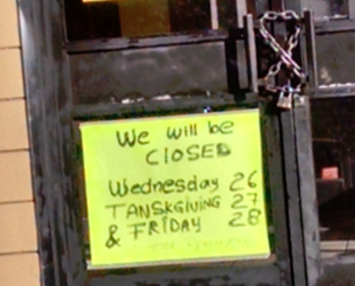
Los Reyes: Delicious Burritos, Not-So-Delicious Spelling

Kara Church

Technical Editor, Advisory

Posted by: Jack Henry | November 25, 2014

Editor’s Corner: Myriad or “a myriad of”?

I’m not sure why this question pops up around the holidays so often, but it seems to be the topic of podcasts, articles, emails to Editor’s Corner, and now a letter to the Chicago Manual of Style. Because I’m feeling fatigued without my morning coffee, I will leave the Q&A to the big boys and girls at CMOS.

Q. Dear Chicago, What is your stance on myriad versus a myriad of? Myriad thanks.

A. CMOS is silent on the issue, but Merriam-Webster’s 11th Collegiate Dictionary (our go-to resource) has this to say, s.v. myriad: “Recent criticism of the use of myriad as a noun, both in the plural form myriads and in the phrase a myriad of, seems to reflect a mistaken belief that the word was originally and is still properly only an adjective. As the entries here show, however, the noun is in fact the older form, dating to the 16th century. The noun myriad has appeared in the works of such writers as Milton (plural myriads) and Thoreau (a myriad of), and it continues to occur frequently in reputable English. There is no reason to avoid it.”

Note: In the paragraph above, s.v. stands for “sub verbo” which means “under the word” or “under the heading.” It is an abbreviation used after an encyclopedia (or in this case, a dictionary) is mentioned, to guide the reader to the section of the reference that is being quoted.

Kara Church

Technical Editor, Advisory

619-542-6773 | Ext: 766773

www.symitar.com

NOTICE: This electronic mail message and any files transmitted with it are intended
exclusively for the individual or entity to which it is addressed. The message,
together with any attachment, may contain confidential and/or privileged information.
Any unauthorized review, use, printing, saving, copying, disclosure or distribution
is strictly prohibited. If you have received this message in error, please
immediately advise the sender by reply email and delete all copies.

Posted by: Jack Henry | November 24, 2014

Editor’s Corner: Since and Because

It may be a holiday week, but that doesn’t mean I’m going to make it easy on you! Rather than talking turkey, today I’m going to delve into a couple of words people seem to have trouble with: since and because. The trouble comes from the times where these words seem to be interchangeable, so let’s review their similarities and differences. (The definitions are from Merriam-Webster; the examples are mine.)

since

1. continuously, from a time in the past until the present
People have been enjoying the food at Blue’s Crab Shack since 1959.

2. before the present time: ago
The rose sachet has been in the drawer for so many years, it has since lost any trace of fragrance.

3. after a time in the past: subsequently
In 1612, an adobe wall (since decayed) was built around the entire settlement.

because

1. since: for the reason that: on account of the cause that
We shouted with glee because the puppies were so cute.

2. that: the fact that: on account of being
Because bananas are mushy and gooey I can’t stand eating them.

Helpful hint: If you can’t decide whether you should use since or because, think of since referring to time and because referring to causation. For example:

· Since I discovered this four leaf clover, I’ve found a pot of gold, I’ve seen three double rainbows, and I’ve married a leprechaun.

· Because I found this four leaf clover, my luck is bound to improve.

Kara Church

Technical Editor, Advisory

Posted by: Jack Henry | November 21, 2014

Editor’s Corner: Corndog winter’s night

Happy Friday!

Today’s selection of misheard song lyrics is brought to you by Hit Me with Your Pet Shark: Misheard Lyrics of the 1980s, by Charles Grosvenor Jr.

Coming soon…holiday song mondegreens from my latest purchase: Deck the Halls with Buddy Holly.

Song Title Artist/Group Mondegreen Actual Lyrics
King of Pain The Police There’s a little black spot on your lung today There’s a little black spot on the sun today
Wrapped Around Your Finger The Police Caught between the skillet and your rib dish Caught between the Scylla and Charybdis
Crazy Little Thing Called Love Queen She leaves me in a cocoa sweat She leaves me in a cool, cool sweat
Send Me an Angel Real Life Send me an eggshell Send me an angel
It’s the End of the World As We Know It R.E.M. Lenny Bruce in birthday pants Lenny Bruce and Lester Bangs
Can’t Fight This Feeling REO Speedwagon Corndog winter’s night Cold, dark winter’s night
Simply Irresistible Robert Palmer Her cantaloupe is mythical That kind of love is mythical
It Must Have Been Love Roxette It must have been rum,

But I’m sober now

It must have been love,

But it’s over now

Soft Cell Tainted Love The lovely Cher seems to go nowhere The love we share seems to go nowhere
The Smiths Bigmouth Strikes Again I’d like to mash a green tooth in your head I’d like to smash every tooth in your head
Cool for Cats Squeeze School for cats Cool for cats
Tempted Squeeze Tempted by the foot of your mother Tempted by the fruit of another

Kara Church

Technical Editor, Advisory

619-542-6773 | Ext: 766773

www.symitar.com

NOTICE: This electronic mail message and any files transmitted with it are intended
exclusively for the individual or entity to which it is addressed. The message,
together with any attachment, may contain confidential and/or privileged information.
Any unauthorized review, use, printing, saving, copying, disclosure or distribution
is strictly prohibited. If you have received this message in error, please
immediately advise the sender by reply email and delete all copies.

« Newer Posts - Older Posts »

Categories