Posted by: Jack Henry | August 18, 2015

Editor’s Corner: Animate, adamant, Adam Ant

I’ve covered frequently confused words before, but it may be time to look into an updated version of this topic. If any of you want to provide me with some suggestions after reading through the ones we’ve already discussed (below) be my guest.

· Frequently Confused Couples

· Frequently Confused Couples, Part 2

Today, however, I have a bit of an odd couple. I was reading the Grammarist blog and came across this article. While the information is interesting, I find it hard to believe that anyone would confuse these two:

Animate vs adamant

Animate means to make alive or to give inspiration or put into motion, to cause something to move as if alive. Animate is a transitive verb, which is a verb which takes an object. Animate may also be used as an adjective to describe something which has life or vigor. Cartoons which are filmed so as to move and appear to have life are animated, the process is referred to as animation. Other related words are animates, animated, and animating. The antonym of animate is inanimate, which means an object that doesn’t move and has no life force. Reanimate means to revive or give fresh impetus. Animate comes from the fourteenth century Latin word, animatus, which means alive.

Adamant is an adjective which means determined, unpersuadable, refusing to allow one’s mind to be changed. As a noun, adamant refers to an unbreakable substance or archaically, a legendary stone said to be impermeable which was often identified as a diamond or lodestone. Adamant comes from the fourteenth century Latin word, adamantem, which means hardest iron, steel and also the Greek adamantos, which means unbreakable, inflexible.

Now I do see how this might be lumped in with the group:

Adam Ant is an English musician who gained popularity in the early 1980s as the lead singer of post-punk rock group, Adam and the Ants. He had a solo singing career, tried his hand at film, and then went bonkers for a few years. Now he’s touring again, and while his voice is still there he looks more like a crazy pirate than Prince Charming.

Adam Ant, 1982

Kara Church

Technical Editor, Advisory

Symitar Documentation Services

Posted by: Jack Henry | August 14, 2015

Editor’s Corner: Lefties and Swifties

I never thought my email about left-handers would provoke such a response! This information is for those of you left-handers who wanted something more positive about the special 10 percent of you out there. Here are some things I found that are hopefully more current and enlightening.

· NPR discussion on left-handedness: http://www.npr.org/2012/01/01/144441028/left-handedness-no-longer-suspect-still-a-mystery

· The book referred to in NPR discussion: The Puzzle of Left-Handedness

· Wordplay: An interesting documentary on Will Shortz that includes some information about left-handers and their puzzle-solving skills. (Will Shortz is an American puzzle creator and currently the crossword puzzle editor for The New York Times. He’s an all-around amazing fellow for you puzzle lovers out there.) I loved this movie, but I’m a word nerd and lifetime Will Shortz fan.

· Products for left-handers: https://www.leftyslefthanded.com/

And now for Friday’s Tom Swifities. We still have quite a few submissions from the contest last month that I haven’t shared with you yet.

For those of you who don’t know what Tom Swifties are, here is a brief description: Tom Swifties are puns “in which the adverb at the end of the sentence takes off punningly from the quotation, as in ‘I dropped my toothpaste, said Tom crestfallen.’”

Thanks to all of the submitters for the gift that keeps on giving!

Emily Gershbein:

· "No, I will not share my salmon with you," said Tom oafishly.
· "I love these little grains in my tabbouleh," said Tom acoustically.

Robert Trescott

· “I’m working hard on my skating skills so I can play for Anaheim when I grow up,” said Tom, productively.

· “When playing hockey, or soccer, I love having the responsibility of defending the goal,” gushed Thomasina, tenderly.

· “My code only errors out 75% of the time!” said Tom, exceptionally proud of himself.

· “Don’t use global variables! Pass in parameters to your function!” insisted Tom, argumentatively.

Matthew Trescott (Robert’s son)

· “When I’m done shaping this lens for my telescope mirror, I hope I can see Jupiter,” said Tom, reflectively.

Eric Nielsen

· “I love the way that picture is framed” said Tom mattedly.
· “It happened in an industrial accident,” said Tom disarmingly.

James Hall

· “Why must it always be horse races,” my wife puffed naggingly.

· “We’re about one-point-eight-five-two kilometers from land,” he stated nautically.

· "I’ve got a knot in my throat," the sailor said nautically.

Laura Reece

· "Yes, I’m wearing gloves bearing advertisements," Tom admitted.

· "I think it’s a great idea to wear your brand on your shirt," Tom said advisably.

· "Trash takes tons of time to transport," Tom said alliteratively.

· "We’ll never escape this gigantic labyrinth. It’s huge," Tom said amazedly.

· "A racy llama taming," Tom said anagrammatically.

· "I’ve lost a lot of blood," Tom said anemically.

Mary Fleenor

· “Let’s meet on the Spanish steps,” he said romantically.

· "Fluffy’s smiling like the Cheshire Cat," she said anthropomorphically.

· "Are you looking for the mean value?" he said averagely.

· "I prefer lying down," he said horizontally.

· "Yes, my brother and I are both physicians," she said paradoxically.

Melody Christian

· “My dog Kodi does not use her principles when taking walks” “said Tom dogmatically”

Mike Godfrey

· “Let’s build a bridge over that river in Thailand,” said Tom quietly.

Mike Timmerman

· “It’s extended to Bastille Day!” she said, revolutionarily.

Moss Wladock

· "I want to win this!" Tom said contestably.

Paul Ruffin

· “But I’m innocent!” said Tom convictedly.

Rob Sampsel

· “You would have to be really thin to fit through there,” said Tom narrowly.

Kara Church

Technical Editor, Advisory

619-542-6773 | Ext: 766773

Symitar Documentation Services

NOTICE: This electronic mail message and any files transmitted with it are intended
exclusively for the individual or entity to which it is addressed. The message,
together with any attachment, may contain confidential and/or privileged information.
Any unauthorized review, use, printing, saving, copying, disclosure or distribution
is strictly prohibited. If you have received this message in error, please
immediately advise the sender by reply email and delete all copies.

Posted by: Jack Henry | August 13, 2015

Editor’s Corner: Left

I wish a Happy Left-Handers Day to those of you with special southpaw talents. I was raised Catholic and I know the Catholic Church frowned upon left-handedness as evil, and judging from the translations below, they weren’t the only ones.

The following list was compiled by Eileen Kreckman, with one addition from me. (Thanks, Eileen!)

The English word “left” is derived from the Anglo-Saxon word lyft, implying “weak or broken.” In Scotland, they have a saying about unlucky people: He must have been baptized by a left-handed priest.

Language Word Meaning
Estonian pahem left, worse
French gauche left, socially awkward
German linkisch left-handed, clumsy
Greek aristeros left, left-hand, sinister
Hungarian bal left, bad
Italian mancino left, deceitful
Latin sinister left, evil
Russian levja left-handed, also a term of insult
Sanscrit waama left, wicked

In most Indo-European languages, the word denoting the right side means “correct.”

Kara Church

Technical Editor, Advisory

619-542-6773 | Ext: 766773

Symitar Documentation Services

NOTICE: This electronic mail message and any files transmitted with it are intended
exclusively for the individual or entity to which it is addressed. The message,
together with any attachment, may contain confidential and/or privileged information.
Any unauthorized review, use, printing, saving, copying, disclosure or distribution
is strictly prohibited. If you have received this message in error, please
immediately advise the sender by reply email and delete all copies.

Posted by: Jack Henry | August 12, 2015

Editor’s Corner: Fixin’ to revisit a few things

Hey, all y’all! My little foray into the language of the South certainly stirred up some stories. Here are a couple of additional lessons I received from some of my favorite subscribers. I have left out names to protect the innocent. Thank you so much for continuing my education!

· Regarding some of her Alabaman kin:

“Fixin’ to” is one I use myself in speech, although I don’t believe I’ve used it in the written word. I heard “used to could” in a Jeff Foxworthy routine, and, I think I’ve heard it elsewhere as well. One my cousins use a lot is “I reckon” when we would say “Yes” or “I suppose so.” Another that really tickles me, although, like “I reckon” it isn’t necessarily incorrect, just different, is “mash” the button (where we would say “press” or “push”) or even “mash the gas pedal”. They also “cut on” and “cut off” the TV or the lights, and they “crank” the car.

· On the triple modals, or stacking, if you prefer, I’ll give you an example of when oughta is usually thrown in to the mix.

Say, for instance, that you’re at a party, and your old boyfriend shows up—and he looks really hot. Your best friend looks at you and says “You might shoulda kept him.” I would probably look back at her and say, “I might oughta should’ve.“

But it’s too late now, and besides, your husband is walking across the room with a drink in his hand for you, and he’s not aware that there is an old boyfriend of yours at the party. Then your friend again looks at you and says, “You need to tell your husband before someone else tells him you and Bobby used to be an item. You might could explain that you were the one who broke things off with Bobby and that might could make him feel less riled up about it.” And you whisper sarcastically to your best friend, “Well, it oughta should!”

· I think I found your “fixin’ to” etymology. My Google-fu is strong. (D.M.)

The earliest example in writing is by an American-born colonist, Col. Benjamin Church, who fought in the First Indian War in the late 1600s. In his account of the conflict, History of King Philip’s War (1716), he wrote: “He fixes for another Expedition.”

Grammarphobia

[KC – What?! Could it be? A person named Church is credited with the first written example of using “fix” to mean
get ready or prepare? Okay. I’ll try to use it at least once a year in honor of this potential relative.]

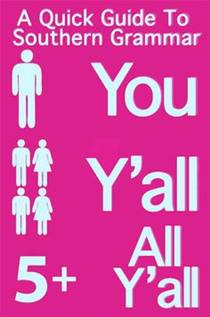
· Here’s a lesson several of you sent to this ignorant West Coaster:

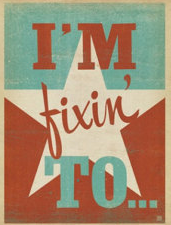
· And the best advertising campaign I saw:

Kara Church

Technical Editor, Advisory

Symitar Documentation Services

Posted by: Jack Henry | August 11, 2015

Editor’s Corner: The Wright Brothers

I found a delightful set of tips on avoiding and fixing the passive voice, one of the top “crimes” we see here at Symitar Editing. Rather than get right into that, however, I’m going to bore you with one more article that’s a result from my North Carolina vacation.

Today’s lesson is from our visit to the Wright Brothers’ Monument in Kitty Hawk, NC. We learned a few new words and concepts while we were there that I thought I would share with you.

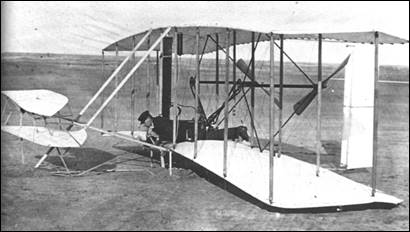
First, here’s Wilbur strapped into the 1903 Wright Flyer I. No, he’s not lying on the plane backwards. Initially, the lift of planes was controlled in the front.

Here’s a diagram of the same plane with the parts and motions marked.

The ranger explained that several of the part names are derived from French:

· fuselage (from the French word for spindle) – the body of the airplane

· canard (the French word for duck) – the “elevator,” the front portion of the Wright brothers’ plane

· aileron (the French word for fin) – the tip of the wing

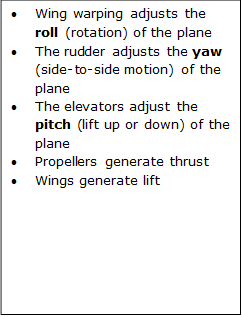
And lastly, we learned about the different motions of the airplane (roll, pitch, and yaw) and which parts of the plane control those motions. I’ve added a text box next to the lovely graphic from PBS, above.

That’s your lesson for the day. Fly! Be free!

Kara Church

Technical Editor, Advisory

Symitar Documentation Services

Posted by: Jack Henry | August 10, 2015

Editor’s Corner: Writing Clear Sentences

Today I’m sharing some tips from a Grammer Girl article called “How to Write Clear Sentences.” The tips mentioned in this article may seem minor; however, they can make a difference between ambiguious, and clear and concise writing.

· Cut out the clutter, such as deadwood phrases (due to the fact that, in order to, in the event that, at this point in time, prior to the start of, etc.). You can improve your writing by replacing these phrases with a more simple, straightforward alternative.

· Get rid of single-word modifiers that don’t enhance the meaning of your sentences, such as very, and really.

Example: We have a very big problem here.

[JS: The word
very doesn’t add any value to the sentence; it’s just an extra word. There can’t be a
slightly big problem. The problem is either big or small.]

· Unless you are creating a conditional sentence, avoid starting sentences with the word if because it just adds words to your sentences. Instead, be direct.

Example: If you want to make your system run faster, you should purge files.

Rewrite: To make your system run faster, purge files.

· Review your sentences and make sure that the helping verbs (may, might, can, must, should, used to, need, etc.) are really helping the main verbs. Use imperatives and avoid modal verbs whenever possible so that your sentences are clear and direct.

Example: You can restrict user access by setting the Restrict User parameter to Yes.

Rewrite: To restrict user access, set the Restrict User parameter to Yes.

“Good writing is clear and concise and gets to the point. Readers don’t want to rummage through a messy verbal flea market to discover one or two sparkly gems of information.” (Julie Wildhaber)

Jackie Solano | Technical Editor | Symitar®

8985 Balboa Ave. | San Diego, CA 92123 | Ph. 619.542.6711 | Extension: 766711

Symitar Documentation Services

NOTICE: This electronic mail message and any files transmitted with it are intended
exclusively for the individual or entity to which it is addressed. The message,
together with any attachment, may contain confidential and/or privileged information.
Any unauthorized review, use, printing, saving, copying, disclosure or distribution
is strictly prohibited. If you have received this message in error, please
immediately advise the sender by reply email and delete all copies.
Posted by: Jack Henry | August 7, 2015

Editor’s Corner: Jiggery-pokery and pure applesauce

It’s been several weeks now since Supreme Court Justice Antonin Scalia utter the terms “pure applesauce” and “jiggery-pokery,” but I’ve had some delightful conversations about the terms so I thought I’d cover them here. (Edith, this higgledy-piggledy jiggery-pokery is for you!)

Pure applesauce, in this context, does not mean that your side dish has no additives or preservatives. Justice Scalia was using the term to mean “nonsense.” According to Merriam-Webster, applesauce is slang for “an insincere expression of opinion; an assertion that is patently absurd and usually phrased in exaggerated terms; bunk; baloney.” The Online Etymology Dictionary lists this slang use from the early 1920s.

Merriam-Webster’s definition of jiggery-pokery is simply delightful. It is listed as a chiefly British term meaning “humbug; nonsense.” The second definition is, “underhanded dealings, conniving, or manipulations; monkey business; skullduggery.” The etymology indicates that it is a variant of the Scottish term “joukery-pawkery,” dated around the late 1800s.

I’d say that Justice Scalia chose to use some great substitutions for our more common, vulgar term that has a first word that starts with B and a second word that starts with S.

Kara Church

Technical Editor, Advisory

619-542-6773 | Ext: 766773

Symitar Documentation Services

NOTICE: This electronic mail message and any files transmitted with it are intended
exclusively for the individual or entity to which it is addressed. The message,
together with any attachment, may contain confidential and/or privileged information.
Any unauthorized review, use, printing, saving, copying, disclosure or distribution
is strictly prohibited. If you have received this message in error, please
immediately advise the sender by reply email and delete all copies.
Posted by: Jack Henry | August 6, 2015

Editor’s Corner: August Q&A from CMOS

Imagine my joy when this month’s Q&A from the Chicago Manual of Style included these timely and sassy items. The grammar police are alive and well, and they are as snarky as ever!

Q. In a sentence like “the authors thank Natalie and Isabel for her editorial assistance,” is it grammatically correct to use the pronoun her and not their?

A. If the authors intend to thank both Natalie and Isabel for assistance, then their is the right choice. However, if the sentence means “The authors thank Natalie [for something other than assistance, but we aren’t saying what] and [we also thank] Isabel for her assistance,” then even if it is technically grammatical (debatable), it is nonetheless confusing. (Correct grammar does not mean everything’s OK. “Striped sentences wish green habits” is grammatical.) In short, your sentence is a disaster and must be rewritten for clarity.

Q. Is it equally acceptable to say “My friends and I went to the concert” and “I and my friends went to the concert”?

A. No; the second construction is popular but not yet considered proper.

Q. I’m wondering how you would handle a possessive of a city-and-state combination: While we were able to recast the sentence, suppose we need to express “the streets of Anytown, New York” as compactly as possible. “Anytown, New York’s, streets” puts the possessive squarely on “New York” because of the necessary comma—and you couldn’t do the logical “Anytown, New York,’s streets” as if the commas were parentheses! Or do we just bite the bullet and have an even longer sentence?

A. Yes—please—bite the bullet.

Kara Church

Technical Editor, Advisory

Symitar Documentation Services

Posted by: Jack Henry | August 5, 2015

Editor’s Corner: Y’all

During our vacation, my husband and I stopped to get some East Coast bagels from a place called Max’s Deli. I noticed this sign and I thought it was pretty cute:

As I’ve mentioned in the past, we English speakers often find ourselves searching for a way to address multiple people in the second person. Though “you” covers one person or more than one person, many people find it lacking. English speakers around the world have come up with several different terms to fill the second person plural gap (from Wikipedia):

  • y’all, or you all – Southern United States and African American Vernacular English. Y’all is also occasionally used for the second person singular.
  • you guys – U.S., particularly in the Midwest, Northeast, South Florida, and West Coast; Canada; Australia. Used regardless of the genders of those referred to.
  • you lot – UK
  • yous(e) – Ireland, Tyneside, Merseyside, Central Scotland, and Australia
  • yous(e) guys – in the U.S., particularly in New York City region, Philadelphia, and the Upper Peninsula of Michigan
  • you-uns/yinz – Western Pennsylvania, Northeastern Pennsylvania, The Ozarks, The Appalachians
  • ye/yee/yees/yiz – Ireland, Tyneside
  • allyuh – Trinidad and Tobago

Kara Church

Technical Editor, Advisory

Symitar Documentation Services

Posted by: Jack Henry | August 4, 2015

Editor’s Corner: Fixin’ to Write

Hello!

After a lovely week meeting family in the Outer Banks (OBX) of North Carolina, I have a few language souvenirs for you from my vacation. Today’s topic seems quite timely, since a week or so before I left, someone asked me about the etymology of the term “fixin’ to” (meaning to get ready to or prepare to do something). For example, I’m fixin’ to eat me a bowl of grits.

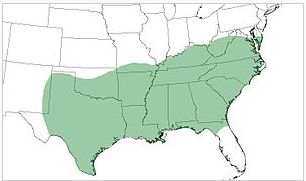
While I didn’t have much luck with an etymology for this phrase, I found a very interesting article on Wikipedia about Southern American English. I have included some selections from the article on the shared features of old and new Southern American English (below).

Regions speaking Southern American English

Shared Features (from Wikipedia)

These grammatical features are characteristic of both older Southern American English and newer Southern American English.

· Use of done as an auxiliary verb between the subject and verb in sentences conveying the past tense.

I done told you before.

· Use of other non-standard preterites [KC – verb tenses], such as drownded as the past tense of drown, knowed as past tense of know, choosed as the past tense of choose, degradated as the past tense of degrade.

I knowed you for a fool soon as I seen you.

· Use of was in place of were, or other words regularizing the past tense of be to was.

You was sittin’ on that chair.

· Use of double modals (might could, might should, might would, used to could, etc.—also called "modal stacking") and sometimes even triple modals that involve oughta (like might should oughta).

I might could climb to the top.

I used to could do that.

· Use of (a-)fixin’ to, or just "fixing to" in more modern Southern, to indicate immediate future action in place of intending to, preparing to, or about to.

He’s fixin’ to eat.

They’re fixin’ to go for a hike.

· Use of ever in place of every.

Ever’where’s the same these days.

· Use of "over yonder" in place of "over there" or "in or at that indicated place," especially to refer to a particularly different spot, such as in "the house over yonder." Additionally, "yonder" tends to refer to a third, larger degree of distance beyond both "here" and "there," indicating that something is a longer way away, and to a lesser extent, in a wide or loosely defined expanse, as in the church hymn "When the Roll Is Called Up Yonder."

Kara Church

Technical Editor, Advisory

Symitar Documentation Services

« Newer Posts - Older Posts »

Categories