Posted by: Jack Henry | April 9, 2014

Editor’s Corner: Calques

Today I have some interesting information for you about calques (also called loan translations). According to Merriam-Webster a calque is “a compound, derivative, or phrase that is introduced into a language through translation of the constituents of a term in another language (as superman from German Übermensch).”

The word calque comes from French and means “copy” or “trace.” Here are some more calques from Daily Writing Tips:

From German:

hang glider from Hängegleiter
flamethrower from Flammenwerfer
gummy bear from the product name Gummibärchen (little gummy bear)
loanword from Lehnwort
Intelligence Quotient (I.Q.) from Intelligenzquotient
Rainforest from Regenwald
Watershed from Wasserscheide
World war from Weltkrieg

Note: In Nietzschean thought, the übermensch is the ideal superior man of the future who transcends conventional Christian morality to create and impose his own values. The German word werfer (“thrower”) is used in sports to refer to the bowler in cricket and the pitcher in baseball.

Here are some calques from the French:

deaf-mute from sourd-muet
free verse from vers libre
rhinestone from caillou du Rhin

Note: The historical term deaf-mute, “unable to hear or speak,” is now considered by some to be insensitive or derogatory; a replacement term is “hearing- and speech-impaired.” German also has Rheinkiesel which, like caillou du Rhin, means “Rhine-pebble.”

Latin calques:

Milky Way (the galaxy that contains Earth’s solar system) from via lactea
“Rest in Peace” from requiescat in pace
“in a nutshell” from in nuce

Calquing goes both ways. Computing terms coined in English have been calqued into other languages. For example, French disque dur, carte mère, souris, and en ligne for English hard disk, motherboard, mouse, and online.

Click here for another article on calques.

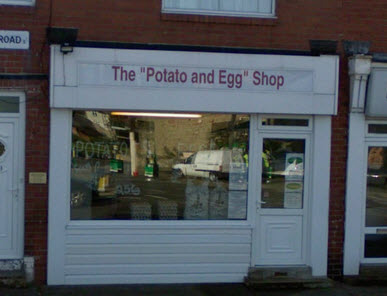
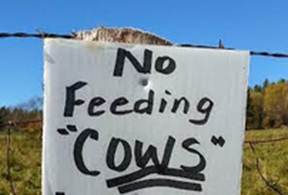
And more from the department of unnecessary quotation marks and bad advertising:

Kara Church

Senior Technical Editor

Posted by: Jack Henry | April 8, 2014

Editor’s Corner: D is for Delcious.com

I have a delightful tidbit selected particularly with German-speakers in mind, but you will have to wait until tomorrow for that. Until then, I have the D and E social media terms from the Building Brand Character & Constant Contact glossaries.

D

· Delicious.com: An online bookmarking service that lets users save website addresses publicly and privately online so they can be accessed from any device connected to the internet and shared with friends. [KC – It sounds a little dirty, but I checked the web page and it is safe for work. Not as delicious as chocolate cake, but it may be enjoyable to some of you.]

· Duplicate Content: Content that is duplicated entirely or partially from either another website or within your own. This is a negative ranking factor and can cause a site to be buried in the rankings.

E

· EBook: An electronic version of a book, typically in a PDF file format.

· Ecommerce Site: A website devoted to retail sales where users can purchase products online.

· EdgeRank: Similar to PageRank, this is Facebook’s algorithm to determine popularity and trust among other (proprietary) factors.

· Engagement: Users who interact with a company or website online, particularly through social media channels. High engagement is a positive sign, as it indicates the target audience is interested in what a brand has to say.

· Embedding: The act of adding code to a website so that a video or photo can be displayed on that site while being hosted by another. For example, YouTube provides a simple snippet of HTML code that can be used to embed a copy of any video on a website or blog. The video will play inside a YouTube-branded player.

· Engaged: People who interact with a business or organization or an individual (on social networks, in email, etc.) by posting comments and sharing content are said to be engaged.

As a juvenile (Type I) diabetic, this cracked me up. Let the cage matches begin!

Kara Church

Senior Technical Editor

Posted by: Jack Henry | April 4, 2014

Editor’s Corner: Social Media Vocabulary – C

It’s a great Friday today! With the addition of the iPay Payment Operations department, we have passed the 1,000 subscriber mark and then some! Editor’s Corner now has 1,027 readers and I want to thank all of you for your curiosity, questions, and submissions over the last few years. It is great to have you along as we try to learn a little more each day about this language we share. Hip hip hooray!

And now for social media terms from the Building Brand Character & Constant Contact glossaries. Today we’re covering the letter C. I also have a couple pictures for you from a blog of unnecessary quotation marks. Have a good weekend!

· Check in

Used by sites like Facebook, Foursquare, and Yelp, it’s a method of virtually checking in to a location, letting others know you’re there.

· Citation

Any site that lists a business’s name, address, and phone number, and is crawlable by search engines. Citations are an incredibly important aspect for local businesses looking to rank high in search results.

· Citation Source

A site that provides a citation, such as a directory.

· Click Fraud

Non-legitimate clicks on a pay-per-click ad, generally performed by a website owner or their employees, in an effort to increase the amount they’re paid.

· CMS

(Content Management System) Programs such as WordPress that allow users to create websites without knowledge of hard coding.

· Comment Spam

Posting comments on blogs for the sole reason of acquiring a link back to a site. Many bloggers disable or review comments because of this tactic.

· Comments

Many social media sites encourage readers and viewers to leave comments on what has been posted, whether it’s a quick status message, a video, an article, or a picture. Some sites, like Facebook, use the number of comments to determine how a post is included in a person’s news feed. On YouTube, video "owners" have the ability to turn off comments for an individual video.

· Content

(text, copy) Content is one of the most valuable aspects of SEO [KC – Search Engine Optimization]. A page’s content should be unique and informative to the user.

· Conversion

(goal) A quantifiable goal of a website. These can be downloads, purchases, or newsletter signups.

· Conversion Rate

The rate at which users on a site convert into customers. This is determined by taking the number of conversions and dividing it by the number of total visits.

· CPC

(cost per click) Describes the average amount of money spent on an ad campaign on a per click basis. This is determined by taking the number of clicks and dividing it by the overall ad budget.

· Crawler

A program that performs a task more or less autonomously. [KC – See definition under “bot” from the other day at:
https://episystechpubs.com/2014/04/02/editors-corner-social-media-vocabulary-b/
.]

· Crowdsource

The practice of asking a collection of individuals online for opinions, suggestions, or submissions. For example, you might not be able to choose between two newsletter articles, so you’d ask the people who “Like” you on Facebook or are following you on Twitter which one you should include. Or you can simply post both stories to Facebook and Twitter and discover which one resonates most based on the number of “Likes,” shares, comments, or retweets. Crowdsourcing can also be helpful if you’re planning an event and can’t decide on a date or location, or if you’re looking for suggestions for a vendor.

Hmm…with the quotation marks I have to ask: Does this mean ‘possum and skunk?

If by “Classrooms” they mean rooms set aside for illegal poker games, then by all means they’ve used the correct punctuation!

Kara Church

Senior Technical Editor

Posted by: Jack Henry | April 3, 2014

Editor’s Corner: Weighty Heifers

As promised, today I have some helpful information on that “I before E, except after C” guideline that many of us learned in grade school. Most people complain that this is a useless rule in English. One of our co-workers told me she relives the trauma of a spelling bee lost after using this rule, every time she hears it. Another co-worker has embraced the guideline as his own, with the version: “I before E, except in Keith.” Until I saw the rhyme in its entirety, I agreed that it seemed useless.

I thought this article from Maeve Maddox at Daily Writing Tips was very helpful, so I am including a big chunk of the article for your reading and learning pleasure. Here it is, starting with the full rhyme:

I before E,
Except after C,
And when sounded as A
As in neighbor and weigh.

Let’s see how far this rule will take us with common words.

I before E
achieve
believe
belief
brief
chief
die
field
fierce
friend
lie
lingerie
niece
pie
piece
pierce
prairie
priest
siege

Except after C
ceiling
conceit
conceive
deceive
receipt
receive
perceive

And when sounded as A,
as in neighbor and weigh
heir
neighbor
reign
rein
skein
surveillance
their
veil
vein
weigh

Exceptions to the Rule
caffeine
counterfeit
either
forfeit
foreign
heifer
leisure
neither
sovereign
seized
weird

This list of 46 words is by no means exhaustive, but it’s a fair gauge of how far the old jingle can take you in spelling the ie/ei words you are most likely to want to write.

(Thanks for the graphic, Mr. Hooper!)

Kara Church

Senior Technical Editor

Posted by: Jack Henry | April 2, 2014

Editor’s Corner: Social Media Vocabulary – B

Good morning, little chickadees. Before I launch into a review of the mantra “I before E, except after C,” I have a few more social media terms for you from the Building Brand Character & Constant Contact glossaries.

· B2B
Business-to-Business

· B2C
Business-to-Consumer

· Back Link
(inlink, incoming link) Any link from one site that points to another.

· Barnacle SEO (Search Engine Optimization)
The act of attaching yourself or your company to a larger, more authoritative site, such as a directory like Yelp, in an attempt to increase rankings and occupy more real estate in search results.

· Bit.ly
A free URL shortening service, most commonly used to condense long URLs to make them more shareable on social media sites like Twitter. (Other URL shortening websites include tinyurl.com, ow.ly, and is.gd.)

· Black Hat
Spammy tactics that violate best practices outlined by search engines, such as the Google Webmaster Guidelines. These tactics are used to gain quick visibility in search rankings, but are frowned upon by search engines and usually result in decreased rankings.

· Blog
(contraction of web log) A website that is typically updated in a consistent manner that consists of discrete entities (“posts”), typically listed in reverse-chronological order.

· Blogroll
A list of recommended blogs on a person’s or business’ blog site.

· Bot
(robot, spider, crawler) A program that performs a task more or less autonomously. Search engines use bots to find and add web pages to their search indexes. Spammers often use bots to “scrape” content for the purpose of plagiarizing it for exploitation by the spammer.

· Bounce Rate
The percentage of users who enter a site and then leave it without viewing any other pages. [KC – Also, the number of times a kid can jump up and down in a bounce-house before getting injured.
J]

Kara Church

Senior Technical Editor

Good morning, ladies and gentlemen. My apologies for the “vacation brain” mistake in yesterday’s email. I’ll try not to make up any words in today’s email. What I will do, though, is share some terms that are fairly fresh to our language. I was asked to provide information on some of the young, social media terminology that has arisen over the past ten years. I found a lot of articles and glossaries out there, but I’ve selected Building Brand Character & Constant Contact as my primary resources.

Note: Terms evolve quickly; some of these may already seem ancient to those of you who super-savvy. J

Over the next few weeks I’ll review terms from avatar to YouTube, in between our other language lessons.

Today we start with 0 to 9 and the letter A:

· 301
A permanent redirect that directs a user or search engine from an old site page to the new.

· Aggregator
A web-based tool or application that collects syndicated content. [KC – Examples: Reddit, Google News, BuzzFeed, Gawker, etc.]

· Algorithm (algo)
A program used for calculation, data processing, and automated reasoning. In online marketing, these are typically used by search engines to determine what site pages are displayed for a certain keyword or phrase.

· Alt Text
The description for an image or graphic, which isn’t typically displayed to the end-user. This code is incredibly useful because search engine spiders cannot “read” images, so this text acts as a description, allowing it to be crawled and indexed. Optimizing alt text is a quick and easy way to rank in search engine image results.

· Analytics
A program that tracks and reports important site metrics, such as number of visits and their sources. Google Analytics is the most popular tool for this, and is also free.

· Anchor Text
The visible text of a link. This is important to both a site’s users and the search engines, because it describes the relevancy of the link through text.

· Angie’s List
A site, founded by Angie Hicks, where users can rate and review service companies in their area.

· API
Short for Application Programming Interface, this is a programming format that a website or piece of software uses to allow other websites to interact with it. For example, Constant Contact’s Join My Mailing List app for Facebook (http://apps.facebook.com/ctctjmml) was created using an API that integrates Facebook and Constant Contact.

· App
Short for application, this is a program or add-on, usually for Facebook or for a mobile device (i.e., an iPhone or Blackberry). Its purpose is to deepen user interaction and provide greater depth of functionality and engagement. An example is the Constant Contact Join My Mailing List app for Facebook (http://apps.facebook.com/ctctjmml), or the Facebook app for the iPhone and Android phone.

· Astroturfing
(Opposite of full disclosure) The practice of disguising the source of a message, usually for political or marketing purposes, as a grassroots participant. Many site users are vehemently against these practices, such as those from Reddit.

· Avatar
An online picture that’s associated with your social media accounts. Business people typically use a headshot for personal accounts, while companies and organizations use their logo.

Kara Church

Senior Technical Editor

619-542-6773 | Ext: 766773

www.symitar.com

NOTICE: This electronic mail message and any files transmitted with it are intended
exclusively for the individual or entity to which it is addressed. The message,
together with any attachment, may contain confidential and/or privileged information.
Any unauthorized review, use, printing, saving, copying, disclosure or distribution
is strictly prohibited. If you have received this message in error, please
immediately advise the sender by reply email and delete all copies.

Posted by: Jack Henry | March 31, 2014

Editor’s Corner: Buenos Dias!

Hello folks! I hope you enjoyed last week with your hostesses Donna and Jackie. I had an enjoyable break with most of my family down in the steamy hot state of Jalisco, in the city of Puerto Vallarta. While I was off swimming with sting rays, dolphins, and humpback whales, my mom was at home watching over our dogs. Interestingly, she was one of the only people that sent in a question while I was gone. She asked, “If a mom is maternal, a dad is paternal, and a brother is fraternal—what is a sister?”

I started to think about other Latin words with these prefixes (matricide, patricide, fratricide, homicide, insecticide, suicide—I know, very dark) and took a stab at it based on the word for “sister killing,” which is sororicide. I checked the dictionary for sororal, and indeed this wor means “of, relating to, or characteristic of a sister.” Additionally, Merriam-Webster tells us the suffix “-al” is added to words to mean “of, relating to, or characterized by.”

I’m sure you can think of other words formed by adding this suffix “-al” to mean related to or characterized by something:

· nocturnal (active during the night)

· diurnal (of, related to the daytime)

· floral (related to flowers)

· hierarchical (of, relating to, or arranged in a hierarchy)

· subdural (situated beneath the dura mater [part of brain])

For a huge list of words ending in this suffix, see this Wiktionary article.

Kara Church

Senior Technical Editor

619-542-6773 | Ext: 766773

www.symitar.com

NOTICE: This electronic mail message and any files transmitted with it are intended
exclusively for the individual or entity to which it is addressed. The message,
together with any attachment, may contain confidential and/or privileged information.
Any unauthorized review, use, printing, saving, copying, disclosure or distribution
is strictly prohibited. If you have received this message in error, please
immediately advise the sender by reply email and delete all copies.

Posted by: Jack Henry | March 24, 2014

Editor’s Corner: Pronouns

Good morning! I hope you all had a great weekend.

Let’s briefly chat about pronouns. A pronoun is a word that substitutes a noun. He, she, you, they, and it are examples of pronouns. It is important to use the correct pronoun so that it is clear which noun the pronoun is referring to.

When using pronouns, many people make the following agreement mistake:

  • Incorrect: When the user logs in, they must have a password.

Pronouns must agree in number, if the pronoun takes the place of a singular noun, you have to use a singular pronoun.

  • Correct: When the user logs in, he or she has to have a password.

If you use a plural noun as your pronoun, then you have to use they.

  • Correct: When users login, they must have a password.

Now go forth, seize this Monday morning , and conquer the pronoun!

Thank you,

Jackie Solano

Technical Writer, Episys Technical Publications

Symitar®

8985 Balboa Avenue

San Diego, California 92123

Direct Line: 619-542-6711

NOTICE: This electronic mail message and any files transmitted with it are intended
exclusively for the individual or entity to which it is addressed. The message,
together with any attachment, may contain confidential and/or privileged information.
Any unauthorized review, use, printing, saving, copying, disclosure or distribution
is strictly prohibited. If you have received this message in error, please
immediately advise the sender by reply email and delete all copies.

Posted by: Jack Henry | March 19, 2014

Editor’s Corner: Darkness Falls on L and K

I have one more selection for you from 8 Pronunciation Errors That Made the English Language What It Is Today by David Shariatmadari.

When L Goes Dark

A dark "l," in linguistic jargon, is one pronounced with the back of the tongue raised. In English, it is found after vowels, as in the words full or pole. This tongue raising can go so far that the "l" ends up sounding like a "w." People frown on this in non-standard dialects such as cockney ("the ol’ bill"). But the "l" in folk, talk, and walk used to be pronounced. Now almost everyone uses a "w" instead—we effectively say fowk, tawk and wawk. This process is called velarisation.

When K Goes Dark

A dark “k,” in Editor’s Corner jargon, is when I disappear from the face of the earth for a brief amount of time. I could be fulfilling my training requirements for the CIA; perhaps I am spending some much needed time organizing my garage for an upcoming sale; some might even say I am going on sabbatical to research more Editor’s Corner topics. Nobody is quite certain…and that is the mystery of the Editrix.

In the meantime, I hand over my precious contact list to Donna and Jackie and bid you adieu.

Kara Church

Senior Technical Editor

619-542-6773 | Ext: 766773

www.symitar.com

NOTICE: This electronic mail message and any files transmitted with it are intended
exclusively for the individual or entity to which it is addressed. The message,
together with any attachment, may contain confidential and/or privileged information.
Any unauthorized review, use, printing, saving, copying, disclosure or distribution
is strictly prohibited. If you have received this message in error, please
immediately advise the sender by reply email and delete all copies.

Posted by: Jack Henry | March 18, 2014

Editor’s Corner: Muskrat Love

Good morning, my little chickadees! Before I get down to business today, I’d like to congratulate Rebecca Robinson and Ruth Sherburne, the lucky Editor’s Corner contest winners! I’ll be sending you ‘Scuse Me While I Kiss This Guy (Rebecca) and He’s Got the Whole World in His Pants (Ruth) so you can read and sing mondegreens to your hearts’ content.

And now, for another pronunciation tidbit from 8 Pronunciation Errors That Made the English Language What It Is Today by David Shariatmadari. There are several more examples if you click the folk etymology link within the paragraph.

What the folk?

Borrowing from other languages can give rise to an entirely understandable and utterly charming kind of mistake. With little or no knowledge of the foreign tongue, we go for an approximation that makes some kind of sense in terms of both sound and meaning. This is folk etymology. Examples include crayfish, from the French écrevisse (not a fish but a kind of lobster); sparrow grass as a variant for asparagus in some English dialects; muskrat (conveniently musky, and a rodent, but named because of the Algonquin word muscascus meaning red); and female, which isn’t a derivative of male at all, but comes from old French femelle meaning woman.

Kara Church

Senior Technical Editor

619-542-6773 | Ext: 766773

www.symitar.com

NOTICE: This electronic mail message and any files transmitted with it are intended
exclusively for the individual or entity to which it is addressed. The message,
together with any attachment, may contain confidential and/or privileged information.
Any unauthorized review, use, printing, saving, copying, disclosure or distribution
is strictly prohibited. If you have received this message in error, please
immediately advise the sender by reply email and delete all copies.

« Newer Posts - Older Posts »

Categories