Posted by: Jack Henry | September 15, 2015

Editor’s Corner: Dependent vs. Independent Clauses

Good morning! I hope your day has started off well.

I keep seeing a common error in emails, so today, we’re going to hash it out. Today’s topic is sentence fragments.

We editors commonly see folks punctuating a dependent clause (part of a sentence, which by itself, does not express a complete thought) as though it were an independent clause (a complete thought). You see, when you put a period (or any other end punctuation) at the end of a dependent clause, you create a sentence fragment.

To keep your writing fragment-free, today we’re going to talk about independent and dependent clauses. According to DrGrammar.org:

An independent clause is a complete sentence; it can stand alone.
[Example:] Tattooing was not known in the Western world.

A dependent (subordinate) clause is part of a sentence; it cannot stand alone.
[Example:] Until Captain Cooke returned from his voyage to Tahiti.

If the above independent and dependent clauses were put together in a sentence, it would read: Until Captain Cooke returned from his voyage to Tahiti, tattooing was not known in the Western world.

Most often, all you have to do is attach your fragment (dependent clause)to the beginning or end of an independent clause. If you’re having trouble picking out the fragments in your writing, try this trick: read your paragraphs backwards. Start with the last sentence in a paragraph and read back to the first sentence. When you read your sentences out of order, you can more easily locate fragments because they are incomplete ideas. Then all you need to do is connect the fragment to the nearby clause that creates a complete thought.

Now, before I get any comments about all the fragments you see in the novels and magazine articles you read, I just want to remind you that there is a big difference between professional and creative writing. In professional writing, our aim is to educate, not to entertain. And to do that, we follow the rules set by our common style guides.

Enjoy your day!

Donna Bradley Burcher | Senior Technical Editor | Symitar®

8985 Balboa Ave. | San Diego, CA 92123 | Ph. 619.278.0432 | Ext: 765432

Posted by: Jack Henry | September 14, 2015

Editor’s Corner: Homophones

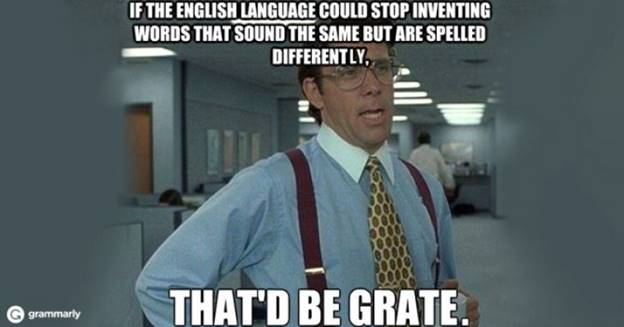
Homophones are words that sound alike but that have different meanings and (usually) different spellings. Here are some examples of homophones (definitions from Merriam-Webster).

Aloud/Allowed

Aloud: (adverb) in a way that can be clearly heard: in a voice that can be heard

Allowed: (verb) to permit something: to regard or treat something as acceptable

Compliment/Complement

Compliment: (noun) a remark that says something good about someone or something

Complement: (noun) something that completes something else or makes it better

It’s/Its

It’s (contraction): it is, it has

Its (adjective): relating to or belonging to a certain thing, animal, etc.

Their/There/They’re

Their (adjective): relating to or belonging to certain people, animals, or things

There (adverb): in that place: at that location

They’re (contraction): they are

To/Too

To (preposition): used to indicate the place, person, or thing that something moves toward

Too (adverb): in addition

You’re/Your

You’re (contraction): you are

Your (adjective): relating to or belonging to you

Jackie Solano | Technical Editor | Symitar®

8985 Balboa Ave. | San Diego, CA 92123 | Ph. 619.542.6711 | Extension: 766711

Symitar Documentation Services

Posted by: Jack Henry | September 11, 2015

Editor’s Corner: Time for the Hen Basket

Happy Friday, everyone!

We have beaten Tom Swifties to death, so now it’s time to have a different kind of fun with words. I recently purchased a book by Robert Alden Rubin, called Going to Hell in a Hen Basket: An Illustrated Dictionary of Modern Malapropisms. Today I’ll share of few of these with you, but first, a reminder of what a malapropism is, from Merriam-Webster:

malapropism:a usually humorous misapplication of a word or phrase; specifically: a blundering use of a word that sounds somewhat like the one intended but is ludicrously wrong in the context

I keep thinking the name of this book is Going to Hen in a Hellbasket, further challenging the original phrase. In any case, here are a few malapropisms to start the weekend with. I’d love to hear from anyone who has their own!

· a posable thumb
A professional hand model would have a posable thumb; only primates have opposable thumbs with which they can touch the fingers on their hands.

· I don’t know you from atom.
Confuses Adam, the generic man, and atom, the generic elemental particle.

· bear (your) fangs
Bearing (carrying) one’s fangs is perhaps less threatening than baring (showing) them, but in both cases, they’re handy and ready for use.

Kara Church

Technical Editor, Advisory

619-542-6773 | Ext: 766773

Symitar Documentation Services

NOTICE: This electronic mail message and any files transmitted with it are intended
exclusively for the individual or entity to which it is addressed. The message,
together with any attachment, may contain confidential and/or privileged information.
Any unauthorized review, use, printing, saving, copying, disclosure or distribution
is strictly prohibited. If you have received this message in error, please
immediately advise the sender by reply email and delete all copies.

Posted by: Jack Henry | September 10, 2015

Editor’s Corner: Your Name Here

I have class today, so I’m going to cheat a little and let this Grammarist article do all of the work. Here’s an interesting explanation of two alternate terms for “signature.”

John Hancock and John Henry

When someone asks for your John Hancock, it means they want your signature.

John Hancock was the first man to sign the United States’ Declaration of Independence in 1776. Knowing that signing this declaration could mean his imprisonment or even death, John Hancock boldly wrote his name in large letters, declaring, “There, I think King George should be able to read this.”

When someone asks for your John Henry, it means they want your signature.

The use of John Henry to refer to a signature became popular in the western United States, fifty years after John Hancock signed the Declaration of Independence. Signing your John Henry is cowboy slang. While there is an American Tall Tale about John Henry, the steel-driving man who outperformed a steam-driven machine, this character does not seem to be related to the phrase sign your John Henry, as the story dates to a time after cowboys began referring to signing your John Henry. Of the two phrases, John Hancock is the most used term, today.

[KC – And when people ask for your
Jack Henry, it means they want your job…or maybe they just want you to recite the company philosophy: "Do the right thing, do whatever it takes, and have fun."]

Signature area of the U.S. Constitution.

Kara Church

Technical Editor, Advisory

Symitar Documentation Services

Posted by: Jack Henry | September 9, 2015

Editor’s Corner: CMOS Q&A – So, can, and may

Huzzah, hurrah! It’s another set of questions and answers from the CMOS Q&A:

Question:

During the past few years, many people have developed the habit of beginning a sentence with the word so, typically when they are responding to a question. This includes politicians, talking heads on television, and others who one might think are “learned” individuals. My view is that the use of the initial so in a sentence is both unnecessary and annoying. Any thoughts? Thank you.

Answer:

There have always been “throat-clearing” words. Even highly intelligent professional speakers need a little thinking room to organize thoughts before speaking. So is no worse than well or um. The trick is not to be annoyed.

Question:

I would like to know more about the use of the modals can and may. Here in Brazil it is being taught that both can be used, as in “Can/May I erase the board?” Could you please distinguish both for me?

Answer:

Traditionally, “Can I?” means “Am I able to?” whereas “May I?” means “Do I have permission to”?

Can I lift six times my weight? Can I get to the parking lot through this alley?

May I take your plate? May I go ahead of you in line?

This use of may is dying, however. We tend to hear it from grandparents when a child asks “Can I have some candy?” and the grandparent replies “May I!” Although it’s not rude to use can when you are asking permission, it is incorrect to use may when asking whether something is possible.

Kara Church

Technical Editor, Advisory

619-542-6773 | Ext: 766773

Symitar Documentation Services

NOTICE: This electronic mail message and any files transmitted with it are intended
exclusively for the individual or entity to which it is addressed. The message,
together with any attachment, may contain confidential and/or privileged information.
Any unauthorized review, use, printing, saving, copying, disclosure or distribution
is strictly prohibited. If you have received this message in error, please
immediately advise the sender by reply email and delete all copies.

Posted by: Jack Henry | September 8, 2015

Editor’s Corner: Passive Voice Evasion #5

We’re done! It’s the final installment of “5 passive-voice evasions and how to fix them,” by Josh Bernoff.

#5: Who is going to pay?

This economic analysis [KC – The city of Boston’s bid for the 2024 Olympics] is rife with passive statements that obscure where the money is coming from.

· Of this $3.7 billion [spent in Massachusetts], we estimate that $2.9 billion would be funded with money from outside of Massachusetts, thus representing a gain to the Commonwealth.

· [Local Olympic Committee] revenue sources cannot be used to construct permanent or legacy projects for a region. Permanent construction associated with the Olympic Games would be paid for using other funding sources.

How to fix: Explain who will pay, or that you don’t know who will pay.

· Visitors from outside Massachusetts will spend $2.9 billion of the $3.7 billion spent here.

· Somebody other than Boston 2024 will have to fund the permanent construction.

And below is a great chart to remind you of the lessons from the past few days. By the way, if you choose to sign up for his blog, remember that his web address and emails contain a swear word, represented by the symbol on the upper left of his chart below. Consider yourself warned.

Kara Church

Technical Editor, Advisory

Symitar Documentation Services

Posted by: Jack Henry | September 4, 2015

Editor’s Corner: Final Swifties

Today is the final day of Tom Swifties. I have the remaining entries from our prizewinners, Eric Nielsen and Scott Whitham. Additionally, I have a few more entries from some of our other more prolific writers, Samantha Armistead, Mary Fleenor, Laura Reece, Emily Gershbein, and Christy Armistead.

One more “thank you” to everyone who participated and to everyone who reads Editor’s Corner. Now, it’s time to figure out what to do for the next contest!

Samantha Armistead

· “Everybody smile for the camera,” said Tom cheesily.

· “Someone else is sitting here,” said Tom deceitfully.

· “I can’t get my CD out of the player,” said Tom dejectedly.

· “I noticed your GPA has dropped,” said Tom degradingly.

· “I’m having bypass surgery,” said Tom hardheartedly.

· “It was the turtle that won the race,” said Tom hurriedly.

· “I’ll never be able to iron this shirt again,” said Tom irrepressibly.

· “I should be nicer to people,” said Tom meaninglessly.

· “You need to do something about that old horse,” said Tom naggingly.

· “You can’t go to the carnival this year,” said Tom nefariously.

· “Guess which hotel room I’m in,” said Tom intuitively.

Mary Fleenor

· “What a long way we have to go,” he said distantly.

· “I do make good coffee,” she said perkily.

· “Okay, I’ll stop…for now,” Mary said haltingly.

· “She’s built like a brick house,” he said figuratively.

· “Not Uncle Ben’s again; I hate that stuff!” he said derisively.

· “Get ready, you bloodsucker; this is gonna hurt,” Buffy said painstakingly.

Laura Reece

· "How do you like my red hair and freckles?" Tom asked gingerly.

· "My family is part Cherokee," Tom said bravely.

· "I caught a fairy," Tom said spritely.

· "My mom is now my dad," Tom said transparently.

· "YOLO," Tom said acronymically.

· "Any credible resource on scientific theory is cautious," Tom said acrostically.

· "I was so the lead singer of a popular band in the ’80s," Tom said adamantly.

Eric Nielsen

· “These crunches are great for my obliques!” said Tom abdominally.

· “That guy down there is very hairy” said Tom overbearingly.

· “Fascinating, Captain. This is a type of metal ore with which I am completely unfamiliar.” said Spock mineralogically.

· “Take the prisoner downstairs,” said the Warden condescendingly.

· “Fencing partners are posted on the bulletin board,” said Tom dualistically.

· “This is not as deep at the Mariana’s Trench,” said the diver fathomlessly.

· “My Royal Flush beats your Full House,” said Tom highhandedly.

· “This poor bird is sick,” said Tom illegally.

· “Look at that baby sheep do sit-ups!” said Tom lambently.

Emily Gershbein

· "I had to twist and jump to get away from that flying rodent," said Tom acrobatically.

· "You need to change the verb in this sentence," said Tom tensely.

· "Will you please turn on the lamp?" said Tom politely.

Christy Armistead

· “Don’t put away that jar of mayonnaise until you’ve closed it!” said Tom pallidly.

· “Have you seen that new dinosaur anime book?” said Tom paleographically.

· “You can never solve an argument with a punch,“ said Tom pacifistically.

· “You’re going to blow a circuit if you plug one more thing into that extension cord,” said Tom overpoweringly.

· “I’m going to buy up all the farm properties that are up sale!“ said Tom outlandishly.

· "You’re going to be in pain if you don’t quit biting your fingernails," said Tom quickly.

· “You’re going to cut your arm off if you’re not more careful with that saw,” said Tom offhandedly.

· “I need to take you to the Doctor to see about your sore throat,” said Tom obstreperously.

· “You need to aim better if you want to hit the bullseye,” said Tom narrowly.

Scott Whitham

· “The seafood market is closed,” said Tom unselfishly.

· “I missed going to the annual political conference this year,” said Tom unconventionally.

· “Since becoming a Dr., I like to text all my clients,” said Tom IMpatiently.

· “I can’t find my board game,” said Tom cluelessly.

· “I removed the barbed wire partition from my pasture,” said Tom defensively.

· “I installed that new light myself,” said Tom shockingly.

· “I sent flowers in a letter shaped glass container,” said Tom evasively.

· “I have successfully cloned myself,” said Tom recreationally.

· “When I grow up I want to be an astronaut,” said Tom spaciously.

· “My arithmetic skills are not very good,” said Tom dividedly.

· “I took the test over, for a second time,” said Tom redundantly.

· “I pick up every penny I find,” said Tom recently.

· “I love to gaze at the stars,” said Tom astronomically.

Kara Church

Technical Editor, Advisory

619-542-6773 | Ext: 766773

Symitar Documentation Services

NOTICE: This electronic mail message and any files transmitted with it are intended
exclusively for the individual or entity to which it is addressed. The message,
together with any attachment, may contain confidential and/or privileged information.
Any unauthorized review, use, printing, saving, copying, disclosure or distribution
is strictly prohibited. If you have received this message in error, please
immediately advise the sender by reply email and delete all copies.

Posted by: Jack Henry | September 3, 2015

Editor’s Corner: Passive Voice – Fixing Evasion 4

It’s lesson four from “5 passive-voice evasions and how to fix them,” by Josh Bernoff. Remember, these examples of passive voice are from a University of Massachusetts article about the city of Boston bidding for the 2024 Olympics.

#4 Has anybody done this?

Sometimes writers use passive when they have no idea who will actually do something.

· To date, using insurance to protect a host city from cost overruns has not been used extensively.

· As of this writing, no detailed funding plan [for moving the USPS facility] has been developed and it’s likely that the Commonwealth will seek significant federal funding.

How to fix: Be honest. Tell us that nobody has done these things.

· No one has ever insured an Olympics against cost overruns.

· There is no funding to move the facility; Massachusetts would need to fund it.

Writers beware: If you aren’t sure who did something or who is going to do something, ask!

When we see things like this:

· After the button is pressed…

· When the job is started…

· When the prompt is set…

First, we die a little inside. Second, we ask:

· Who is pressing the button? Your great aunt Tillie?

· Who or what started the job? Bob the cat?

· Who or what set the prompt? Your mom? A spontaneous power surge?

Be proactive (or Proactiv®) like the acne medicine. Ask questions and find out who did something before telling us what happened. It will help you avoid the passive voice.

Kara Church

Technical Editor, Advisory

619-542-6773 | Ext: 766773

Symitar Documentation Services

NOTICE: This electronic mail message and any files transmitted with it are intended
exclusively for the individual or entity to which it is addressed. The message,
together with any attachment, may contain confidential and/or privileged information.
Any unauthorized review, use, printing, saving, copying, disclosure or distribution
is strictly prohibited. If you have received this message in error, please
immediately advise the sender by reply email and delete all copies.

Posted by: Jack Henry | September 2, 2015

Editor’s Corner: Quick break from the passive voice

Here I am, taking a break from our passive voice discussion to answer a couple of questions from one of our faithful readers.

Dear Editrix,

I send out tons of cards and I’m not always sure how to phrase things. What is the proper way to congratulate a graduate or tell someone you are sorry for their loss?

Sincerely, with regards, and thank you,

Ms. M.

Dear Ms. M.,

It sounds like you are a fine friend and that you may be keeping Hallmark in business! Here are the traditional ways to phrase your greetings and wishes.

When celebrating a graduate, it is common to say “Congratulations on your graduation” (rather than for your graduation). For a ton of other ways to say it, try Graduation Card Messages from the Greeting Card Poet. For a previous article on graduation peeves, see this Editor’s Corner from last year: Pet Peeves Graduation.

As for the more serious messages, when you are giving someone your condolences, there are many ways to phrase it. Generally, it is “Condolences on your loss.” This web page (Sympathy Card Messages, also from the Greeting Card Poet) provides many options for what to write, especially if you are so sad you get writer’s block.

I hope this helps!

Editrix

Kara Church

Technical Editor, Advisory

619-542-6773 | Ext: 766773

Symitar Documentation Services

NOTICE: This electronic mail message and any files transmitted with it are intended
exclusively for the individual or entity to which it is addressed. The message,
together with any attachment, may contain confidential and/or privileged information.
Any unauthorized review, use, printing, saving, copying, disclosure or distribution
is strictly prohibited. If you have received this message in error, please
immediately advise the sender by reply email and delete all copies.

Posted by: Jack Henry | September 1, 2015

Editor’s Corner: Passive Voice and the Blame Game

It’s the third day we’re looking at the passive voice from the article “5 passive-voice evasions and how to fix them,” by Josh Bernoff. One of the top reasons we see passive voice used is to avoid blame. Today’s evasive item is:

#3: Who did this stuff?

If you don’t know or want to hide who is responsible for some action, passive will do that for you. But your reader would rather know who did things.

· [A]fter the Olympics, the Olympic Stadium site and Olympic Boulevard could be developed into seven million square feet of mixed-use residential and commercial space.

· In both the case of Los Angeles and Salt Lake City, . . . profits were used to help fund nonprofit organizations.

How to fix: Solve the whodunit mystery. Tell us who is supposed to do this stuff:

· Boston needs to find a real-estate developer who will develop the stadium sites.

· The Los Angeles and Salt Lake City Olympic Committees gave their profits to non-profit organizations.

Kara Church

Technical Editor, Advisory

Symitar Documentation Services

« Newer Posts - Older Posts »

Categories