Posted by: Jack Henry | September 25, 2018

Editor’s Corner: The Three-Letter Word with over 600 Meanings

Thank you Reader’s Digest, for bringing this interesting fact to my attention! Maybe some of you already read about this, but according to the Reader’s Digest, this common little three-letter wordis “the most complicated, multifaceted word in the English language.”

What word, you ask? Run.

The article states that the definitions of run in the print version of the Oxford English Dictionary start with “to go with quick steps on alternate feet” and then go on to fill 75 columns. Apparently, it took one lexicographer over nine months to research all the definitions. The Reader’s Digest article includes this paragraph to illustrate the many varied meanings of run:

When you run a fever, for example, those three letters have a very different meaning than when you run a bath to treat it, or when your bathwater subsequently runs over and drenches your cotton bath runner, forcing you to run out to the store and buy a new one. There, you run up a bill of $85 because besides a rug and some cold medicine, you also need some thread to fix the run in your stockings and some tissue for your runny nose and a carton of milk because you’ve run through your supply at home, and all this makes dread run through your soul because your value-club membership runs out at the end of the month and you’ve already run over your budget on last week’s grocery run when you ran over a nail in the parking lot and now your car won’t even run properly because whatever idiot runs that Walmart apparently lets his custodial staff run amok and you know you’re letting your inner monologue run on and on but, God—you’d do things differently if you ran the world. Maybe you should run for office.

Before the word run held this prestigious honor, the word with the most definitions in the print version of the Oxford English Dictionary was the word set, which has 200 definitions that begin with “put, lay, or stand (something) in a specified place or position.”

I had no idea!

Donna Bradley Burcher | Senior Technical Editor | Symitar®

8985 Balboa Ave. | San Diego, CA 92123 | Ph. 619.278.0432 | Extension: 765432

Symitar Documentation Services

NOTICE: This electronic mail message and any files transmitted with it are intended
exclusively for the individual or entity to which it is addressed. The message,
together with any attachment, may contain confidential and/or privileged information.
Any unauthorized review, use, printing, saving, copying, disclosure or distribution
is strictly prohibited. If you have received this message in error, please
immediately advise the sender by reply email and delete all copies.

Posted by: Jack Henry | September 20, 2018

Editor’s Corner: Email Etiquette

We cover the topic of email etiquette periodically as a reminder to all our readers. It’s an important topic. So, when I read this article from Business Insider, that reviews a book by Barbara Pachter called The Essentials of Business Etiquette, I knew I needed to share the information with you.

One of the biggest pet peeves held by professional employees is the overuse or misuse of email messages. The article I read states that U.S. employees “…spend about a quarter of the workweek combing through hundreds of emails.” I know that’s true for me. I dread coming back to work after just a couple of days off. The article also says, and I’m sure you agree, that “plenty of professionals still don’t know how to use email properly.” And here’s something the article brings up that is worth thinking about: “Because of the sheer volume of messages we’re reading and writing, we may be more prone to making embarrassing errors, and those mistakes can have serious consequences.”

So, to help you avoid “embarrassing errors and mistakes that have serious consequences,” I’m listing the 15 email etiquette rules every professional should know along with a brief explanation from the article. I know I’ve broken a couple of these rules, but I’ve been lucky not to make too big a faux pas. I’ve known others who weren’t so lucky.

Here’s hoping we all make fewer mistakes and that we receive fewer unnecessary emails in our inbox in the future (a girl can hope!).

1. Include a clear, direct subject line.

Ex: “Meeting date changed” or “Quick question about your presentation”

2. Use a professional email address.

Your email address (even your personal one) should convey your name and be appropriate for the workplace.

3. Think twice before hitting “reply all.”

None of us wants to receive a bunch of “reply all” emails that don’t pertain to us. Often, if you need to reply at all, it is just to one person.

4. Include a signature block.

Your signature should include your name, title, company name, and contact information.

5. Use professional salutations.

Hello and hi are most common, but Dear John and other more formal salutations are always safe.

6. Use exclamation points sparingly.

You only need one exclamation point. More than one can appear unprofessional.

7. Be cautious with humor.

Because humor can be misinterpreted, only use it if you know the recipient well.

8. Know that people from different cultures speak and write differently.

If you communicate with people from different cultures, be conscientious of the differences.

9. Reply to your emails — even if the email wasn’t intended for you.

Out of politeness, you should try to reply to every email that is sent to you by a trusted source, even if you believe the email was sent to you by mistake (just to let the writer know it didn’t go to the intended party). To avoid possible phishing attempts, do not click any links that you are not expecting to receive.

10. Proofread every message.

Don’t rely on spelling and grammar checkers. Read your email, preferably out loud, before you click send.

11. Add the email address last.

Adding the email address last keeps you from accidentally sending an email before you are ready.

12. Double-check that you’ve selected the correct recipient.

This final check keeps you from sending a message to the wrong person.

13. Keep your fonts classic.

Generally, you should stick with 10- to 12-point type and an easy-to-read font such as Arial, Calibri, or Times New Roman.

14. Keep tabs on your tone.

Make sure that by trying to be straightforward you don’t come off as angry or curt. Reading your message out loud helps. Remembering to say “please” and “thank you” also helps.

15. Nothing is confidential — so write accordingly.

Emails are often forwarded, so to be safe, assume that others will see what you write.

Donna Bradley Burcher | Senior Technical Editor | Symitar®

8985 Balboa Ave. | San Diego, CA 92123 | Ph. 619.278.0432 | Extension: 765432

Symitar Documentation Services

NOTICE: This electronic mail message and any files transmitted with it are intended
exclusively for the individual or entity to which it is addressed. The message,
together with any attachment, may contain confidential and/or privileged information.
Any unauthorized review, use, printing, saving, copying, disclosure or distribution
is strictly prohibited. If you have received this message in error, please
immediately advise the sender by reply email and delete all copies.

Posted by: Jack Henry | September 18, 2018

Editor’s Corner: A Smattering of Latin

In technical writing, we try to steer away from Latin abbreviations as much as possible, even though some terms like i.e. and e.g. sneak in now and then. Another term I’ve seen a lot lately is ad hoc, and it is generally written incorrectly with a hyphen (ad-hoc). Why do we try to avoid Latin words and abbreviations? I would say primarily because people get mixed up and misuse the terms.

Nevertheless, I’m sharing some information with you today so that you will know exactly what authors are saying when they do sneak a little bit of Latin into their writing (or, if you find yourself in the local court room for some reason).

From Daniel Miessler’s blog:

§ ex ante means before the event, and is basically a prediction of something. In the financial world it’s often a prediction of a return on an investment.

§ ex post means after the event, and means something that is settled after the event actually happens. For investment companies, it’s a look back at how the company actually did as opposed to how well they planned on doing.

§ a priori means from earlier, and refers to knowledge we have naturally, obviously, or before (and not requiring) testing or experience.

§ a posteriori means from the latter, and refers to knowledge we must acquire by testing or evidence.

§ ad hoc means for this, and indicates something designed for a specific purpose rather than for general usage.

§ post hoc means after this, and refers to reasoning, discussion, or explanation that takes place after something has already transpired.

§ i.e. comes from id est in Latin, basically meaning it is, and signifies a restatement of what was just said. It’s a reiteration, not an example or case in point. [KC – The preferred English term in our documentation is “in other words.”]

§ e.g. comes from exempli gratia in Latin, which means “for example”. So if you make a point and then say, e.g., you don’t want to restate your point, you want to provide an instance of that being true. [KC – The preferred English term in our
documentation is, as he mentions, “for example.”]

Kara Church

Technical Editor, Advisory

Symitar Documentation Services

ery]

Posted by: Jack Henry | September 13, 2018

Editor’s Corner: Adverse or Averse?

Adverse and averse are an especially tricky word pair. Not only are they just one letter apart; they also both suggest negative feelings towards something.

Here are Merriam-Webster’s definitions for adverse and averse:

  • adverse: acting against or in a contrary direction; opposed to one’s interests; harmful
  • averse: having an active feeling of repugnance, dislike, or distaste

Here are some mnemonics to help you remember the difference between adverse and averse, along with some examples from recent newspaper headlines.

Tip: Adverse and bad both contain the letter D. If something is adverse, it is bad.

“Why an adverse drug reaction needs to be reported immediately” (Standard Digital). An adverse reaction is a bad reaction.

“Adverse weather, fruit fly attacks hit mango production this season” (Times of India). Adverse weather is bad weather.

Tip: Averse and avoid both start with av-. If you’re avoiding something, you are averse to it.

“Help your budget-averse college student” (Post-Bulletin). College students avoid budgets. They are budget-averse.

“Averse to owning? Auto subscription services bundle car, insurance, maintenance” (Insurance Journal). Are you avoiding owning a car? You are averse to owning.

About Editor’s Corner

Editor’s Corner keeps your communication skills sharp by providing information on grammar, punctuation, JHA style, and all things English. As editors, we spend our days reading, researching, and revising other people’s writing. We love to spend a few extra minutes to share what we learn with you and keep it fun while we’re doing it.

Did someone forward this email to you? Click here to subscribe.

Don’t want to get Editor’s Corner anymore? Click here to unsubscribe.

Do you have a question or an idea for Editor’s Corner? Send your suggestions or feedback to Kara, <a href="mailto:DBurcher, Jackie, or <a href="mailto:BRitter.

Ben Ritter | Technical Editor | Symitar®
8985 Balboa Avenue | San Diego, CA 92123
619-682-3391 | or ext. 763391 | www.Symitar.com

Symitar Documentation Services

NOTICE: This electronic mail message and any files transmitted with it are intended
exclusively for the individual or entity to which it is addressed. The message,
together with any attachment, may contain confidential and/or privileged information.
Any unauthorized review, use, printing, saving, copying, disclosure or distribution
is strictly prohibited. If you have received this message in error, please
immediately advise the sender by reply email and delete all copies.

Posted by: Jack Henry | September 11, 2018

Editor’s Corner: Revisiting Salutations

Hello! Good morning! Salutations!

A few times a year, I am asked by our readers about appropriate greetings for letters and emails. Even more often, readers ask about how to properly end a correspondence. Here is some great information from a newsletter I receive from GrammarBook.com. It includes information, explanations, and examples of polite, acceptable ways to communicate with business associates.

A business relationship can be close or distant; in either case, the careful writer will remain aware of a professional context with proper boundaries and degrees of distance.

The salutation Dear (Name) can be used as the writer sees appropriate in business correspondence. The name can be the recipient’s first name, full name, or last name preceded by Mr., Mrs., or Ms. If unsure of a recipient’s gender, include the full name and exclude the prefix.

Salutations in business correspondence are followed by a colon if formal, or a comma if informal.

Examples

Dear Susan, (informal, closer relationship)
Dear Mr. Welsh: (formal, relationship not as close)
Dear Mrs. Martinez: (formal, you know she prefers “Mrs.” over “Ms.”)
Dear Ms. Martinez: (formal, she prefers “Ms.” or you aren’t sure of her preference)
Dear Macy Stapleton: (formal, relationship not close)
Dear Tyler Clancy: (formal, gender not known)

In any event, be diligent about spelling names correctly, including a person’s use of hyphens and second capital letters (e.g., Sheila Perkins-McMurtry as opposed to Sheila Perkins Mcmurtry).

In today’s business communication, careful writers will avoid the once-acceptable salutations Dear Sir or Madam and To Whom It May Concern. Such openings suggest the sender did not take time to learn basic details about the recipient, which may not make the best first impression.

To close business correspondence, you can use one of several commonly accepted sign-offs as you believe fit. [KC – Note the case used with these: the initial word is uppercase, and the rest of the words are lowercase. You would follow these sign-offs with a comma and your name.]

Respectfully yours

Kind (or Best) regards

Sincerely yours

With regards

With many thanks

All the best

Sincerely

Best wishes

Cordially

Kara Church

Technical Editor, Advisory

Symitar Documentation Services

Posted by: Jack Henry | September 6, 2018

Editor’s Corner: This is She

Good morning!

I’ve been asked this question quite a few times: “When someone calls on the phone and asks for me, should I respond, ‘This is her’ or ‘This is she’”?

Well, between those two choices, the correct response is “This is she,” and I’ll tell you why. He and she are nominative, meaning they are the subject of the verb. He and she are subjects; him and her are objects. These examples might help:

  • She (subject) gave me a big tip.
  • I (subject) gave a big tip to her (object).

To better understand why “This is she” is correct, maybe it will help to switch the words around. You’ll find that “she is this” makes more sense that “her is this.”

But you do have other choices. If someone calls and asks for you, you can respond with your name, for instance, I would say, “This is Donna.” Or you could simply say, “Speaking.”

Or if you’re in a feisty mood, don’t even give them a chance to ask for you:

Donna Bradley Burcher | Senior Technical Editor | Symitar®

8985 Balboa Ave. | San Diego, CA 92123 | Ph. 619.278.0432 | Ext: 765432

About Editor’s Corner

Editor’s Corner keeps your communication skills sharp by providing information on grammar, punctuation, JHA style, and all things English. As editors, we spend our days reading, researching, and revising other people’s writing. We love to spend a few extra minutes to share what we learn with you and keep it fun while we’re doing it.

Did someone forward this email to you? Click here to subscribe.

Don’t want to get Editor’s Corner anymore? Click here to unsubscribe.

Do you have a question or an idea for Editor’s Corner? Send your suggestions or feedback to Kara, <a href="mailto:DBurcher, Jackie, or <a href="mailto:BRitter.

NOTICE: This electronic mail message and any files transmitted with it are intended
exclusively for the individual or entity to which it is addressed. The message,
together with any attachment, may contain confidential and/or privileged information.
Any unauthorized review, use, printing, saving, copying, disclosure or distribution
is strictly prohibited. If you have received this message in error, please
immediately advise the sender by reply email and delete all copies.

Posted by: Jack Henry | September 4, 2018

Editor’s Corner: Apart vs. A Part

Dear readers,

In an effort to unclutter your mail boxes, we are trying out a new schedule for Editor’s Corner, starting today. We will be sending you articles twice a week: Tuesdays and Thursdays. Please note the new subscription options at the bottom of each email. If you have comments, questions, ideas, or suggestions for us, feel free to use the link (also below), or just send me a reply.

Thank you all for reading our articles. We hope you find that they are informative and fun. Now for today’s tidbit!

*****************************************************************

Good morning, my little dumplings! I hope you are having a great day so far.

Today, unlike most days, I have a simple message and lesson for you. We are going to talk about the single word “apart,” versus the two words “a part.” Yes, I’ve heard reports that some people here don’t seem to know the difference, so let’s have a look.

apart: (adverb) separated by distance; aside; to one side

Examples:

  • As the two friends aged, their interests grew apart.
  • Apart from salt and pepper, my spice drawer is empty.
  • Bob stood apart from the other dancers; he never liked the smell of men in tights.

a part: (noun) a piece of something; a component; some (but not all) of something; a role in a play or movie; the part of the scalp that shows when you comb a line in your hair

Examples:

  • Josie got a part in the musical Evita.
  • A part of my heart froze when I saw my first gray hair.
  • I have that puzzle, but a part of it is missing and I can’t finish it.
  • I like to wear a part in my hair on the right side.

When you’re writing, consider what you’re talking about. Are you using an adverb? Is something getting separated from something else? You probably need to use apart. Are you talking about a piece of something or a noun? You can probably use a part.

Kara Church

Technical Editor, Advisory

Symitar Documentation Services

Posted by: Jack Henry | August 30, 2018

Editor’s Corner: In Behalf of and On Behalf of

Good morning! I’ll assume you’ve had your coffee or tea or Unicorn Frappuccino® and dive right in.

Although they are not phrases we use much in technical writing, the phrases I’m discussing today are fairly common, and they are often misused, so I thought you might like to know the difference and know how to use them correctly.

The phrases are in behalf of and on behalf of. And while many people use the phrases interchangeably, they actually have different meanings. Let’s take a look.

In behalf of means “for the benefit, advantage, or interest of.” It means that someone is acting as an agent, friend, or benefactor. You can think of in behalf of as helping someone. Here are some examples of sentences that use in behalf of correctly:

  • Employees raised $4,000 in behalf of the fire victims.
  • The wealthy patron donated enough money to open a temporary shelter in behalf of the animals displaced by the hurricane.

In contrast, on behalf of means “as the agent of,” “in place of,” or “on the part of.” You can think of on behalf of as representing someone or something. Here are some examples of how to use the phrase on behalf of:

  • The social worker spoke eloquently on behalf of the 11-year-old child.
  • I would like to thank you on behalf of my colleagues who couldn’t be here tonight.
  • Karen has power of attorney, so she can sign the documents on behalf of her father.

And, to help you draw a clearer distinction, here’s an example of both terms used in one sentence:

  • The teachers are meeting with the school board on behalf of their students to finalize plans for a student-run program that provides free school supplies in behalf of transient children.

Most people use on behalf of in both instances. But we’re not most people; so, to recap, you should use in behalf of when you’re talking about helping someone, and you should use on behalf of when you’re talking about representing someone or something else.

Enjoy your day!

Donna Bradley Burcher | Senior Technical Editor | Symitar®

8985 Balboa Ave. | San Diego, CA 92123 | Ph. 619.278.0432 | Extension: 765432

Symitar Documentation Services

NOTICE: This electronic mail message and any files transmitted with it are intended
exclusively for the individual or entity to which it is addressed. The message,
together with any attachment, may contain confidential and/or privileged information.
Any unauthorized review, use, printing, saving, copying, disclosure or distribution
is strictly prohibited. If you have received this message in error, please
immediately advise the sender by reply email and delete all copies.
Posted by: Jack Henry | August 29, 2018

Editor’s Corner: Palate, Palette, Pallet

Today, I’m going to discuss three commonly confused words: palate, palette, and pallet. I’ll also give you some tips to remember how to spell each word correctly.

Palate

Here’s the definition of palate (from Merriam-Webster):

  • palate: the roof of the mouth separating the mouth from the nasal cavity

Palate can also refer more generally to the sense of taste (as in the phrase, “serves Korean food adapted for the American palate”).

How to Remember Palate

That food you ate was pleasing to your palate. Palate contains the word ate.

Palette

Here’s the definition of palette (from Merriam-Webster):

  • palette: a thin oval or rectangular board or tablet that a painter holds and mixes pigments on

Palette can also refer to a range of elements (other than paint). For example, the Laredo Morning Times recently used the headline, “Jack White expands palette on solo tour,” meaning that the former White Stripes guitarist drew from a range of musical styles.

How to Remember Palette

The suffix -ette (“little”) is common in French, and there are many famous French painters. Imagine a French painter mixing colors on a palette.

Pallet

Here’s the definition of pallet (from Wiktionary):

  • pallet: a portable platform, usually designed to be easily moved by a forklift, on which goods can be stacked for transport or storage

How to Remember Pallet

You can use a wooden pallet as firewood. But first, you need to break it up with a mallet. Pallet is spelled like mallet.

About Editor’s Corner

Editor’s Corner keeps your communication skills sharp by providing information on grammar, punctuation, JHA style, and all things English. As editors, we spend our days reading, researching, and revising other people’s writing. We love to spend a few extra minutes to share what we learn with you and keep it fun while we’re doing it.

Did someone forward this email to you? Click here to subscribe.

Don’t want to get Editor’s Corner anymore? Click here to unsubscribe.

Do you have a question or an idea for Editor’s Corner? Send your suggestions or feedback to Kara, <a href="mailto:DBurcher, Jackie, or <a href="mailto:BRitter.

Ben Ritter | Technical Editor | Symitar®
8985 Balboa Avenue | San Diego, CA 92123
619-682-3391 | or ext. 763391 | www.Symitar.com

Symitar Documentation Services

NOTICE: This electronic mail message and any files transmitted with it are intended
exclusively for the individual or entity to which it is addressed. The message,
together with any attachment, may contain confidential and/or privileged information.
Any unauthorized review, use, printing, saving, copying, disclosure or distribution
is strictly prohibited. If you have received this message in error, please
immediately advise the sender by reply email and delete all copies.

Posted by: Jack Henry | August 28, 2018

Editor’s Corner: Coin a Phrase

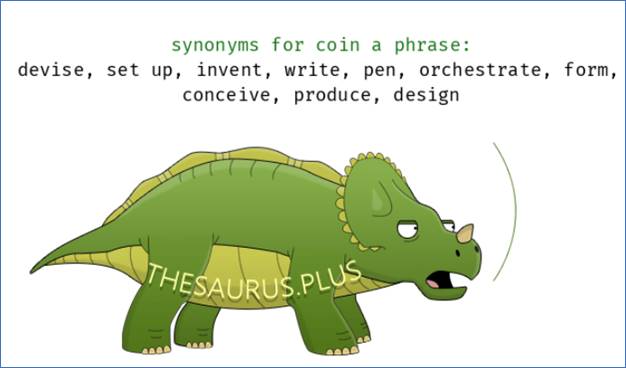
In the past couple of weeks, I’ve discussed some terms and mentioned when and where these terms and phrases were coined. Now, someone has asked me about the term “coin a phrase.” Coining a phrase, as many of you know, means to create a new phrase. But where did this come from?

Here’s what I found out from The Phrase Finder:

…Coining, in the sense of creating, derives from the coining of money by stamping metal with a die. Coins—also variously spelled coynes, coigns, coignes, or quoins—were the blank, usually circular, disks from which money was minted. This usage derived from an earlier 14th century meaning of coin, which meant wedge. The wedge-shaped dies which were used to stamp the blanks were called coins and the metal blanks and the subsequent ‘coined’ money took their name from them.

Coining later began to be associated with inventiveness in language. In the 16th century the “coining” of words and phrases was often referred to. By that time the monetary coinage was often debased or counterfeit and the coining of words was often associated with spurious linguistic inventions; for example, in George Puttenham’s The arte of English poesie, 1589:

"Young schollers not halfe well studied… will seeme to coigne fine wordes out of the Latin."

Shakespeare, the greatest coiner of them all, also referred to the coining of language in Coriolanus, 1607:

"So shall my Lungs Coine words till their decay."

Quoin has been retained as the name of the wedge-shaped keystones or corner blocks of buildings. Printers also use the term as the name for the expandable wedges that are used to hold lines of type in place in a press. This has provoked some to suggest that “coin a phrase” derives from the process of quoining (wedging) phrases in a printing press. That is not so. “Quoin a phrase” is recorded nowhere and “coining” meant “creating” from before the invention of printing in 1440…

“Coin a phrase” itself arises much later than the invention of printing—the 19th century in fact. It appears to be American in origin—it certainly appears in publications there long before any can be found from any other parts of the world. The earliest use of the term that I have found is in the Wisconsin newspaper The Southport American, July 1848:

"Had we to find… a name which should at once convey the enthusiasm of our feelings towards her, we would coin a phrase combining the extreme of admiration and horror and term her the Angel of Assassination."

Kara Church

Technical Editor, Advisory

Symitar Documentation Services

About Editor’s Corner

Editor’s Corner keeps your communication skills sharp by providing information on grammar, punctuation, JHA style, and all things English. As editors, we spend our days reading, researching, and revising other people’s writing. We love to spend a few extra minutes to share what we learn with you and keep it fun while we’re doing it.

Did someone forward this email to you? Click here to subscribe.

Don’t want to get Editor’s Corner anymore? Click here to unsubscribe.

Do you have a question or an idea for Editor’s Corner? Click here to provide suggestions or feedback.

NOTICE: This electronic mail message and any files transmitted with it are intended
exclusively for the individual or entity to which it is addressed. The message,
together with any attachment, may contain confidential and/or privileged information.
Any unauthorized review, use, printing, saving, copying, disclosure or distribution
is strictly prohibited. If you have received this message in error, please
immediately advise the sender by reply email and delete all copies.

« Newer Posts - Older Posts »

Categories