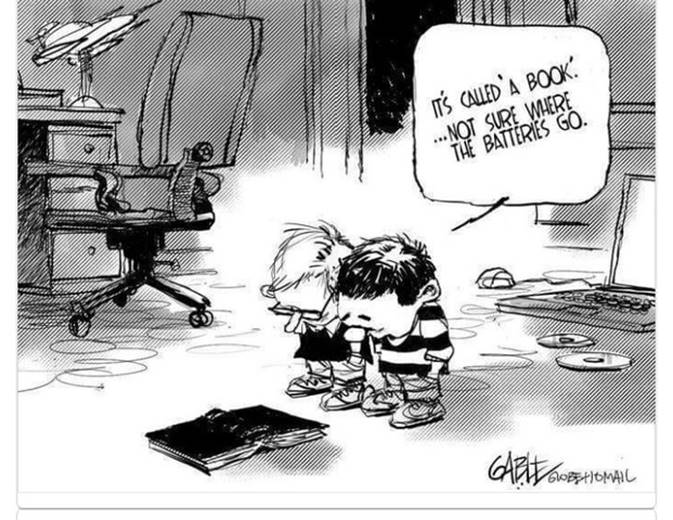
Posted by: Jack Henry | October 30, 2018

Editor’s Corner: Scare Quotes

In the spirit of Halloween, I’d like to take the opportunity to share some spooky information about scare quotes (also known as sneer quotes, shudder quotes, and sometimes quibble marks). To be honest, scare quotes are not spooky, but as long as I have your interest, read on!

Scare quotes are a fairly recent phenomenon, and according to Merriam-Webster, they are intended to express skepticism. Since the advent of word processors, quotation marks around a single word or phrase are no longer used to provide emphasis. Now, they tell you to question or doubt the information.

So, a problem occurs when writers use quotation marks to provide emphasis. These days, readers are most likely to interpret the quotation marks as scare quotes. I’ll provide some examples to show you what I mean.

  • Our competitor claims to have made “significant profits” last fiscal year.

The quotation marks imply that there is some doubt about whether the competitor is actually profitable.

  • The restaurant always served “fresh” fish.

Adding quotation marks around the word fresh suggests that the fish is not fresh. You probably don’t want to order the fish at this restaurant.

  • Yesterday, I was chased by my neighbor’s “dog”: a poodle.

The quotation marks give the impression that poodles are not actually dogs. Balderdash! Of course they are! They didn’t ask for those haircuts.

These three examples are not intended to be sarcastic, but the quotation marks, which are being used to provide emphasis (albeit unnecessary) could easily be misinterpreted, leaving the reader with doubt and uncertainty (and maybe a chuckle).

To avoid being misunderstood, do not use quotation marks for emphasis. You can use them when you are directly quoting someone, or for the titles of chapters in a book and song titles, etc., or when your coining a new word or phrase. And of course, you can use them to be sarcastic or ironic. No quotation marks were necessary in my three examples because no emphasis was necessary.

What do you do if you want to emphasize a word or phrase? The JHA Style Guide tells us to use italics, but it warns to use them sparingly or they lose their significance.

Donna Bradley Burcher | Senior Technical Editor | Symitar®

8985 Balboa Ave. | San Diego, CA 92123 | Ph. 619.278.0432 | Ext: 765432

About Editor’s Corner

Editor’s Corner keeps your communication skills sharp by providing information on grammar, punctuation, JHA style, and all things English. As editors, we spend our days reading, researching, and revising other people’s writing. We love to spend a few extra minutes to share what we learn with you and keep it fun while we’re doing it.

Did someone forward this email to you? Click here to subscribe.

Don’t want to get Editor’s Corner anymore? Click here to unsubscribe.

Do you have a question or an idea for Editor’s Corner? Send your suggestions or feedback to Kara, <a href="mailto:DBurcher, Jackie, or <a href="mailto:BRitter.

About Editor’s Corner

Editor’s Corner keeps your communication skills sharp by providing information on grammar, punctuation, JHA style, and all things English. As editors, we spend our days reading, researching, and revising other people’s writing. We love to spend a few extra minutes to share what we learn with you and keep it fun while we’re doing it.

Did someone forward this email to you? Click here to subscribe.

Don’t want to get Editor’s Corner anymore? Click here to unsubscribe.

Do you have a question or an idea for Editor’s Corner? Send your suggestions or feedback to Kara, <a href="mailto:DBurcher, Jackie, or <a href="mailto:BRitter.

NOTICE: This electronic mail message and any files transmitted with it are intended
exclusively for the individual or entity to which it is addressed. The message,
together with any attachment, may contain confidential and/or privileged information.
Any unauthorized review, use, printing, saving, copying, disclosure or distribution
is strictly prohibited. If you have received this message in error, please
immediately advise the sender by reply email and delete all copies.

Posted by: Jack Henry | October 25, 2018

Editor’s Corner: Oh boy!

Good morning, my fellow word lovers!

The other day someone asked me, “Why do we say ‘Oh boy!’ as an exclamation or interjection to express shock or surprise?” I’m sure the people around me wish I said, “Oh boy,” instead of some of the other things I say when I’m surprised.

I started looking into this seemingly simple question, but you know that rabbit hole I’ve mentioned traveling down? Well the bunnies really taunted me this time! Today we’ll start with “boy,” and over the next few days, we’ll work our way to the other topics I found. This excerpt is from a longer article in Daily Writing Tips:

Boy has been in the language since 1300. More than one etymology has been argued, but its origin is uncertain. Its earliest use in English was with the meaning “male servant” or “slave.”

Note: Before boy came to mean “a male child,” the word girl was used to refer to young people of either sex. A speaker who wanted to refer to a “male ‘girl’” used the expression “knave girl.” Both words, boy and girl, had taken on their present meanings by the 1400s.

In the British colonies and in the American South, boy was used to refer to non-white servants, regardless of age. Today, of course, such usage is considered to be extremely offensive. In France, until fairly recently, the usual term for summoning a waiter was garçon, “boy,” but nowadays, serveur is the masculine term for “waiter.”

Apart from its general meaning of “a young male, (usually below the age of puberty, or still in school),” boy occurs in a great variety of idioms that refer not just to male human beings of any age, but to dogs as well.

Oh boy! Depending upon context and intonation, this exclamation can denote delight or dismay. For example, “Oh boy! I’ve won the lottery!” or, “Oh boy, you’re in trouble now.”

That’s my boy! A parent, proud of a son, might say this in approval of some accomplishment.

Old boys’ club/old boys’ network: network of social and professional connections that perpetuate favoritism in government and other sectors. The expression originated with the British “public school” system. (In the U.K., “public schools” are elite private schools attended by the children of the wealthy.) Male graduates of exclusive schools were called “old boys.” Because of connections forged in school, these “old boys” went on to occupy highly placed jobs in government and commerce, helped by a previous generation of “old boys” who made up a segment of insiders. By extension, the expression can be used to refer to any kind of favoritism that makes advancement difficult for outsiders.

There’s a good boy! An expression pet owners use with male dogs. Sometimes it is phrased as a question: “Who’s a good boy?”

Down, boy! This expression is used to address a dog that is jumping on someone.

Boys’ night out: A weekly social outing for friends, limited to men. [KC – Compare to “girls’ night out,” which would, of course be more fun because I’d be there with you. LOL.]

Boys will be boys: An expression of resigned acceptance uttered when men do something despicable that is considered to be characteristic of age or sex.

Send a boy to do a man’s job: to ask someone young, ill-equipped, or inexperienced to do difficult or complicated work. Usually in negative contexts, as “Never send a boy to do a man’s job.”

boy next door: Unlike most “boy” expressions, this one has a corresponding one for women: girl next door. The expressions denote a stereotypical personification of a young, unspoiled, admirable character whom one might safely fall in love with.

boy king: Tutankhamen is often referred to as “the boy king.” Boy can be used in a descriptive sense with any noun: “boy wonder,” “boy genius.”

My boy, Harvey, enjoying a Starbucks™ “puppuccino.”

Kara Church

Technical Editor, Advisory

Symitar Documentation Services

Posted by: Jack Henry | October 23, 2018

Editor’s Corner: Folk Etymologies

After spending a few weeks on vacation in Germany, I could not resist sharing this list of folk etymologies from Daily Writing Tips with you. Munich and Berlin were full of oak trees, chestnuts, gin, and gingerbread. For more folk etymologies, click the link above.

This post lists words derived from words in other languages as a result of folk etymology, a process by which speakers adopt the foreign terms after revising them by using existing elements from their native language.

acorn: This word is descended from the Old English term aecerne, meaning “tree nut” but originally referring in various forms in Germanic languages to the trunk of a tree; by folk etymology, the current spelling derived from a false association with ac (“oak”) and corn (“grain”). (The word is, however, related to acre.)

chestnut: The name of a type of tree, the wood harvested from it, and the edible nut it produces stems from the Latin term castanea (probably itself borrowed from a language of Asia Minor) by way of Old French and Middle English. By the early 1500s, it was (redundantly) called a chesten nut; that word developed into the current form.

gin: Gin, the name for a liquor flavored with juniper berries, is a truncation of genever, related to the Old French term geniévre and the Dutch word jenever, all of which derive from the Latin word juniperus.

gingerbread: The name of the molasses- and ginger-based confection has nothing to do with bread; the term derives from the Old French word gingembrat, a variation of gimgembre, meaning “ginger.” Gingembrat, and its Middle English derivation gingebred, referred originally to a ginger paste used both in cooking and medicine.

spare rib: This term for a cut of pork ribs alludes to its scarcity of fat, but the source is the Middle Low German word ribbesper; sper meant “spear” or “spit” and referred to the method of roasting the meat on a spit. (Spear, spar, and spire are all related.)

Oktoberfest gingerbread cookies:

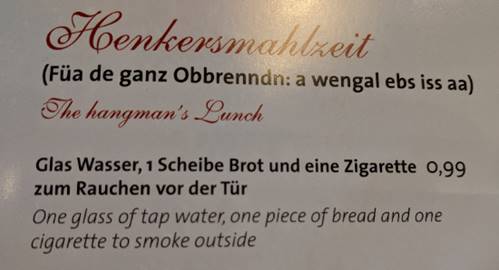
And my favorite menu item in all the land: The Hangman’s Lunch

Kara Church

Technical Editor, Advisory

Symitar Documentation Services

Posted by: Jack Henry | October 18, 2018

Editor’s Corner: 20 Common Usage Mistakes

Good morning.

In linguistics, the term usage refers to the way words are used in a particular language. It’s not about grammar so much as it is about how words are used. I recently read an article by Jordan Conrad called 35 Mistakes to Avoid in Your Writing: A Cheat Sheet for Common English Grammar Mistakes. The article included 20 usage mistakes (commonly confused words) that I want to share with you.

I think you’ll notice that we’ve covered some of these before, but some are new, and we can all benefit from an occasional refresher. Here you go!

  1. Affect vs. Effect

Incorrect: The game will effect our standings in the league.

Correct: The game will affect our standings in the league.

Although both words can be used as nouns and verbs, effect is usually used as a noun and affect is usually used as a verb.

  1. Apart vs. A part

Incorrect: Can I be apart of your group?

Correct: Can I be a part of your group?

Apart is an adverb meaning, “separated by some distance.” These two rocks are three feet apart from each other. A part is two separate words, the article “a” and the noun “part.” Apart is usually paired with “from” and a part is usually paired with “of.”

  1. Assure vs. Ensure

Incorrect: You must take the proper precautions to assure your privacy.

Correct: You must take the proper precautions to ensure your privacy.

To ensure something happens is to guarantee it. Assure is to tell someone something positively or confidently to remove any doubt. Greg assured me nothing was wrong. In order to ensure that nothing was wrong, Greg locked the door.

  1. Who vs. Whom

Incorrect: Who did you give that to?

Correct: To whom did you give that?

Who functions as a subject while whom functions as an object. An easy way to re­member the difference is to substitute he/him into your sentences. If he works, it should be who. If him works, it should be whom. Who (he) told me to make dinner. You delivered a pizza to whom (him)?

  1. Attain vs. Obtain

Incorrect: Joe worked very hard and obtained a great level of success.

Correct: Joe worked very hard and attained a great level of success.

Attain and obtain are both verbs. Attain means “to accomplish, reach, or achieve something through effect.” Obtain means “to get, acquire, or to gain possession of something.” Attain implies effort put forth to produce the outcome.

  1. Break vs. Brake

Incorrect: There’s been a brake in the water pipe.

Correct: There’s been a break in the water pipe.

Break can be used as a noun and verb. To break something is to cause it to separate into pieces. A break is the act or action of breaking. We took a break at work. Brake can also be used as a noun and verb. To brake is to stop your car.

  1. Capital vs. Capitol

Incorrect: We took a tour of the capital building today.

Correct: We took a tour of the capitol building today.

Capital refers to a city, specifically a governmental seat. It can also be used in a financial sense to describe money or equipment. Capitol is a building where a legis­lature meets.

  1. Compliment vs. Complement

Incorrect: Today I received a nice complement from a friend.

Correct: Today I received a nice compliment from a friend.

A compliment is a flattering or praising remark. A complement is something that completes or brings something to perfection. Those shoes are the perfect comple­ment for that dress.

  1. Comprise vs. Compose

Incorrect: Fifty states comprise the United States.

Correct: Fifty states compose the United States.

Comprise means “to be made up of.” Compose means “to make up the constituent parts of.” With comprise, the whole is the subject. With compose, the parts are the subject.

  1. Emigrate vs. Immigrate

Incorrect: My grandparents emigrated into the United States.

Correct: My grandparents immigrated into the United States.

To immigrate is to enter a new place. To emigrate is to leave a place. You immigrate into places and emigrate from places.

  1. Everyday vs. Every day

Incorrect: I get coffee before work everyday.

Correct: I get coffee before work every day.

Everyday, when used as a single word, is an adjective meaning commonplace, usual, and suitable for ordinary days. Every day, two words, is an adverbial phrase. Substi­tuting “each day” for “every day” will help you keep them separated.

  1. Explicit vs. Implicit

Incorrect: Please be implicit; what is it that you want?

Correct: Please be explicit; what is it that you want?

To say something explicitly is to spell it out clearly so that it is unambiguous. Some­thing is implicit when it is implied or not said clearly and directly.

  1. Invoke vs. Evoke

Incorrect: This comic strip will invoke laughter.

Correct: This comic strip will evoke laughter.

To invoke is to assert something as authority or appeal to someone for help. Great Britain invoked military aid from the United States. To evoke is to bring someone forth or to recall something to the conscious mind. Invoke is a more direct action than evoke.

  1. Who vs. That

Incorrect: The woman that opened the door for you is my mom.

Correct: The woman who opened the door for you is my mom.

When referring to inanimate objects or animals without a name, use that. When re­ferring to human beings and animals with a name, use who. [dbb – There is some disagreement about this rule. Commonly, experts say to use
who when you’re talking about a person and that when you’re talking about an inanimate object regardless of whether you are using a name. Pets are a gray area, however, and both
who and that are acceptable.]

  1. Onto vs. On to

Incorrect: The cat jumped on to the dresser.

Correct: The cat jumped onto the dresser.

Onto is a preposition that means “on top of, to a position on.” On to, two words, is used when on is part of a verb phrase such as “held on.” She held on to the chains while swinging. A good trick is to mentally say “up” before “on” in a sentence. If it still makes sense, then onto is the correct choice.

  1. Passed vs. Past

Incorrect: The car past me on the left.

Correct: The car passed me on the left.

Passed implied movement of some sort. Past is a period of time before the present. Bill Clinton is a past president.

  1. To vs. Too vs. Two

Incorrect: There are to many people here.

Correct: There are too many people here.

Too means “also, very, or excessive.” Two is the number 2. I need two pizzas. To is just about everything else. Can you drive me to the mall?

  1. There vs. Their vs. They’re

Incorrect: All of there equipment was loaded into the truck.

Correct: All of their equipment was loaded into the truck.

There is a directional word and is usually paired with “is” or “are.” Over there is a crocodile. Their is possessive. Their house is very cute. They’re is a contraction of “they are.” They’re (they are) moving in next door.

  1. Toward vs. Towards

The difference between towards and toward is entirely dialectal. In American Eng­lish, you should use toward. In British English, you should use towards.

  1. Principal vs. Principle

Incorrect: Mr. Babcock is the principle of the high school.

Correct: Mr. Babcock is the principal of the high school.

Principal refers to a person of high authority or prominence. It also has specific meanings in finance and law. How much have you repaid on the principal of your loan? Principle is a natural, moral legal rule or standard. The principle of free speech is essential in any democracy.

About Editor’s Corner

Editor’s Corner keeps your communication skills sharp by providing information on grammar, punctuation, JHA style, and all things English. As editors, we spend our days reading, researching, and revising other people’s writing. We love to spend a few extra minutes to share what we learn with you and keep it fun while we’re doing it.

Did someone forward this email to you? Click here to subscribe.

Don’t want to get Editor’s Corner anymore? Click here to unsubscribe.

Do you have a question or an idea for Editor’s Corner? Send your suggestions or feedback to Kara, <a href="mailto:DBurcher, Jackie, or <a href="mailto:BRitter.

Donna Bradley Burcher | Senior Technical Editor | Symitar®

8985 Balboa Ave. | San Diego, CA 92123 | Ph. 619.278.0432 | Extension: 765432

Symitar Documentation Services

NOTICE: This electronic mail message and any files transmitted with it are intended
exclusively for the individual or entity to which it is addressed. The message,
together with any attachment, may contain confidential and/or privileged information.
Any unauthorized review, use, printing, saving, copying, disclosure or distribution
is strictly prohibited. If you have received this message in error, please
immediately advise the sender by reply email and delete all copies.

Posted by: Jack Henry | October 16, 2018

Editor’s Corner: Terse with your verse?

Last week I wrote about some things to consider if you tend to be verbose in your communication. Today I have some advice for people who are the opposite—you know, you generally respond with the most minimal communication possible. That’s okay sometimes, but other times, when you get an email and the sender asks, “Do you want me to help this client with their website or their ATM?” and you answer “Yes,” well, there are a couple issues there. J

For those of you who do not write much or who are looking to add a little more to your writing, consider these questions:

Kara Church

Technical Editor, Advisory

Symitar Documentation Services

Posted by: Jack Henry | October 11, 2018

Editor’s Corner: Couple, Few, Several

Sometimes, it is not practical to include a precise number in your writing, either because it is unknown or unimportant. That’s when couple, few, and several come in handy.

However, these words come with their own set of questions: Does a couple mean exactly two? Does a few mean exactly three? What is the cutoff between a few and several?

The short answer is that these words are useful because they’re imprecise, so forget mapping each word to a specific number or range of numbers. In other words, if you’re using a few to mean exactly three, why wouldn’t you just say three?

Here are some definitions from Merriam-Webster:

  • couple: two; also few—used with a <a couple drinks>
  • few: at least some but indeterminately small in number—used with a <caught a few fish>
  • several: more than one <several pleas>; more than two but fewer than many <moved several inches>

For some history on these three words, see ‘Couple,’ ‘Few,’ and ‘Several’: The (Mostly) Definitive Guide on the Merriam-Webster website.

If precision is important, use an exact number, an approximation (“about four”), or a range (“from three to six”). If precision is not important, it’s fine to write a sentence such as, “The file may take a few minutes to download.” But don’t be surprised when a reader’s definition is different than yours.

About Editor’s Corner

Editor’s Corner keeps your communication skills sharp by providing information on grammar, punctuation, JHA style, and all things English. As editors, we spend our days reading, researching, and revising other people’s writing. We love to spend a few extra minutes to share what we learn with you and keep it fun while we’re doing it.

Did someone forward this email to you? Click here to subscribe.

Don’t want to get Editor’s Corner anymore? Click here to unsubscribe.

Do you have a question or an idea for Editor’s Corner? Send your suggestions or feedback to Kara, <a href="mailto:DBurcher, Jackie, or <a href="mailto:BRitter.

Ben Ritter | Technical Editor | Symitar®
8985 Balboa Avenue | San Diego, CA 92123
619-682-3391 | or ext. 763391 | www.Symitar.com

Symitar Documentation Services

NOTICE: This electronic mail message and any files transmitted with it are intended
exclusively for the individual or entity to which it is addressed. The message,
together with any attachment, may contain confidential and/or privileged information.
Any unauthorized review, use, printing, saving, copying, disclosure or distribution
is strictly prohibited. If you have received this message in error, please
immediately advise the sender by reply email and delete all copies.

Posted by: Jack Henry | October 9, 2018

Editor’s Corner: Flowery Language

Hello!

It’s been awhile since we’ve chatted. I was on a mission to Germany to visit relatives and participate in Oktoberfest with my best friends. Well, now I’m back, and ready to rumble!

I know you may think of us editors as red-pen-wielding wildcats, but we have a calmer gentler side to our positions: we offer writing advice and instruction to others, and sometimes we get the opportunity to mentor those who do a lot of writing in their daily jobs.

Sometimes we work with people who love flowery, friendly, abundant writing—but they want to learn how to tone it down. Others come to us with very terse, no-frills, stark writing—and they want to learn to add some flair. Our goal is to teach writers to work somewhere in between terse and frilly. We aim for clear, concise, polite communication. We want to get the point across without wasting anybody’s time.

I have a few tips for those of you who ask for advice about that middle ground. Keep in mind that we are talking about business English. If you want to wax poetic with your personal writing, go for it. We’re just trying to guide you here at work.

Today, I’m offering help for those who tend to write lengthy documents and emails. Tomorrow we’ll have a look at those of you who often write one-word emails.

Potentially flowery folks, here are some questions to ask yourself:

  • Is this information necessary? (Under most circumstances, you don’t need to include weather forecasts, questions about the reader’s new puppy, or a lot of adjectives to describe the situation.)
  • Am I being redundant? (You only need to say it once, one way. You don’t need to tell them the same thing three different ways—that’s confusing.)
  • Is this the best way to say what I want to say? (Use straightforward sentences with a subject, verb, and object. For example, “Call Tony S. to repair your printer.”)
  • Is this information in any way confusing? (Re-read what you’ve written. Make sure it progresses smoothly. If it involves steps, make sure all of the steps are included.)
  • Am I using easily understood words and phrases? (Are you proactively leveraging something? Are you architecting something impactful in your wheelhouse? Is your holistic approach to open the kimono? Well then stop! Be simple and straightforward; avoid jargon.)
  • Am I using long sentences? (We often see lengthy sentences that could be two or three separate smaller sentences. The easier your sentences are to read, the easier your writing is to follow. This is particularly important with technical information.)

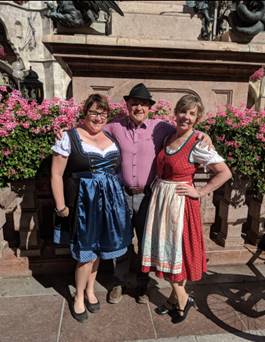
A sunny Munich day with my buddies.

Kara Church

Technical Editor, Advisory

Symitar Documentation Services

Here is a list of commonly misspelled words in business writing from DailyWritingTips. The list also includes some tips that may help you to remember the correct spelling.

Remember that spell checker programs catch a lot of errors, but they don’t always catch everything. It is important to reread your communication before sending it out.

1.
Misspelled: seperate
Correct: separate
Tip: There’s a rat in sep-a-rate.

2.
Misspelled: definate
Correct: definite
Tip: Take a close look at the final syllable: nite.

3.
Misspelled: calender
Correct: calendar
Tip: You probably pronounce the last syllable as [er], so you have to think [ar] as you write it: cal-en-dar.

4.
Misspelled: mispell
Correct: misspell
Tip: You know how to spell spell; add the prefix mis- to it: mis-spell.

5.
Misspelled: privlege
Correct: privilege
Tip: You may pronounce this three-syllable word with only two syllables. Notice the second i: priv-i-lege. Another common misspelling is privilige. Note the e in the final syllable: priv-i-lege.

6.
Misspelled: arguement
Correct: argument
Tip: The verb argue ends in e, but you must drop the e for ar-gu-ment.

7.
Misspelled: concensus
Correct: consensus
Tip: The sensus in consensus has nothing to do with the word census. Our word census comes from Latin censare, “to rate, assess.” Consensus comes from Latin consensus, “agreement, accord, sympathy, common feeling.” Think SSS: Con-Sen-SuS.

8.
Misspelled: pronounciation
Correct: pronunciation
Tip: There’s no “ounce” in pronunciation, but there is a “nun.” The verb is pronounce; the noun is pro-nun-ci-a-tion.

9.
Misspelled: accomodate
Correct: accommodate
Tip: Two sets of double letters, cc and mm: accommodate

10.
Misspelled: dependant
Correct: dependent
Tip: People who misspell this one may be thinking of defendant, which does end in –ant (although the –ant in defendant is also pronounced [ent].) Note the final syllable in dependent: de-pen-dENT.

Jackie Solano | Technical Editor | Symitar®

8985 Balboa Ave. | San Diego, CA 92123 | Ph. 619.542.6711 | Extension: 766711

Symitar Documentation Services

NOTICE: This electronic mail message and any files transmitted with it are intended
exclusively for the individual or entity to which it is addressed. The message,
together with any attachment, may contain confidential and/or privileged information.
Any unauthorized review, use, printing, saving, copying, disclosure or distribution
is strictly prohibited. If you have received this message in error, please
immediately advise the sender by reply email and delete all copies.

I recently read an article about five English phrases that even native speakers get wrong. I love articles like this because they give us the opportunity to learn without the embarrassment of being called out in person for our mistakes. Yes, I am speaking from personal experience.

When I was in college, speaking to an English professor about one of my term papers, I pointed out a section of my paper that still needed to be “flushed out.” Without the slightest smirk or condescension, my professor informed me that I meant to say, “fleshed out” and explained that I wanted to bulk it up by adding information; I did not want to flush it down the toilet. Lesson learned. I never made that mistake again, and I’m very aware now when I hear others make the same mistake. But I also learned not to judge. Sometimes, we just get it wrong.

The phrase “flesh out” is not one of the five phrases mentioned in the article I read. It’s a bonus for you. I’m giving you six for the price of five! Here are the 5 English Phrases Even Native Speakers Get Wrong:

Correct Phrase Incorrect Phrase Explanation
Free rein Free reign To give someone free rein is to give that person significant leeway to act as he or she pleases.
Beck and call Beckon call To be at someone’s beck and call is to be readily available at a moment’s notice.
Bear with me Bare with me If you ask someone to bear with you, you are asking for patience from that person.
All of a sudden All of the sudden This phrase is a popular English idiom, and it functions as an adverb, similar to the word suddenly.
Make do Make due To make something do is to manage with limited or inadequate means.

Donna Bradley Burcher | Senior Technical Editor | Symitar®

8985 Balboa Ave. | San Diego, CA 92123 | Ph. 619.278.0432 | Extension: 765432

Symitar Documentation Services

NOTICE: This electronic mail message and any files transmitted with it are intended
exclusively for the individual or entity to which it is addressed. The message,
together with any attachment, may contain confidential and/or privileged information.
Any unauthorized review, use, printing, saving, copying, disclosure or distribution
is strictly prohibited. If you have received this message in error, please
immediately advise the sender by reply email and delete all copies.
Posted by: Jack Henry | September 27, 2018

Editor’s Corner: Around, About, Approximately

The words around, about, and approximately all indicate uncertainty or imprecision. Here are the definitions from Merriam-Webster:

  • around: in the neighborhood of
  • about: with some approach to exactness in quantity, number, or time
  • approximately: reasonably close to

Although around, about, and approximately mean roughly the same thing, they imply subtly different levels of formality and precision.

Consider the following sentences. Which would you say to your friend? Which would you say to the police?

  • I left work around 4:30.
  • I left work at approximately 4:30.

According to the AMA Style Insider blog, “Authorities for the most part agree that around, about, and approximately lie on a scale from casual to formal. As it happens, around is also thought of as the most imprecise and approximately the most precise, with about falling somewhere in between.”

Symitar Technical Publications doesn’t use the American Medical Association’s AMA Manual of Style, but The Chicago Manual of Style offers similar advice: “When idiomatically possible, use the adverb about instead of approximately. In the sciences, however, approximately is preferred {approximately 32 coding-sequence differences were identified}.”

Most of the writing you do at work falls somewhere between talking to a friend and writing a scientific research paper. Around is too casual. Approximately is too formal (unless you want to signal a high degree of precision). For everyday writing, about is just right.

About Editor’s Corner

Editor’s Corner keeps your communication skills sharp by providing information on grammar, punctuation, JHA style, and all things English. As editors, we spend our days reading, researching, and revising other people’s writing. We love to spend a few extra minutes to share what we learn with you and keep it fun while we’re doing it.

Did someone forward this email to you? Click here to subscribe.

Don’t want to get Editor’s Corner anymore? Click here to unsubscribe.

Do you have a question or an idea for Editor’s Corner? Send your suggestions or feedback to Kara, <a href="mailto:DBurcher, Jackie, or <a href="mailto:BRitter.

Ben Ritter | Technical Editor | Symitar®
8985 Balboa Avenue | San Diego, CA 92123
619-682-3391 | or ext. 763391 | www.Symitar.com

Symitar Documentation Services

NOTICE: This electronic mail message and any files transmitted with it are intended
exclusively for the individual or entity to which it is addressed. The message,
together with any attachment, may contain confidential and/or privileged information.
Any unauthorized review, use, printing, saving, copying, disclosure or distribution
is strictly prohibited. If you have received this message in error, please
immediately advise the sender by reply email and delete all copies.

« Newer Posts - Older Posts »

Categories