Posted by: Jack Henry | August 28, 2018

Editor’s Corner: Coin a Phrase

In the past couple of weeks, I’ve discussed some terms and mentioned when and where these terms and phrases were coined. Now, someone has asked me about the term “coin a phrase.” Coining a phrase, as many of you know, means to create a new phrase. But where did this come from?

Here’s what I found out from The Phrase Finder:

…Coining, in the sense of creating, derives from the coining of money by stamping metal with a die. Coins—also variously spelled coynes, coigns, coignes, or quoins—were the blank, usually circular, disks from which money was minted. This usage derived from an earlier 14th century meaning of coin, which meant wedge. The wedge-shaped dies which were used to stamp the blanks were called coins and the metal blanks and the subsequent ‘coined’ money took their name from them.

Coining later began to be associated with inventiveness in language. In the 16th century the “coining” of words and phrases was often referred to. By that time the monetary coinage was often debased or counterfeit and the coining of words was often associated with spurious linguistic inventions; for example, in George Puttenham’s The arte of English poesie, 1589:

"Young schollers not halfe well studied… will seeme to coigne fine wordes out of the Latin."

Shakespeare, the greatest coiner of them all, also referred to the coining of language in Coriolanus, 1607:

"So shall my Lungs Coine words till their decay."

Quoin has been retained as the name of the wedge-shaped keystones or corner blocks of buildings. Printers also use the term as the name for the expandable wedges that are used to hold lines of type in place in a press. This has provoked some to suggest that “coin a phrase” derives from the process of quoining (wedging) phrases in a printing press. That is not so. “Quoin a phrase” is recorded nowhere and “coining” meant “creating” from before the invention of printing in 1440…

“Coin a phrase” itself arises much later than the invention of printing—the 19th century in fact. It appears to be American in origin—it certainly appears in publications there long before any can be found from any other parts of the world. The earliest use of the term that I have found is in the Wisconsin newspaper The Southport American, July 1848:

"Had we to find… a name which should at once convey the enthusiasm of our feelings towards her, we would coin a phrase combining the extreme of admiration and horror and term her the Angel of Assassination."
Kara Church

Technical Editor, Advisory

Symitar Documentation Services

About Editor’s Corner

Editor’s Corner keeps your communication skills sharp by providing information on grammar, punctuation, JHA style, and all things English. As editors, we spend our days reading, researching, and revising other people’s writing. We love to spend a few extra minutes to share what we learn with you and keep it fun while we’re doing it.

Did someone forward this email to you? Click here to subscribe.

Don’t want to get Editor’s Corner anymore? Click here to unsubscribe.

Do you have a question or an idea for Editor’s Corner? Click here to provide suggestions or feedback.

NOTICE: This electronic mail message and any files transmitted with it are intended
exclusively for the individual or entity to which it is addressed. The message,
together with any attachment, may contain confidential and/or privileged information.
Any unauthorized review, use, printing, saving, copying, disclosure or distribution
is strictly prohibited. If you have received this message in error, please
immediately advise the sender by reply email and delete all copies.

Posted by: Jack Henry | August 27, 2018

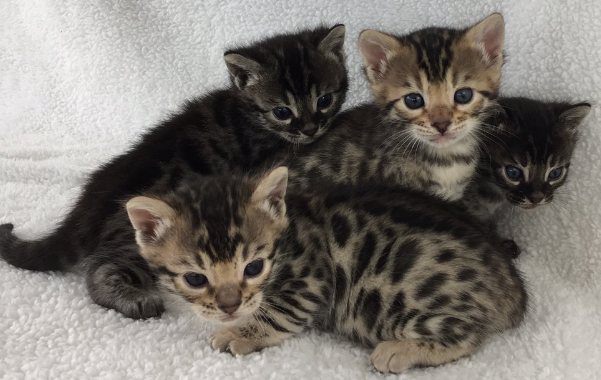
Editor’s Corner: Kitty

I recently wrote an article about slush funds, and I received a fascinating tale from one of you readers who used to work in a bank. From Marilyn:

Internal auditors went crazy when they discovered tellers who had a “kitty” for balancing at the end of the day. Bad tellers would hide the amount they were out of balance (if over for the day) and use it for the day they ended up short. One day, the internal auditor found, in her opinion, a large “kitty” (less than $5) that an absent teller had stashed away in her paper clip tray. She gasped and said “Oh boy! Just look at the kitty I found today!”

Why is a teller’s “illegal” fund called a kitty?

I’m familiar with the term “kitty” when playing cards, to refer to the money or chips that people put down for bets. I am guessing that the teller’s stash is being referred to similarly, as a small collection of funds. Let’s see what else we can find out from Merriam-Webster and the Online Etymology Dictionary!

From M-W:

kitty (noun):

1: a small bowl or other receptacle

2a

(1): a fund in a poker game accumulated by taking one or two chips from each large pot and used (as to pay expenses or buy refreshments) for the players

(2): a pool that belongs to all players in a game but that participates in the scoring or settlement of certain hands as though it were a player opposed to the bidder

2b: a sum of money or collection of goods usually accumulated by occasional small contributions and often administered by or for the contributors: pool, fund

<enough in the kitty to make the trip — E. K. Gann>

<a campaign kitty raised by oil and utility companies — Time>

<the ground crew’s kitty of cigarettes — Saul Levitt>

2c: (called) the widow in skat, pinochle, and other games (also called the blind)

And from the Online Etymology Dictionary:

kitty (n.2)

"pool of money in a card game," 1884, American English, of uncertain origin. OED connects it with kit (n.1) in the 19c. sense of "collection of necessary supplies;" but perhaps it is rather from northern England slang kitty "prison, jail, lock-up" (1825), a word itself of uncertain origin.

By the Widow, or as it is more commonly known as "Kitty," is meant a percentage, taken in chips at certain occasions during the game of Poker. This percentage may be put to the account of the club where the game is being played, and defrays the cost of cards, use of chips, gas, attendance, etc. The Kitty may, however, be introduced when no expenses occur. ["The Standard Hoyle," New York, 1887]

I prefer this kind of kitty. One hundred percent legal and extremely tender!

Kara Church

Technical Editor, Advisory

Symitar Documentation Services

Good morning! For some time now, I’ve wanted to cover the overuse of grammatical expletives to start sentences. But it’s been difficult to figure out how to explain this quasi-rule simply. I think it would be best to start with a definition: grammatical expletives are words and phrases that do not “add to sense or meaning.” You can think of them as filler. Swear words are a type of expletive—they don’t add grammatical value; they are emotional filler. But swear words are not the expletives I will be dealing with today: at least not during work hours!

I want to discuss a particular expletive that people often use to begin sentences: There is/There are. Although I don’t know of a specific rule that says you cannot start sentences with these words, experts agree that, usually, they just clutter your writing.

Using a few examples, I’ll show you that the words There is/There are, in many cases, are not necessary at the beginning of a sentence. Often, this expletive—like empty calories in your diet—doesn’t add any nutritional value.

Sentence beginning with expletive Sentence without expletive
There is a madman that lives in the house on the hill. A madman lives in the house on the hill.
There is a Membership Status field in the Account record that allows credit unions to designate a non-member status. The Membership Status field in the Account record allows credit unions to designate a non-member status.
There are five different types of parameters involved in inventory control for traveler’s checks. Five different types of parameters are involved in inventory control for traveler’s checks.
There are a variety of settings or user preferences that I can change for you. I can change a variety of settings or user preferences for you.
There are jobs running. Jobs are running

I am not saying that you should never use There is/There are to start a sentence. Sometimes the phrase cannot be edited out as simply as I’ve shown above, and sometimes the phrase is useful. For example, you might choose to say, “There is no reason to be upsetrather than “Don’t be upset.”The later sounds a little too much like an order. You always need to consider the situation, your tone, who you’re talking to, what you’re talking about, etc. But for the purposes of professional, minimalist writing, you’ll find you can usually omit this expletive or revise your sentence to make it more concise.

What I’m asking you to do is this: when you are writing in a professional capacity, and you start a sentence with there is or there are, ask yourself if you can revise the sentence to get rid of the expletive. If you can, you probably should, just for the sake of cleaner, clearer writing.

If you want more information on this topic, check out these links:

Donna Bradley Burcher | Senior Technical Editor | Symitar®

8985 Balboa Ave. | San Diego, CA 92123 | Ph. 619.278.0432 | Extension: 765432

Symitar Documentation Services

NOTICE: This electronic mail message and any files transmitted with it are intended
exclusively for the individual or entity to which it is addressed. The message,
together with any attachment, may contain confidential and/or privileged information.
Any unauthorized review, use, printing, saving, copying, disclosure or distribution
is strictly prohibited. If you have received this message in error, please
immediately advise the sender by reply email and delete all copies.

Posted by: Jack Henry | August 22, 2018

Editor’s Corner: Slush Fund

Dear Editrix,

What is a slush fund?

Sincerely,

Curious in Cincinnati

Dear Curious,

This was certainly an interesting read, although I hope your tummy’s ready for the etymology! Here is the definition of a slush fund and its etymology from Wikipedia:

A slush fund, also known as a black fund, is a fund or account maintained for corrupt or illegal purposes, especially in the political sphere. Such funds may be kept hidden and maintained separately from other funds that are used for legitimate purposes. They may be employed by government or corporate officials as part of efforts to discreetly pay influential people in return for preferential treatment, advance information (for example, to acquire non-public information in financial transactions) or some other service

The term slush fund was originally a nautical term: the slush was the fat or grease skimmed from the top of the cauldron when boiling salted meat. Ship officers would sell the fat to tallow makers, with the resulting proceeds kept as a slush fund for making small purchases for the ship’s crew.

Of course, I don’t like political corruption very much, so I prefer maintaining a slushie fund instead. Here’s what the internet has to say about the Slurpee® and slushie arena:

Kara Church

Technical Editor, Advisory

Symitar Documentation Services

Posted by: Jack Henry | August 21, 2018

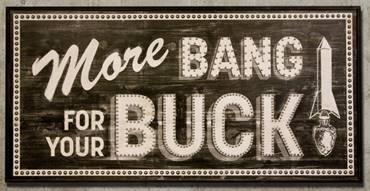
Editor’s Corner: Bang for the Buck

Dear Editrix,

Where did the phrase “bang for the buck” come from?

Mr. U.

Dear Mr. U,

I was a little worried about where this research might take me, but I was happily surprised to find a nice article on Wikipedia about this idiom. Here’s what they had to say:

Bang for the buck is an idiom meaning the worth of one’s money or exertion. The phrase originated from the slang usage of the words "bang" which means "excitement" and "buck" which means "money." Variations of the term include "bang for your buck," "bang for one’s buck," "more bang for the buck," "bigger bang for the buck," and mixings of these. "More bang for the buck" was preceded by "more bounce to the ounce," an advertising slogan used in 1950 to market the carbonated soft drink Pepsi.

The phrase "bigger bang for the buck" was notably used by U.S. President Dwight D. Eisenhower’s Secretary of Defense, Charles Erwin Wilson, in 1954. He used it to describe the New Look policy of depending on nuclear weapons, rather than a large regular army, to keep the Soviet Union in check. Today, the phrase is used to mean a greater worth for the money used.

Kara Church

Technical Editor, Advisory

Symitar Documentation Services

Posted by: Jack Henry | August 20, 2018

Editor’s Corner: Fluffy Words

I noticed this sign as I was walking into a store. Basically, this sign is telling people to watch for cars—but it is positioned at the entrance to the store! I was so distracted by it that I almost got hit by a car.

This sign is a good example of using fluffy words (vehicular drive isle), which clutter your writing and could cause confusion. Instead, be as clear and concise as possible; someone’s life may depend on it. And the only fluff I want is in my pancakes.

Jackie Solano | Technical Editor | Symitar®

8985 Balboa Ave. | San Diego, CA 92123 | Ph. 619.542.6711 | Extension: 766711

Symitar Documentation Services

Posted by: Jack Henry | August 16, 2018

Editor’s Corner: Happy Palindrome Week

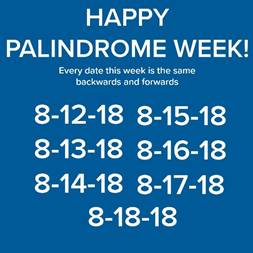
I may not be the first, but let me be the most enthusiastic in wishing you a happy Palindrome Week! Who doesn’t love a palindrome? Maybe only those who aren’t quite sure what it is. So, for those folks, here’s a definition: a palindrome is “a word, phrase, or sequence that reads the same backward and forward, e.g., madam or nurses run.” This is a very special week because every date is a palindrome.

I just got back from a trip to England, and I am pretty certain Palindrome Week is not being celebrated there (or in most of the world) because they write dates in the day/month/year format, making today 16/8/18. Oh well, we’ll celebrate twice as heartily for them.

So, palindromes can be made up of numbers (like this week’s dates and like my zip code, which is 92129), but we are probably more familiar with palindromes made up of letters. These palindromes can be a single word:

  • kayak
  • noon
  • racecar
  • rotator

Or they can be a few words:

  • my gym
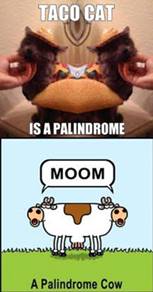
  • taco cat
  • top spot

Or they can be an entire sentence:

  • A Santa lived as a devil at NASA.
  • Eva, can I stab bats in a cave?
  • Mr. Owl ate my metal worm.
  • Was it a car or a cat I saw?
  • Yo, banana boy!

A palindrome can even be made up of a sequence of words instead of letters, as in this example:

  • King, are you glad you are king?

And if you’re interested, I found this history of the palindrome (from Your Dictionary):

The word palindrome is derived from the Greek “palin,” or “back” and “dromos” or "direction." The actual Greek phrase alluded to the backward movement of the crab. Palindromes date back to about 70AD, when they were first found as a graffito buried in ash at Herculaneum.

This first known palindrome was in Latin and read “sator arepo tenet opera rotas” which means either:

The sower Arepo holds the wheels with effort.

or

The sower Arepo leads with his hand the plough.

Not exactly a grammatically correct sentence, but still pretty fun.

Palindromes were also found in ancient Greek and in ancient Sanskrit, so obviously people have been having quite a lot of fun with these unique words for quite a long time.

I hope all of you enjoy the rest of Palindrome Week.

Donna Bradley Burcher | Senior Technical Editor | Symitar®

8985 Balboa Ave. | San Diego, CA 92123 | Ph. 619.278.0432 | Ext: 765432

One of my Editor’s Corner helpers left this article on my desk. It brings up some interesting points that I thought I’d share with my fellow language lovers. (Some edits were made for the sake of Human Resources.)

Is the English Language Prejudiced Against Women? by Richard Lederer

Women make up the majority of the population in almost every country in the world. Yet concern has been growing that the English language stigmatizes women as an inferior group of human beings, undermines their self-images and restricts their perceptions of life’s possibilities. As a way of examining this contention, I ask you to answer the following questions as precisely and honestly as you can and to compare your responses with the comments that come afterward.

1. Which of the following people are married and which are single: Mr. John Smith, Mrs. John Smith, Miss Mary Jones, Ms. Mary Jones?

Mr. John Smith may be married or single, but Mrs. John Smith is definitely married. In addition, she has acquired her husband’s last name, passively defined in relationship to his identity. You think this form is timeworn and proper. But it isn’t. Martha Washington would have been mystified to receive a letter addressed to Mrs. George Washington.

Miss Mary Jones is, of course, unattached, but Ms. Mary Jones, like Mr. John Smith, may be single or married. It is the unequal state of affairs that exists between Mr. John Smith and Miss Mary Jones that women are protesting when they ask to be identified as Ms. rather than Mrs. or Miss, or simply as Mary Jones. Ms. is a sincere attempt to return to a connubially neutral name for women that matches the one for men.

2. If a king rules a kingdom, what does a queen rule? If a man mans a station, what does a woman do? If a man fathers a movement, what does a woman do?

Queens, of course, rule kingdoms, not “queendoms,” and nobody “womans” a station or “mothers” a movement. Apparently, we English speakers feel that nouns like queendom and verbs like to woman and to mother are too weak. But language can change. The rise of to parent in our language has given us just the androgynous word we need to express the co-adventure of being a parent and to unite the two genders in mutual activity.

3. What do you picture when you hear or read the following expressions: The Ascent of Man, Renaissance man, Language separates mankind from the other creatures, A teacher affects eternity. No one knows where his influence stops. (Henry Adams)?

Do words like man, mankind and he include women and children? This question was tested by sociologists who asked 300 college students to select illustrations from pictures that were supplied for chapters in a textbook. One group of students was presented titles such as “Social Man, “Industrial Man” and “Political Man,” the other titles such as “Society,” “Industrial Life” and “Politics.” Results indicated that the word man evoked pictures of males participating in that activity far more than women or children. Another survey revealed that children from kindergarten through seventh grade interpreted the sentences “Man must work in order to eat” and “Around the world man is happy” to mean male adults, not females and children.

Read and hear this: “Whan that April with his showres soote/The droughte of March hath perced to the roote . . . .” These are the opening lines of Geoffrey Chaucer’s Canterbury Tales, written in Middle English between 1387 and 1400. The history of English, like that of all living languages and living things, is the history of unstinting change. I believe that our vocabulary can evolve so that men, women and children can be free to imagine and explore the full range of their human potential.

Kara Church

Technical Editor, Advisory

Symitar Documentation Services

Posted by: Jack Henry | August 14, 2018

Editor’s Corner: Smurfing

Dear Editrix,

Speaking of criminal activities like kiting, how about smurfing?

Sincerely,

Gargamel and Azrael

Dear G and A,

See what happens when you little devils get a bit of freedom? Well, here is an answer to your question about smurfing—in the banking world, the gaming world, and the drug world.

From Wikipedia:

Structuring, also known as smurfing in banking jargon, is the practice of executing financial transactions such as making bank deposits in a specific pattern, calculated to avoid triggering financial institutions to file reports required by law, such as the United States’ Bank Secrecy Act (BSA). … Structuring may be done in the context of money laundering, fraud, and other financial crimes. Legal restrictions on structuring are concerned with limiting the size of domestic transactions for individuals.

Structuring is the act of parceling what would otherwise be a large financial transaction into a series of smaller transactions to avoid scrutiny by regulators and law enforcement. Typically, each of the smaller transactions is executed in an amount below some statutory limit that normally does not require a financial institution to file a report with a government agency. Criminal enterprises may employ several agents ("smurfs") to make the transaction.

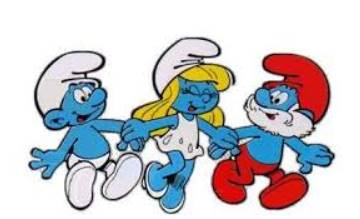
The term "smurfing" is derived from the image of the comic book characters, the Smurfs, having a large group of many small entities. Miami-based lawyer Gregory Baldwin is said to have coined the term in the 1980s.

As far as gaming, I didn’t find an official source, but I read a few “boards” about the term smurfing. In gaming, smurfing means to create different accounts to disguise who you are, so that people don’t know what your skill level is. This is one way an experienced player can be matched up with the inexperienced, and gain easy wins.

And who knew? Meth makers also make use of smurfs to do their smurfing. What is smurfing for a meth maker, you ask? Smurfing is when you get people (friends, family, or whoever) to go into the store to buy the allergy medicine that is used to make meth. The individuals can only purchase one or two packages of Sudafed at a time. The meth maker later gathers all of the packages to create his or her payload. This is similar to smurfing in the banking arena in that the smaller purchases or smaller deposits are to stay under the radar of those watching for bigger chunks of money (or meth) to be moved around.

Kara Church

Technical Editor, Advisory

Symitar Documentation Services

Posted by: Jack Henry | August 13, 2018

Editor’s Corner: “To Include” or “Including”?

Lately, I’ve noticed people using the infinitive “to include” when the gerund “including” would make more sense.

Example (Correct): I have visited every national park, including Death Valley.

Example (Incorrect): I have visited every national park, to include Death Valley.

People communicate with different levels of formality. You probably use more formal language when emailing the CEO of your company than you do when talking to a friend.

Many common writing mistakes are a result of using language that is too casual—writing like you speak. I believe that “to include” is an example of the opposite phenomenon: very formal language (like you might see in a legal document) creeping into less formal everyday writing.

Futurity, Arrangement in Advance, or Obligation

According to Merriam-Webster, the word be is “used with the infinitive with to to express futurity, arrangement in advance, or obligation.”

Example: I am to interview him today.

Example: You are to repay the loan in monthly installments.

Although I can understand these sentences, they sound awkward. I would instead write, “I am scheduled to interview him today,” and, “You must repay the loan in monthly installments.”

Most people don’t use the “be + to + infinitive” construction often. It doesn’t seem too far-fetched to imagine a sentence becoming mangled when the tense changes.

Before: You are to submit an application, [which is] to include your birth certificate.

After: We received your application, to include your birth certificate.

The first sentence is awkward; the second sentence is incorrect. The application was already received, so it doesn’t make sense to refer to the future inclusion of the birth certificate.

In technical writing, the goal is to write clearly, not to sound fussy and unnatural. Even if you’re sure that your sentence is grammatically correct, ask yourself whether you can say it more simply.

Ben Ritter | Technical Editor | Symitar®
8985 Balboa Avenue | San Diego, CA 92123
619-682-3391 | or ext. 763391 | www.Symitar.com

Symitar Documentation Services

NOTICE: This electronic mail message and any files transmitted with it are intended
exclusively for the individual or entity to which it is addressed. The message,
together with any attachment, may contain confidential and/or privileged information.
Any unauthorized review, use, printing, saving, copying, disclosure or distribution
is strictly prohibited. If you have received this message in error, please
immediately advise the sender by reply email and delete all copies.

« Newer Posts - Older Posts »

Categories