Posted by: Jack Henry | July 24, 2012

Editor’s Corner: Parallel Construction

This may not be an exciting topic, but it is one of the top ten things we look for in documents that we edit. Parallel construction provides structure and clarity to your writing and it makes editors everywhere love you.

The following article is from Grammarbook.com:

Parallel Construction

Sentences and lists are awkward when they contain a series of items with inconsistent grammatical structure. But as your reader scans through a series of items with parallel grammatical structure, the relationships between different items of information become clear. Here’s an example:

Which of the two sentences below is easier to follow?

At the February meeting we will hold a discussion of the new health plan, whether to revise the procedures manual, and then a draft will be developed of the early retirement policy.

At the February meeting, we will discuss the new health plan, decide whether to revise the procedures manual, and draft an early retirement policy.

In the second example, the parallel verb tenses saved space and helped us grasp the ideas immediately. To help your writing flow smoothly and make sense, use the same format for items you present in a series.

The same approach applies to lists, which are much easier to read when the grammar is parallel.

Incorrect Example
The agenda for the March meeting includes the following goals:

· Discussion of the new health plan

· Whether to revise the procedures manual

· The early-retirement policy will change

Correct Example
The agenda for the March meeting includes the following goals:

· Discussing the new health plan

· Deciding whether to revise the procedures manual

· Revising the early-retirement policy

Parallel construction can help you organize your thoughts, make your writing flow smoothly, and make your meaning clear immediately. (Now that sentence is a good example of parallel construction!)

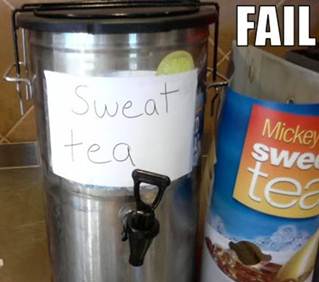
And from the English Fail blog, a special gift for the hot weather: some not-so-tasty liquid refreshment!

Today I’ve grabbed another topic from the e-mail bag: a versus an.

Dear Editrix,

When I run spellcheck and the grammar checker, they always suggests “a” instead of “an” in the following sentence: “I just sent you an e-mail.” Why would it not be “an,” since e-mail starts with a vowel?

Are there other such examples where the “proper” use of “a” (vs. “an”) seems to run opposite common thinking?

Sincerely,

A or an English Fan

Dear Fan,

Regarding the first question, you are correct—the appropriate article for “e-mail” is “an e-mail.” I can’t answer for certain why the grammar checker might be correcting that phrase, but here is a little secret: the Microsoft spelling and grammar checkers are not always correct. For example, spellcheck hates the word “lets” and insists it is a contraction every time, all the time.

There are several ways to add to your dictionary, define which words and terms to autocorrect, and tinker with your grammar and spelling settings. In our version of Outlook, you can make these changes in File → Options → Mail → Editor Options. Be careful in here, though. You don’t want to turn off all of the electronic help these options provide.

As for your second question, there are exceptions to the rule which says: Use a before words that start with consonants; use an before words that start with vowels. This is a more accurate version of the rule, that should help with the quirky situations:

“…use a before words that start with a consonant sound and an before words that start with a vowel sound.”*

For example, it is an hour, not a hour, because hour sounds like it begins with a vowel. The same goes for “a university,” “a user,” etc.

For more information on this topic, see Grammar Girl (link below). If you’d like to read a little more about this part of speech (articles) in general, go to the Purdue OWL (http://owl.english.purdue.edu/owl/resource/540/01/).

*Quote from Grammar Girl (http://grammar.quickanddirtytips.com/a-versus-an.aspx).

Hope this helps!

Editrix

Posted by: Jack Henry | July 20, 2012

Editor’s Corner: Start the weekend with a bang!

If you are a Facebook fan, Twitter fanatic, e-mail aficionado, or tend to get excited when you are communicating with others, you may be familiar with the use of more than one exclamation point (!). Somebody asked me, “When is it okay to use more than one exclamation point at the end of a sentence?”

The nice answer:

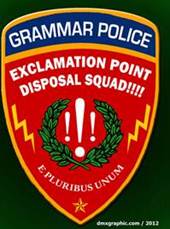
The Chicago Manual of Style tells us: “An exclamation point (which should be used sparingly to be effective) marks an outcry or an emphatic or ironic comment.” [KC – Note the article here: An exclamation point. One. Singular. Alone. Uno. Un. Έʋα.
Ein.]

My answer:

Never!

I won’t be as cruel as some who say “a person’s sanity is inversely proportional to the number of exclamation marks they use!” (http://wiki.lspace.org/wiki/Multiple_exclamation_marks), but I will say again that you only need one at the end of a sentence. The only time you should see an exclamation point in technical material is when you are writing about a warning or error that displays in the software.

http://dmxart.wordpress.com/2012/01/24/grammar-police-exclamation-point-disposal-squad/

Posted by: Jack Henry | July 19, 2012

Editor’s Corner: However

Dear Editrix,

Here’s a question that always has me wondering. Hopefully the answer is not too complicated or I won’t remember it.

Is there a rule about when you use a semicolon before the word however vs. just ending the sentence and starting a new sentence with However, and any other proper way of using however? Enquiring minds want to know.

Sincerely,

Enquiring Minds

Dear Enquiring Mind,

There’s never a simple or easy answer with English. 🙂

Here’s the “why” and the “when” of the semicolon used with however, borrowed in part from the Purdue OWL (http://owl.english.purdue.edu/owl/resource/598/01/):

However is an independent marker word. An independent marker word is used at the beginning of an independent clause.

These words can always begin a sentence that can stand alone. When the second independent clause in a sentence has an independent marker word, a semicolon is needed before the independent marker word.

Jim studied in the Sweet Shop for his chemistry quiz; however, it was hard to concentrate because of the noise.

Some common independent markers are: also, consequently, furthermore, however, moreover, nevertheless, and therefore.

The “where” to place however in a sentence is less formulaic. Placement depends on the sentence flow and where you want the emphasis to be. Some say that putting however at the end of a sentence is inelegant; putting it at the beginning is considered informal.

As an editor, my issue with it is that many people use it too often. It is sometimes used as a buckle to combine two independent clauses, which is not a problem in itself. The problem is that these clauses are often gigantic and unclear, and adding a fancy word in between only makes them longer, not better.

I’ve included some sentences to give you an idea of the flow and flavor as they’re changed by the placement of the word. (The middle sentence does not require a semicolon because it is not two independent clauses):

  • However, the runt of the litter became an alpha male.
  • The runt of the litter, however, became an alpha male.
  • The runt of the litter became an alpha male, however.

So, that’s the short answer! For (a lot) more on however see the article below.

· http://grammar.quickanddirtytips.com/starting-a-sentence-with-however.aspx

Warm regards,

Editrix

Posted by: Jack Henry | July 18, 2012

Editor’s Corner: Passed and Past

Yesterday, I received a pleading e-mail to go over the difference between the words passed and past—a pet peeve of one of our managers, so take note! Here is a brief explanation and a few examples to get you past the grammarlicious terms. For more information on these frequently confused words, there is a more lengthy post on the topic at DailyWritingTips.com (http://www.dailywritingtips.com/passed-vs-past/).

Passed

Passed is the past participle of the verb “to pass.”

· Pass (transitive verb)
I passed the hospital on my way to the rally.

· Pass (intransitive verb)
She passed through life without a worry.

· Pass (intransitive verb, sometime used as euphemism for “die”)

He passed last night at bedtime, after we sang his favorite hymn.

Past

Past can be used as several different parts of speech:

· adjective
Don’t be angry at your sister for past offenses.

· adverb
I thought the dog would stop, but he just ran past.

· preposition
Dorothy has a horrible fake ID—she can never get past the bouncer!

Posted by: Jack Henry | July 17, 2012

Editor’s Corner: Acronyms, Initialisms, & the Apostrophe

So much to do, so little time! Here is another excerpt from Grammar Girl’s newest book: Grammar Girl’s 101 Troublesome Words You’ll Master in No Time.

Making Abbreviations Plural: RBIs

Acronyms are abbreviations that are pronounced as words (NASA), and initialisms are abbreviations for which you say each letter (FBI).

Even though it doesn’t make perfect sense, you make initialisms and acronyms plural by adding an s to the end no matter what part would be plural if you wrote out the whole thing. Therefore, even though you would write runs batted in, the plural is RBIs.

In the past, some publications used apostrophes to make acronyms and initialisms plural, so until a few years ago, it was common to see something like RBI’s or CD’s in The New York Times. But these days, the major style guides recommend omitting the apostrophe.

[KC – We do the same here in our documentation at Symitar—at least the items that come through our editing queue. You may notice that PCs, VPNs, IDs, and other
acronyms do not contain apostrophes after we’ve had our way with them. Occasionally, we may make an exception if the apostrophe adds clarity.]

Posted by: Jack Henry | July 13, 2012

Editor’s Corner: Gray vs. Grey

A few weeks ago when I wrote about the different spellings of blond (blondand blonde ), someone asked about the word grey—or is it gray?

This is another one of those words where the primary difference in the spelling is where you live. The preferred American spelling is gray with an “a.” The rest of the English-speaking world tends to use grey with an “e.” In our Symitar documentation, we go with the rest of America and use gray, unless of course we’re writing about greyhounds (and you know that happens all the time in technical writing).

Here’s a little bit of history from Wikipedia and the Merriam-Webster Dictionary:

The first recorded use of grey as a color name in the English language was in AD 700. Grey is the British, Canadian, Australian, Irish, New Zealand and South African spelling, although gray remained in common usage in the UK until the second half of the 20th century. Gray is the preferred American spelling, although grey is an accepted variant. Gray became the preferred spelling in American English around 1825.

Have a super weekend!

Kara

Greyhound puppies from CutePuppyWorld.com

Posted by: Jack Henry | July 12, 2012

Editor’s Corner: Answers and a Sweet Treat

Here are the selections from earlier and the number of people who selected each answer. The total number follows, along with the original questions and a photo for your amusement.

1) EBE – 0

2) CBB – 38

3) EAD – 1

4) CBA – 14

5) CAB – 18

Total number of responses: 71

Questions:

1. In the sentence "The pig ate her corndog," the underlined pronoun has which of the following combinations of person, number, and case:

C. third person, singular, possessive

2. In the sentence "Each of the elephants have a pedigree," the verb agreement is which of the following:

B. Incorrect

3. What punctuation does the following example require? "He has carefully fixed all of the dents moreover, he has replaced and polished all of the chrome."

B. A semicolon after "dents"

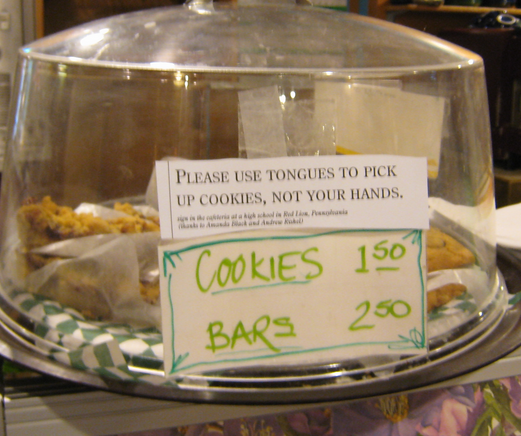
From www.englishfailblog.com, a major failure from the bakery:

Posted by: Jack Henry | July 12, 2012

Editor’s Corner: Thursday’s Quiz

It’s quiz day! If you’re getting this via Outlook, use the voting buttons above to select the correct answer. If you’re reading this on the website, you’ll just have to write down your answer and check in later. I will send the correct answers this afternoon around 1:00 p.m. Have fun!

1.  In the sentence “The pig ate her corndog,” the underlined pronoun has which of the following combinations of person, number, and case:

  • A. third person, plural, possessive
  • B. third person, plural, accusative
  • C. third person, singular, possessive
  • D. third person, plural, subjective
  • E. none of the above

2. In the sentence “Each of the elephants have a pedigree,” the verb agreement is which of the following:

  • A. Correct
  • B. Incorrect

3. What punctuation does the following example require? “He has carefully fixed all of the dents moreover, he has replaced and polished all of the chrome.”

  • A. A comma after “dents”
  • B. A semicolon after “dents”
  • C. A period after “dents”
  • D. A colon after “dents”
  • E. None

Posted by: Jack Henry | July 11, 2012

Editor’s Corner: Can I Have a Kudo?

This made me laugh, and it’s short but sweet. Today’s item is from the new book Grammar Girl’s 101 Troublesome Words You’ll Master in No Time.

No Such Thing as a Kudo

What’s the Trouble? Some people mistakenly believe that kudos is plural.

Kudos means “praise” or “glory” and is often used where congratulations would fit. It comes directly from Greek and is singular, just as praise and glory are singular. However, because kudos ends in s and congratulations is plural, some people mistakenly believe that kudos is plural and use kudo as a singular form. Such use is incorrect.

What Should You Do? Use kudos, and remember that it’s singular.

« Newer Posts - Older Posts »

Categories