Posted by: Jack Henry | August 7, 2012

Editor’s Corner: Take me to dinner and bring me a martini

Several people have asked me to review bring vs. take. I thought Grammar Girl’s explanation got a little lengthy and confusing, as did some of my other usual sources. The simplest and most straightforward information I found was actually on a forum for the Purdue OWL (http://owl.english.purdue.edu/). The writer asked the experts to explain the correct use of take and bring. For example: “I will take this with me; I will bring this with me.” Put simply:

The two words have become more and more interchangeable in contemporary speech, but they imply distinct acts. "Take" implies leaving with something; "bring" implies arriving with something. You could take a cake from home and bring it to a party.

For more information on the two, and the confusion caused by some exceptions and idiomatic phrases (such as “take a bath”), Grammar Girl gets into the nitty-gritty details on her site at: http://grammar.quickanddirtytips.com/bring-versus-take.aspx

Posted by: Jack Henry | August 6, 2012

Editor’s Corner: Who wants the answers?

ABBA – 10

ABBB -39

ABAB – 29

BBAB – 0

1. (A) You’ll be shocked when I tell you who called me last night.

Explanation: "he = who" "him = whom" You would say, "He called me last night."

2. (B) Whom should I ask to the dance?

Explanation: "he = who" "him = whom" You would say, "I should ask him to dance."

3. (B) The doctor whom you recommended is not available for three months.

Explanation: "he = who" "him = whom" You would say, "The doctor is not available for three months. You recommended

him."[KC] This is tricky if you ask yourself the wrong question.

4. (B) Cedric hasn’t decided who should be appointed yet.

Explanation: "he = who" "him = whom" You would say, "Cedric hasn’t decided. He should be appointed yet."

Posted by: Jack Henry | August 4, 2012

Editor’s Corner: Who/Whom Quiz

As promised, it’s the “who/whom” quiz! Let’s see if you’re up for it after the weekend. From each pair below, select the correct answer. Use the voting buttons above (in Outlook) to select the option that matches your answers. I’ll send a tally of how many people picked each set of answers—and explanations of the answers—some time Monday afternoon.

Hint: Don’t forget the “he/him” rule from August 2 (https://episystechpubs.wordpress.com/2012/08/02/editors-corner-who-whom-the-who/).

1. Choose the correct sentence.

A) You’ll be shocked when I tell you who called me last night.

B) You’ll be shocked when I tell you whom called me last night.

2. Choose the correct sentence.

A) Who should I ask to the dance?

B) Whom should I ask to the dance?

3. Choose the correct sentence.

A) The doctor who you recommended is not available for three months.

B) The doctor whom you recommended is not available for three months.

4. Choose the correct sentence.

A) Cedric hasn’t decided whom should be appointed yet.

B) Cedric hasn’t decided who should be appointed yet.

These questions are brought to you by the GrammarBook.com website.

Posted by: Jack Henry | August 3, 2012

Editor’s Corner: Let them eat cake!

Happy Friday! No time to spare today, so I’ll send you off into the weekend with something easy: a cake. Next week we’ll have a “who/whom” quiz so you can practice everything you learned yesterday.

Enjoy the sunshine!

Kara

When phoning in a cake order goes very, very wrong:

Photo from DailyWritingTips.com.

For the complete article see: http://www.dailywritingtips.com/cake-mistakes-and-kooky-cookies/

Posted by: Jack Henry | August 2, 2012

Editor’s Corner: Who, Whom, & The Who

Okay, so I don’t have any lyrics from the band today, but for those of you who clamored for information on who and whom, I have part of an article from the Grammar Girl website (www.quickanddirtytips.com), followed by an excerpt from Grammar Girl’s (Mignon Fogarty’s) new book: 101 Misused Words You’ll Never Confuse Again. I’ve also added a few examples from another resource.

From the website (emphasis mine):

So here we go. The words "who" and "whom" are both pronouns. I’ll have a quick and dirty trick for you later, but first I want you to actually understand the right way to use these words.

First, to know whether to use "who" or "whom," we need to talk about the difference between subjects and objects because you use "who" when you are referring to the subject of a clause and "whom" when you are referring to the object of a clause.

I know: subject and object sound pretty abstract, but it’s easy. If we think about people, the subject of the sentence is the person doing something, and the object of the sentence is having something done to them. If I step on Squiggly, then I am the subject and Squiggly is the object…

And continued from the book, Grammar Girl’s 101 Misused Words You’ll Never Confuse Again, by Mignon Fogarty:

If you choke when confronted with the terrifying choice between who and whom, I have a cure: the him-lick maneuver. Ask if you can hypothetically answer the question with the word him. If you can, the right choice is whom. Notice that him and whom both end with the letter m.

For Whom the Bell Tolls (It tolls for him.)

If you can’t answer with him (for example, if he is the word that fits), whom is the wrong answer—you must use who.

Who is your daddy? (He is your daddy.)

The trick works because whom refers to objects and him is any object pronoun, so him makes a good test case.

Here are some extra examples, from grammarbook.com. Try the “he/who, him/whom rule” on the first sentence of each set:

· Who/Whom wrote the letter?
He wrote the letter. Therefore, who is correct.

· For who/whom should I vote?
Should I vote for him? Therefore, whom is correct.

· We all know who/whom pulled that prank.
This sentence contains two clauses: We all know and who/whom pulled that prank. We are interested in the second clause because it contains the who/whom. He pulled that prank. Therefore, who is correct. (Are you starting to sound like a hooting owl yet?)

· We want to know on who/whom the prank was pulled.
This sentence contains two clauses: We want to know and the prank was pulled on who/whom. Again, we are interested in the second clause because it contains the who/whom. The prank was pulled on him. Therefore, whom is correct.

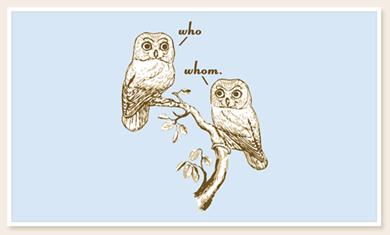
And if you are still befuddled, here is something to make you smile:

Graphic from: http://www.onehorseshy.com/kids/who-vs-whom-owl/

Posted by: Jack Henry | August 1, 2012

Editor’s Corner: Common Grammar Mistakes, Part 2

For those of you who have been eagerly awaiting the next six most common grammar mistakes in social media—your wait is over! Here is part two of yesterday’s article by Deb Donston-Miller. (If you missed part one, or want to read the entire article click here: http://tinyurl.com/bqvwstk.) The text and opinions below are Ms. Donston-Miller’s; the italics below are mine.

Punctuation in General: As author Lynne Truss taught us, "eats, shoots, and leaves" is very different than "eats shoots and leaves." In addition, "Apples iPhone" is wrong; "Apple’s iPhone" is right. "Facebook, which recently went public released its first earnings report" is wrong; "Facebook, which recently went public, released its first earnings report" is right. You get the idea.

Lose and Loose: This one really drives me nuts. You "lose" your keys. The dog gets "loose."

Then and Than: If you drink too much coffee, "then" you will likely be jittery. I like the original Parent Trap better "than" the remake with Lindsey Lohan.

Using Apostrophes to Make Words Plural: This is a mistake I have seen on signs all across the country. For some reason, people seem to think that you should use an apostrophe to make a word plural. You don’t! You may say "tomato’s" and I may say "tomatoes," but unless the tomato owns something, I would be right.

I and Me: "I" is the subject pronoun and "me" is the object pronoun. If that means nothing to you (and I wouldn’t blame you if it didn’t), just use this simple trick to determine which pronoun is correct: Try the sentence with just the pronoun. So, if you have the sentence "Sally and [I/me] went to the store," which sounds right? "I went to the store" or "Me went to the store"? (Hopefully, the former sounds right to you.)

Good and Well: Watching Toddlers and Tiaras the other night (yes, I admit it), I was dismayed that every parent said to his or her child after a performance, "You did really good!" Good is an adjective; well is an adverb. The creepily made-up youngsters all did well, not good.

[KC – Suddenly I find myself cringing for repeating grammar lessons from someone watching
Toddlers and Tiaras; that I even know what that is makes me cry.]

Posted by: Jack Henry | July 31, 2012

Editor’s Corner: Common Grammar Mistakes, Part 1

Hello and welcome!

Today I have the first part of an article on the eleven most common grammar mistakes in social media, by Deb Donston-Miller. The reason I am including these isn’t to chastise you for poor spelling habits or shortcuts while texting. I am including these because they are also the most common mistakes I run into while editing documents at work. (To read the entire article click here: http://tinyurl.com/bqvwstk.) To make her explanations clearer, I have added italics below.

I’ve been an editor for a long time, so it’s been my job to correct mistakes in grammar, spelling, punctuation, usage, and syntax, among other things. It’s not my place to correct friends and colleagues on social media, but I would like to offer up a list of the mistakes that I see most. I truly believe that respecting the language earns you respect in return.

1. It’s and Its: I see people mix up its and it’s a lot. People often use it’s to convey possession. That would seem to make sense because an apostrophe usually indicates possession, but it’s is a contraction for it is. Its is a possessive pronoun. So, "It’s time to eat the doughnuts" is correct. "Its fleece was white as snow" is also correct.

2. Your and You’re: This one seems to cause people a lot of problems, too (more on "too" later). Your is a possessive pronoun. You’re is a contraction for you are. "My mother is smarter than your mother" is correct. "You’re the best mother in the world" is also correct.

3. To, Two, and Too: To is a preposition. ("It’s a long way to Tipperary.") Two is a number. ("Two roads diverged in the woods.") Too is a synonym for also. ("I, too, am excited about the start of the Olympics.")

4. There, Their, and They’re: Homonyms certainly seem to give people a lot of trouble, don’t they? There means in or at a place. ("There are miles to go before we sleep.") Their is a plural possessive pronoun. ("They ate their fair share.") They’re is a contraction for they are. ("They’re shipping up to Boston.")

5. Sentence Starters and Endings: Every sentence must start with a capital letter and end with a period, a question mark, or an exclamation point. Period.

Kara Church

Senior Technical Editor

S Y M I T A R

8985 Balboa Ave.

San Diego, CA 92123

Phone: 619-542-6773 | Extension: 766773

NOTICE: This electronic mail message and any files transmitted with it are intended
exclusively for the individual or entity to which it is addressed. The message,
together with any attachment, may contain confidential and/or privileged information.
Any unauthorized review, use, printing, saving, copying, disclosure or distribution
is strictly prohibited. If you have received this message in error, please
immediately advise the sender by reply email and delete all copies.

Posted by: Jack Henry | July 27, 2012

Editor’s Corner: Achtung Baby!

Happy Friday, everyone! I just want to take a minute to thank Christine Estrada, John Thomas, and Jane Gredvig for recommending the Editor’s Corner to co-workers this week. Thanks to you, we have just passed 500 subscribers!

Now, today’s selection is from Daily Writing Tips. The original list contained 25 terms we’ve borrowed from the German language—I’ve narrowed it to 15. (See http://www.dailywritingtips.com/25-german-loanwords/ for the full article.)

The German language has provided English with a huge inventory of words, many of them pertaining to music, science, and politics, thanks to the influence of German-speaking people on those areas of human endeavor. Here are some of the more useful German terms borrowed into English.

· Blitz (“lightning”): used only literally in German, but in English refers to a sudden movement, such as a rush in a contact sport

· Carabiner (“rifle”): an equivalent of the English word carbine, this truncation of karabinerhaken (“riflehook”) refers to a metal loop originally employed with ropes in mountaineering, rock climbing, and other sports and activities but now widely employed for more general uses

· Delicatessen (“delicate eating”): a restaurant or food shop selling meats, cheeses, and delicacies

· Doppelgänger (“double-goer”): in German, refers to a look-alike, but in English, the primary connotation is of a supernatural phenomenon — either a spirit or a duplicate person

· Gestalt (“figure”): something more than the sum of its parts, or viewed or analyzed with other contributing phenomena

· Hinterland (“land behind”): originally a technical geographic term; later, in both German and English, came to connote undeveloped rural or wilderness areas, and in British English has a limited sense of “artistic or scholarly knowledge,” as in “Smith’s hinterland isn’t very impressive”

· Kitsch: something of low taste and/or quality, or such a condition

· Leitmotiv (“leading motive”): a recurring theme, originally applied to music and later literature and theater but now in general usage

· Poltergeist (“noisy ghost”): a mischievous and/or malicious apparition or spectral force thought responsible for otherwise inexplicable movement of objects

· Schadenfreude (“harm joy”): enjoyment of others’ misfortune

· Sturm und drang (“storm and stress”): turmoil, drama

· Verboten (“forbidden”): prohibited

· Weltschmerz (“world pain”): despair or world-weariness

· Wunderkind (“wonder child”): a child prodigy

· Zeitgeist (“time ghost”): the spirit of the time, or a prevailing attitude, mentality, or worldview

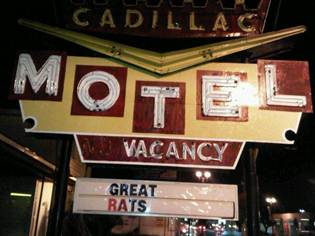
And for something completely unrelated—the makings of a frightening vacation from the English Fail Blog (http://www.englishfailblog.com/):

Posted by: Jack Henry | July 26, 2012

Editor’s Corner: Answers for Capital Quiz

Capitalization rules can be tricky. After the correct answer, you will find a brief explanation of the rule used for that sentence.

The stats and correct answers for today’s quiz:

ABAB – 3

BBBB – 7

CBAB – 31

BBAB – 6

BAAA – 47

Total respondents: 94 (Terrific!)

#1

Correct Answer: B

I plan to take economics as well as Statistics 101 next semester.

Explanation: Capitalize specific names of courses and those derived from proper nouns.

#2

Correct Answer: A

It’s a federal offense to open another person’s mail without permission.

Explanation: Capitalize federal or state when used as part of an official agency name or in government documents where these terms represent an official name. If they are being used as general terms, you may use lowercase letters.

#3

Correct Answer: A

Would you mind repeating that again, Professor?

Explanation: Capitalize any title when used as a direct address.

#4
Correct Answer: A

Gloria Dubois, the mayor of Portland, will be attending the meeting tomorrow.

Explanation: Capitalize a person’s title when it precedes the name. Do not capitalize when the title is acting as a description following the name.

Kara Church

Posted by: Jack Henry | July 26, 2012

Editor’s Corner: Quiz on Capitals

Today’s quiz is on capital letters. We’ve done one of these before, but I’ve noticed that people still get very excited about their subject matter, and tend to use capitals where they don’t belong.

Choose the correct answers, then use the voting buttons (in Outlook) to send in your selections. Answers and explanations will be provided sometime this afternoon. Good luck!

Choose the correct sentence from each group:

#1

A) I plan to take economics as well as statistics 101 next semester.

B) I plan to take economics as well as Statistics 101 next semester.

C) I plan to take Economics as well as Statistics 101 next semester.

#2

A) It’s a federal offense to open another person’s mail without permission.

B) It’s a Federal offense to open another person’s mail without permission.

#3

A) Would you mind repeating that again, Professor?

B) Would you mind repeating that again, professor?

#4

A) Gloria Dubois, the mayor of Portland, will be attending the meeting tomorrow.

B) Gloria Dubois, the Mayor of Portland, will be attending the meeting tomorrow.

Material created by Jane Straus and Co. Copyright by Jane Straus.

Kara Church

Senior Technical Editor

S Y M I T A R

NOTICE: This electronic mail message and any files transmitted with it are intended
exclusively for the individual or entity to which it is addressed. The message,
together with any attachment, may contain confidential and/or privileged information.
Any unauthorized review, use, printing, saving, copying, disclosure or distribution
is strictly prohibited. If you have received this message in error, please
immediately advise the sender by reply email and delete all copies.

« Newer Posts - Older Posts »

Categories