Posted by: Jack Henry | September 26, 2013

Editor’s Corner: But is the past tense of Dexter “dext”?

Today’s healthy morsel is from DailyWritingTips:

The predominant way to represent the past tense of a verb is to add -ed, but some verbs take -t as a variant ending, or even as the only form. Here are forty such verbs, including some ubiquitous words (like left and shot) we may not even think of as having irregular forms because they are the only forms we know—for example, leaved and shooted are not options—as well as some that survive only in poetry or mock-archaic usage.

1. Bent: the only correct form of the past tense of bend, although the archaic form bended is used jocularly, for example in the phrase “on bended knee”

2. Blest: a variant form of the past tense of bless

3. Built: the primary form of the past tense of build, though builded is used in some dialects [KC – I bet they architected those buildings before the builded them.]

4. Burnt: a variant form of the past tense of burn; used in favor of the primary spelling in names of pigments such as burnt orange and burnt sienna (familiar to Crayola crayon aficionados)

5. Clapt: a variant form of the past tense of clap

6. Cleft: a variant form of the past tense of cleave; also, a noun or adjective referring to a split

7. Clept: the past tense of the archaic term clepe (“name,” “call”; the present-tense and past-tense words are also spelled yclepe and yclept)

8. Crept: the only correct form of the past tense of creep, except in the slang sense of being creeped out, or unsettled

9. Dealt: the only correct form of the past tense of deal

10. Dreamt: a variant form of the past tense of dream

11. Drest: an obsolete variant form of the past tense of dress

12. Dwelt: a variant form of the past tense of dwell

13. Felt: the only correct form of the past tense of feel; also, a noun referring to a type of material or a similar substance

14. Gilt: a variant form of the past tense of gild; also, a synonym for gold or a noun or adjective referring to gold plating or other surfacing, or a young female pig

15. Girt: a variant form of the past tense of gird

16. Kent: a variant form of the past tense of ken, an archaic synonym for know or recognize

17. Knelt: the primary form of the past tense of kneel

18. Leant: an alternate form of the past tense of lean, used mostly in British English but occasionally appearing in American English usage as well (pronounced “lent”)

19. Leapt: a variant form of the past tense of leap

20. Learnt: an alternate form of the past tense of learn, used mostly in British English but occasionally appearing in American English usage as well

21. Left: the only correct form of the past tense of leave, meaning “go,” although the past tense for leave in the sense of forming leaves is leaved

22. Lent: the only correct form of the past tense of loan

23. Lost: the only correct form of the past tense of lose

24. Meant: the only correct form of the past tense of mean (pronounced “ment”)

25. Pent: an alternate form of the past tense of pen, meaning “confine,” although the past tense for pen in the sense of writing is penned

26. Reft: an alternate form of the past tense of reave

27. Rent: an alternate form of the past tense of rend

28. Sent: the only correct form of the past tense of send

29. Shot: the only correct form of the past tense of shoot

30. Slept: the only correct form of the past tense of sleep

31. Smelt: a variant form of the past tense of smell; also, a noun referring to a type of fish or a verb for melting or reducing metal or another substance

32. Spelt: an alternate form of the past tense of spell, used mostly in British English but occasionally appearing in American English usage as well; also, a noun referring to a type of wheat [KC – Great! Two ways to spell the past tense of
spell! English rocks!]

33. Spent: the only correct form of the past tense of spend

34. Spilt: a variant form of the past tense of spill

35. Spoilt: a variant form of the past tense of spoil

36. Stript: a variant form of the past tense of strip

37. Vext: a variant form of the past tense of vex

38. Wept: the only correct form of the past tense of weep

39. Went: the only correct form of the past tense of go

40. [KC – I removed one because there was a typo and I couldn’t figure out what the author intended.]

Kara Church

Senior Technical Editor

619-542-6773 | Ext: 766773

www.symitar.com

NOTICE: This electronic mail message and any files transmitted with it are intended
exclusively for the individual or entity to which it is addressed. The message,
together with any attachment, may contain confidential and/or privileged information.
Any unauthorized review, use, printing, saving, copying, disclosure or distribution
is strictly prohibited. If you have received this message in error, please
immediately advise the sender by reply email and delete all copies.

Welcome to Wednesday! I have several more redundant words and phrases for us to watch out for from the list of 200 Common Redundancies we started…was that last week? It seems like years ago. In any case, I bring you those beginning with G, H, I and J.

G

  • gather (together)
  • (general) public [KC – Unless you are part of the punk/mod/ska band from the early 1980s, in which case you’d be General Public with initial caps.]
  • GOP (party)
  • GRE (exam)
  • green [or blue or whatever] (in color)
  • grow (in size)

H

  • had done (previously)
  • (harmful) injuries [KC – If you are one of the few people in the world with congenital analgesia, I will accept your argument that this is not redundant; otherwise, each e-mailed argument will
    cost a dollar.]
  • (head) honcho
  • HIV (virus)
  • hoist (up)
  • hurry (up)

I

  • (illustrated) drawing
  • incredible (to believe)
  • indicted (on a charge)
  • input (into)
  • integrate (together)
  • integrate (with each other)
  • interdependent (on each other) [KC
    – C’mon folks. This just sounds horrible!]
  • introduced (a new)
  • introduced (for the first time)
  • (ir)regardless [KC – I get several requests a year asking me to discuss this word (or rather, pleading with me to tell people not to use it). This is probably the fifth or sixth
    time I have included an article with the instructions DO NOT USE THE NON-WORD IRREGARDLESS. Unfortunately, I can guarantee you will hear it again and it will make you cry.]
  • ISBN (number)

J

  • join (together)
  • (joint) collaboration

Kara Church

Senior Technical Editor

619-542-6773 | Ext: 766773

www.symitar.com

NOTICE: This electronic mail message and any files transmitted with it are intended
exclusively for the individual or entity to which it is addressed. The message,
together with any attachment, may contain confidential and/or privileged information.
Any unauthorized review, use, printing, saving, copying, disclosure or distribution
is strictly prohibited. If you have received this message in error, please
immediately advise the sender by reply email and delete all copies.

Posted by: Jack Henry | September 24, 2013

Editor’s Corner: Planet Earth

Hello all! A big “thank you” to Donna for covering the Editor’s Corner while I was out and about—it is much cleaner than I left it!

I’m going to skip the redundancies today and continue with another of the planetary symbols from that chart I included here several weeks ago. Today’s symbol is for a place close to home: Earth.

There are several theories on why Earth is represented by a circle divided into four quarters. The most popular theory is that it represents the globe and the four directions (more on that later). The other theory is that is represents the globus cruciger or in English, the cross-bearing orb. From Latin: globus = “orb” and cruciger = “cross” (crux) + “to wear” (gerere). The globus cruciger is a Christian symbol representing Christ’s dominion over the world. Here is an example of a Danish globus cruciger:

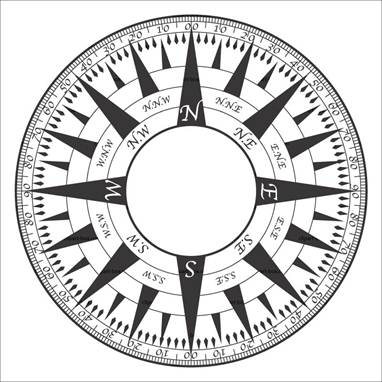
Returning to the theory of directions, the lines on the Earth symbol above represent the four cardinal directions: north, south, east, and west. (When using shorthand, the directions are represented by capital letters: N, S, E, and W, respectively. There are also ordinal points on a compass (which are also referred to as intercardinal or intermediate directions): northeast, southeast, southwest, and northwest. These are also represented by all capital abbreviations (NE, SE, SW, and NW). Lastly, there is the secondary intercardinal direction, which includes north northeast, east northeast, etc. These are all represented on the compass rose (shown below) moving from the cardinal directions on the innermost ring toward the secondary intercardinal directions on the third ring (NNW, NNE, ENE, etc.).

Hope you are having a great week so far!

Kara Church

Senior Technical Editor

Posted by: Jack Henry | September 17, 2013

Editor’s Corner: Redundancies

As I listened to the radio this morning, there was a report on yesterday’s shooting at the Washington D.C. Navy Yard. The news reported "we have the single and sole person responsible" for the shooting. As I pondered that redundancy, I heard the local news repeat the same line about the “single and sole shooter.” I started wondering if there was some subtle difference I was missing. I looked both words up and they are definitely redundant: single is defined as “only one” and sole is defined as “only or single.”

1.

2. Here I offer you the A’s and B’s from a list of 200 common redundancies, brought to us by grammar.about.com:

A

  • (absolutely) essential
  • (absolutely) necessary
  • (actual) facts
  • advance (forward)
  • (advance) planning
  • (advance) preview
  • (advance) reservations
  • (advance) warning
  • add (an additional)
  • add (up)
  • (added) bonus
  • (affirmative) yes
  • (aid and) abet
  • (all-time) record
  • alternative (choice)
  • A.M. (in the morning)
  • (and) etc.
  • (anonymous) stranger
  • (annual) anniversary
  • (armed) gunman
  • (artificial) prosthesis
  • ascend (up)
  • ask (the question)
  • assemble (together)
  • attach (together)
  • ATM (machine)
  • autobiography (of his or her own life)

B

  • balsa (wood)
  • (basic) fundamentals
  • (basic) necessities
  • best (ever)
  • biography (of his–or her–life)
  • blend (together)
  • (boat) marina
  • bouquet (of flowers)
  • brief (in duration)
  • (brief) moment
  • (brief) summary
  • (burning) embers

Have a good day!

Kara

NOTICE: This electronic mail message and any files transmitted with it are intended
exclusively for the individual or entity to which it is addressed. The message,
together with any attachment, may contain confidential and/or privileged information.
Any unauthorized review, use, printing, saving, copying, disclosure or distribution
is strictly prohibited. If you have received this message in error, please
immediately advise the sender by reply email and delete all copies.
Posted by: Jack Henry | September 16, 2013

Editor’s Corner: Run like the wind

Here is a request I get frequently, though it is not from inquiring minds like most of the e-mail I receive. No, this is a request from people who have gone batty from hearing other people use the word incorrectly. That word is run. Here is the condensed grammatical layout of this problem child:

· Present tense form of run: run (I run, you run, he runs, she runs, it runs, we run, they run)

Example: When the program runs for more than ten minutes, the laptop starts to heat up.

· Past tense form of run: ran (I ran, you ran, he ran, she ran, it ran, we ran, they ran)

Example: The report ran for two hours before the client called.

· Past participle form of run: run (I have run, you have run, he has run, she has run, it has run, we have run, they have run)

Example: Once you have run the three PowerOn specfiles, ask your supervisor to verify that you have generated the correct reports.

Most of the errors we see (or hear) are with the past participle. Let’s look at one more example:

Correct, good, fantastic, all is right with the world:

After you have run the update program, you have to log off and log back on again.

Incorrect, bad, terrible, watch your back—you might send someone off the deep end:

After you have ran the update program, you have to log off and log back on again.

For an article on ran vs. run, see The Many Faces of “Run” from DailyWritingTips.com. For a table of the word run in its conjugated forms, see: Verbix.

NOTICE: This electronic mail message and any files transmitted with it are intended
exclusively for the individual or entity to which it is addressed. The message,
together with any attachment, may contain confidential and/or privileged information.
Any unauthorized review, use, printing, saving, copying, disclosure or distribution
is strictly prohibited. If you have received this message in error, please
immediately advise the sender by reply email and delete all copies.

Posted by: Jack Henry | September 12, 2013

Editor’s Corner: Word Rant

Caution: Proceed at your own risk. This is a rant. When I rant, I like using a lot of sentence fragments, so critics beware.

Today someone asked me about the word architect. Actually, she asked me specifically if the word architected was real or turning architect into a verb is just technical jargon. For example, “Sabrina Mc Nolte architected and implemented the fantastic new learning management system.”

Could you hear that? That was me, sitting in my home office in San Diego, screaming in horror.

I’m not a fan of jargon. At one of my previous jobs, us folks in the Documentation department would make BINGO cards with the mid-1990s manufacturing world jargon in place of numbers and take the cards to all-staff meetings. We checked off words as they were spoken by our leaders and the winner would get a free breakfast from the rest of us. Of course, I would never do that now. 🙂

But boy, this one—architect as a verb—this is a particular peeve of mine. Why? Well, my dad is an architect. I grew up around architects. I worked in an architectural firm after school when I was an adolescent. You know what those architects never did? They never architected!

Architects study, write proposals, draft designs, and design zoos and sewage treatment plants and libraries; yet never once did I witness one “architecting.”

According to my beloved Merriam-Webster dictionary, here are two definitions for you:

1ar·chi·tect

noun

\ˈär-kə-ˌtekt\

plural -s

1: a person who designs buildings and advises in their construction (from 1563)

2: one that plans and achieves especially an objective that is felt to be the product of painstaking construction

Synonyms: engineer, mastermind

Unfortunately, in the early 1800s, poet John Keats used the word architect as a verb (“This was architected thus By the great Oceanus.”) and it has reared its ugly head in the Oxford English Dictionary. Of course, there are plenty of curse words in unabridged dictionaries, too, and we don’t throw those around willy-nilly in our writing. To me, hearing “they carefully architected something” is much more painful than the saltiest curse I’ve ever heard…and my uncle is a sailor, so that’s saying something.

Bottom line? I have a special setting on my PC that automatically turns the word “architecting” into “designing,” just like magic. 🙂

NOTICE: This electronic mail message and any files transmitted with it are intended
exclusively for the individual or entity to which it is addressed. The message,
together with any attachment, may contain confidential and/or privileged information.
Any unauthorized review, use, printing, saving, copying, disclosure or distribution
is strictly prohibited. If you have received this message in error, please
immediately advise the sender by reply email and delete all copies.
Posted by: Jack Henry | September 11, 2013

Editor’s Corner: Mars

Let’s return today to the symbols of planets we covered while talking about capitalization. Since I covered Venus (♀)

last time, it seems only right to talk about her planetary mate, Mars. The symbol for Mars is also the alchemical symbol for iron, and the biological symbol for man:

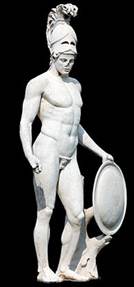
As the symbol for Venus represented the mirror the goddess held, the symbol for Mars represents the Roman god’s shield and spear. Though both the Roman god Mars (and his Greek equivalent Ares) represent the god of war, the two cultures regarded the god of war differently. Mars was considered the father of the Roman people and was highly regarded and dignified in ancient religion as a “guardian diety.” The Greek myths don’t spend much time on Ares. While his sister, the goddess Athena represented strategy and wisdom in war, Ares represented raw strength, violence, carnage, and the untamed.

Ares (Mars) minus his spear

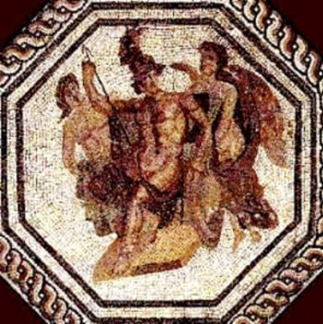
One of the most interesting aspects of Mars is the two moons: Deimos and Phobos. Indeed, these two moons (probably former asteroids that became stuck in Mars’ gravity) revolve around the planet Mars; however they are also part of mythology. In Greek mythology, Ares (Mars) and Aphrodite (Venus) “got together” and became the proud parents of two boys, Deimos (which means “terror” or “dread”) and Phobos (which means “fear,” as in “phobia”). Deimos and Phobos followed their father into battle, as the moons named after them follow the planet Mars in the solar system.

Ares (middle), Phobos, and Deimos

Kara Church

Senior Technical Editor

Posted by: Jack Henry | September 10, 2013

Editor’s Corner: Formatting Titles

Good morning! Yesterday while ranting about using single quotes, I provided an example that brought on more questions. The question was about the titles of works (paintings, books, articles, etc.). How should titles be formatted? With an underline? With italics? In quotation marks?

The answer is: it depends. The following are rules we use from the Chicago Manual of Style.

Note: In publishing, plain text (not italicized, bold, or underlined) is referred to as “roman” or is said to be “set in roman.”

· Book titles: Title case, italicized

Many editors use The Chicago Manual of Style.

· Book series and editions: Title case, roman

the Loeb Classical Library

a Modern Library edition

the Crime and Justice series

· Movies: Title case, italicized.

Gone with the Wind

· Musical works:

Too specialized for the CMOS; additional references sited.

· Periodicals: Title case, italicized

Sports Illustrated magazine

· Plays: Italicized

Shaw’s Arms and the Man, in volume 2 of his Plays: Pleasant and Unpleasant

· Poems (short): Title case, roman, enclosed in quotation marks

Robert Frost’s poem “The Housekeeper” in his collection North of Boston

· Poems (long, book-length): Italicized

Dante’s Inferno

· TV and radio (series): Title case, italicized

PBS’s Sesame Street [KC – The network name and call letters are set in roman.]

· TV and radio (single episodes): Title case, roman, enclosed in quotation marks

“Casualties,” is an episode in The Fortunes of War television series.

· Websites and web page titles: Title case, roman
Websites with comparable printed versions: Title case, italicized
References to titled sections or special features on website: Enclose in quotation marks

The website for Apple Inc.; Apple.com

Google; Google Maps; the “Google Maps Help Center”

Wikipedia; Wikipedia’s “Let It Be” entry; Wikipedia’s entry on the Beatles’ album Let It Be

the Oxford English Dictionary Online; the OED Online; the online version of the Oxford English Dictionary

· Works of art (known artist): Italicized

Leonardo da Vinci’s Mona Lisa and The Last Supper

North Dome, one of Ansel Adams’s photographs of Kings River Canyon

· Works of art (unknown artist): Roman

the Winged Victory

the Venus de Milo

Kara Church

Senior Technical Editor

619-542-6773 | Ext: 766773

www.symitar.com

Kara

NOTICE: This electronic mail message and any files transmitted with it are intended
exclusively for the individual or entity to which it is addressed. The message,
together with any attachment, may contain confidential and/or privileged information.
Any unauthorized review, use, printing, saving, copying, disclosure or distribution
is strictly prohibited. If you have received this message in error, please
immediately advise the sender by reply email and delete all copies.
Posted by: Jack Henry | September 9, 2013

Editor’s Corner: Single Quote Marks

I’m almost afraid to breathe: the Symitar Education Conference begins today. The Education half of our department is worked into a frenzy of development, session practices, and rounding up presenters; the Technical Publications half of the department is also busy helping with presentations, room monitoring, and working in the Tech Expo demonstrating our wares to clients; and then there’s Editing, the third half of the department. 🙂 Okay, my math is better than that. We’re only about 14% of the department worker bees, but we do all of the editing and then buzz in during the rest of the week to help anywhere else we can.

That said, I’ll do my best to stay true to all of you with a little bit of Editor’s Corner each day.

Today I’m here to tell you about a trend I noticed in some of the SEC submissions: the single quote (Ꞌ). In the English language, as practiced here in the USA, there are three primary reasons to use single quote marks. Since, as you will read, these circumstances are rarely seen here at JHA, stick with double quotes (") to be safe!

Reason 1: The Associated Press (AP Style) uses single quote marks for quotations in headlines. Unless you are writing news stories for AP, your best bet is double quotes.

Reason 2: Some disciplines (e.g., philosophy, theology) use single quotes to call attention to words that have a special meaning. Since our world of finance doesn’t fit under either of those topics and more people use double quotes or italics to perform that same job, again, I’d stick with double quotes.

Reason 3: Quotes within quotes. This is the one time when you might see single quotes used in an acceptable manner here at work. It is not often we have the opportunity to use quotes or dialog in our client-facing documentation, but if the need arises you can use single quotes. What do I mean by quotes within quotes? Here are a few examples from the Chicago Manual of Style:

“Don’t be absurd!” said Henry. “To say that ‘I mean what I say’ is the same as ‘I say what I mean’ is to be as confused as Alice at the Mad Hatter’s tea party. You remember what the Hatter said to her: ‘Not the same thing a bit! Why you might just as well say that “I see what I eat” is the same thing as “I eat what I see”!’ ”

“Admit it,” she said. “You haven’t read ‘The Simple Art of Murder.’ ”

Note: It is common for the typesetter or printer to add a half-space between the single quote and double quote when they are used together.

Kara Church

Senior Technical Editor

619-542-6773 | Ext: 766773

www.symitar.com

NOTICE: This electronic mail message and any files transmitted with it are intended
exclusively for the individual or entity to which it is addressed. The message,
together with any attachment, may contain confidential and/or privileged information.
Any unauthorized review, use, printing, saving, copying, disclosure or distribution
is strictly prohibited. If you have received this message in error, please
immediately advise the sender by reply email and delete all copies.

Posted by: Jack Henry | September 6, 2013

Editor’s Corner: Mistaken Phrases

Happy Friday, everyone! Today I have a sampling of phrases for you, from a blog titled 25 Common Phrases That You’re Saying Wrong. Thanks to Rob Stewart for these new additions to an old theme. For the full article, by Dominique Jackson, click here.

The phrases on the left are incorrect; the phrases on the right are correct.

Extract revenge vs. Exact revenge

When you extract something, you’re taking it out of something else. When you exact onto something, you’re dishing it out. Therefore, extracting revenge on someone would mean you’re taking out that person’s revenge. Exacting revenge onto them means that you’re taking your revenge out on them.

Conversating vs. Conversing

Drop the “on” and add an “ng” and you have yourself a new verb right? Wrong. Conversating is an unofficial word that a lot of people use in place of the correct term, conversing.

I made a complete 360 degree change in my life vs. I made a complete 180 degree change in my life

People say they’ve made a complete 360 degree change in their life to imply that they’ve completely changed from the way they used to be. However, going 360 degrees means that you’ve returned to the exact same place you started. Which would mean you didn’t change at all. A 180 degree change would mean that you are the complete opposite which is what most people are trying to say.

Nip it in the butt vs. Nip it in the bud

Nipping something in the bud means that you’re putting an end to it before it has a chance to grow or start. Nipping something in the butt means you’re biting its behind.

Curl up in the feeble position vs. Curl up in the fetal position

Feeble means weak and frail. So in a way, curling up in a feeble position isn’t too far off. However, the actual fetal position that people are referring to is the curled up position that fetuses use while in the womb.

I hope you enjoy the weekend!

Kara Church

Senior Technical Editor

619-542-6773 | Ext: 766773

www.symitar.com

NOTICE: This electronic mail message and any files transmitted with it are intended
exclusively for the individual or entity to which it is addressed. The message,
together with any attachment, may contain confidential and/or privileged information.
Any unauthorized review, use, printing, saving, copying, disclosure or distribution
is strictly prohibited. If you have received this message in error, please
immediately advise the sender by reply email and delete all copies.

« Newer Posts - Older Posts »

Categories