Note: This is a lengthier article than usual, but Editor’s Corner may be a little sporadic over the next few days. Read it slowly to make it last. 🙂

When it comes to language, there is no such thing as a short answer. Today I picked a question out of my mailbox that seemed like an easy one…but once I got started on research I found myself down another rabbit hole of information. Today’s topic is “case.” I’m just sharing tidbits of information, but for a longer article on the topic see Letter Case.

Most languages based on Latin, Cyrillic, Greek, Armenian, and Coptic alphabets use upper and lower cases to clarify writing. Scripts with both upper and lower cases are called bicameral scripts. Hebrew and Arabic, when written, only use one case and are called unicase scripts.

Before the terms uppercase and lowercase were coined, the term for capital letters was majuscule and the term for lowercase letters was minuscule. The terms for case were developed during the time of the printing press. Typesetters kept shallow wooden or metal drawers (called cases) with the letters in them. The majuscule letters were in the top (upper) case; the miniscule letters in the bottom (lower) case.

Typesetter’s Case

That gives us uppercase and lowercase, but what about all these other cases we hear about? Sentence case? Camel case? Title case? Well, here’s a brief explanation.

Sentence case and title case are the two standard “cases” you will find defined in style guides. The others are more recent inventions of the computer age, designed as part of file naming conventions.

· Sentence case: The case used for prose. The first letter of the sentence begins with a capital letter and uses lowercase letters for the rest of the sentence (unless you run into a proper noun). The sentence ends with some sort of terminal punctuation (e.g., period, question mark).

Example: The little dog found an old hamburger in the gutter.

· Title case: The case used for titles of books, TV shows, works of art, music, etc. Capitalization depends on the style guide used, but generally includes rules such as:

· first and last word capitalized

· nouns capitalized

· adjectives capitalized

· prepositions lowercased

· conjunctions lowercased

· etc.

Example: Charlie and the Great Glass Elevator

· Toggle case: An option in Microsoft® Word that allows you to flip the case of words you’ve typed. For example, if you have turned on Caps Lock by mistake and end up typing “tHE mAN OF lA mANCHA,” you can select the text, click Toggle Case, and it will change it to “The Man of La Mancha.”

· Camel case: I’ve only seen this as a file naming convention. Named camel case because of the humps created by having capital letters in the middle of a string of lowercase letters. Camel case requires that you capitalize the first letter of each new word, and cram the words altogether.

Example: A Word document called Backing Up Your Data would be saved in camel case as: BackingUpYourData.

· Snake case: According to Wikipedia, this case can be used for variable names, file names, and function names. The “case” involves removing punctuation and spaces and replacing them with underscores. The words can be all lowercase, all uppercase, or mixed case.

Examples:

007_UNDERCOVER_FILE

007_undercover_file

007_Undercover_file

· Spinal case: Similar to “snake case,” only the underscore marks are replaced by hyphens.

Examples:

THE-SECRET-OF-THE-HOLY-GRAIL

the-secret-of-the-holy-grail

The-secret-of-the-holy-grail

Kara Church

Senior Technical Editor

Posted by: Jack Henry | September 3, 2013

Editor’s Corner: Goddess on the Mountain Top

Good morning! I hope you enjoyed the three-day weekend wherever you were and whatever you were doing. Today I have a little something for you about another one of the planetary symbols—from a few weeks ago. The symbol for the planet Venus is a circle with a cross underneath it, as follows:

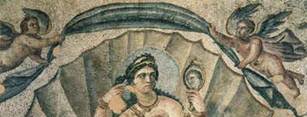
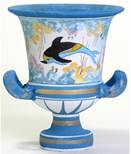
This symbol is from the shape of the handheld mirror Aphrodite (Venus) uses to admire her beauty. Aphrodite, with her symbolic mirror, is shown in both the mosaic and photo of a painted krater, below.

Aphrodite Mosaic

Aphrodite on Krater

Not only does the symbol of the mirror (♀) represent the planet Venus, it represents females (the goddesses of love and beauty, incarnate), and the alchemical symbol for copper (the material used to make mirrors, in antiquity).

Now, for some vocabulary connections (rated M for Mature):

· krater: (Greek) Large vase in which wine and water were mixed

Minoan Dolphin Krater

· venereal: (from Roman Venus: when the goddess of love and beauty goes bad) Of or related to sexual pleasure or indulgence; of or related to disease contracted by sexual contact [KC – This term is antiquated and considered politically incorrect since the root of this word indicates it comes from females only.]

· aphrodisiac: (from Greek Aphrodite) An agent (as a food or drug) that arouses or is held to arouse sexual desire

Kara Church

Senior Technical Editor
619-542-6773 | Ext: 766773

www.symitar.com

NOTICE: This electronic mail message and any files transmitted with it are intended
exclusively for the individual or entity to which it is addressed. The message,
together with any attachment, may contain confidential and/or privileged information.
Any unauthorized review, use, printing, saving, copying, disclosure or distribution
is strictly prohibited. If you have received this message in error, please
immediately advise the sender by reply email and delete all copies.

Posted by: Jack Henry | August 30, 2013

Editor’s Corner: Time for a Capitalization Vacation!

I hope you all have a great Labor Day weekend!

I was just reviewing the Chicago Manual of Style, trying to select which aspect of capitalization we should focus on today. Then I realized this: there are almost 200 topics on capitalization alone. This is just a random selection of the other topics with specific capitalization rules:

· Titles of nobility: Usually lowercase unless referring to the nobles by their titles and names.
Examples: the duke; the duchess; the Duke and Duchess of Windsor

· Generation: Lowercase the word “generation.”
Examples:

o generation X

o the MTV generation

· Government entities: Generally capitalized.
Example: That is a City of Chicago ordinance.

· Judicial bodies: Specific bodies are capitalized, general terms are not.
Examples:

o The United States (or US) Supreme Court

o the Supreme Court

o the court

· Sporting events: Capitalize terms that are part of the event name (e.g., NBA Finals); lowercase terms that are used generally (e.g., the finals of the Olympic Games).
More examples:

o the Olympics

o the Winter Olympics

· Lecture names: Use title case for the name of a lecture series. Use quote marks and title case for the title of a specific lecture.
Example:
This year’s Robinson Memorial Lectures were devoted to the nursing profession. The first lecture, “How Nightingale Got Her Way,” was a sellout.

· Services and rites: This one looks like a free-for-all.
Examples:

o baptism

o bar mitzvah

o the Eucharist

o High Mass

· Wars and revolutions: Specific wars are capitalized, the word “war” by itself is not.
Examples:

o Korean War

o the war

· Genes: Human gene names are in all caps (e.g., BRCA1, GPC3); mouse gene names have an initial capital letter but the rest of the abbreviation is lowercase (e.g., Cmv1, Fgf12).

And the list goes on. If you don’t want to memorize two hundred sets of rules and exceptions, my best advice is to check the dictionary when you aren’t sure whether a word is capitalized. We use the unabridged online version of Merriam-Webster, but the Merriam-Webster abridged version is free and will be able to answer most of your questions.

Kara Church

Senior Technical Editor

619-542-6773 | Ext: 766773

www.symitar.com

NOTICE: This electronic mail message and any files transmitted with it are intended
exclusively for the individual or entity to which it is addressed. The message,
together with any attachment, may contain confidential and/or privileged information.
Any unauthorized review, use, printing, saving, copying, disclosure or distribution
is strictly prohibited. If you have received this message in error, please
immediately advise the sender by reply email and delete all copies.

Posted by: Jack Henry | August 29, 2013

Editor’s Corner: Mercury

A couple weeks ago I mentioned that the names of planets are capitalized. I also included a graphic of planetary symbols that several of you asked about. Instead of talking about capital letters today, I’d like to go back to those symbols—in particular, Mercury.

The following symbol is traditionally used for the planet Mercury and as the medieval alchemical sign for the element mercury (Hg). Hg is the abbreviation for Greek hydrargyros (hydr- + argyros) which would be roughly translated as “watery silver.”

Why does this symbol represent the planet Mercury? Mercury (in Greek, Hermes) was the messenger god, flying around with winged feet and winged helmet. The crescent at the top of the symbol represents Mercury’s winged helmet.

Mercury (Hermes) the Messenger
& His Winged Helmet & Feet

Below the “wings” is the symbol for Venus (woman). My guess at the connection is the strong relationship between Mercury (Greek: Hermes) and Venus (Greek: Aphrodite) in mythology. In Greek mythology, Hermes and Aphrodite conceive a child together: Hermaphrodite. From their child’s name, we get the word hermaphrodite, the term for a person born with both male and female “private parts.”

Talk about a tangent! But I think these stories about our language, symbols, vocabulary, and all the details are fascinating.

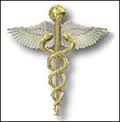
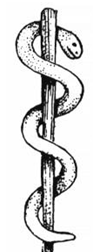
A little more vocabulary for you, related to our friend the messenger: as you can see in the sculpture above, Mercury is carrying an odd looking staff. This staff, carried by heralds and messengers, is called a caduceus. It is winged at the top, and has two snakes intertwining their way up from the bottom. The caduceus represents commerce, though many people misuse it to represent medicine. There is actually a different symbol that should be used for medicine: the Staff of Asclepius. Asclepius was the ancient Greek god of medicine and healing.

A caduceus:

The Staff of Asclepius:

I hope you’ve found this interesting because I have information for the other symbols, too!

Kara Church

Senior Technical Editor

Hello friends and associates! Today we have a few more mini-lessons about capital letters. Before I get to those, though, I must tell you about one of the cruelest acronyms I’ve ever run across. Yesterday, during the wee hours of the morning, I drove my mom to the hospital for knee replacement surgery. As we wandered around looking for the correct building, Mom told me that we were supposed to show up at the “spa.” The “hostess” found us and led us on our way. I thought, “Gee, a hostess taking Mom to the spa? That doesn’t sound half bad.” As we approached the spa, the truth was revealed: the spa was actually the Surgical Procedure Area. The relaxation would come after visiting with more types of nurses than you ever knew existed and getting anesthesia in the spine. Nice “spa.”

Now, on to capitalizing different measurements of time:

· Seasons: The names of the seasons are lowercase unless they are part of a proper name or title.

Examples:

o 2013 Autumn Semester

o 2014 Winter Olympics

· Months: The names of months are capitalized.

Examples:

o Few people look forward to San Diego’s May gray or June gloom.

o April showers bring May flowers.

· Days: The days of the week are capitalized.

Examples:

o Taco Tuesdays are very popular fund raising events.

o You can see her Wednesday or Friday afternoons at the Fan-Tan Follies.

· Hours: There are several different ways to abbreviate ante meridiem and post meridiem. The least confusing seems to be the British method, which is with lowercase letters separated by periods. This is the method we use in editing, too, unless we are writing about something in the system where small caps or no punctuation is used.

Examples:

o 10:00 a.m.

o 4:30 p.m.


Note:
Use the en-dash to indicate a range of time, such as 9:00 a.m.–11:30 a.m.

Kara Church

Senior Technical Editor

619-542-6773 | Ext: 766773

www.symitar.com

NOTICE: This electronic mail message and any files transmitted with it are intended
exclusively for the individual or entity to which it is addressed. The message,
together with any attachment, may contain confidential and/or privileged information.
Any unauthorized review, use, printing, saving, copying, disclosure or distribution
is strictly prohibited. If you have received this message in error, please
immediately advise the sender by reply email and delete all copies.

Posted by: Jack Henry | August 23, 2013

Editor’s Corner: Winner, winner, chicken dinner!

Okay, no chicken dinners today, but I do have two winners to announce for the Editor’s Corner contest that ended last week. I would like to thank Steve Hooper, Senior VP of Payment Strategy at iPay Solutions, for signing up as a new subscriber to Editor’s Corner and writing a lovely letter that encouraged ten other people to sign up. In addition to my undying appreciation, Steve gets a $25 Amazon gift certificate!

Our other winner is Casey Hughes, the QA Manager of Teller and Voice. Casey had the Mad Lib that got the most laughs and she wins a $25 Amazon gift certificate for her creativity. As promised, Casey’s Mad Lib is here:

How to Cross a Piranha-Infested River

If you are traveling in Zimbabwe and find yourself having to cross a piranha-filled river, here’s how to do it swiftly:

· Piranhas are more hideous during the day, so cross the river at night.

· Avoid areas with netted hippo traps—piranhas may be dancing there looking to twerk them!

· When shopping in the river, swim promptly. You don’t want to wake them up and make them gorgeous!

· Whatever you do, if you have an open wound, try to find another way to get back to the the office. Piranhas are attracted to fresh Kool-Aid and will most likely take a bite out of your big toe if you are strutting in the water!

Thank you to everyone who participated and everyone who recently signed up! I hope you enjoy our daily tips and language tidbits!

Kara

NOTICE: This electronic mail message and any files transmitted with it are intended
exclusively for the individual or entity to which it is addressed. The message,
together with any attachment, may contain confidential and/or privileged information.
Any unauthorized review, use, printing, saving, copying, disclosure or distribution
is strictly prohibited. If you have received this message in error, please
immediately advise the sender by reply email and delete all copies.

Posted by: Jack Henry | August 21, 2013

Editor’s Corner: Elmore Leonard’s 10 Writing Rules

Elmore Leonard, a prolific writer of fiction, passed away yesterday at the age of 87. I heard some of these rules on a radio story about him and thought you might enjoy them. In his own words, here are his 10 Rules of Writing. For the complete text see Writers on Writing, from The New York Times.

1. Never open a book with weather.
If it’s only to create atmosphere, and not a character’s reaction to the weather, you don’t want to go on too long. The reader is apt to leaf ahead looking for people. There are exceptions. If you happen to be Barry Lopez, who has more ways to describe ice and snow than an Eskimo, you can do all the weather reporting you want.

2. Avoid prologues.
They can be annoying, especially a prologue following an introduction that comes after a foreword. But these are ordinarily found in nonfiction. A prologue in a novel is backstory, and you can drop it in anywhere you want.

3. Never use a verb other than ”said” to carry dialogue.
The line of dialogue belongs to the character; the verb is the writer sticking his nose in. But said is far less intrusive than grumbled, gasped, cautioned, lied. I once noticed Mary McCarthy ending a line of dialogue with ”she asseverated,” and had to stop reading to get the dictionary.

4. Never use an adverb to modify the verb ”said” . . .
. . . he admonished gravely. To use an adverb this way (or almost any way) is a mortal sin. The writer is now exposing himself in earnest, using a word that distracts and can interrupt the rhythm of the exchange. I have a character in one of my books tell how she used to write historical romances ”full of rape and adverbs.”

5. Keep your exclamation points under control.
You are allowed no more than two or three per 100,000 words of prose.

6. Never use the words ”suddenly” or ”all hell broke loose.”

This rule doesn’t require an explanation. I have noticed that writers who use ”suddenly” tend to exercise less control in the application of exclamation points.

7. Use regional dialect, patois, sparingly.

Once you start spelling words in dialogue phonetically and loading the page with apostrophes, you won’t be able to stop.

8. Avoid detailed descriptions of characters.

Which Steinbeck covered. In Ernest Hemingway’s ”Hills Like White Elephants” what do the ”American and the girl with him” look like? ”She had taken off her hat and put it on the table.” That’s the only reference to a physical description in the story, and yet we see the couple and know them by their tones of voice, with not one adverb in sight.

9. Don’t go into great detail describing places and things.

Unless you’re Margaret Atwood and can paint scenes with language or write landscapes in the style of Jim Harrison. But even if you’re good at it, you don’t want descriptions that bring the action, the flow of the story, to a standstill.

10. Try to leave out the part that readers tend to skip.

A rule that came to mind in 1983. Think of what you skip reading a novel: thick paragraphs of prose you can see have too many words in them. What the writer is doing, he’s writing, perpetrating hooptedoodle, perhaps taking another shot at the weather, or has gone into the character’s head, and the reader either knows what the guy’s thinking or doesn’t care. I’ll bet you don’t skip dialogue.

My most important rule is one that sums up the 10.

If it sounds like writing, I rewrite it. Or, if proper usage gets in the way, it may have to go. I can’t allow what we learned in English composition to disrupt the sound and rhythm of the narrative. [KC-If you’re writing prose this is a good rule. If you’re writing technical material, your editor may tell you to throw this rule out the window.] It’s my attempt to remain invisible, not distract the reader from the story with obvious writing. (Joseph Conrad said something about words getting in the way of what you want to say.)

If I write in scenes and always from the point of view of a particular character — the one whose view best brings the scene to life — I’m able to concentrate on the voices of the characters telling you who they are and how they feel about what they see and what’s going on, and I’m nowhere in sight.

Kara Church

Senior Technical Editor

619-542-6773 | Ext: 766773

www.symitar.com

NOTICE: This electronic mail message and any files transmitted with it are intended
exclusively for the individual or entity to which it is addressed. The message,
together with any attachment, may contain confidential and/or privileged information.
Any unauthorized review, use, printing, saving, copying, disclosure or distribution
is strictly prohibited. If you have received this message in error, please
immediately advise the sender by reply email and delete all copies.

Posted by: Jack Henry | August 20, 2013

Editor’s Corner: Q&A

The Editing Triad is in a three-day meeting this week, so I will keep this brief. Today’s tidbit is a quick Q&A from the Chicago Manual of Style:

Q. In a policy, I have to indicate that the word facility could be plural. The person editing the document has written it as facility(s). What is the correct way to portray nouns that end in y when necessary to indicate they could be singular or plural?

A. “Facility or facilities” and “one or more facilities” are both clear. And often the simple singular does just fine in implying one or more: “In the event that your facility is struck by terrorists, this contract is void.” You can see that if two facilities were struck by terrorists, the clause would apply to both.

Note: Using parentheses to indicate singular or plural and then altering the verbs the same way (is/are, goes/go) drives me batty. Stay away from this kind of construction so you don’t lose your message among all of the switching subjects, different verb conjugations, and extra punctuation.

NOTICE: This electronic mail message and any files transmitted with it are intended
exclusively for the individual or entity to which it is addressed. The message,
together with any attachment, may contain confidential and/or privileged information.
Any unauthorized review, use, printing, saving, copying, disclosure or distribution
is strictly prohibited. If you have received this message in error, please
immediately advise the sender by reply email and delete all copies.

Posted by: Jack Henry | August 19, 2013

Editor’s Corner: Capitalizing Particles?

Good morning folks! I hope your weekend was better than mine. I made a very unhappy discovery that the power had been out to our garage freezer for about five days. Black beans, salmon burgers, turkey, chicken, lentils, ice cream, and some wool yarn (long story) added to 80 or 90 degree heat? The smell of death was a barf-inducing weekend spoiler. I think the vegetarian contingent at work just added a new member.

On that note, let’s talk about something else. Today’s article is about particles. Nope, not the fine layer of dust on your curio cabinet, but grammatical particles. Like dust particles, grammatical particles are also tiny. They are the words included in some names, such as de, d’, de la, le, la, l’, the, von, van, and ten.

The capitalization and spacing rules for particles varies, since most of these are from non-English names and may follow rules particular to the country they are from. The Chicago Manual of Style recommends checking a biographical dictionary when you aren’t sure of the spelling or capitalization. Here are some other rules (and examples) they recommend to help you with an educated guess:

· Le, La, and L’ are always capitalized when not preceded by de:

Robert M. La Follette Sr.; La Follette

John Le Carré; Le Carré

Pierre-Charles L’Enfant; L’Enfant

Walter de la Mare; de la Mare

· The, which sometimes appears with the English form of a Native American name, is always lowercased.

the Prophet Tenskwatawa

· When the surname is used alone, the particle is usually retained, capitalized or lowercased and spaced as in the full name (though always capitalized when beginning a sentence).

Alfonse D’Amato; D’Amato

Diana DeGette; DeGette

Paul de Man; de Man

Thomas De Quincey; De Quincey

Page duBois; duBois

W. E. B. DuBois; DuBois

Daphne du Maurier; du Maurier

Anwar el-Sadat; Sadat

Abraham Ten Broeck; Ten Broeck

Robert van Gulik; van Gulik

Stephen Van Rensselaer; Van Rensselaer

Wernher von Braun; von Braun

Kara Church

Senior Technical Editor
619-542-6773 | Ext: 766773

www.symitar.com

NOTICE: This electronic mail message and any files transmitted with it are intended
exclusively for the individual or entity to which it is addressed. The message,
together with any attachment, may contain confidential and/or privileged information.
Any unauthorized review, use, printing, saving, copying, disclosure or distribution
is strictly prohibited. If you have received this message in error, please
immediately advise the sender by reply email and delete all copies.

Posted by: Jack Henry | August 15, 2013

Editor’s Corner: Faze vs Phase

Good morning! Let’s take a quick break from our discussion about which nouns should and shouldn’t be capitalized and talk about a set of homonyms: faze and phase.

According to our friends at Merriam-Webster, faze means:

To disturb the composure of: disconcert, daunt. This word evolved from feeze, meaning to drive away or frighten.

· Nothing fazed him when he ran—not the wind nor the rain nor the heat of the sun.

· As she missed a step and tore her dress on the way to accept the award, she continued forward unfazed and took her prize with dignity.

Also from Merriam-Webster, phase is defined as:

1: a particular appearance or state in a regularly recurring cycle of changes <phases of the moon>

2a: a distinguishable part in a course, development, or cycle <the early phases of her career>

b: an aspect or part (as of a problem) under consideration

And this is for an inquiring mind that wanted to know what the planetary symbol of Earth is.

I found some interesting information on this topic, but we will continue with more on capital letters before I get into that!

Kara Church

Senior Technical Editor
« Newer Posts - Older Posts »

Categories