Posted by: Jack Henry | February 4, 2014

Editor’s Corner: Comma, comma, comma chameleon

Good morning and congratulations to Megan Altis for bringing over 30 new subscribers to the Editor’s Corner. Megan wins the coveted Amazon gift card! I’m also sending a huge thank you to Jim Vivoli who came in a close second and to everyone else who recommended the Editor’s Corner to their friends and co-workers.

Today we’re going to tackle a punctuation mark that is difficult for many people: the comma. It isn’t surprising that commas are tough. I have at least a dozen different rules for us to consider. Instead of throwing the whole list at you at once, I’m going to go through the rules one at a time and let you savor each one.

Most of these rules are from the Purdue OWL, one of my favorite grammar sites.

RULE: Use commas to separate independent clauses when they are joined by any of these seven coordinating conjunctions: and, but, for, or, nor, so, yet.

Examples:

The shop was out of frozen yogurt, so Mickey and Rachel decided to go home.

The Seahawks scored again, and the crowd went wild.

He rewrote the sentences a third time, yet the paragraph still confused the editor.

The wind was blowing and snow was falling, but Susan insisted on running the 5k without a jacket.

And for your entertainment:

Kara Church

Senior Technical Editor

Posted by: Jack Henry | February 3, 2014

Editor’s Corner: You’re (Not Your) Awesome!

Let’s start this week off with something easy. First, I send a warm welcome to you new readers! Second, I want to give high praise to all of you for taking a little extra time each day to learn more about English and how to use it better and more effectively. Third, I’m providing an excerpt for you to read so you can see how sad the world is for other people who don’t get a daily dose of learning in their email.

Excerpt from the San Diego Union-Tribune, written by Richard Lederer, founder of A Way with Words (radio show), lecturer, teacher, and author of over 30 books on English.

Recent reports indicate that new jobs are being created in some abundance but that there aren’t enough candidates who can speak and write clearly to fill those aborning positions. Part of the mismatch between job availability and the dearth of qualified applicants can be traced to lack of education in the art and craft of expository writing. When the Department of Education in 2012 published “The Nation’s Report Card: Writing 2011,” just 24 percent of eighth- and 12th-graders were proficient in writing.

The number of literate college graduates has also declined dramatically over the past two decades. Could it be that the global, speed-of-byte interconnectivity we enjoy through television, texting and social media comes at the expense of our fundamental language skills? We communicate more, but we say less.

That’s a crying shame because in a recent survey of corporate recruiters by the Graduate Management Admission Council, the organization that administers the standardized test for business school, 86 percent said strong communication skills were a priority—well ahead of any other skill. We must shrink this communications gap.

See how lucky you are? You are shrinking the gap every day by reading Editor’s Corner! Aren’t you amazing? I think you are. Have a fantastic Monday!

NOTICE: This electronic mail message and any files transmitted with it are intended
exclusively for the individual or entity to which it is addressed. The message,
together with any attachment, may contain confidential and/or privileged information.
Any unauthorized review, use, printing, saving, copying, disclosure or distribution
is strictly prohibited. If you have received this message in error, please
immediately advise the sender by reply email and delete all copies.

Posted by: Jack Henry | January 31, 2014

Editor’s Corner: Lean, mean mondegreen!

Before you get your treat, this is the last reminder to send me new subscribers for Editor’s Corner. I am extending the contest to the end of the day in hopes that I can break the tie between Jim Vivoli and Megan Altis. Remember, all you need to do is recommend this column to your friends and coworkers and have them email me at kchurch to sign up. (They should tell me you sent them so you get the points.) The winner will be announced Monday. Now, down to business!

Back by popular demand, for the end of FUN week, I have a collection of mondegreens for you. In short, mondegreens are misheard song lyrics. For an extended description, see the Wikipedia article here. The following are some of the cleaner mondegreens I borrowed from When a Man Loves a Walnut and from ‘Scuse Me While I Kiss This Guy, both collections by Gavin Edwards.

I’ve listed the singer first, followed by the name of the song. On the second line are the misheard lyrics, followed by the actual lyrics in parentheses. Yes, sometimes the actual lyrics sound crazier than the misheard ones. It’s easy to understand how some of these mix-ups occur!

Enjoy!

Bread (Baby I’m-a Want You)

Baby I’m a warm shoe, baby I’m a neat shoe. (Baby I’m-a want you, baby I’m-a need you.)

Michael Jackson (Wanna Be Startin’ Somethin’)

Mamma say mamma saw my moccasin (Ma ma se mama sa ma ma coo sa)

Elton John (Goodbye Yellow Brick Road)

Goodbye yellow brick road/With the darkened sorority house. (Goodbye yellow brick road/ where the dogs of society howl.)

Nirvana (Smells Like Teen Spirit)

I’m blotto and bravado/I’m a scarecrow and a Beatle. (A mulatto, an albino/A mosquito, my libido.)

The Beatles (Lucy in the Sky with Diamonds)

The girl with colitis goes by (The girl with kaleidoscope eyes)

Pearl Jam (Glorified G)

Forty-five versions of a pelican. (Glorified version of a pellet gun.)

Peter Gabriel (Shock the Monkey)

Jaques the monkey. (Shock the monkey.)

Carl Carlton (She’s a Bad Mama Jama)

She wears bad plaid pajamas. (She’s a bad mama jama.)

TLC (Waterfalls)

Go, go, Jason Waterfalls. (Don’t go chasin’ waterfalls.)

Def Leppard (Pour Some Sugar on Me)

Poor son, shoot your own leg. (Pour some sugar on me.)

The Pretenders (Brass in Pocket)

· Gonna use my sausage.

· Gonna use my soft-sell.

· Gonna use my senses.

· Gonna use my sauté.

· Gonna use my sassy.

(Gonna use my sidestep.)

Elton John (Rocket Man)

· Rocket man, burning up the trees on every lawn.

· Rocket man, turning out his shoes for everyone.

(Rocket man, burning out his fuse up here alone.)

David Bowie (Space Oddity)

Clown Control to Mao Tse-Tung. (Ground control to Major Tom.)

Kara Church

Senior Technical Editor

619-542-6773 | Ext: 766773

www.symitar.com

NOTICE: This electronic mail message and any files transmitted with it are intended
exclusively for the individual or entity to which it is addressed. The message,
together with any attachment, may contain confidential and/or privileged information.
Any unauthorized review, use, printing, saving, copying, disclosure or distribution
is strictly prohibited. If you have received this message in error, please
immediately advise the sender by reply email and delete all copies.

Posted by: Jack Henry | January 30, 2014

Editor’s Corner: Who vs. Whom

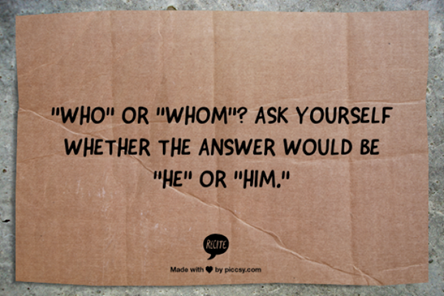
Good morning, everyone! I have returned from yesterday’s Olympic tangent as promised, with a little trick for figuring out when to use who vs. whom. Instead of getting into the subject and direct object discussion, we’re going to head straight to the “he/him” trick that many people use to get to the right answer.

The He/Him Trick

he = who

him =whom

You are facing the question, “Should I use who or whom in this case?” Ask yourself whether the answer to your question would be he or him. If the answer is “he,” then you use “who.” If the answer is “him,” you use “whom.”

Examples:

Who/whom broke the vase?

He broke the vase. (Not “Him broke the vase.”) Therefore, who is correct.

For who/whom does the bell toll?

The bell tolls for him. Therefore, whom is correct.

We all know who/whom won the gold medal.

He won the gold medal. Therefore, who is correct.

Does anyone know to who/whom the gold medal was given?

The gold medal was given to him. Therefore, whom is correct.

Now, apply this rule to other examples and see how you do. You can try either of these quizzes and sites for more information: Grammar Girl or the Grammar Monster.

Kara Church

Senior Technical Editor

Posted by: Jack Henry | January 29, 2014

Editor’s Corner: Let the games begin!

Good morning! If you are an employee who is lucky enough to go into the office each week and you are there today, you should be able to join in the Office Olympics!

I started out my email today ready to talk about a helpful hint for remembering when to use who or whom, but you’ll have to wait until tomorrow for that. Instead I will go off on a bit of a tangent to talk about the Olympic flag, in honor of the day’s festivities and the XXII Olympic Winter Games (Sochi), which begin on Friday, February 7, 2014.

The flag, as we know it now, is white with five interlocking rings. It was designed in 1912 by Baron Pierre de Coubertin, the co-founder of the modern Olympic Games. The reason for five rings? Each one represents the five continents that participated in the 1912 games: Europe, Asia, Africa, Australia/Oceania, and America (North and South). Contrary to popular belief, the ring colors do not represent specific continents.

So what do the colors represent? The colors, including the white background, represent the colors of all of the nations’ flags at the time it was established. For example, the Swiss flag is red and white; the Greek flag is blue and white; the Kenyan flag is black, red, green, and white, etc. The intention was for this to be a true international symbol.

Though the Olympics originated in Greece, the motto is Latin. It was also provided by Baron de Coubertin in 1912 and reads: Citius, Altius, Fortius. In English, this means “Faster, Higher, Stronger.” Not quite the Six Million Dollar Man’s theme, but close.

Oh, and one more detail. In the ancient Olympics, winners received a wreath of olives, not a wreath of laurels. What else would you expect for a proud Greek Olympian?

Go forth this day and show us that you deserve the Office Olympics gold! (Or send me new subscribers for the Editor’s Corner by Friday and win the Editor’s Corner Amazon Gift Card [$25].)

Kara Church

Senior Technical Editor

Posted by: Jack Henry | January 28, 2014

Editor’s Corner: Passage to India

The other day I was in the shower trying to remember a joke I’d heard about shampoo. Maybe it was just a quote, but it was kind of disgusting, and it made me wonder where we got the word shampoo from. Serendipitously, I got the answer today in an email about English words with origins in Hindi, Urdu, and Sanskrit. For the entire list see DailyWritingTips.

· Avatar
In Hinduism, an avatar is the manifestation in human or animal form of a god, especially Vishnu. The word first appeared in English in the 18th century and derives ultimately from the Sanskrit word avatara meaning descent. More recently the word has gained additional senses, for example to refer to a computer user’s visual representation within a game, on a forum etc.

· Bangle
A rigid ornamental bracelet worn around the wrist (or ankle). Its appearance in English dates back to the 18th century. It derives from the Hindi word bangri meaning a glass ring or bracelet.

· Bungalow
A one-storied house. Derives from the Hindi word bangla meaning, literally, in the style of or belonging to Bengal. The word bungalow in English dates back to the 17th century when it was used to refer to a type of cottage built in Bengal for early European settlers.

· Cot
This word has several meanings, but in the sense of a portable bed or a high-sided child’s bed, it derives from the Hindi word khat, meaning a bedstead or hammock. It arrived in the English language during the 17th century.

· Guru
Originally a Hindu or Sikh spiritual guide, guru entered English in the 17th century, where it now also means any important and respected intellectual guide or mentor. The original word in the Hindi and Sanskrit, also guru, means venerable.

· Juggernaut
In English, a juggernaut is an unstoppable force or movement that sweeps aside or destroys anything in its path. In the UK it is also used to refer to very large lorries (trucks). The word arrived in English in the 19th century and derives from the word Jagannath, a form of the Hindu deity Vishnu.

· Loot
Loot is both a noun and a verb. As a verb it means to ransack, to steal from someone or something, often in a violent way. The noun means whatever is stolen by the act of looting or, simply, any money. The word derives from the Hindi verb lut, meaning to plunder or steal.

· Pyjamas/Pajamas
A set of loose-fitting sleeping clothes, consisting of a jacket and trousers. The pajama spelling is used in North America. The word entered English in the 19th century. It derives from the Hindi word payjamah, meaning leg (pay) and clothing (jamah).

· Shampoo
A soapy liquid for washing the hair (or other things such as carpets). It arrived in English in the 18th century and derives from the Hindi word champo, meaning to squeeze, knead, or massage.

· Thug
A brutal or violent person, it derives ultimately from the Hindi word thag meaning a thief or a cheat. It entered the English language early in the 19th century.

Kara Church

Senior Technical Editor

619-542-6773 | Ext: 766773

www.symitar.com

NOTICE: This electronic mail message and any files transmitted with it are intended
exclusively for the individual or entity to which it is addressed. The message,
together with any attachment, may contain confidential and/or privileged information.
Any unauthorized review, use, printing, saving, copying, disclosure or distribution
is strictly prohibited. If you have received this message in error, please
immediately advise the sender by reply email and delete all copies.

Posted by: Jack Henry | January 24, 2014

Editor’s Corner: Malapropisms

Call them malapropisms, phonological word substitutions, or Dogberryisms, these amusing slips of the tongue seem like a good topic for a Friday afternoon. Here is a brief history of the malapropism from Literary Devices, followed by some examples from literature, television, and other sources.

Malapropism, from French mal a propos (inappropriate), is a use of an incorrect word in place of a similar sounding word that results in a nonsensical and humorous expression.

The word malapropism comes from “Mrs. Malaprop,” a character in Richard Sheridan’s comedy The Rivals, who has a habit of replacing words with incorrect and absurd utterances producing a humorous effect. A mis-speech is considered malapropism when it sounds similar to the word it replaces but has an entirely different meaning. For instance, replacing acute with obtuse is not a malapropism because both words have a contrasting meanings but do not sound similar. Using obtuse for abstruse, on the other hand, is a malapropism, as there is a difference in meaning and both words sound similar.

These characteristics make malapropism different from other errors in speech such as eggcorns and spoonerisms.

Note: “Dogberryism” is a synonym for malapropism. The name comes from Officer Dogberry in Shakespeare’s Much Ado About Nothing, who often makes this type of error.

Examples:

· "He is the very pineapple of politeness."(pinnacle) – Mrs. Malaprop in Richard Sheridan’s The Rivals)

· Officer Dogberry said, "Our watch, sir, have indeed comprehended two auspicious persons" (apprehended two suspicious persons)

· "The police are not here to create disorder, they’re here to preserve disorder." – Richard Daley, former mayor of Chicago

· "Texas has a lot of electrical votes." (electoral votes) – Yogi Berra

· "Well, that was a cliff-dweller." (cliff-hanger) – Wes Westrum

· "Create a little dysentery among the ranks." (dissension) – Christopher Moltisanti from "The Sopranos"

· "Last will and tentacle…" (testament) – Archie Bunker from "All in the Family"

· "In closing, I’d like to say Molotov!" (Mazel Tov) – Archie Bunker from "All in the Family"

· "It will take time to restore chaos and order." – George W. Bush

Unattributed examples:

· Rainy weather can be hard on the sciences. (sinuses)

· Alice said she couldn’t eat crabs or any other crushed Asians. (crustaceans)

· You could have knocked me over with a fender. (feather)

· Unfortunately, my affluence over my niece is very small. (influence)

· A rolling stone gathers no moths. (moss)

· Good punctuation means not to be late. (punctuality)

· The flood damage was so bad they had to evaporate the city. (evacuate)

· Dad says the monster is just a pigment of my imagination. (figment)

· Everybody in the company has their own cuticle. (cubicle)

· I remember because I have photogenic memory. (photographic)

These examples and others can be found at About.com and Your Dictionary.

Kara Church

Senior Technical Editor

619-542-6773 | Ext: 766773

www.symitar.com

NOTICE: This electronic mail message and any files transmitted with it are intended
exclusively for the individual or entity to which it is addressed. The message,
together with any attachment, may contain confidential and/or privileged information.
Any unauthorized review, use, printing, saving, copying, disclosure or distribution
is strictly prohibited. If you have received this message in error, please
immediately advise the sender by reply email and delete all copies.

Posted by: Jack Henry | January 23, 2014

Editor’s Corner: 2014 Contest

As I sit here with my nose pressed up against the window, eagerly awaiting the books I ordered about mondegreens (misheard song lyrics), something tells me it is time for another contest! No Mad Libs this time—just the promise of a hot new $25 Amazon gift card to the reader out there who can entice the most people to join the Editor’s Corner for the first time.

Here are the details, my language-loving associates:

Who: You and any of your JHA friends who don’t already subscribe to the Editor’s Corner.

What: Email kchurch and ask me to sign your friends up (with their permission) OR
have your friends email me directly and mention that you sent them. The person who brings me the most new subscribers will win the Amazon gift card!

When: Between now and Friday, January 31, 2014 at 12:00 noon (PT).

Where: In the magic land of email.

Why: Because it’s fun!

If your friends need a reason, tell them it’s educational, interesting, thought-provoking, helpful, and whatever else it might be to you. If your friends want to have a look before they leap, they can cruise around the website for a taste of daily grammar goodness. The formatting isn’t always great, but the information is there. https://episystechpubs.com/

Thank you and good luck!

Kara Church

Senior Technical Editor

619-542-6773 | Ext: 766773

www.symitar.com

NOTICE: This electronic mail message and any files transmitted with it are intended
exclusively for the individual or entity to which it is addressed. The message,
together with any attachment, may contain confidential and/or privileged information.
Any unauthorized review, use, printing, saving, copying, disclosure or distribution
is strictly prohibited. If you have received this message in error, please
immediately advise the sender by reply email and delete all copies.

Good morning!

I had so many of you Anglophiles writing to me yesterday about other words that are spelled differently between American and British English, I decided to send you the remainder of this article today rather than stringing you along for an extra day. I somehow misplaced the link for the list below, but for similar information on British and American spellings, click here and here.

British and American Spelling

Words ending in -yse

Verbs in British English that end in -yse are always spelled -yze in American English:

British US
analyse analyze
breathalyse breathalyze
paralyse paralyze

Words ending in a vowel plus l

In British spelling, verbs ending in a vowel plus l double the l when adding endings that begin with a vowel. In American English, the l is not doubled:

British US
travel travel
travelled traveled
travelling traveling
traveller traveler
fuel fuel
fuelled fueled
fuelling fueling

Words spelled with double vowels

British English words that are spelled with the double vowels ae or oe are just spelled with an e in American English:

British US
leukaemia leukemia
manoeuvre maneuver
oestrogen estrogen
paediatric pediatric

Note that in American English, certain terms, such as archaeology, keep the ae spelling as standard, although the spelling with just the e (i.e. archeology) is usually acceptable as well.

Nouns ending with –ence

Some nouns that end with -ence in British English are spelled -ense in American English:

British US
defence defense
licence license
offence offense
pretence pretense

Nouns ending with –ogue

Some nouns that end with -ogue in British English end with either -og or -ogue in American English:

British US
analogue analog or analogue
catalogue catalog or catalogue
dialogue dialog or dialogue

The distinctions here are not hard and fast. The spelling analogue is acceptable but not very common in American English; catalog has become the US norm, but catalogue is not uncommon; dialogue is still preferred over dialog.

Miscellaneous

British American
aeroplane airplane
aluminium aluminum
axe ax
cosy cozy
kerb (edge of road) curb
furore furor
grey gray
carat (gold) karat
liquorice licorice
moustache mustache
nought naught
pyjamas pajamas
sceptic skeptic
phial vial
whisky whiskey

Kara Church

Senior Technical Editor

619-542-6773 | Ext: 766773

www.symitar.com

NOTICE: This electronic mail message and any files transmitted with it are intended
exclusively for the individual or entity to which it is addressed. The message,
together with any attachment, may contain confidential and/or privileged information.
Any unauthorized review, use, printing, saving, copying, disclosure or distribution
is strictly prohibited. If you have received this message in error, please
immediately advise the sender by reply email and delete all copies.
Posted by: Jack Henry | January 21, 2014

Editor’s Corner: BBC America

Here we are, two weeks into the latest season of Downton Abbey and the third season of Sherlock Holmes (with Benedict Cumberbatch), which seems like the perfect time to talk about some of the differences between British and American English spelling.

Years ago, I received an edited document and asked my mentor: “What is wrong with my spelling of catalogue?” And the answer he gave me was, “It is not wrong…if you live in England!” So I dropped the “ue” and tried to start spelling “gray” the American way. Then three days ago, I found another word that I’ve been spelling wrong for years: moustache. Yes! Apparently that is the British spelling and us ‘mericans are s’posed to spell it mustache!

Over the next couple of days, for all of our sakes, I’ll be sharing some information from Spellzone, a site that breaks down some of the primary differences between American spelling and British spelling.

Important: Though both spellings may be labeled “correct” in a dictionary, since we are in the U.S. we need to follow the accepted American spellings.

Words ending in –re

British English words that end in -re often end in -er in American English:

British US
centre center
fibre fiber
litre liter
theatre theater or theatre

Words ending in -our

British English words ending in -our usually end in -or in American English:

British US
colour color
flavour flavor
humour humor
labour labor
neighbour neighbor

Words ending in -ize or -ise

Verbs in British English that can be spelled with either -ize or -ise at the end are always spelled with -ize at the end in American English:

British US
apologize or apologise apologize
organize or organise organize
recognize or recognise recognize

Kara Church

Senior Technical Editor

619-542-6773 | Ext: 766773

www.symitar.com

NOTICE: This electronic mail message and any files transmitted with it are intended
exclusively for the individual or entity to which it is addressed. The message,
together with any attachment, may contain confidential and/or privileged information.
Any unauthorized review, use, printing, saving, copying, disclosure or distribution
is strictly prohibited. If you have received this message in error, please
immediately advise the sender by reply email and delete all copies.

« Newer Posts - Older Posts »

Categories