It’s another mondegreen Friday! I think maybe it’s time to join up with a local karaoke bar to create a drink called the “Mondegreen” (though “Mondegreen Mondays” has a better ring to it) and let the singing begin! Today I’ve collected a few favorites with a common theme: critters! Whether there are animals in the songs or not, we seem to hear lyrics about dogs, cats, bears, lice (ick!), chicken, and more.

As before, these mondegreens are from books by Gavin Edwards: ‘Scuse Me While I Kiss This Guy, When a Man Loves a Walnut, and He’s Got the Whole World In His Pants.

Remember, mondegreens are misheard song lyrics. These are presented as follows:

Group/Singer (Song Title)

Mondegreen. (Actual song lyrics.)

Stevie Nicks (Edge of Seventeen)

Just like the one-winged dog (Just like the white-winged dove)

J. Geils Band (Freeze-Frame)

Flea spray (Freeze frame)

Sheryl Crow (All I Wanna Do)

Dry their shiny dachshunds (Drive their shiny Datsuns)

Traditional (Gladly, the Cross I’d Bear)

Gladly, the cross-eyed bear. (Gladly, the cross I’d bear.)

David Bowie (Suffragette City)

Don’t lean on me man, ‘cause you ain’t my type of chicken (Don’t lean on me many, ‘cause you can’t afford the ticket)

Smashing Pumpkins (Bullet with Butterfly Wings)

The spider marines, Siam’s steel-chested rabbit arcade. (In spite of my rage, I am still just a rat in a cage.)

The Grateful Dead (Sugar Magnolia)

She paints my chicken when I sleep. (She pays my ticket when I speed.)

Jimmy Buffet (Margaritaville)

Wasting away in my gorilla suit. (Wasting away in Margaritaville.)

The Knack (My Sharona)

Mice aroma (My Sharona)

The Clash (Rock the Casbah)

Sherry don’t like it/Rock the catbox (The Sharif don’t like it/Rock the casbah)

Cher (Gypsies, Tramps, and Thieves)

Gypsies, chimpanzees/And every night all the men would come around and lay the monkey down. (Gypsies, tramps, and thieves/And every night all the men would come around and lay their money down.)

The Rolling Stones (Street Fighting Man)

My name is Countess Gerbil (My name is called disturbance)

Elton John (Tiny Dancer)

Count the head lice on the highway (Count the headlights on the highway)

Elton John (Goodbye Yellow Brick Road)

Your cat just peed in your penthouse (You can’t plant me in your penthouse)

Kara Church

Senior Technical Editor

619-542-6773 | Ext: 766773

www.symitar.com

NOTICE: This electronic mail message and any files transmitted with it are intended
exclusively for the individual or entity to which it is addressed. The message,
together with any attachment, may contain confidential and/or privileged information.
Any unauthorized review, use, printing, saving, copying, disclosure or distribution
is strictly prohibited. If you have received this message in error, please
immediately advise the sender by reply email and delete all copies.

Good afternoon everyone! Here’s another comma lesson for you. This one should come in handy to almost everyone. Use commas in the following instances to set off certain types of information, such as geographical names or dates. Here are some of the items you can set off with commas and examples of where commas are appropriate.

Item Examples
Geographical · The city of Seattle, Washington, got its name from Chief Seattle of the Suquamish Tribe.

· When you said you’d be in Toledo, did you mean Toledo, Ohio, or Toledo, Spain?

Note: Following the rules of the Chicago Manual of Style, we write out the full name of the state in running text; abbreviations are saved for addresses.

Dates · A new build of the software will be available on April 1, 2014.

· Francis said his life changed on February 20, 1941, when his second son was born.

Note: When you only use the month and the year, you do not need a comma. For example, “He graduated from high school in June 1999.”

Addresses · Most Americans know who lives at 1600 Pennsylvania Avenue, Washington, D.C.

· Joe Baldocky’s mailing address is:

300 Maple Lane

Salt Lake City, UT 84112

Titles · Joe-Bob Schwartz, MD, is presenting his latest findings on skunk “night life” at the seminar in Las Vegas.

· Judith Sheindlin, JD, is better known as “Judge Judy.”

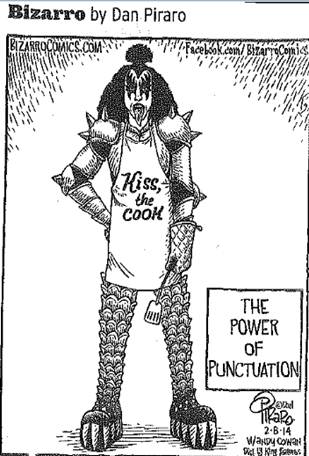
And a comic strip which mysteriously appeared on my desk:

Kara Church

Senior Technical Editor

Posted by: Jack Henry | February 19, 2014

Editor’s Corner test

I feel pretty comfortable with most punctuation rules, but for some reason, the hyphen continues to rattle me. I’m thinking maybe some of you have the same mental block; so, today I’m going to share one tip about hyphens (there are quite a few more rules; this only gets us started).
Rule: Use hyphens for phrasal adjectives when the phrasal adjective is placed before the noun. (A phrasal adjective is simply a phrase—more than one word—that describes a noun.)
To explain this rule, I’ll give you an example from my not-too-distant past. I was recently in need of someone to repair my microwave, and I sent an email to my co-workers asking if anyone could provide a referral for a small appliance repairman. I got several responses asking just how small I wanted him to be and one asking what I had against tall repair women.
One of my mistakes was in the omission of the hyphen between “small” and “appliance.” As I mentioned, you need to hyphenate phrasal adjectives like “small-appliance,” “first-rate,” or “top-notch” when they precede a noun like “repairman.” The hyphen clears up any confusion about which words are working together.
The other mistake was that I didn’t choose a gender-neutral term (like “repair person” or “technician”). Good old-fashioned public humiliation helped me to finally internalize this rule and reminded me to be even more conscientious about my word choice. I would thank my smart-alecky colleagues, but I’m still holding a grudge.

You can read more about this rule at the Grammarist website. Enjoy your day.

Donna Bradley Burcher | Technical Editor | Symitar®
8985 Balboa Ave. | San Diego, CA 92123 | Ph. 619.278.0432 | Ext: 765432

Posted by: Jack Henry | February 19, 2014

Editor’s Corner: Commas for a pause

Good afternoon! You’ll be happy to see that today’s comma lesson from the Purdue OWL is short.

Use a comma near the end of a sentence to separate contrasted coordinate elements or to indicate a distinct pause or shift.

He was merely ignorant, not stupid.

The chimpanzee seemed reflective, almost human.

You’re one of the senator’s close friends, aren’t you?

The speaker seemed innocent, even gullible.

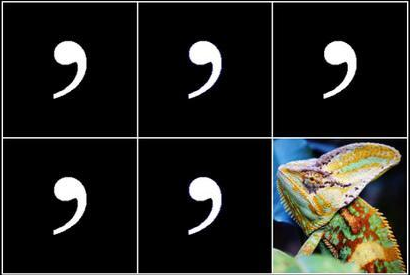
And a graphic take on a song title I used a couple weeks ago (aka some more word nerd humor):

Enjoy your day!

Kara Church

Senior Technical Editor

Posted by: Jack Henry | February 18, 2014

Editor’s Corner: Commas, adjectives, and some crazy rules

I hope you all enjoyed the extra day off! Now that you are super-charged with extra energy, let’s try to find our way through the next few comma rules. It’s understandable why people get confused—I don’t know if there are this many rules for other punctuation marks. Here’s today’s rule, which is a three-parter, from the Purdue OWL.

· DO use commas to separate two or more coordinate adjectives that describe the same noun.

· DO NOT add an extra comma between the final adjective and the noun itself.

· DO NOT use commas with non-coordinate adjectives.

Coordinate adjectives are adjectives with equal status in describing the noun; neither adjective is subordinate to the other. You can decide if two adjectives in a row are coordinate by asking the following questions:

· Does the sentence make sense if the adjectives are written in reverse order?

· Does the sentence make sense if the adjectives are written with and between them?

If you answer yes to these questions, then the adjectives are coordinate and should be separated by a comma. Here are some examples of coordinate and non-coordinate adjectives:

He was a difficult, stubborn child. (coordinate)

They lived in a white frame house. (non-coordinate)

She often wore a gray wool shawl. (non-coordinate)

Your cousin has an easy, happy smile. (coordinate)

There’s actually a hierarchy of adjectives when describing a noun. This is referred to as the cumulative order of adjectives. The order, type of adjective, and an example of each appears below. These would not be separated by commas since they are not coordinate adjectives.

Order Adjective Type Example
1 articles

demonstrative pronouns

possessive

a, an, the

this, that

his, yours, Gumby’s

2 quantity

number

some, few

three, fifty, five hundred

3 opinion pretty, handsome, stupid, cheap, happy, cheerful
4 appearance size: huge, small, tiny

shape: circular, square, long, short

condition: broken, new, wet, snowy

5 age

color

old, new, young

purple, blue, green, aqua

6 nationality

religion

Chilean, Greek, Irish

Buddhist, Jewish, Christian

7 material

purpose

silk, lead, silver, bamboo

sledding, reading, digging

Correct:

Thirty handsome young Greek men met our cruise ship.

A large black umbrella was the only thing that remained of Mary Poppins.

The plumber found an old lead pipe underneath our house.

Incorrect:

A Christian young huge man rang our doorbell.

Digging good new shovel was used to dig up the plant.

Silken aqua Pokey’s boot was found at the scene of the crime.

Kara Church

Senior Technical Editor

619-542-6773 | Ext: 766773

www.symitar.com

NOTICE: This electronic mail message and any files transmitted with it are intended
exclusively for the individual or entity to which it is addressed. The message,
together with any attachment, may contain confidential and/or privileged information.
Any unauthorized review, use, printing, saving, copying, disclosure or distribution
is strictly prohibited. If you have received this message in error, please
immediately advise the sender by reply email and delete all copies.

Posted by: Jack Henry | February 14, 2014

Editor’s Corner: Happy Valentine’s Day!

I wish you a Happy Valentine’s Day and a great three-day weekend in honor of U.S. presidents past and present. My gift to you is a series of lovey-dovey mondegreens from these three books by Gavin Edwards: ‘Scuse Me While I Kiss This Guy, When a Man Loves a Walnut, and He’s Got the Whole World In His Pants.

Remember, mondegreens are misheard song lyrics. These are presented as follows:

Group/Singer (Song Title)

Mondegreen. (Actual song lyrics.)

Bonnie Tyler (It’s a Heartache)

It’s a hard egg. (It’s a heartache.)

John Travolta and Olivia Newton-John (You’re the One That I Want)

I got shoes, they’re made of plywood (I’ve got chills, they’re multiplying)

Paul Young (Everytime You Go Away)

Every time you go away/you take a piece of meat with you. (Every time you go away/you take a piece of me with you.)

Belinda Carlisle (Mad About You)

I’m mad about food, you’re mad about cheesecake. (I’m mad about you, you’re mad about me babe.)

The Rascals (Groovin’)

Life could be ecstasy/Just you and me and Leslie, groovin’. (Life could be ecstasy/Just you and me endlessly groovin’.)

Diana Ross (Love Hangover)

I’ve got a Swedish hangover. (I’ve got the sweetest hangover.)

Barry Manilow (Mandy)

Oh Mandy, you kissed me and stopped me from shaving. (Oh Mandy, you kissed me and stopped me from shaking.)

Live (All Over You)

I love you like Walter. (Our love is like water.)

Kenny Rogers & Dolly Parton (Islands in the Stream)

Eyelids in the street. (Islands in the stream.)

Orleans (Still the One)

You’re still the one, eye with a twitch (You’re still the one, and I wouldn’t switch)

Bonnie Raitt (Something to Talk About)

Let’s give them something from Taco Bell. (Let’s give them something to talk about.)

George Harrison (Got My Mind Set on You)

I’ve got my man scent on you. (I’ve got my mind set on you.)

The Four Tops (Ain’t No Woman)

Ain’t no woman like the one-eyed Gott (Ain’t no woman like the one I’ve got)

Aerosmith (Love in an Elevator)

Loving an alligator. (Love in an elevator.)

Van Morrison (Brown Eyed Girl)

Hey there, amigo! (Hey where did we go?)

The Hues Corporation (Rock the Boat)

So I’d like to know where you got your nose from (So I’d like to know where you got the notion)

Kara Church

Senior Technical Editor

619-542-6773 | Ext: 766773

www.symitar.com

NOTICE: This electronic mail message and any files transmitted with it are intended
exclusively for the individual or entity to which it is addressed. The message,
together with any attachment, may contain confidential and/or privileged information.
Any unauthorized review, use, printing, saving, copying, disclosure or distribution
is strictly prohibited. If you have received this message in error, please
immediately advise the sender by reply email and delete all copies.
Posted by: Jack Henry | February 13, 2014

Editor’s Corner: Commas, clauses, and nonessential elements.

Good morning!

Today’s comma rule and its examples are a little lengthy…but you can do it! Push through today and you will be rewarded with three things: Valentine’s Day candy if you are in the office, some love-song mondegreens to take you into the weekend, and three days off to relax and enjoy visions of presidents and sugarplums dancing in your heads. Today’s rule and examples are brought to you from the Purdue OWL.

Note: In case you are new to Editor’s Corner, I generally keep my comments and examples in blue text. If I “borrow” from elsewhere I may reformat the text, but I’ll provide the resource and put it in black font.

Do not use commas to set off essential elements of the sentence, such as clauses beginning with that (relative clauses). That clauses after nouns are always essential. That clauses following a verb expressing mental action are always essential.

That clauses after nouns:

The book that I borrowed from you is excellent.

The apples that fell out of the basket are bruised.

That clauses following a verb expressing mental action:

She believes that she will be able to earn an A.

He is dreaming that he can fly.

I contend that it was wrong to mislead her.

They wished that warm weather would finally arrive.

Examples of other essential elements (no commas):

Students who cheat only harm themselves.

The baby wearing a yellow jumpsuit is my niece.

The candidate who had the least money lost the election.

Examples of nonessential elements (set off by commas):

Fred, who often cheats, is just harming himself.

My niece, wearing a yellow jumpsuit, is playing in the living room.

The Green party candidate, who had the least money, lost the election.

Apples, which are my favorite fruit, are the main ingredient in this recipe.

Professor Benson, grinning from ear to ear, announced that the exam would be tomorrow.

Tom, the captain of the team, was injured in the game.

It is up to you, Jane, to finish.

She was, however, too tired to make the trip.

Two hundred dollars, I think, is sufficient.

Kara Church

Senior Technical Editor

619-542-6773 | Ext: 766773

www.symitar.com

NOTICE: This electronic mail message and any files transmitted with it are intended
exclusively for the individual or entity to which it is addressed. The message,
together with any attachment, may contain confidential and/or privileged information.
Any unauthorized review, use, printing, saving, copying, disclosure or distribution
is strictly prohibited. If you have received this message in error, please
immediately advise the sender by reply email and delete all copies.

Posted by: Jack Henry | February 12, 2014

Editor’s Corner: Comma Drama, continued

Good afternoon! I hope you enjoyed your break from commas with Donna’s excellent adventures in hyphenation. That’s what we’re all about here—having fun and living the dream!

Here is a brief rule that causes all kinds of commotion. The rule is to use commas to separate three or more words, phrases, or clauses written in a series. Some say the second comma isn’t necessary; others argue its necessity. This comma has several names: the serial comma, the Oxford comma, and the Harvard comma. No matter what you call it, it is required according to a rule in the Jack Henry Corporate Style Guide.

Here are a few examples:

· We visited Athens, Hydra, and Santorini on our summer vacation.

· My favorite names for a boy dog are Spartacus, Tobias, and Bob.

· Mr. Finley said he would fix the lock, repair the kitchen window, and check the water heater.

· Everyone on the block claimed that Cecil, who had the kindest parents, who had the best education, and who made the most money, was the saddest person they’d ever met.

And here is my favorite example of how not using it can change the meaning of a sentence:

“Among those interviewed were his two ex-wives, Kris Kristofferson and Robert Duvall.” (Merle Haggard)

Kara Church

Senior Technical Editor

Posted by: Jack Henry | February 7, 2014

Editor’s Corner: Comma Pairs

Happy Friday! Donna will be giving you a break from commas during the beginning of next week, so here is a dose to last you for a few days.

RULE: Use a pair of commas in the middle of a sentence to set off clauses, phrases, and words that are not essential to the meaning of the sentence. Use one comma before to indicate the beginning of the pause and one at the end to indicate the end of the pause.

Here are some clues to help you decide whether the sentence element is essential:

· If you leave out the clause, phrase, or word, does the sentence still make sense?

· Does the clause, phrase, or word interrupt the flow of words in the original sentence?

· If you move the element to a different position in the sentence, does the sentence still make sense?

If you answer "yes" to one or more of these questions, then the element in question is nonessential and should be set off with commas.

Examples of commas with non-essential elements:

Clause: On Saturday, which happens to be National Kiwi Day, we are going to Belmont Park.

Phrase: When I’m in San Francisco, I love walking through the arboretum in Golden Gate Park. The Japanese Tea Garden, in addition, is a splendid place to spend the afternoon.

Word: You got to choose the restaurant last time. This time, therefore, Donny gets to choose the place we go for dinner.

And a little (missing) comma humor to start your weekend right. I think the magazine editor got so excited with the clever take on Eat, Pray, Love that he or she forgot the commas in the remainder of the text.

Kara Church

Senior Technical Editor

In a bit of a rush today, so today’s comma lesson doesn’t include my own examples. The following information was lovingly borrowed from the Purdue OWL.

Use commas after introductory a) clauses, b) phrases, or c) words that come before the main clause.

a. Common starter words for introductory clauses that should be followed by a comma include after, although, as, because, if, since, when, while.

While I was eating, the cat scratched at the door.

Because her alarm clock was broken, she was late for class.

If you are ill, you ought to see a doctor.

When the snow stops falling, we’ll shovel the driveway.

However, don’t put a comma after the main clause when a dependent (subordinate) clause follows it (except for cases of extreme contrast).

Incorrect: She was late for class, because her alarm clock was broken.

Incorrect: The cat scratched at the door, while I was eating.

Correct: She was still quite upset, although she had won the Oscar. (This comma use is correct because it is an example of extreme contrast.)

b. Common introductory phrases that should be followed by a comma include participial and infinitive phrases, absolute phrases, nonessential appositive phrases, and long prepositional phrases (over four words).

Having finished the test, he left the room.

To get a seat, you’d better come early.

After the test but before lunch, I went jogging.

The sun radiating intense heat, we sought shelter in the cafe.

c. Common introductory words that should be followed by a comma include yes, however, well.

Well, perhaps he meant no harm.

Yes, the package should arrive tomorrow morning.

However, you may not be satisfied with the results.

Kara Church

Senior Technical Editor

619-542-6773 | Ext: 766773

www.symitar.com

NOTICE: This electronic mail message and any files transmitted with it are intended
exclusively for the individual or entity to which it is addressed. The message,
together with any attachment, may contain confidential and/or privileged information.
Any unauthorized review, use, printing, saving, copying, disclosure or distribution
is strictly prohibited. If you have received this message in error, please
immediately advise the sender by reply email and delete all copies.

« Newer Posts - Older Posts »

Categories