Posted by: Jack Henry | January 29, 2015

Editor’s Corner: Get Your Adverbs Here

This one’s for you, John Thomas!

Today’s topic is adverbs. Most of you know that adverbs modify verbs, but did you know they also modify adjectives and other adverbs? Well, let’s start with what we know: adverbs modify verbs.

The following examples show adverbs (italic) modifying verbs (bold):

· Marie is moving slowly.

· Brenda regarded him quizzically.

· I painted butterfly pictures yesterday.

· They go to concerts frequently.

· Joe Baldocky jumped out of the freezing water quickly.

Adverbs answer these questions:

· When? (She arrived today.)

· Where? (He put the pacifier there.)

· How? (Melvin shucked the corn slowly.)

· How often? (Beatrice washes her hair daily.)

And now, my apologies for the poor quality of this video—it looks every bit of its <cough> 41 years—but I can’t send you off without the Schoolhouse Rock Lolly adverb song.

NOTICE: This electronic mail message and any files transmitted with it are intended
exclusively for the individual or entity to which it is addressed. The message,
together with any attachment, may contain confidential and/or privileged information.
Any unauthorized review, use, printing, saving, copying, disclosure or distribution
is strictly prohibited. If you have received this message in error, please
immediately advise the sender by reply email and delete all copies.

Posted by: Jack Henry | January 28, 2015

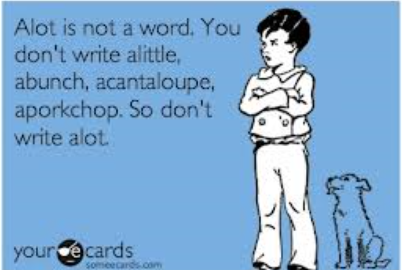
Editor’s Corner: A lot of lots

Dear Editrix,

Please cover the difference between a lot, alot, and allot.

Sincerely,

Lost with Lots

Dear Lost,

Here are some definitions for you:

· a lot: A great deal of something; an abundance.

· a lot: A place you park your car. If vacant, a place to play ball or get in trouble with your parents by getting into all kinds of shenanigans.

· allot: To assign a portion to; allocate.

· alot: This is not a word.

Sincerely,

Editrix

Kara Church

Technical Editor, Advisory

Posted by: Jack Henry | January 27, 2015

Editor’s Corner: Better, stronger, faster

We’re back with adjectives for one more day. Today we’ll cover descriptive adjectives, which shouldn’t be so tough. Descriptive adjectives are what most of us probably think of when we are playing Mad Libs: chewy, furry, green, shiny, angry, sultry, sandy, vicious, despicable, pretty, etc.

Here’s the thing to remember about descriptive adjectives: they have comparative and superlative forms. In the following examples, the adjectives are bolded:

Comparative

The taffy Jane makes is chewier than my aunt’s taffy.

Jim’s chest is furrier than Sam’s.

Chihuahuas are more vicious than other dogs when protecting their chicken bones.

Superlative

The taffy that Jane makes is the chewiest that I’ve ever eaten.

Jim has the furriest chest in town; he won the Alameda County Sasquatch trophy three years in a row.

Chihuahuas are the most vicious dogs known to humans.

You’ll notice in the examples above that sometimes descriptive adjectives are formed by adding more or most before the adjective. According to The McGraw-Hill Handbook of English Grammar and Usage, the two patterns used to form the comparative and superlative depend partly on the word’s history and partly on the word’s length. Some two-syllable words (especially from French) and all three-syllable (or longer) adjectives follow the more/most pattern. The patterns are as follows:

-er/-est Pattern more/most Pattern
brave, braver, bravest ambitious, more ambitious, most ambitious
shy, shyer, shyest serious, more serious, most serious
witty, wittier, wittiest loyal, more loyal, most loyal
happy, happier, happiest vicious, more vicious, most vicious

You can combine descriptive adjectives, though there are rules about when to use and when not to use commas. More on that later. If you can’t wait, we did cover it in the past here: https://episystechpubs.com/2014/02/18/editors-corner-commas-adjectives-and-some-crazy-rules/

Kara Church

Technical Editor, Advisory

619-542-6773 | Ext: 766773

www.symitar.com

NOTICE: This electronic mail message and any files transmitted with it are intended
exclusively for the individual or entity to which it is addressed. The message,
together with any attachment, may contain confidential and/or privileged information.
Any unauthorized review, use, printing, saving, copying, disclosure or distribution
is strictly prohibited. If you have received this message in error, please
immediately advise the sender by reply email and delete all copies.

Posted by: Jack Henry | January 26, 2015

Editor’s Corner: Piglet’s Last Stand

Good morning! I hope you all enjoyed a splendid weekend wherever you were. Let’s start where we left off on Thursday, with adjectives. We are going to categorize adjectives today in ways you never dreamed possible. According to our handy-dandy textbook, The McGraw-Hill Handbook of English Grammar and Usage:

Adjectives can be subdivided into two main classes: determiners and descriptive adjectives.

Today we’re going to concentrate on determiners. Determiners are further classified into different groups, but they have one thing in common. They always come before descriptive adjectives. Here are five of the subclasses and examples:

· articles: the, a, an (Note: Articles are sometimes considered separately as their own part of speech.)

· demonstratives: this, that, these, those

· number words:

o cardinal numbers: one, two, three

o ordinal numbers: first, second, third

o words indicating order: first, last, middle

· possessives used as adjectives:

o Chico’s (dog), Buster’s (yard)

o (possessive pronouns): his, their, our, its, her

· quantifiers: few, some, several, many

Now together with a descriptive adjective, you can see that these must always come before the descriptive adjective and noun. Here are a few examples, with the determiners in italics and the descriptive adjectives in bold:

· the first pickled pepper

· that piglet’s stinky sty

· a few wrinkly sheets

As you can see, the determiners must come first. It is incorrect to say “stinky piglet’s that sty.”

Kara Church

Technical Editor, Advisory

Posted by: Jack Henry | January 23, 2015

Editor’s Corner: Aptanagrams

It’s Friday, a day for fun! I know, I unpacked our adjectives yesterday, but those can wait until Monday. I have a new book to share with you called Tyrannosaurus Lex: The Marvelous Book of Palindromes, Anagrams, & Other Delightful & Outrageous Wordplay, by Rod L. Evans, Ph.D. (I believe Mr. Evans was paid by the word for that title!)

From the introduction of the Aptanagrams (Chapter 1):

Whole words can be hidden in other words by rearranging their letters, as when news becomes sewn. Such transformations are called anagrams, and aptanagram (ap-TAN-uh-gram) can be used to describe an anagram of an extraordinary kind. As its name suggests, it’s an anagram that forms an apt word (phrase or sentence).

For your Friday viewing pleasure, I have selected some of the more clever, less offensive items from this collection.

a decimal point = I’m a dot in place

a shoplifter = has to pilfer

A stitch in time saves nine = Is this meant as incentive?

angered = enraged

asteroid threats = disaster to Earth

Clint Eastwood = old west action

considerate = care is noted

conversation = voices rant on

dormitory = dirty room

election results = lie, let’s recount

eleven + two = twelve + one

fir cones = conifers

hibernates = the bear’s in

punishment = nine thumps

rats and mice = in cat’s dream

the eyes = they see

Western Union = no wire unsent

Kara Church

Technical Editor, Advisory

619-542-6773 | Ext: 766773

www.symitar.com

NOTICE: This electronic mail message and any files transmitted with it are intended
exclusively for the individual or entity to which it is addressed. The message,
together with any attachment, may contain confidential and/or privileged information.
Any unauthorized review, use, printing, saving, copying, disclosure or distribution
is strictly prohibited. If you have received this message in error, please
immediately advise the sender by reply email and delete all copies.
Posted by: Jack Henry | January 22, 2015

Editor’s Corner: Unpack Your Adjectives

Today I introduce you to our third part of speech: adjectives.

· The first role of adjectives is to modify nouns. When adjectives modify nouns they come before the noun.

Examples (the adjectives are in bold, the nouns are italicized):

o big, hairy toe

o auburn curls

o vicious hamster

· The second role is as predicate adjectives. What the heck are predicate adjectives, you ask? These are adjectives that modify the linking verbs we talked about. (The “predicate” is the part of the sentence that contains the verb.) As stated in The McGraw-Hill Handbook of English Grammar and Usage, “As predicate adjectives, adjectives follow linking (descriptive) verbs and describe the subject.”

Examples (the predicate adjectives are in bold, the verb is italicized):

o The breadsmelled delicious.

o Charlie is happy.

o The caterpillarbecame restless.

We are going to concentrate on adjectives that modify nouns for the next day or so. Until then, I have another trip down memory lane for you with Schoolhouse Rock.

Kara Church

Technical Editor, Advisory

619-542-6773 | Ext: 766773

www.symitar.com

NOTICE: This electronic mail message and any files transmitted with it are intended
exclusively for the individual or entity to which it is addressed. The message,
together with any attachment, may contain confidential and/or privileged information.
Any unauthorized review, use, printing, saving, copying, disclosure or distribution
is strictly prohibited. If you have received this message in error, please
immediately advise the sender by reply email and delete all copies.

Posted by: Jack Henry | January 21, 2015

Editor’s Corner: The “Will” Test for Verbs

Let’s continue from where we left off yesterday. I think it was the swamp of verbs and The McGraw-Hill Handbook of English Grammar and Usage definition and examples:

The defining characteristic of all verbs is that verbs (and only verbs) have tenses: present, past, and future. Unless a word can be used in the present, past, and future tense, it is not a verb—no exceptions. Verbs come in two flavors: regular and irregular. Regular verbs form their past tenses in an absolutely regular way by adding –ed (sometimes just –d if the verb already ends in an e). Irregular verbs form their past tense in some other irregular way, often by changing the vowel of the verb.

Examples:

Present: Wilbur always remembers his mother’s birthday.

Orville always forgets his mother’s birthday.

Past: Wilbur remembered his mother’s birthday this year.

Orville forgot his mother’s birthday this year.

Future: Wilbur will remember his mother’s birthday this year.

Orville will forget his mother’s birthday this year.

The Will Test for Verbs

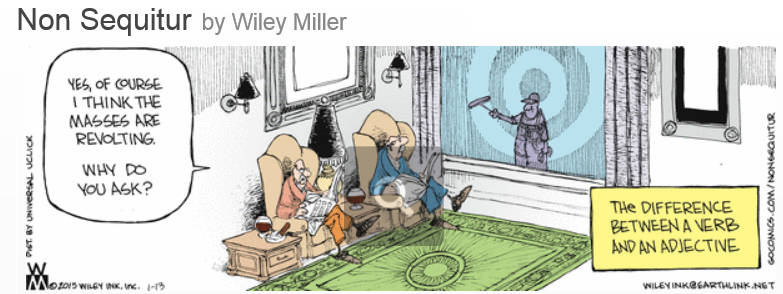
If you can put will in front of a word and the result is grammatical, then that word must be a verb.

Ah-ha! Another handy test to see what part of speech a word is being used for. Let’s test some examples:

Initial sentences:

· He planted a row of strawberries.

· I row to Bainbridge Island every morning.

Applying the Will Test for Verbs:

· He planted a (will) row of strawberries. (Sounds horrible. In this case, row is a noun.)

· I (will) row to Bainbridge Island every morning. (That works! In this case, row is a verb.)

http://www.gocomics.com/nonsequitur/2015/01/13 Thanks for sending this, Kathy S.!

Kara Church

Technical Editor, Advisory

Posted by: Jack Henry | January 20, 2015

Editor’s Corner: Action and Linking Verbs

I hope you feel rested and relaxed after this weekend because today we are diving back into the parts of speech, belly-flopping straight into verbs. First, the traditional definition of a verb from The McGraw-Hill Handbook of English Grammar and Usage: “a word used to express action or describe a state of being.” Based on this definition, we’ll further categorize verbs as action verbs and linking verbs. For example:

Action Verbs

(The subject of the sentence is performing some action.)

· Suzie always cries at sad movies.

· Blake writes a column for the Seattle Times.

· Hodor caught a rabbit for dinner.

Linking Verbs

(The subject is not doing anything in particular.)

· Suzie is hilarious.

· Blake’s novel was famous.

· The roasted rabbit smelled delicious. (The rabbit isn’t doing the smelling in this case, so smell is a linking verb.)

This differentiation will come in handy later on. Tomorrow we’ll further categorize verbs into “regularity” and tense. Until then, more Schoolhouse Rock.

Kara Church

Technical Editor, Advisory

619-542-6773 | Ext: 766773

www.symitar.com

NOTICE: This electronic mail message and any files transmitted with it are intended
exclusively for the individual or entity to which it is addressed. The message,
together with any attachment, may contain confidential and/or privileged information.
Any unauthorized review, use, printing, saving, copying, disclosure or distribution
is strictly prohibited. If you have received this message in error, please
immediately advise the sender by reply email and delete all copies.

Posted by: Jack Henry | January 16, 2015

Editor’s Corner: Gus Foster

Happy Friday! I hope you enjoy your Dr. Martin Luther King, Jr. Day, too. To send you off to the weekend on the right foot, I have some misheard song lyrics for you. A couple of them might be repeats from other resources, but I think you’ll still enjoy them.

Today’s mondegreens are from The Ants Are My Friends, by Martin Toseland.

Song Title Artist Actual Lyrics Mondegreen
What a Wonderful World Louis Armstrong The bright blessed day,
Dark sacred nights
The bride bless the day,

The dogs say goodnight

Don’t It Make My Brown Eyes Blue Chrystal Gale Don’t it make my brown eyes blue Doughnuts make my brown eyes blue
Love Hurts Nazareth Love hurts, love scars, love wounds, it mars Love Earth, love stars,

Love Moon, and Mars

Emotion Destiny’s Child (remake of Samantha Sang version) Cry me a river
That leads to an ocean
Cry me a river
That leads to erosion
Fall on Me R.E.M. Buy the sky and sell the sky and lift your arms up to the sky
And ask the sky and ask the sky
Don’t fall on me
Find this guy and tell this guy and lift your arms to beg this guy
And ask this guy and ask this guy

To fall on me

Eyes Without a Face Billy Idol Eyes without a face Flies in outer space
We Will Rock You Queen You’ve got mud on your face, big disgrace You’ve got mud on your face, front disc brakes
La Isla Bonita Madonna Last night I dreamt of San Pedro Last night I dreamt of some bagels
Cruel Summer Bananarama It’s a cruel, cruel summer It’s a fruit, fruit samba
Brass in Pocket The Pretenders Gonna use my style
Gonna use my sidestep
Gonna use my style
Gonna use my sausage
The Sound of Silence Simon and Garfunkel Silence like a cancer grows Silence like a casserole
Ghostbusters Ray Parker Jr. Who you gonna call?

Ghostbusters!

Who you gonna call?

Gus Foster!

Kara Church

Technical Editor, Advisory

619-542-6773 | Ext: 766773

www.symitar.com

NOTICE: This electronic mail message and any files transmitted with it are intended
exclusively for the individual or entity to which it is addressed. The message,
together with any attachment, may contain confidential and/or privileged information.
Any unauthorized review, use, printing, saving, copying, disclosure or distribution
is strictly prohibited. If you have received this message in error, please
immediately advise the sender by reply email and delete all copies.

Posted by: Jack Henry | January 15, 2015

Recall: Editor’s Corner: Any Place That You Could Go…

Kara Church would like to recall the message, “Editor’s Corner: Any Place That You Could Go…”.
NOTICE: This electronic mail message and any files transmitted with it are intended exclusively for the individual or entity to which it is addressed. The message,
together with any attachment, may contain confidential and/or privileged information.
Any unauthorized review, use, printing, saving, copying, disclosure or distribution is strictly prohibited. If you have received this message in error, please immediately advise the sender by reply email and delete all copies.
« Newer Posts - Older Posts »

Categories


