Posted by: Jack Henry | January 15, 2015

Correction: Editor’s Corner: Any Place That You Could Go…

See important correction below.

Today we return briefly to The McGraw-Hill Handbook of English Grammar and Usage to talk about nouns. “The word noun comes from a Latin word that means “name.” Accordingly, nouns are often defined by their naming ability: a noun is a word used to name a person, a place, a thing, or an idea.” (p.4)

Now, those of us who grew up watching “Schoolhouse Rock” probably have that definition lodged deeply in our brains. (If not, click here and I bet you’ll be humming the chorus all day.) But as I mentioned yesterday, sometimes words can function as more than one part of speech, and that gets us a bit confused.

McGraw-Hill has a little test to figure out if a word is being used as a noun in a particular sentence. It’s called “The the Test for Common Nouns.” It states: “If the can be put immediately in front of a word and the result makes sense, then that word is a noun.” (p.5) Let’s see how that works.

I tried to (the) run across the field. (Yuck! Sounds terrible. In this case, run is not a noun; run is a verb.)

The pony’s (the) roan coat was quite unusual. (Horrible! There’s no way roan being used as a noun; roan is an adjective.)

Putting the in front of those words does not make sense and that indicates they are [KC] NOT common nouns.

Now let’s try some different sentences:

Jim put Toby in the dog run so he could enjoy the summer air. (run is a noun)

The strawberry roan grazed in the fields. (roan is a noun)

In the following cases, “the” is actually already there in the sentence:

Jim put Toby in the (dog) run

The (strawberry) roan grazed…

Next on the agenda: verbs.

Kara Church

Technical Editor, Advisory

619-542-6773 | Ext: 766773

www.symitar.com

NOTICE: This electronic mail message and any files transmitted with it are intended
exclusively for the individual or entity to which it is addressed. The message,
together with any attachment, may contain confidential and/or privileged information.
Any unauthorized review, use, printing, saving, copying, disclosure or distribution
is strictly prohibited. If you have received this message in error, please
immediately advise the sender by reply email and delete all copies.

Posted by: Jack Henry | January 15, 2015

Editor’s Corner: Any Place That You Could Go…

Today we return briefly to The McGraw-Hill Handbook of English Grammar and Usage to talk about nouns. “The word noun comes from a Latin word that means “name.” Accordingly, nouns are often defined by their naming ability: a noun is a word used to name a person, a place, a thing, or an idea.” (p.4)

Now, those of us who grew up watching “Schoolhouse Rock” probably have that definition lodged deeply in our brains. (If not, click here and I bet you’ll be humming the chorus all day.) But as I mentioned yesterday, sometimes words can function as more than one part of speech, and that gets us a bit confused.

McGraw-Hill has a little test to figure out if a word is being used as a noun in a particular sentence. It’s called “The the Test for Common Nouns.” It states: “If the can be put immediately in front of a word and the result makes sense, then that word is a noun.” (p.5) Let’s see how that works.

I tried to (the) run across the field. (Yuck! Sounds terrible. In this case, run is not a noun; run is a verb.)

The pony’s (the) roan coat was quite unusual. (Horrible! There’s no way roan being used as a noun; roan is an adjective.)

Putting the in front of those words does not make sense and that indicates they are common nouns.

Now let’s try some different sentences:

Jim put Toby in the dog run so he could enjoy the summer air. (run is a noun)

The strawberry roan grazed in the fields. (roan is a noun)

In the following cases, “the” is actually already there in the sentence:

Jim put Toby in the (dog) run

The (strawberry) roan grazed…

Next on the agenda: verbs.

Kara Church

Technical Editor, Advisory

619-542-6773 | Ext: 766773

www.symitar.com

NOTICE: This electronic mail message and any files transmitted with it are intended
exclusively for the individual or entity to which it is addressed. The message,
together with any attachment, may contain confidential and/or privileged information.
Any unauthorized review, use, printing, saving, copying, disclosure or distribution
is strictly prohibited. If you have received this message in error, please
immediately advise the sender by reply email and delete all copies.

Posted by: Jack Henry | January 14, 2015

Editor’s Corner: Back to Basics

I’m calling this first portion of our grammar adventure “Back to Basics.” We’re going to start at the beginning (a very good place to start)—not quite like Maria von Trapp, but close. I am using The McGraw-Hill Handbook of English Grammar and Usage as my guide and we’re going to ease into this whole thing.

Parts of Speech

Yes, we’ve covered these before, but let’s come at it from a different angle this time. Depending on your resources, there may be seven, eight, or nine parts of speech. We are sticking with the classic eight: nouns, pronouns, adjectives, verbs, adverbs, conjunctions, prepositions, and interjections.

That’s fine and dandy, but how does that help us? Well, knowing how a word functions in a sentence can eventually improve your use of that word and your grammar. From the McGraw grammar book:

Words are classified into parts of speech according to the way words function in a sentence. It is important to realize that a word’s part of speech is not inherent in the word itself but in the way the word is used. [KC – Emphasis mine.] It is not unusual for a word to belong to more than one part of speech class depending on how the word is used. For example, the word round can be used as a noun, a verb, or an adjective:

Noun: Should we get another round?

Verb: Horses round the last post and head for home.

Adjective: He put a small, round pebble in his pocket.

So, instead of asking the question, “What part of speech is X?,” we should always ask the question, “What part of speech is X in this sentence?”

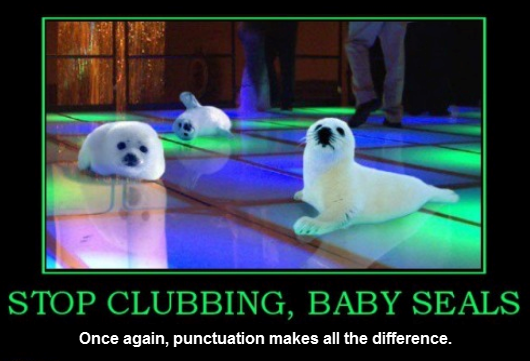
While you chew on that a bit, here is a repeat of one of my favorite punctuation jokes:

Kara Church

Technical Editor, Advisory

Posted by: Jack Henry | January 13, 2015

Editor’s Corner: What Is Grammar?

Good morning, everyone! As I was packing a giant piñata and my laptop into the car this morning, I somehow managed to forget my grammar book. So much for the plans to get started with our grammar adventures! I do have an article from Daily Writing Tips about grammar. I must warn you it is a little stuffier than what I hope to produce in the weeks to come. My goal is for us all to discover (or re-discover) a few things about English, without killing your desire to learn.

Here is the post from January 10, 2015:

A Web search for the word grammar brings up about 171,000,000 hits. Many of the links lead to discussions of “bad grammar.” In popular usage, grammar can mean anything from misspelling a word to putting an apostrophe where it doesn’t belong.

In Modern English Usage (1926-1964), Fowler defines grammar as “a general term for the science of language.” In the 1965 revision, Gower points out that the science of language is now called linguistics and that grammar is a branch of it.

Linguistics is concerned with such terms as phonology, morphology, accidence, orthoepy, orthography, composition, semantics, syntax, and etymology. Language blogs may attract readers who are interested in all of these aspects of language, but as Fowler points out and Gower echoes, orthography, accidence, and syntax are what most English speakers focus on when they talk about grammar–bad or good.

Orthography: the art of writing words with the proper letters according to standard usage. Misspelled words are errors of orthography. So are misplaced apostrophes. [KC – So is yo’ mamma. Sorry. It was getting a little heavy here.]

Accidence: the part of grammar that deals with changes in words to change their meaning, for example, adding endings to verbs or changing their spelling to indicate different tenses (walk/walked, run/ran, go/went), adding letters to nouns or changing their spelling to indicate number (boy/boys, man/men), and spelling pronouns differently to indicate subject or object. “Has went” and “between you and I” are examples of errors of accidence.

Syntax: the arrangement of word forms to show their mutual relations in the sentence.
“Coming out of the auditorium, a purse was lost” is an error of syntax.

Here are Fowler’s and Gower’s simple definitions of the other terms:

phonology: how sounds are made and depicted.
morphology: how words are made.
orthoepy: how words are said.
composition: how words are fused into compounds.
semantics: how words are to be understood.
etymology: how words are derived and formed.

And now, why grammar is so important:

Kara Church

Technical Editor, Advisory

Posted by: Jack Henry | January 9, 2015

Editor’s Corner: In or Within?

Dear Editrix,

I get confused by when to use in or within. Is this dependent on the context or are both generally acceptable?

Signed,

Wondering Within

Dear Wondering,

Excellent question! While in and within can both play the role of a preposition, they are not always interchangeable. Rather than go through all of the possible ways you can use the words, let’s focus on the areas in which they might be confusing.

· in: Used to indicate location or position. For example:

o The nurse gave me an injection in my arm.

o Sunny swam in the lake.

· within:Used to indicate enclosure, containment, and limitations. For example:

o Company V is excellent about promoting from within their organization.

· in or within: In the following cases you could use one or the other. It depends whether you want to emphasize the object’s location (in the jar) or that the object is contained (within the fenced area, within the center of the target). For example.

o The cookies are in the jar.

o Cats are not allowed within the fenced area of Grape Street Dog Park.

o Sam’s aim was perfect; all of the bullets landed within the center of the target.

Sincerely,

Editrix

NOTICE: This electronic mail message and any files transmitted with it are intended
exclusively for the individual or entity to which it is addressed. The message,
together with any attachment, may contain confidential and/or privileged information.
Any unauthorized review, use, printing, saving, copying, disclosure or distribution
is strictly prohibited. If you have received this message in error, please
immediately advise the sender by reply email and delete all copies.
Posted by: Jack Henry | January 8, 2015

Editor’s Corner: Resilience vs Resiliency

Before we start on our next great adventure into grammar, I’m going to answer a few questions from the audience.

Dear Editrix,

While watching NFL football this past weekend, I noticed quite a few of the sportscasters using the word resiliency when describing a team’s ability to overcome their opponent’s scoring, i.e., the Cowboys’ resiliency is impressive. To my ear, the correct word should be resilience. However, when researching it appears the words can be used interchangeably and both have the same definition. Is there any difference?

Sincerely,

Football Fan

Dear Football Fan,

What an interesting observation! I’m with you—to my ear, resiliency sounds like the sportscasters trying to be fancy. Here’s what our friends at Merriam-Webster have to say:

resilience (noun)

: the ability to become strong, healthy, or successful again after something bad happens

: the ability of something to return to its original shape after it has been pulled, stretched, pressed, bent, etc.

resiliency (noun)

: resilience

I checked a few resources on the histories of both words and it seems that resilience has been around several more decades than resiliency, but both words are from the 1600s (1620 and 1660, respectively). Not only do I agree with your “ear”—that resilience sounds better—but your conclusion that they are interchangeable seems to be correct, too.

Thanks for the question!

Editrix

NOTICE: This electronic mail message and any files transmitted with it are intended
exclusively for the individual or entity to which it is addressed. The message,
together with any attachment, may contain confidential and/or privileged information.
Any unauthorized review, use, printing, saving, copying, disclosure or distribution
is strictly prohibited. If you have received this message in error, please
immediately advise the sender by reply email and delete all copies.

Posted by: Jack Henry | January 7, 2015

Editor’s Corner: Homely vs Homey

Good morning, folks! I received an email tip from Grammar Girl today about the terms “homely vs homey.” With Downton Abbey back on TV, goodness knows we want you to be able to tell when someone is hurling an insult at someone else! Mignon Fogarty’s words of wisdom:

Kits wrote, "I watch some British shows, mainly home purchase or decor, and I often hear the word ‘homely.’ To me, ‘homely’ means ugly or at least unattractive, and I think the Brits must mean what I would call ‘homey,’ meaning cozy, comfortable, etc. Can you explain how ‘homely’ came to mean the total opposite over here and how ‘homey’ arose (and why it isn’t used over there)?"

It seems that homely underwent a progression in meaning that survived in the U.S. but didn’t survive in Britain.

In Middle English, homely first simply referred to something of the home; later it came to mean a simple or ordinary home. Then homely could also mean a simple or ordinary person—perhaps someone who was good around the house at ordinary domestic tasks or was unadorned, plain, or unsophisticated. Finally, all those words—plain, simple, unadorned, unattractive, and by extension, ugly—were applied to appearance and you could describe a house or person as homely, and it was a bad thing. That "unattractive" meaning was used in both Britain and North America for a while, but today it mainly survives only in North America.

I can’t explain why the "unattractive" meaning didn’t stick in Britain, but it’s good to know that if you’re an American traveling in Britain, you shouldn’t be offended if someone offers to rent you a homely room.

An interesting etymological note is that in some cases, homely was closely tied to humble, and long ago it was sometimes spelled with a u: humly.

Kara Church

Technical Editor, Advisory

619-542-6773 | Ext: 766773

www.symitar.com

NOTICE: This electronic mail message and any files transmitted with it are intended
exclusively for the individual or entity to which it is addressed. The message,
together with any attachment, may contain confidential and/or privileged information.
Any unauthorized review, use, printing, saving, copying, disclosure or distribution
is strictly prohibited. If you have received this message in error, please
immediately advise the sender by reply email and delete all copies.

Posted by: Jack Henry | January 6, 2015

Editor’s Corner: New Year’s Resolutions

As you may have guessed with my timing of the 12 Days of English and today’s topic (New Year’s resolutions), I’m not exactly on the same schedule as the rest of the world. Today’s article is from Wikipedia, and it is a brief explanation of what a New Year’s resolution is and where the idea came from.

I also want to congratulate Ron Harman for winning my lightly used copy of Deck the Halls with Buddy Holly. Enjoy!

A New Year’s resolution is a tradition, most common in the Western Hemisphere but also found in the Eastern Hemisphere, in which a person makes a promise to do an act of self-improvement or something slightly nice, such as opening doors for people beginning from New Year’s Day.

Religious origins

· The ancient Babylonians made promises to their gods at the start of each year that they would return borrowed objects and pay their debts.

· The Romans began each year by making promises to the god Janus, for whom the month of January is named.

· In the Medieval era, the knights took the "peacock vow" at the end of the Christmas season each year to re-affirm their commitment to chivalry.

· At watchnight services, many Christians prepare for the year ahead by praying and making these resolutions.

· There are other religious parallels to this tradition. During Judaism’s New Year, Rosh Hashanah, through the High Holidays and culminating in Yom Kippur (the Day of Atonement), one is to reflect upon one’s wrongdoings over the year and both seek and offer forgiveness. People may act similarly during the Christian liturgical season of Lent, though the motive behind this holiday is more of sacrifice than of responsibility, in fact the practice of New Year’s resolutions partially came from the Lenten sacrifices.

The concept, regardless of creed, is to reflect upon self-improvement annually.

Kara Church

Technical Editor, Advisory

619-542-6773 | Ext: 766773

www.symitar.com

NOTICE: This electronic mail message and any files transmitted with it are intended
exclusively for the individual or entity to which it is addressed. The message,
together with any attachment, may contain confidential and/or privileged information.
Any unauthorized review, use, printing, saving, copying, disclosure or distribution
is strictly prohibited. If you have received this message in error, please
immediately advise the sender by reply email and delete all copies.

Posted by: Jack Henry | January 5, 2015

Editor’s Corner: And the winner is…

Good morning. I thought it would be fun to provide you with a list of the top words for 2014. However, when I searched for the top words of 2014 on the Internet, a news heading caught my eye. According to the 15th Annual Survey of Global English conducted by Global Language Monitor (GLM), the Heart emoji was the most used word of 2014, even though it’s not a word.

GLM analyzes how frequently words are used in global media channels, including the Internet, blogs, electronic and print media, and social media sources.

Per GLM’s website, “The English Language is now undergoing a remarkable transformation unlike any in its 1400 year history – its system of writing, the Alphabet, is gaining characters at amazing rate.” [sic]

Yes, the English language continues to evolve. However, the use of emoji’s or emoticons in business writing is still frowned upon. So, unless you are a 13-year old girl, it’s always best to use words. You never know who will end up reading your writing.

Jackie Solano | Technical Editor | Symitar®

8985 Balboa Ave. | San Diego, CA 92123 | Ph. 619.542.6711 | Extension: 766711

Posted by: Jack Henry | January 2, 2015

Editor’s Corner: Desserts or Deserts?

The holidays are over, and I don’t know about you but I’m done with desserts (for a while). You might say, “I’ve had my just desserts,” but if you said that, you’d be wrong—not because I want more dessert, but because desserts is the wrong word to use in that context.

The correct word is deserts. However, it is pronounced the same way we pronounce the word that stands for those lovely sweets we eat too many of this time of year. You might be surprised to learn the several definitions of the word desert and to see their pronunciations:

[DEZ-ert] (noun): an arid place

[deh-ZERT] (verb): to abandon

[deh-ZERT] (noun): worthiness of recompense

So when we get our “just deserts,” we are not getting the sweet that we deserve, and we’re not getting an arid location, we are getting compensated (and it usually isn’t good). If you want to read a little bit more about this old adage, Maeve Maddox wrote an interesting article on Daily Writing Tips.

Donna Bradley Burcher | Technical Editor, Adv. | Symitar®

8985 Balboa Ave. | San Diego, CA 92123 | Ph. 619.278.0432 | Ext: 765432

« Newer Posts - Older Posts »

Categories