Posted by: Jack Henry | April 28, 2015

Editor’s Corner: Semicolon or Colon?

Recently, Kara gave a great presentation called What You Need to Know about Common Grammatical Errors. During the Q&A, someone asked, “How do I know when to use a colon and when to use a semicolon?” Today, I’m going to answer that question. I won’t give you all the rules for colons and semicolons, just the main rule that differentiates the two.

· Use a semicolon to separate two complete sentences.

Example: On Friday, she went out with a man she met on Match.com; on Saturday, she closed her Match.com account.

Note: Use a semicolon rather than a period to separate two complete sentences when the sentences are closely related. (We use semicolons in our documentation, but not frequently.)

· Use a colon to separate a complete sentence from an item or a list that illustrates or amplifies the sentence. (A colon generally means “as follows.”)

Example: The man had only three topics of conversation: his cat, his collection of horror movie paraphernalia, and his mother.

Note: The text that comes before the colon must always be a complete sentence. The text that comes after the colon provides further explanation and does not have to be a complete sentence.

Make the best of the rest of your day.

Donna Bradley Burcher | Technical Editor, Adv. | Symitar®

8985 Balboa Ave. | San Diego, CA 92123 | Ph. 619.278.0432 | Extension: 765432

Symitar Technical Publications Writing and Editing Requests

NOTICE: This electronic mail message and any files transmitted with it are intended
exclusively for the individual or entity to which it is addressed. The message,
together with any attachment, may contain confidential and/or privileged information.
Any unauthorized review, use, printing, saving, copying, disclosure or distribution
is strictly prohibited. If you have received this message in error, please
immediately advise the sender by reply email and delete all copies.


Posted by: Jack Henry | April 27, 2015

Editor’s Corner: The Job Has Run

Welcome back from the weekend. I hope yours was as good as mine.

Today’s language tip is about tense. A few people have asked the editors to explain the correct way to talk about a job or process that has already taken place. The question is “Has the job ran or has the job run?”

Let’s start with this simple fact: the three standard forms of the verb to run are:

· run (present tense)

· ran (past tense)

· have run (present perfect tense)

Now, let’s concentrate on the one that causes trouble: have run.

So, which of these two sentences do you think is correct?

· Make sure that you have already run Daily Posting.

· Make sure that you have already ran Daily Posting.

If you’re still not sure, maybe it will be more clear if we move the word already, like this:

· Make sure that you have run Daily Posting already.

· Make sure that you have ran Daily Posting already.

Recall the simple fact we started with—the standard forms of the verb to run are run, ran, and have run—and you might be able to deduce that the correct answers are:

· Make sure that you have already run Daily Posting.

· Make sure that you have run Daily Posting already.

Tip: We use the perfect tense—and specifically the present perfect tense (have run)—to talk about things that occur at vague times in the past.

Joke: The past, the present, and the future walk into a bar. It was tense.

Donna Bradley Burcher | Technical Editor, Adv. | Symitar®

8985 Balboa Ave. | San Diego, CA 92123 | Ph. 619.278.0432 | Extension: 765432

Symitar Technical Publications Writing and Editing Requests

NOTICE: This electronic mail message and any files transmitted with it are intended
exclusively for the individual or entity to which it is addressed. The message,
together with any attachment, may contain confidential and/or privileged information.
Any unauthorized review, use, printing, saving, copying, disclosure or distribution
is strictly prohibited. If you have received this message in error, please
immediately advise the sender by reply email and delete all copies.
Posted by: Jack Henry | April 24, 2015

Editor’s Corner: Take That Semordnilap!

It’s Friday fun-day at the Editor’s Corner. And I have a new word (at least it’s new to me) to introduce to you. The word is semordnilap.

As you already know, when a word is spelled the same way forward and backward, it is called a palindrome (for example, mom, rotator, and racecar). However, when a word that is spelled backward reveals another word (for example, maps spelled backward becomes spam), that word is called a semordnilap (which is palindromes spelled backward).

For your Friday viewing pleasure, here is a partial list of semordnilaps:

Bonk Knob
Brag Garb
Buns Snub
Decal Laced
Deliver Reviled
Denim Mined
Desserts Stressed
Devil Lived
Diaper Repaid
Doom Mood
Drawer Reward
Edit Tide
Evil Live
Gulp Plug
Nuts Stun
Pacer Recap
Parts Strap
Peels Sleep
Rebut Tuber
Reknit Tinker
Snips Spins
Snoops Spoons
Snot Tons
Straw Warts

Information about semordnilaps and the list above come from Rod L. Evans’ book Tyrannosaurus Lex: The Marvelous Book of Palindromes, Anagrams, & Other Delightful & Outrageous Wordplay.

Enjoy the rest of your day and the upcoming weekend, my friends!

Donna Bradley Burcher | Technical Editor, Adv. | Symitar®

8985 Balboa Ave. | San Diego, CA 92123 | Ph. 619.278.0432 | Ext: 765432

Symitar Technical Publications Writing and Editing Requests

NOTICE: This electronic mail message and any files transmitted with it are intended
exclusively for the individual or entity to which it is addressed. The message,
together with any attachment, may contain confidential and/or privileged information.
Any unauthorized review, use, printing, saving, copying, disclosure or distribution
is strictly prohibited. If you have received this message in error, please
immediately advise the sender by reply email and delete all copies.
Posted by: Jack Henry | April 23, 2015

Editor’s Corner: After Earth

Yesterday, we learned to capitalize the word Earth when it is used like a name. We also learned to lowercase earth if it is preceded by the (such as, “The earth is the densest planet in our solar system”). Today, we’ll get some quality time with the moon.

According to the Chicago Manual of Style, the word moon should be lowercase unless you write for a publication in the field of astronomy or a related science. Unless you’re paid to think about space, give that moon the lowercase.

Examples:

· When the moon is full, the whole village goes for a walk.

· Earth has one moon, Saturn has many moons, and the Death Star is no moon.

Thanks,

Laura Bowers | Technical Writer | Symitar®

8985 Balboa Ave. l San Diego, CA 92123-1507

619.542.6935 l or Ext. 766935

Symitar Documentation Services

Posted by: Jack Henry | April 22, 2015

Editor’s Corner: Get Your Earth On!

It’s Earth Day, but should we talk about the Earth… or the earth? Today’s Editor’s Corner will help you write confidently about your favorite home planet.

Capitalization rules can vary between style guides, but at Symitar, we follow the Chicago Manual of Style. Here’s what it has to say:

In nontechnical contexts the word earth, in the sense of our planet, is usually lowercased when preceded by the or in such idioms as “down to earth” or “move heaven and earth.”

In other words, the word earth should usually be lowercased if the is in front of it. For example, you could say, “The earth is full of renewable resources.” You should also lowercase earth when you use earth in a figure of speech such as, “What on earth has gotten into that kazoo player?”

When used as the proper name of our planet, especially in context with other planets, it is capitalized, and the is usually omitted.

In other words, capitalize Earth when you use it like any other proper name. For example, you might say, “Space debris orbits Earth” or “Earth is similar in size to Venus.” You would never put the in front of a proper name unless your name is Dwayne Johnson.

Another approach is to see if you can replace the word Earth with world. If world makes sense, lowercase earth.

Happy Earth Day!

Thanks,

Laura Bowers | Technical Writer | Symitar®

8985 Balboa Ave. l San Diego, CA 92123-1507

619.542.6935 l or Ext. 766935

Symitar Documentation Services

Posted by: Jack Henry | April 21, 2015

Editor’s Corner: Leftovers

Hello folks! Over the next week, my dear fellow-editors will be taking over Editor’s Corner. Donna, Jackie, and Laura have some verbal delights and nifty nuggets that are sure to please you!

A few questions came in about numbers this week. Here are the questions and answers for you.

· Question: What is the proper way to write third party? 3rd party? Third-party? One party to the right of the second party?

· Answer: It depends how you are using the word.

o First, don’t use the ordinal—spell out third.

o Second, if you are using the entire term third-party as an adjective, it is hyphenated:

§ Third-party software

§ Third-party interface

o Third, when you are using the adjective third to modify the noun party, then it is not hyphenated:

§ A third party was involved to mediate between the two sides.

§ That was the third party I went to Saturday night.

· Question: Which way should the single quote mark be facing when using it before the abbreviation of a decade?

· Answer: It should actually be an apostrophe, but if you aren’t careful, Word will “fix” it for you and turn it into a single, opening quote mark. So, it should look like it does below, not like yesterday’s email.

o In the ’70s and early ’80s, I rocked several pairs of gauchos and corduroy OshKoshes®.

There’s one more question, but it is a bit more involved, so I’ll save it for another day.

Gauchos a-go-go!

Kara Church

Technical Editor, Advisory

Symitar Documentation Services

Posted by: Jack Henry | April 20, 2015

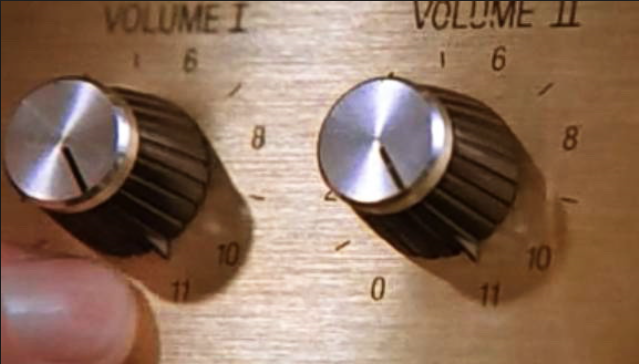
Editor’s Corner: This one goes to eleven.

I hope you all enjoyed the weekend! Today I continue with tips on using numbers in your writing.

Rule #6

When writing out a number of three or more digits, the word and is not necessary. However, use the word and to express any decimal points that may accompany these numbers.

Examples:
two thousand four hundred twenty-five dollars
two thousand four hundred twenty-five dollarsandsixty-two cents

Rule #7:

When writing out a date, do not use ordinals. They aren’t necessary and they tend to cause formatting trouble if you have Microsoft® Word set up to insert them automatically.

Examples:
June 30, 1934 (no -th necessary)
Fourth of July (or Independence Day)

Rule #8:

When spelling out decades, do not capitalize them.

Example: During the eighties and nineties, the U.S. economy grew.

Bonus Round: If you are using numerals instead of words to talk about decades, the apostrophe goes before the numerals and you do not use an apostrophe before the “s.”

Examples:
I have always had straight hair, except in the ‘80s when I lost my sense and got a perm.
The outfits from the ‘50s and ‘60s still make popular Halloween costumes.

Spinal Tap: This one goes to eleven.

Kara Church

Technical Editor, Advisory

Symitar Documentation Services

Posted by: Jack Henry | April 17, 2015

Editor’s Corner: Hold Me Closer, Tony Danza

I have more number rules for you, but it is Friday. Friday is a day to relax a little and start easing into the weekend. Plus, I have a new book of mondegreens (misheard song lyrics, for those of you new to the Editor’s Corner). I still have some from the last contest, too.

Today’s mondegreens are from our favorite collector, Charles Grosvenor Jr., and his book Hold Me Closer, Tony Danza.

Song Title Artist/Group Actual Lyrics Mondegreen
Let Me Go 3 Doors Down In this world,
There’s real and make believe
In this world,

There’s real and Maybeline

In Da Club 50 Cent We’re gon’ sip Bacardi like it’s your birthday We’re gon’ send a cardy like it’s your birthday
I Do (Cherish You) 98 Degrees Your hand brushes mine Your hair versus mine
Give Me Just One Night (Una Noche) 98 Degrees Give me just one night, una noche! Give me just one night, on a lawn chair!
Are You That Somebody? Aaliyah Give me goose bumps and high fevers Give me tube socks and long sleeves
We Need a Resolution Aaliyah Now tell me what’s the reason? Stupid yo? Now tell me what’s the reason? Snoop video?
Crazy Aerosmith I feel like the color blue. I feel like a caribou.
Dude Looks Like a Lady Aerosmith Dude looks like a lady Do the dragon lady
Jaded Aerosmith You think that’s where it’s at,
But is that where it’s supposed to be
Your finger’s where it’s at,

But is that where it’s supposed to be

Janie’s Got a Gun Aerosmith Run away from the pain, yeah Run away from the pagan
You Don’t Know My Name Alicia Keys And your cuff links are shining all bright And your cough mixture’s shining all bright
If I Ain’t Got You Alicia Keys Some people want diamond rings Some people want collard greens

Kara Church

Technical Editor, Advisory

619-542-6773 | Ext: 766773

Symitar Documentation Services

NOTICE: This electronic mail message and any files transmitted with it are intended
exclusively for the individual or entity to which it is addressed. The message,
together with any attachment, may contain confidential and/or privileged information.
Any unauthorized review, use, printing, saving, copying, disclosure or distribution
is strictly prohibited. If you have received this message in error, please
immediately advise the sender by reply email and delete all copies.

Posted by: Jack Henry | April 16, 2015

Editor’s Corner: Count Chocula

Good morning! Thanks to those of you who sat in on my 60-Minute University presentation yesterday. My apologies for the horrible sound during the video.

Today we continue with how to handle numbers in writing. In case you missed yesterday’s items, they are here: https://episystechpubs.com/2015/04/15/editors-corner-i-am-a-number/.

Rule 4: Use commas in figures with four or more digits.

Starting from the far right of the number and excluding decimal points, place commas as follows:

· At the Home Depot grand opening, over 3,500 people passed through the doors and collected a free screwdriver.

· The United States debt currently stands at $16,787,451,118,147.46.

Rule 5: When writing time, use noon and midnight instead of 12:00 p.m. and 12:00 a.m. to avoid confusion.

Note: According to JHA standards, when we write time, use the numerals and follow them with a.m. or p.m. This format is preferred over AM/PM and A.M./P.M.

· Class starts at 8:00 a.m.

· The WebEx meeting begins at 11:30 a.m. and ends at 12:30 p.m.

Kara Church

Technical Editor, Advisory

Symitar Documentation Services

Posted by: Jack Henry | April 15, 2015

Editor’s Corner: I Am a Number

Over the next few days I’m going to cover some general rules for using numbers in your writing. As I mentioned before, this can be a tricky subject. I will do my best to give you the general rules and the rules we use here at JHA. Follow them and you should be in good shape!

Rule 1: Spell out numbers zero to nine; use numerals for numbers 10 and above.

Examples:

· Dino has three breadsticks and four pieces of focaccia bread.

· Tamara swam 60 laps yesterday and plans on swimming 70 laps today.

Exception: If you’re mixing numbers under and over 10, but you are counting the same unit, you should either spell them out or write digits, not both:

· I have two birds, Lucy has three birds, and Rosco has twelve birds!

· I was expecting 8 people for lunch, but 13 people came.

Rule 2: Spell out numbers at the beginning of a sentence.

Example:

· Fifteen hundred people attended the Potatopalooza, where famous faces were supposedly seen in potato chips.

Rule 3: Hyphens

· Hyphenate compound numbers from twenty-one through ninety-nine.

Examples:

· Forty-five people dressed as Superman at San Diego Comic-Con.

· Thirty-seven of the people dressed as Superman should have worn bigger capes.

· Hyphenate fractions that are written out in prose.

Examples:

· They asked that we donate one-tenth of our paycheck to the hurricane victims.

· Joey ate three-fourths of the chocolate cake.

P.S. For those of you who were curious about yesterday’s photo, it was taken in South Pittsburgh, Tennessee.

Kara Church

Technical Editor, Advisory

619-542-6773 | Ext: 766773

Symitar Documentation Services

NOTICE: This electronic mail message and any files transmitted with it are intended
exclusively for the individual or entity to which it is addressed. The message,
together with any attachment, may contain confidential and/or privileged information.
Any unauthorized review, use, printing, saving, copying, disclosure or distribution
is strictly prohibited. If you have received this message in error, please
immediately advise the sender by reply email and delete all copies.

« Newer Posts - Older Posts »

Categories