Posted by: Jack Henry | April 14, 2015

Editor’s Corner: Playing dice

I’ve had a bunch of questions lately about numbers. You thought yesterday’s rule about pluralizing letters was a little loony, wait until you see some of the rules for numbers!

Dear Editrix,

If I mind my p’s and q’s and use an ’s for the plural, do I do the same with numbers?

Sincerely,

At Sixes and Sevens

Dear Reader,

When you are writing about groups of numbers, you do NOT use an ’s. Simply add an “s” to the number. For example:

While playing his favorite dice game, Paulie rolled two 2s, one 3, one 4, four 5s, and three 6s.

In this example, there are several other rules about numbers being demonstrated. More on these rules in the days to come!

Sincerely,

Editrix

Kara Church

Technical Editor, Advisory

Sitar Documentation Services

Posted by: Jack Henry | April 13, 2015

Editor’s Corner: Crazy Rules for Plural Letters

It is with my humblest apologies that I introduce today’s slightly confusing topic, Making Single Letters Plural. Here is the full story and rule on this practice, from The Grammar Devotional: Daily Tips for Successful Writing from Grammar Girl™, by Mignon Fogarty (p.179).

Note: This rule is different from the rules for acronyms, initialisms, and decades. You make these items plural with a simple “s,” no apostrophe. For example: ATMs, PINs, 1900s.

The Apostrophe Exception: Making Single Letters Plural

It’s shocking, but you make single letters plural by putting an apostrophe before the s!

Mind your p’s and q’s.

The apostrophe makes it clear that you’re writing about multiple p’s and q’s. The apostrophe is especially important when you are writing about a’s, I’s, and u’s because without the apostrophe, readers could easily thing you are writing the words as, is, and us.

The Chicago Manual of Style goes a little further. It says that if you are talking about letters you should italicize the letter itself. Here are some examples:

· Bob prefers the letter R to the letter B, so he always signs his name as Robert.

· My name begins with a capital K.

· That word starts with a lowercase g.

· I have horrible Scrabble tiles! I’m stuck with three i’s, one a, and three o’s.

But here’s an interesting tidbit. There are two common phrases in which you add the ‘s, but you do not italicize the letters. Those phrases are:

· Mind your p’s and q’s!

· Dot the i’s and cross the t’s.

Kara Church

Technical Editor, Advisory

619-542-6773 | Ext: 766773

Symitar Documentation Services

NOTICE: This electronic mail message and any files transmitted with it are intended
exclusively for the individual or entity to which it is addressed. The message,
together with any attachment, may contain confidential and/or privileged information.
Any unauthorized review, use, printing, saving, copying, disclosure or distribution
is strictly prohibited. If you have received this message in error, please
immediately advise the sender by reply email and delete all copies.

Posted by: Jack Henry | April 10, 2015

Editor’s Corner: Riding a randem in tandem

Happy Friday!

It’s time for more wordplay and interesting tidbits from Tyrannosaurus Lex: The Marvelous Book of Palindromes, Anagrams, & Other Delightful & Outrageous Wordplay, by Rod L. Evans, Ph.D. Today’s topic is homophones (words that are pronounced the same but that differ in meaning). These aren’t your garden variety homophones like their, there, and they’re. These are more obscure and will hopefully provide you with some new Scrabble possibilities!

Here is a selection from Chapter 37:

answer anser (genus of birds containing geese)
cops copse (thicket or growth of small trees)
cross crosse (stick used in game of lacrosse)
duke dook (an incline at a mine for hauling)
file phial (small container of liquids, especially in medicine)
furs furze (spiny evergreen shrub common throughout Europe)
glare glair (a liquid made from egg white)
groin groyne (barrier against the tide to prevent beach erosion)
impressed imprest (a loan or advance of money)
lewd leud (feudal tenant in the ancient Frankish kingdoms)
moolah mullah (learned teacher of the laws and dogmas of Islam)
police pelisse (furred long cloak with arm openings)
random randem (three horses harnessed, one behind the other, to a vehicle)
send scend (to heave upward under the influence of a natural force, as a ship on a wave)

Kara Church

Technical Editor, Advisory

619-542-6773 | Ext: 766773

Symitar Documentation Services

NOTICE: This electronic mail message and any files transmitted with it are intended
exclusively for the individual or entity to which it is addressed. The message,
together with any attachment, may contain confidential and/or privileged information.
Any unauthorized review, use, printing, saving, copying, disclosure or distribution
is strictly prohibited. If you have received this message in error, please
immediately advise the sender by reply email and delete all copies.

Posted by: Jack Henry | April 8, 2015

Editor’s Corner: Slashes and Lacrosse

The Chicago Manual of Style just sent out their monthly Q&A. Here are my two favorite entries from April:

Q. Good day! I am currently revising our stylebook based on The Chicago Manual of Style. I would like to ask if you have a strict standard on slashes, whether I should put a space after the slash before typing/writing the next element, or is it all right if there is none?

A. If the slash divides two words, there is no space.

[KC – This is one of my pet peeves. Don’t put a space before and after a slash. These aren’t lines of poetry we’re writing—we’re writing technical documentation and business
communication.

Correct: widgets/gobstoppers
Incorrect: widgets / gobstoppers]

Q. How to get better at shooting in lacrosse?

A. Spend more time practicing and less time annoying grown-ups online.

Kara Church

Technical Editor, Advisory

619-542-6773 | Ext: 766773

Symitar Documentation Services

NOTICE: This electronic mail message and any files transmitted with it are intended
exclusively for the individual or entity to which it is addressed. The message,
together with any attachment, may contain confidential and/or privileged information.
Any unauthorized review, use, printing, saving, copying, disclosure or distribution
is strictly prohibited. If you have received this message in error, please
immediately advise the sender by reply email and delete all copies.

Posted by: Jack Henry | April 7, 2015

Editor’s Corner: Quotation Marks with Other Punctuation

¡Buenos Dias!

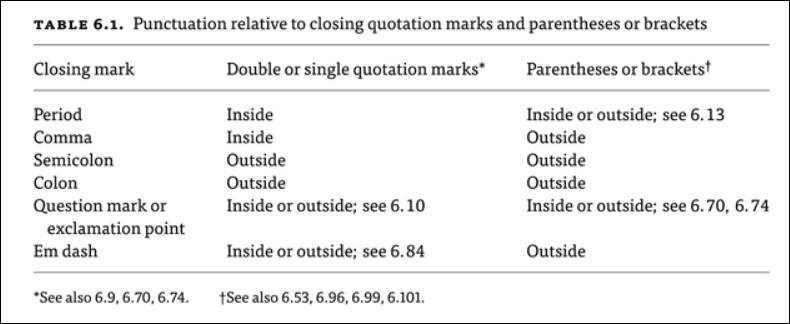
Today’s topic is quotation marks and other assorted punctuation. There are some crazy rules out there, but I’ll do my best to keep things simple. Oh, the first rule is that this is American punctuation; British punctuation is different.

Double quotation marks (“”)

· Use for quoted words, phrases, and sentences.

· Use for direct discourse or dialog.

· Use with other punctuation as follows:

o Periods go inside double quotation marks.

o Commas go inside double quotation marks.

o Colons and semicolons go outside quotation marks.

o Question marks and exclamation points? It depends whether they are part of the quoted material.

Examples:

o Marcy screamed, “Get that tarantula away from me!”

o “I think I’d like to try the vegetarian haggis,” she replied.

o His favorite parting line was to tell us to “Keep on truckin’.”

Single quotation marks (‘’)

· Use for quotations within quotations.

· Do not use to replace double quotation marks.

Example:

“Clarke,” said Maude, “I’ll help you with the first words to the Preamble. It starts ‘We the people, of the United States of America.’ ″

For more information, I’ve included a chart from the Chicago Manual of Style and you can click here to see what the Purdue OWL has to say.

From the Chicago Manual of Style online.

Kara Church

Technical Editor, Advisory

Symitar Documentation Services

Posted by: Jack Henry | April 6, 2015

Editor’s Corner: Parentheses and Abbreviations

Good morning!

It seems many of you have been finding Grammar Girl’s tips very helpful, so I’ll provide you with more of them this week (from The Grammar Devotional: Daily Tips for Successful Writing from Grammar Girl™, by Mignon Fogarty). For those of you attempting your own research on her site (Quick and Dirty Tips), I regret to inform you that it is blocked because of some malicious shenanigans discovered by our trusty Help Desk.

Today’s tip is about parentheses and abbreviations (p. 23 of the Devotional).

Parentheses and Abbreviations

Let’s combine parentheses with abbreviations! (Oh, come on. Live a little!)

If the bit inside parentheses isn’t a complete sentence and ends with an abbreviation, you put a period after the abbreviation, and another period after the parenthesis to end the sentence. You can’t ignore the parenthesis and let the period end both the abbreviation and the sentence:

Squiggly likes chocolate (including chocolate mixed with yummies such as nuts, candy, etc.).

If the bit inside parentheses is a complete sentence and ends with an abbreviation, you only use one period because the final parenthesis isn’t in your way.

(Squiggly likes sweets—candy, cookies, cake, etc.)

And from a former JHA employee who is now living in Japan—a fantastic pizza box translation:

Kara Church

Technical Editor, Advisory

Symitar Documentation Services

Posted by: Jack Henry | April 3, 2015

Editor’s Corner: Phantonyms

Here’s a fun new term: phantonym. Today’s Friday fare is from Tyrannosaurus Lex: The Marvelous Book of Palindromes, Anagrams, & Other Delightful & Outrageous Wordplay, by Rod L. Evans, Ph.D. (pp. 140-142). I’ve selected several phantonyms to share with you.

Phony Opposites: Phantonyms

A phantonym is a word or phrase that appears to be opposite in meaning to another word or phrase but isn’t.

ahead afoot
back up back down
badly goodly
breakdown breakup
cargo bus stop
catalog dogwood
coffee coffer
downfall uprise
enrage outrage
famous infamous
forgive forget
founder loser
giveaway getaway
headlights footlights
hereafter therefore
inception exception
inning outing
intend extend
left off Right on!
maternity dress paternity suit
offset onset
outhouse in-house
outgrown ingrown
pair impair
pale impale
shut-out shut-in
undergo overcome
upright downright
walkout run in

Kara Church

Technical Editor, Advisory

619-542-6773 | Ext: 766773

Symitar Documentation Services

NOTICE: This electronic mail message and any files transmitted with it are intended
exclusively for the individual or entity to which it is addressed. The message,
together with any attachment, may contain confidential and/or privileged information.
Any unauthorized review, use, printing, saving, copying, disclosure or distribution
is strictly prohibited. If you have received this message in error, please
immediately advise the sender by reply email and delete all copies.

Posted by: Jack Henry | April 2, 2015

Editor’s Corner: Abbreviations at the End of Sentences

Today’s tip is another excerpt from The Grammar Devotional: Daily Tips for Successful Writing from Grammar Girl™, by Mignon Fogarty (p. 19).

Abbreviated Endings

When you end a sentence with an abbreviation, you don’t need an extra period.

Apple Computer, Inc. became Apple, Inc.. (wrong)

The period that ends the abbreviation also ends the sentence. Think of it as an environmentally friendly rule—one dot of ink serves two purposes.

However, such sentences can confuse readers because it may not be obvious that you’ve started a new sentence. Try to rewrite the sentence so the abbreviation doesn’t come at the end or write out the abbreviated word.

The story is different when the sentence is a question or exclamation—then you need both punctuation marks:

Why did they choose Apple, Inc.?

I adore their name—Apple, Inc.!

Kara Church

Technical Editor, Advisory

619-542-6773 | Ext: 766773

Symitar Documentation Services

NOTICE: This electronic mail message and any files transmitted with it are intended
exclusively for the individual or entity to which it is addressed. The message,
together with any attachment, may contain confidential and/or privileged information.
Any unauthorized review, use, printing, saving, copying, disclosure or distribution
is strictly prohibited. If you have received this message in error, please
immediately advise the sender by reply email and delete all copies.

Posted by: Jack Henry | April 1, 2015

Editor’s Corner: Whiches and Whats

It’s April Fools’ Day, one of my least favorite days of the year. My husband, however, regards this as a great opportunity to play dead, pretend to turn around his politics, and last year he decided to post that I was having a miracle baby. Don’t be fooled!

Yesterday we focused on “that’s” and “whiches,” and I received a follow-up question asking about “whiches” and “whats.” “Editrix,” the woman wrote, “Can you please explain when to use which and what in questions?”

But of course! I will do the best I can.

Generally, if there are an unknown or infinite number of possible answers, you would use the open-ended what to ask a question. Examples:

· What time are you going to dinner?

· What is your favorite color?

· What are you going to do this weekend?

Use which for a limited, finite set of answers.

· Which do you prefer, the red one or the blue one?

· Which finger did you break?

· Which showing are you going to?

Occasionally, either one is a possibility. It depends how much the “asker” knows about the options and what kind of assumptions he or she is making.

· What bus should I take? (Maybe I have no idea if there are two buses or two hundred buses that leave from the depot.)

· Which bus should I take to the rave? (I am assuming there are a limited number of options.)

Kara Church

Technical Editor, Advisory

619-542-6773 | Ext: 766773

Symitar Documentation Services

NOTICE: This electronic mail message and any files transmitted with it are intended
exclusively for the individual or entity to which it is addressed. The message,
together with any attachment, may contain confidential and/or privileged information.
Any unauthorized review, use, printing, saving, copying, disclosure or distribution
is strictly prohibited. If you have received this message in error, please
immediately advise the sender by reply email and delete all copies.

Posted by: Jack Henry | March 31, 2015

Editor’s Corner: Which Witch is Which?

This week, I think I’m going to share some random excerpts from The Grammar Devotional: Daily Tips for Successful Writing from Grammar Girl™, by Mignon Fogarty (p. 22).

Scram, Whiches: Which Versus That

I like to make choices simple: use that before a restrictive clause and which before everything else.

A restrictive clause can’t be eliminated; it restricts the noun.

Dogs that howl make me crazy.

That howl restricts the kind of dogs I mean. Without it, I’d be saying all dogs make me crazy, which isn’t true.

A nonrestrictive clause can be dropped without changing the meaning of the sentence.

Dogs, which have four legs, run fast.

All dogs run fast, so leaving out the words which have four legs doesn’t change the meaning of the sentence.

A tip (with apologies to Wiccans and Hermione Granger) is that you can always throw out the “whiches” and no harm will be done. If it would change the meaning to throw out the clause, you need a that.

Kara Church

Technical Editor, Advisory

619-542-6773 | Ext: 766773

Symitar Documentation Services

NOTICE: This electronic mail message and any files transmitted with it are intended
exclusively for the individual or entity to which it is addressed. The message,
together with any attachment, may contain confidential and/or privileged information.
Any unauthorized review, use, printing, saving, copying, disclosure or distribution
is strictly prohibited. If you have received this message in error, please
immediately advise the sender by reply email and delete all copies.

« Newer Posts - Older Posts »

Categories