Posted by: Jack Henry | March 30, 2015

Editor’s Corner: As promised, malapropisms

So, a few of you asked what the difference between an eggcorn and a malapropism is. Here’s a quick answer from Wikipedia:

In linguistics, an eggcorn is an idiosyncratic substitution of a word or phrase for a word or words that sound similar or identical in the speaker’s dialect (sometimes called oronyms). The new phrase introduces a meaning that is different from the original, but plausible in the same context, such as "old-timers’ disease" for "Alzheimer’s disease". This is as opposed to a malapropism, where the substitution creates a nonsensical phrase. Classical malapropisms generally derive their comic effect from the fault of the user, while eggcorns are errors that exhibit creativity or logic. Eggcorns often involve replacing an unfamiliar, archaic, or obscure word with a more common or modern word ("baited breath" for "bated breath").

For those of you who want a quicker answer, here’s Merriam-Webster’s definition:

malapropism: a usually humorous misapplication of a word or phrase; specifically : a blundering use of a word that sounds somewhat like the one intended but is ludicrously wrong in the context

Martin Toseland, the author of The Ants Are My Friends (and the supplier of last week’s eggcorn definition), defines malapropisms as a term “provoked when a character or person is under pressure and the words they utter reveal what they think as opposed to what they meant to say.” So they know the correct word, but make a sort of Freudian slip and reveal their feelings.

The following are a few malapropisms from his book:

· I don’t want to cast asparagus at my opponents. (aspersions)

· Waste of time. They’re all a load of belladonnas. (prima donnas)

· (From Dan Quayle) “Republicans understand the importance of bondage between a mother and child.” (the bond)

· It’s a proven fact that Capital Punishment is a detergent for crime. (deterrent)

· Don’t ever wear yellow, dear. It makes your skin look shallow and emancipated. (emaciated)

Here are some other articles I’ve written on the two topics over the last few years:

· Malapropisms

· https://episystechpubs.com/2012/06/08/editors-corner-eggcorns/

· https://episystechpubs.com/2014/02/27/editors-corner-eggcorns-2/

· https://episystechpubs.com/2014/01/17/editors-corner-spoonerisms-for-the-3-day-weekend/

Kara Church

Technical Editor, Advisory

619-542-6773 | Ext: 766773

Symitar Documentation Services

NOTICE: This electronic mail message and any files transmitted with it are intended
exclusively for the individual or entity to which it is addressed. The message,
together with any attachment, may contain confidential and/or privileged information.
Any unauthorized review, use, printing, saving, copying, disclosure or distribution
is strictly prohibited. If you have received this message in error, please
immediately advise the sender by reply email and delete all copies.


Posted by: Jack Henry | March 27, 2015

Editor’s Corner: Eggcorn Correction

Correction:

· That man is a real charmer; a regular Don Coyote. (Don Quixote)

My apologies to Miguel de Cervantes and Mr. Rogers (for his Donkey Hodie in the Land of Make-Believe).

Kara Church

Technical Editor, Advisory

619-542-6773 | Ext: 766773

www.symitar.com

From: Kara Church
Sent: Friday, March 27, 2015 6:41 AM
To: Kara Church
Subject: Editor’s Corner: More Eggcorns for Foghorn Leghorn

Let’s start the weekend off with a few more eggcorns!

From the Editor’s Corner readers:

Everything is Crisco clear now that you have explained it. (crystal clear)

The lawyer flea bargained the case down to a misdemeanor. (plea bargained)

From The Ants Are My Friends, by Martin Toseland (again, with British spelling and punctuation):

· We will be revisiting this topic shortly, as it is the crutch of the matter. (crux)

· She called the turnout at the clinic ‘just awesome’, but added, ‘It’s still disturbing to see the cars pulling in…it just curdles my hair”. (curdles my blood)

· (They) …paid a curtsey call on the President of the Kyrgyz Republic. (courtesy call)

· What gets his dandruff up is the film, ‘Loose Change.’ (dander)

· From Catering magazine, “The coverage provides for protection from claims for libel, slander, and deformation of character”. (defamation of character)

· The true matter is: it’s a doggy-dog world out there, and they’re all in it for the money. (dog-eat-dog world)

· That man is a real charmer; a regular Don Coyote. (Don Juan)

· These deals allow cardholders to pay off their credit card debt over a long period of time without accruing more debt due to exuberant interest rates. (exorbitant)

· This is an exercise in fertility. (futility)

Monday: What’s the difference between eggcorns and malapropisms?

Kara Church

Technical Editor, Advisory

619-542-6773 | Ext: 766773

www.symitar.com

NOTICE: This electronic mail message and any files transmitted with it are intended
exclusively for the individual or entity to which it is addressed. The message,
together with any attachment, may contain confidential and/or privileged information.
Any unauthorized review, use, printing, saving, copying, disclosure or distribution
is strictly prohibited. If you have received this message in error, please
immediately advise the sender by reply email and delete all copies.

Posted by: Jack Henry | March 27, 2015

Editor’s Corner: More Eggcorns for Foghorn Leghorn

Let’s start the weekend off with a few more eggcorns!

From the Editor’s Corner readers:

Everything is Crisco clear now that you have explained it. (crystal clear)

The lawyer flea bargained the case down to a misdemeanor. (plea bargained)

From The Ants Are My Friends, by Martin Toseland (again, with British spelling and punctuation):

· We will be revisiting this topic shortly, as it is the crutch of the matter. (crux)

· She called the turnout at the clinic ‘just awesome’, but added, ‘It’s still disturbing to see the cars pulling in…it just curdles my hair”. (curdles my blood)

· (They) …paid a curtsey call on the President of the Kyrgyz Republic. (courtesy call)

· What gets his dandruff up is the film, ‘Loose Change.’ (dander)

· From Catering magazine, “The coverage provides for protection from claims for libel, slander, and deformation of character”. (defamation of character)

· The true matter is: it’s a doggy-dog world out there, and they’re all in it for the money. (dog-eat-dog world)

· That man is a real charmer; a regular Don Coyote. (Don Juan)

· These deals allow cardholders to pay off their credit card debt over a long period of time without accruing more debt due to exuberant interest rates. (exorbitant)

· This is an exercise in fertility. (futility)

Monday: What’s the difference between eggcorns and malapropisms?

Kara Church

Technical Editor, Advisory

619-542-6773 | Ext: 766773

www.symitar.com

NOTICE: This electronic mail message and any files transmitted with it are intended
exclusively for the individual or entity to which it is addressed. The message,
together with any attachment, may contain confidential and/or privileged information.
Any unauthorized review, use, printing, saving, copying, disclosure or distribution
is strictly prohibited. If you have received this message in error, please
immediately advise the sender by reply email and delete all copies.

Posted by: Jack Henry | March 26, 2015

Editor’s Corner: Eggcorns

The other day, my dear co-worker Javier reminded me of a fun topic to discuss: eggcorns. What is an eggcorn? Here is an explanation and examples for you from The Ants Are My Friends, by Martin Toseland. [Note: I have preserved the British spelling and punctuation in the quoted material.]

‘Eggcorn’ is the name for a particular kind of misheard word. It was coined by linguist Mark Lieberman who came across someone who had heard ‘eggcorn’ in the phrase ‘great oaks from little acorns grow’. Lieberman thought that ‘eggcorn’ was an excellent word and was just as suggestive, if not more so, than ‘acorn’. From that point on, more and more of these creations appeared and a pattern of sorts emerged. The misheard word (the one being replaced) was often archaic or only used in a phrase or expression; our natural tendency is to use what is familiar to us when faced with something that is unfamiliar or unrecognisable. So, we grasp for a word we know that sounds like one we don’t know, rather than hazard a guess as to what the original might have been. Hence, we get ‘chestfallen’ for ‘crestfallen’ and ‘damp squid’ for ‘damp squib’. (pp. 9-10)

Now, let’s get to some examples! The eggcorns are bolded in the quotes; the correct word follows in parentheses.

· When asked how he could shoot baskets so well, Cozell McQueen responded, “It could be because I’m amphibious.” (ambidextrous)

· “That’s why I developed the appendix on the historical shortcomings of the thesis in Mystery of Romans. Let me share with you antidotal evidence for the need to provide the appendix.” (anecdotal)

· “The cookbook is being compiled. Please submit your favourite recipe and a short antidote concerning it.” (anecdote)

· From the Aussie Pythons and Snakes herpetology chat room: “If he was in the US, no one would even batter an eyelid at what he says because they are all like that over there.” (bat an eyelid)

· When asked what the future held for him, Mike Tyson responded, “I guess I’m going to fade into Bolivian.” (oblivion)

· Wes Westrum, a US baseball player and manager, describes a game as “a real cliff-dweller.” (cliff-hanger)

Kara Church

Technical Editor, Advisory

619-542-6773 | Ext: 766773

www.symitar.com

NOTICE: This electronic mail message and any files transmitted with it are intended
exclusively for the individual or entity to which it is addressed. The message,
together with any attachment, may contain confidential and/or privileged information.
Any unauthorized review, use, printing, saving, copying, disclosure or distribution
is strictly prohibited. If you have received this message in error, please
immediately advise the sender by reply email and delete all copies.

Posted by: Jack Henry | March 25, 2015

Editor’s Corner: Heads Up!

Good morning folks. I would like to take a minute to thank all of you for the attention you pay to improving your grammar, punctuation, and conversation skills. Almost every day I get great ideas, questions, suggestions, and kind notes, and I appreciate you for that.

Today’s little blurb is about a term I use out loud, but I avoid in writing because I wasn’t sure how to use it correctly! I stumbled on this article last night at the Grammarist, and thought I’d share it with you. (Click the link if you want to see their examples, too.)

Heads Up!

Heads upis an interjection used when you need to warn someone to look out. A heads-up is the actual warning you gave the individual. This is commonly used in the phrase giving someone a heads-up. While the correct spelling includes the hyphen, actual usage suggests that it will become obsolete some day.

Heads-up can also be used as an adjective to describe a person as being cautious or aware of surroundings. Keeping one’s head up means to be watchful.

Be aware that the verb head can also mean to lead, so to say, “She heads up the project” means that she directs the project.

A head-up display is a gauge or reading which does not require the pilot or driver to lower his or her eyes. It can also be called a heads-up display.

A related term is head up which is used in sailing to mean steer into the wind.

And while I don’t condone tormenting dogs or feeding them people food, I have to say that Fritz here could use a lesson on what “Heads Up!” means: Fritz – The World’s Least Deadly Catch.

Kara Church

Technical Editor, Advisory

Posted by: Jack Henry | March 23, 2015

Editor’s Corner: Misused Phrases, Part 3

Good morning and the happiest of Mondays to you. Today I have the final few misused phrases for you, from 20 Common Phrases Even the Smartest People Misuse.

One in the Same

“One in the same” would literally mean that the “one” is inside the same thing as itself, which makes no sense at all. The proper phrase is “one and the same,” meaning the same thing or the same person. For example, “When Melissa was home schooled, her teacher and her mother were one and the same.”

Make Due

When something is due, it is owed. To “make due” would mean to “make owed,” but the phrase to “make do” is short for “to make something do well” or “to make something sufficient.” When life gives you lemons, you make do and make lemonade. [KC – Also not to be confused with “Make Dude” which is similar to being knighted, but it happens here on the beaches of California and it isn’t reserved for the elite.]

By in Large

The phrase “by and large” was first used in 1706 to mean “in general.” It was a nautical phrase derived from the sailing terms “by” and “large.” While it doesn’t have a literal meaning that makes sense, “by and large” is the correct version of this phrase.

Do Diligence

While it may be easy to surmise that “do diligence” translates to doing something diligently, it does not. “Due diligence” is a business and legal term that means you will investigate a person or business before signing a contract with them or before formally engaging in a business deal together. You should do your due diligence and investigate business deals fully before committing to them.

Peaked My Interest

To “pique” means to arouse, so the correct phrase here is “piqued my interest,” meaning that my interest was awakened. To say that something “peaked my interest” might suggest that my interest was taken to the highest possible level, but this is not what the idiom is meant to convey.

Kara Church

Technical Editor, Advisory

619-542-6773 | Ext: 766773

www.symitar.com

NOTICE: This electronic mail message and any files transmitted with it are intended
exclusively for the individual or entity to which it is addressed. The message,
together with any attachment, may contain confidential and/or privileged information.
Any unauthorized review, use, printing, saving, copying, disclosure or distribution
is strictly prohibited. If you have received this message in error, please
immediately advise the sender by reply email and delete all copies.
Posted by: Jack Henry | March 20, 2015

Editor’s Corner: Misused Phrases, Part II

Today’s list is the continuation of 20 Common Phrases Even the Smartest People Misuse.

· Emigrated To

With this one there is no debate. The verb “emigrate” is always used with the preposition “from,” whereas immigrate is always used with the preposition “to.” To emigrate is to come from somewhere, and to immigrate is to go to somewhere. “Jimmy emigrated from Ireland to the United States” means the same thing as “Jimmy immigrated to the United States from Ireland.” It’s just a matter of what you’re emphasizing—the coming or the going.

· Slight of Hand

“Sleight of hand” is a common phrase in the world of magic and illusion, because “sleight” means dexterity or cunning, usually to deceive. On the other hand, as a noun, a “slight” is an insult.

· Honed In

First, it’s important to note that this particular expression is hotly debated. Many references now consider “hone in” a proper alternate version of “home in.” That said, it is still generally accepted that “home in” is the more correct phrase. To home in on something means to move toward a goal, such as “The missile homed in on its target.” To “hone” means to sharpen. You would say, “I honed my résumé writing skills.” But you would likely not say, “The missile honed in on its target.” When followed by the preposition “in,” the word “hone” just doesn’t make sense.

· Baited Breath

The term “bated” is an adjective meaning suspense. It originated from the verb “abate,” meaning to stop or lessen. Therefore, “to wait with bated breath” essentially means to hold your breath with anticipation. The verb “bait,” on the other hand, means to taunt, often to taunt a predator with its prey. A fisherman baits his line in hopes of a big catch. Considering the meaning of the two words, it’s clear which is correct, but the word “bated” is mostly obsolete today, leading to ever-increasing mistakes in this expression.

· Piece of Mind

This should be “peace” of mind, meaning calmness and tranquility. The expression “piece of mind” actually would suggest doling out sections of brain.

· Wet Your Appetite

This expression is more often used incorrectly than correctly—56% of the time it appears online, it’s wrong. The correct idiom is “whet your appetite.” “Whet” means to sharpen or stimulate, so to “whet your appetite” means to awaken your desire for something.

· For All Intensive Purposes

The correct phrase is “for all intents and purposes.” It originates from English law dating back to the 1500s, which used the phrase “to all intents, constructions, and purposes” to mean “officially” or “effectively.”

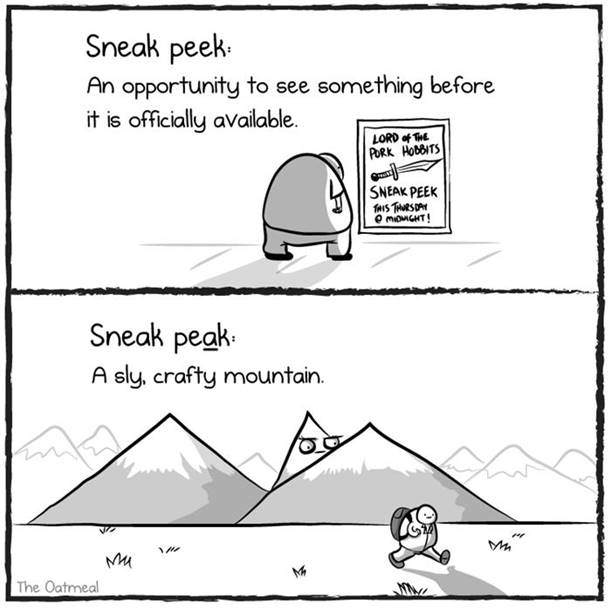
From: http://theoatmeal.com/comics/sneak_peek

Kara Church

Technical Editor, Advisory

Posted by: Jack Henry | March 19, 2015

Editor’s Corner: Misused Phrases, Part 1

Several people sent this article to me yesterday (20 Common Phrases Even the Smartest People Misuse)

and I thought I’d pass the information along. I can’t say I’ve heard the first one misused at work, but I have had questions about many of the other phrases.

In general, it’s good policy to avoid clichés and idiomatic phrases in your writing. This is particularly true when communicating with people who speak and read English as a second language.

Thank you to those of you who sent these in!

(For the sake of time and space, I’ll be sending these out in a few installments. Note that the bolded phrase is incorrect. The correct phrase is included in the description.)

· Prostrate Cancer

It’s an easy misspelling to make—just add an extra r and “prostate cancer” becomes “prostrate cancer,” which suggests “a cancer of lying face-down on the ground.” Both the Centers for Disease Control and Prevention (CDC) and the Mayo Clinic websites include this misspelling.

· First-Come, First-Serve

This suggests that the first person to arrive has to serve all who follow. The actual phrase is “first-come, first-served,” to indicate that the participants will be served in the order in which they arrive. Both Harvard and Yale got this one wrong.

· Sneak Peak

A “peak” is a mountain top. A “peek” is a quick look. The correct expression is “sneak peek,” meaning a secret or early look at something. This error appeared on Oxford University’s site as well as that of the National Park Service.

· Deep-Seeded

This should be “deep-seated,” to indicate that something is firmly established. Though “deep-seeded” might seem to make sense, indicating that something is planted deep in the ground, this is not the correct expression. Correctica found this error on the Washington Post and the White House websites.

· Extract Revenge

To “extract” something is to remove it, like a tooth. The correct expression is “exact revenge,” meaning to achieve revenge. Both The New York Times and the BBC have made this error.

· I Could Care Less

“I couldn’t care less” is what you would say to express maximum apathy toward a situation. Basically you’re saying, “It’s impossible for me to care less about this because I have no more care to give. I’ve run out of care.” Using the incorrect “I could care less” indicates that “I still have care left to give—would you like some?”

· Shoe-In

“Shoo-in” is a common idiom that means a sure winner. To “shoo” something is to urge it in a direction. As you would shoo a fly out of your house, you could also shoo someone toward victory. The expression started in the early 20th century, relating to horse racing and broadened to politics soon after. It’s easy to see why the “shoe-in” version is so common, as it suggests the door-to-door sales practice of moving a foot into the doorway to make it more difficult for a prospective client to close the door. But “foot in the door” is an entirely different idiom.

Kara Church

Technical Editor, Advisory

619-542-6773 | Ext: 766773

www.symitar.com

NOTICE: This electronic mail message and any files transmitted with it are intended
exclusively for the individual or entity to which it is addressed. The message,
together with any attachment, may contain confidential and/or privileged information.
Any unauthorized review, use, printing, saving, copying, disclosure or distribution
is strictly prohibited. If you have received this message in error, please
immediately advise the sender by reply email and delete all copies.

Posted by: Jack Henry | March 18, 2015

Editor’s Corner: Stand and Deliver

This one is for my buddy, Todd, who lost his lectern the other day.

From The Grammar Devotional: Daily Tips for Successful Writing from Grammar Girl™, by Mignon Fogarty (p. 55):

Stand and Deliver: Lectern Versus Podium

Public speaking is scary enough without having to worry about what to call that thing you’re standing on or behind. Give yourself plenty of time to prepare, and remind yourself to breathe and make eye contact without being creepy. Then proceed to the podium (the raised platform where speakers stand; remember that it has the same root word as podiatrist and it’s what you put your feet on) and put your notes on the lectern (the stand for your papers; think of it as putting your lecture on the lectern).

Kara Church

Technical Editor, Advisory

Posted by: Jack Henry | March 17, 2015

Editor’s Corner: Avoid Noun Strings

Good morning!

This is the last tip I have for you from Grammarly.com:

Avoid Vague Nouns and Noun Strings

All-purpose nouns, such as factor, situation, and area, lead to obscure writing.

· Vague: A college education is an important factor in finding a job in the area of accounting.

· Better: For accounting jobs, a college degree is important.

Writers in a specialty niche such as healthcare or technology often slip into jargon, resulting in noun strings that obscure meaning.

· Vague: The mammography team is working on the radiology technologist radiation protection quality improvement program.

· Better: The mammography team will complete a quality improvement program for protecting radiology technicians from excess radiation.

Writing for clarity requires a ruthless eye for editing your work; it’s helpful to walk away from your composition for a few hours and approach it with new eyes. Then cut the unnecessary, rewrite the unwieldy, and, in the words of Elmore Leonard, “Try to leave out the parts that people skip.”

Kara Church

Technical Editor, Advisory

619-542-6773 | Ext: 766773

www.symitar.com

NOTICE: This electronic mail message and any files transmitted with it are intended
exclusively for the individual or entity to which it is addressed. The message,
together with any attachment, may contain confidential and/or privileged information.
Any unauthorized review, use, printing, saving, copying, disclosure or distribution
is strictly prohibited. If you have received this message in error, please
immediately advise the sender by reply email and delete all copies.

« Newer Posts - Older Posts »

Categories