Posted by: Jack Henry | May 18, 2015

Editor’s Corner: A pile of a while

I am going through different questions and requests from readers and here is one I promised to discuss a while ago. I hope it sheds some light on when to use awhile versus a while. The dictionary definitions (in black) are from our buddies at Merriam-Webster.

while (noun): a period of time especially when short and marked by the occurrence of an action or a condition

Helpful hint: When there is a preposition, use a while (for a while; in a while).

Examples:

· I sat in the garden for a while. (I sat in the garden for a short time.)

· Don drove his Cadillac for a while and then opted for a more fuel-efficient car. (Don drove his Cadillac for a short time.)

· She left a while ago, before we served dessert. (She left a short time ago.)

awhile (adverb): for a short time

Helpful hint: Awhile is used when there is not a preposition. It is an adverb which modifies a verb.

Examples:

· We can wait awhile for Susan. (Awhile modifies the verb wait.)

· After running the marathon, I’ll need to rest awhile. (Awhile modifies the verb rest.)

Extra Helpful Hint: If you aren’t sure whether to use awhile or a while, try substituting another adverb in the sentence (something like quickly, hurriedly, slowly, angrily, etc.). If the adverb works, you should use awhile. If it doesn’t sound right, use a while.

· She said she would meet for quickly. (Yuck, this definitely doesn’t work. Use a while here.)

She said she would meet for a while.

· She said she would meet quickly. (Okay. Not sure why she’s in such a rush, but it is grammatically sound. In this case you would use awhile.)

She said she would meet awhile.

For a previous article on this topic, see this issue of the Editor’s Corner.

Kara Church

Technical Editor, Advisory

619-542-6773 | Ext: 766773

Symitar Documentation Services

NOTICE: This electronic mail message and any files transmitted with it are intended
exclusively for the individual or entity to which it is addressed. The message,
together with any attachment, may contain confidential and/or privileged information.
Any unauthorized review, use, printing, saving, copying, disclosure or distribution
is strictly prohibited. If you have received this message in error, please
immediately advise the sender by reply email and delete all copies.

Posted by: Jack Henry | May 15, 2015

Editor’s Corner: Would you like to pet my monkey?

Over the past few years, a passel of people have sent me different collections of words and phrases with the “real” explanations of where they came from. I say “real” because I usually find some of the explanations so outrageous that I have to check the Snopes website to see whether these lists are vetted. Usually I find that someone has been mischievously passing around half-truths.

Today’s excerpts, from Tyrannosaurus Lex: The Marvelous Book of Palindromes, Anagrams, & Other Delightful & Outrageous Wordplay, by Rod L. Evans, Ph.D. are along those lines, but I am really hoping that he had a fact checker for this and his other book, Sorry, Wrong Answer.

Now, a few interesting tidbits from chapter 39, “Welsh Rabbit Is a Cheese Dish: Misnomers, Misleading Expressions, and Illogicalities”:

· Blackboards can be blue or green.

· Black boxes on large airplanes are orange.

· Peanuts aren’t peas or nuts; they’re legumes.

· English muffins weren’t invented in England but in America.

· French poodles originated in Germany.

· French fries weren’t invented in France but in Belgium.

· Danish pastries aren’t from Denmark, but Austria.

· The second hand on a watch is the third hand.

· Mobile homes got the name from the name of the place where they were first mass produced: Mobile, Alabama.

· The Norway rat originated in North China.

· Chinese checkers can be traced to a nineteenth-century English game called Halma.

· Great Danes originated in Germany.

· A jackrabbit is a hare.

· A Belgian hare is a rabbit.

· The monkey wrench was named after Charles Moncky.

Kara Church

Technical Editor, Advisory

619-542-6773 | Ext: 766773

Symitar Documentation Services

NOTICE: This electronic mail message and any files transmitted with it are intended
exclusively for the individual or entity to which it is addressed. The message,
together with any attachment, may contain confidential and/or privileged information.
Any unauthorized review, use, printing, saving, copying, disclosure or distribution
is strictly prohibited. If you have received this message in error, please
immediately advise the sender by reply email and delete all copies.
Posted by: Jack Henry | May 14, 2015

Editor’s Corner: Punctuation with Cities and States

One of you astute Editor’s Corner readers noticed some inconsistences within different articles containing state abbreviations and comma use. At JHA, we use the Chicago Manual of Style, so here is a brief excerpt on the topic and some additional information I’ve collected for inquiring minds.

From the CMOS: “When following the name of a city, the names of states, provinces, and territories are enclosed in commas, whether they are spelled out (as in running text) or abbreviated (as in tabular matter or lists). In an exception to the rule, no comma appears between the postal code [KC – The two-letter abbreviation.] and a zip code.”

Examples of using cities, states, and commas in running text:

· Chicago Manual of Style

Her voyage will take her from Charlotte, North Carolina, to San Diego, California.

· AP Stylebook

Her voyage will take her from Charlotte, N.C., to San Diego, Calif.

· Postal Address

Please send the free ice cream maker to Vernon Clamato at 8985 Balboa Ave., San Diego, CA 92123.

State Traditional
abbreviation
Postal (two-letter) abbreviation
Alabama Ala. AL
Alaska Alaska AK
Arizona Ariz. AZ
Arkansas Ark. AR
California Calif. CA
Colorado Colo. CO
Connecticut Conn. CT
Delaware Del. DE
Florida Fla. FL
Georgia Ga. GA
Hawaii Hawaii HI
Idaho Idaho ID
Illinois Ill. IL
Indiana Ind. IN
Iowa Iowa IA
Kansas Kans. KS
Kentucky Ky. KY
Louisiana La. LA
Maine Maine ME
Maryland Md. MD
Massachusetts Mass. MA
Michigan Mich. MI
Minnesota Minn. MN
Mississippi Miss. MS
Missouri Mo. MO
Montana Mont. MT
Nebraska Nebr. NE
Nevada Nev. NV
New Hampshire N.H. NH
New Jersey N.J. NJ
New Mexico N. Mex. NM
New York N.Y. NY
North Carolina N.C. NC
North Dakota N. Dak. ND
Ohio Ohio OH
Oklahoma Okla. OK
Oregon Oreg. OR
Pennsylvania Pa. PA
Rhode Island R.I. RI
South Carolina S.C. SC
South Dakota S. Dak. SD
Tennessee Tenn. TN
Texas Tex. TX
Utah Utah UT
Vermont Vt. VT
Virginia Va. VA
Washington Wash. WA
West Virginia W. Va. WV
Wisconsin Wis. WI
Wyoming Wyo. WY

Kara Church

Technical Editor, Advisory

619-542-6773 | Ext: 766773

Symitar Documentation Services

NOTICE: This electronic mail message and any files transmitted with it are intended
exclusively for the individual or entity to which it is addressed. The message,
together with any attachment, may contain confidential and/or privileged information.
Any unauthorized review, use, printing, saving, copying, disclosure or distribution
is strictly prohibited. If you have received this message in error, please
immediately advise the sender by reply email and delete all copies.
Posted by: Jack Henry | May 13, 2015

Editor’s Corner: May versus Might

May versus Might

For those of you who requested information on when to use may versus might, I’m being lazy today and letting the Oxford Dictionaries explain it and provide examples.

May and might are both ways of expressing possibility. Is there a difference between the way in which they should be used?

Some people insist that you should use may (present tense) when talking about a current situation and might (past tense) when talking about an event that happened in the past. For example:

· I may go home early if I’m tired. (present tense)

· He might have visited Italy before settling in Nuremberg. (past tense)

In practice, this distinction is rarely made today and the two words are generally interchangeable:

· I might go home early if I’m tired.

· He may have visited Italy before settling in Nuremberg.

But there is a distinction between may have and might have in certain contexts. If the truth of a situation is still not known at the time of speaking or writing, either of the two is acceptable:

· By the time you read this, he may have made his decision.

· I think that comment might have offended some people.

If the event or situation referred to did not in fact occur, it’s better to use might have:

The draw against Italy might have been a turning point, but it didn’t turn out like that.

When homonyms hurt: Facebook Fail.

Posted by: Jack Henry | May 12, 2015

Editor’s Corner: Shall versus Will

Shall versus Will

Yesterday we started the week with can versus may. Today, I have a tidbit for you on the verbs shall and will. This article is from the Oxford Dictionaries website, which is why they’ve spelled behavior differently.

Shall or Will?

The traditional rule in standard British English is that shall is used with first person pronouns (i.e., I and we) to form the future tense, while will is used with second and third person forms (i.e., you, he, she, it, they). For example:

I shall be late.

They will not have enough food.

However, when it comes to expressing a strong determination to do something, the roles are reversed: will is used with the first person, and shall with the second and third. For example:

I will not tolerate such behaviour.

You shall go to the ball!

In practice, though, the two words are used more or less interchangeably, and this is now an acceptable part of standard British and US English.

As far as questions go, the primary use of shall is with the first person (I, we), to make or ask for suggestions. For example:

· Shall we go to a movie today?

· Shall I wear a fake moustache to the fair?

· What shall we do if it rains?

· When shall we leave for the hockey game?

In the U.S., the word should is used more often than shall, especially in the last two examples.

Kara Church

Technical Editor, Advisory

619-542-6773 | Ext: 766773

Symitar Documentation Services

NOTICE: This electronic mail message and any files transmitted with it are intended
exclusively for the individual or entity to which it is addressed. The message,
together with any attachment, may contain confidential and/or privileged information.
Any unauthorized review, use, printing, saving, copying, disclosure or distribution
is strictly prohibited. If you have received this message in error, please
immediately advise the sender by reply email and delete all copies.

Posted by: Jack Henry | May 11, 2015

Editor’s Corner: Can versus May

A good Monday to you all!

Last week someone asked me to explain the difference between can versus may. After some research, I’m surprised to say that more and more sources say that they can be used interchangeably with regards to permission.

But I hear the grade school teacher in my brain and smart aleck kids responding to the question, “Can I use the restroom?” with “I don’t know. Can you?” Here is the traditional differentiation between the two.

Can is generally translated as “to be able,” thus the hazing you get when you are intending to mean “Do I have permission to use the restroom?” and the listeners are translating that as “Am I able to use the restroom?” Can is considered less formal or polite, too.

May has been used traditionally to mean “to be permitted” or to indicate the possibility of something. It is considered the polite way to ask for permission.

Here are some examples and additional information from the Blue Book of Grammar and Punctuation:

Example: He can hold his breath for 30 seconds.

Meaning: He is able to hold his breath for 30 seconds.

Example: He may hold his breath for 30 seconds.

Meaning #1: It is possible that he will hold his breath.

Meaning #2: He has permission to hold his breath. (This meaning is unlikely.)

Example: May/Can I go to the mall tonight?

In spoken English, a request for permission is generally answered with can, cannot, or can’t, rather than with may or may not, even if the question was formed using may. (Although mayn’t is a word, it looks and sounds strange even to native speakers.)

Kara Church

Technical Editor, Advisory

619-542-6773 | Ext: 766773

Symitar Documentation Services

NOTICE: This electronic mail message and any files transmitted with it are intended
exclusively for the individual or entity to which it is addressed. The message,
together with any attachment, may contain confidential and/or privileged information.
Any unauthorized review, use, printing, saving, copying, disclosure or distribution
is strictly prohibited. If you have received this message in error, please
immediately advise the sender by reply email and delete all copies.

Posted by: Jack Henry | May 8, 2015

Editor’s Corner: Bird in Disguise

It’s a rainy Friday here in San Diego, so we definitely need a little pre-weekend pick-me-up with some mondegreens. Today’s misheard song lyrics are from Hold Me Closer, Tony Danza, by Charles Grosvenor Jr.

Song Title Artist/Group Actual Lyrics Mondegreen
Where It’s At Beck I got two turntables and a microphone I got two tin cans and a microphone

I got Toontown tables and a microphone

Me, Myself, and I Beyoncé I’m dealing with your three kids in my home I’m dealing with the crickets in my home
Hey Mama The Black Eyed Peas Cutie, cutie Cooty, cooty
All the Small Things Blink 182 All the small things, true care, truth brings All the small things, Drew Carey sings
Bad Medicine Bon Jovi Bad medicine is what I need Sam Kinison is what I need
Livin’ on a Prayer Bon Jovi Take my hand, we’ll make it, I swear Take my pants, we’ll make it, I swear
Brilliant Disguise Bruce Springsteen Is that you baby, or just a brilliant disguise Is that you baby, or just a bird in disguise
1, 2 Step Ciara This beat is automatic, supersonic, hypnotic, funky fresh This beat is hydroponic, supersonic, smelling fresh
Oh Ciara Oh, round here we riding slow Oh, round here they fry ‘em slow
Trouble Coldplay And they spun a web for me And they spammed the Web for me
Yellow Coldplay Look at the stars Lou Cat, the Scar
Euro-Trash Girl Cracker Euro-trash girl You’re a trash girl
Higher Creed To a place where blind men see To a place where linemen sing
My Sacrifice Creed My sacrifice My sack of rice

Kara Church

Technical Editor, Advisory

619-542-6773 | Ext: 766773

Symitar Documentation Services

NOTICE: This electronic mail message and any files transmitted with it are intended
exclusively for the individual or entity to which it is addressed. The message,
together with any attachment, may contain confidential and/or privileged information.
Any unauthorized review, use, printing, saving, copying, disclosure or distribution
is strictly prohibited. If you have received this message in error, please
immediately advise the sender by reply email and delete all copies.

Posted by: Jack Henry | May 7, 2015

Editor’s Corner: Stuff ‘n’ Thangs

Here is the last five of the “15 Words You Need to Eliminate from Your Vocabulary to Sound Smarter,” by Jennie Haskamp. As many of you have noted, some of these apply more to creative writing than business writing. Still, they’re worth a look even if you aren’t writing the next Moby Dick or Great Gatsby.

· Just

It’s a filler word and it makes your sentence weaker, not stronger. Unless you’re using it as a synonym for equitable, fair, even-handed, or impartial, don’t use it at all.

· Maybe

This makes you sound uninformed, unsure of the facts you’re presenting. Regardless of the topic, do the legwork, be sure, write an informed piece. The only thing you communicate when you include this word is uncertainty.

· Stuff

This word is casual, generic even. It serves as a placeholder for something better. If the details of the stuff aren’t important enough to be included in the piece? Don’t reference it at all. If you tell your reader to take your course because they’ll learn a lot of stuff? They’re likely to tell you to stuff it.

· Things

See: Stuff.

[KC – I guess the store in my neighborhood that calls itself “Stuff ‘n’ Thangs” may as well just give up.]

· Irregardless

This doesn’t mean what you think it means, Jefe. It means regardless. It is literally (see what I did there?) defined as: regardless. Don’t use it. Save yourself the embarrassment.

And just for fun…

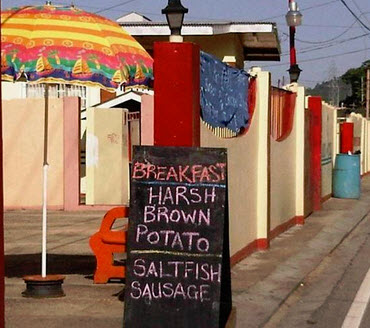
There’s a slight metallic taste to this dish…

Thank you, Phil, for making my day yesterday with these photos!

Kara Church

Technical Editor, Advisory

Symitar Documentation Services

Posted by: Jack Henry | May 6, 2015

Editor’s Corner: Really Amazing

I hope you all enjoyed a fiesta of Mexican food yesterday. Today we continue with the article “15 Words You Need to Eliminate From Your Vocabulary to Sound Smarter,” by Jennie Haskamp.

· Really

Unless you’re a Valley Girl, visiting from 1985, there’s no need to use really to modify an adjective. Or a verb. Or an adverb. Pick a different word to make your point. And never repeat really, or very for that matter. That’s really, really bad writing.

· Amazing

The word means “causing great surprise or sudden wonder.” It’s synonymous with wonderful, incredible, startling, marvelous, astonishing, astounding, remarkable, miraculous, surprising, mind-blowing, and staggering. You get the point, right? It’s everywhere. It’s in corporate slogans. It dominated the Academy Awards acceptance speeches. It’s all over social media. It’s discussed in pre-game shows and post-game shows.

Newsflash: If everything is amazing, nothing is.

[KC – I’m beginning to think we can generalize some of these rules to “don’t overuse certain adjectives.” I’m sure I’d be chastised for
too many shouts of “Awesome!”]

· Always

Absolutes lock the writer into a position, sound conceited and close-minded, and often open the door to criticism regarding inaccuracies. Always is rarely true. Unless you’re giving written commands or instruction, find another word.

· Never

See: Always.

· Literally

Literally means literal. Actually happening as stated. Without exaggeration. More often than not, when the term is used, the writer means figuratively. Whatever is happening is being described metaphorically. No one actually “waits on pins and needles.” How uncomfortable would that be?

[KC – As I mentioned in my 60-Minute University presentation, when you say something was so funny you “literally peed your pants,” you’ll
be called The Lone Ranger for more than one reason.]

Kara Church

Technical Editor, Advisory

Symitar Documentation Services

Hello and feliz Cinco de Mayo!

Grab a quesadilla or pollo asado burrito and dig in to the first of several tips from the article “15 Words You Need to Eliminate From Your Vocabulary to Sound Smarter,” by Jennie Haskamp. These tips are directed more toward creative writing, but the information is helpful for writing in general. To avoid confusion, I have made some edits to remove material that doesn’t agree with the JHA Style Guide.

· That

Don’t use that when you refer to people. “I have several friends that live in the neighborhood.” No. No, you don’t. You have friends who. Not friends that.

· Went

I went to school. Or the store, or to church, or to a conference, to Vegas, wherever it is you’re inclined to go. Instead of went, consider drove, skated, walked, ran, flew. There are any number of ways to move from here to there. Pick one. Don’t be lazy and miss the chance to add to your story.

· Honestly

People use honestly to add emphasis. The problem is, the minute you tell your reader this particular statement is honest, you’ve implied the rest of your words were not.

· Absolutely

Adding this word to most sentences is redundant. Something is either necessary, or it isn’t. Absolutely necessary doesn’t make it more necessary. If you recommend an essential course to your new employees, it’s essential. Coincidentally, the definition of essential is “absolutely necessary.” Chicken or egg, eh?

· Very

Accurate adjectives don’t need qualifiers. If you need to qualify it? Replace it.

Very is intended to magnify a verb, an adjective, or another adverb. What it does is makes your statement less specific. If you’re very happy? Be ecstatic. If you’re very sad, perhaps you’re melancholy or depressed. Woebegone, even. Very sad is a lazy way of making your point. Another pitfall of using very as a modifier? It’s subjective. Very cold and very tall mean different things to different people. Be specific. She’s 6’3" and it’s 13 degrees below freezing? These make your story better while also ensuring the reader understands the point you’re making.

Kara Church

Technical Editor, Advisory

619-542-6773 | Ext: 766773

Symitar Documentation Services

NOTICE: This electronic mail message and any files transmitted with it are intended
exclusively for the individual or entity to which it is addressed. The message,
together with any attachment, may contain confidential and/or privileged information.
Any unauthorized review, use, printing, saving, copying, disclosure or distribution
is strictly prohibited. If you have received this message in error, please
immediately advise the sender by reply email and delete all copies.

« Newer Posts - Older Posts »

Categories