First, Happy (almost) Thanksgiving! I hope you enjoy the day with friends and family, or perhaps taking a break from friends and family. Now, down to business!

Adage, axiom, maxim, saying, aphorism, motto, proverb…the list of words for little sayings and “words to the wise” is plentiful. When we write articles on different sayings from different areas of the country, we always get a lot of responses from our readers. Today I thought I’d define, and provide examples for, a few of these literary devices from the Literary Devices webpage. I personally find them all very similar, but maybe my eyeballs have been focused on technical writing for too long.

An aphorism is a statement of truth or opinion expressed in a concise and witty manner. The term is often applied to philosophical, moral and literary principles.

  • Youth is a blunder; Manhood a struggle; Old age regret. [Benjamin Disraeli]
  • The man who removes a mountain begins by carrying away small stones. [William Faulkner]
  • Life’s Tragedy is that we get old too soon and wise too late. [Benjamin Franklin]
  • The simplest questions are the hardest to answer. [Northrop Frye]

A maxim is literary device; a simple and memorable line, quote or rule for taking action and leading a good life. Simply put, it is a thought with moralistic values that intends to motivate individuals.

  • It’s better to be safe than sorry.
  • You’re never too old to learn.
  • Opposites attract.
  • Nothing ventured, nothing gained.

An adage is a short, pointed and memorable saying based on facts, and is considered a veritable truth by the majority of people. Famous adages become popular due to their usage over a long period of time. In fact, an adage expresses a general fact or truth about life. As it becomes popular, it is then accepted as a universal truth. For instance, “God helps those who help themselves” is now considered a universal truth because of its usage throughout human history. Often repeated sayings and quotes become adages that pass on to many generations.

  • Tis better to have loved and lost
    Than never to have loved at all.
  • Things are not always what they seem.
  • Appearances often are deceiving.
  • Don’t cast your pearls before swine. (Matthew 7:6)
  • More blessed to give than to receive. (Acts 20:35)

A proverb is a brief, simple and popular saying, or a phrase that gives advice and effectively embodies a commonplace truth based on practical experience or common sense. A proverb may have an allegorical message behind its odd appearance. The reason of popularity is due to its usage in spoken language as well as in the folk literature.

From Chinua Achebe’s Things Fall Apart:

  • “If a child washes his hands he could eat with kings.”

    If you remove the dirt of your ancestors, you can have a better future. Everyone can build his/her own fame.

  • “A toad does not run in the daytime for nothing.”

    Everything happens for a reason and for something not for nothingness.

  • “A child’s fingers are not scalded by a piece of hot yam which its mother puts into its palm.”

    Children who obey their mothers are not punished.

Kara Church

Technical Editor, Advisory

619-542-6773 | Ext: 766773

Symitar Documentation Services

NOTICE: This electronic mail message and any files transmitted with it are intended
exclusively for the individual or entity to which it is addressed. The message,
together with any attachment, may contain confidential and/or privileged information.
Any unauthorized review, use, printing, saving, copying, disclosure or distribution
is strictly prohibited. If you have received this message in error, please
immediately advise the sender by reply email and delete all copies.
Posted by: Jack Henry | November 24, 2015

Editor’s Corner: 2015 “Word” of the Year

Every now and then, my husband finds it greatly amusing to send me an email or share information with me that he knows I’m going to hate. You can thank him for today’s Editor’s Corner.

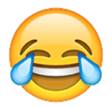
The Oxford English Dictionary announced its “word” of the year recently. Here it is. Tell me what you think:

Yes. That is it. That picture, graphic, pictograph, emoji is the 2015 Word of the Year. The name of the emoji is “Face with Tears of Joy.” And now, I scream:

Aghhhhhhhhhhhhhhhhhhhhhhhhhhhhhhh!

How could you say that a picture is the word of the year? And not just one word, but five words: “face with tears of joy.” Five words that make me want to vomit a sea biscuit because of this whole situation. According to the Oxford English Dictionary itself, the definition of “word” is:

A single distinct meaningful element of speech or writing, used with others (or sometimes alone) to form a sentence and typically shown with a space on either side when written or printed.

Have you ever tried to say or write an emoji? It’s pretty tough without a smartphone or some kind of electronic device. Of course, you can make your own decision on this. I’m providing you with two things:

· The announcement and explanation from the Oxford Dictionaries website

· A response to this atrocity from Daily Writing Tips

Oxford—why hast thou forsaken me?

Kara Church

Technical Editor, Advisory

Symitar Documentation Services

Posted by: Jack Henry | November 23, 2015

Editor’s Corner: Acronyms, Initialisms, and Abbreviations

A while ago, I sent an Editor’s Corner article about avoiding texting and Internet slang when you write business emails and documentation because some people may not be familiar with the slang. I received an overwhelming response from subscribers stating how frustrating it is when a writer uses acronyms in documentation and assumes that everyone knows what they stand for.

Today we are going discuss acronyms, initialisms, and abbreviations. We use the word abbreviation to include all shortened form of words, so acronyms and initialisms are often considered abbreviations, but there is also a specific meaning for the term abbreviation, which I show below. Here are some examples of each:

· acronym: a word formed from the first letters of each one of the words in a phrase (pronounced as a word)

Examples:

HELOC – Home equity line of credit

Benexlux – Belgium, Netherlands, Luxembourg

ARM – Adjustable rate mortgage

PIN – Personal identification number

scuba – self-contained underwater breathing apparatus

· initialism: an abbreviation formed from initial letters (pronounced by each letter)

Examples:

ACH – Automated Clearing House

ATM – Automated teller machine

CVV – Card Validation Value

· abbreviation: a shortened form of a word or name that is used in place of the full word or name

Examples of abbreviations:

vs. – versus

Asst. Mgr. – Assistant Manager

natl. – national

When you use an acronym, initialism, or abbreviation, spell out the words in the first instance, and then write the acronym, initialism, or abbreviation in parentheses after the words. You can make exceptions for common acronyms, initialisms, and abbreviations.

Example:

The FRB changed the ABA URL directory listing on February 22, 2015.

Correction:

The Federal Reserve Bank (FRB) changed the American Banking Association (ABA) URL directory listing on February 22, 2015.

Jackie Solano | Technical Editor | Symitar®

8985 Balboa Ave. | San Diego, CA 92123 | Ph. 619.542.6711 | Extension: 766711

Symitar Documentation Services

NOTICE: This electronic mail message and any files transmitted with it are intended
exclusively for the individual or entity to which it is addressed. The message,
together with any attachment, may contain confidential and/or privileged information.
Any unauthorized review, use, printing, saving, copying, disclosure or distribution
is strictly prohibited. If you have received this message in error, please
immediately advise the sender by reply email and delete all copies.

Posted by: Jack Henry | November 20, 2015

Editor’s Corner: Companion and Pantry

I have a great new book to share called Words of a Feather: A Humorous Puzzlement of Etymological Pairs, by Murray Suid. Mr. Suid traces the etymologies of seemingly unrelated word pairs back to where they started, and in the process, he shows us what they actually have in common. Today I’ll start with the connection between friends, breads, and kitchen closets.

Companion and Pantry
Companion goes back to the Latin companio, made up of com, “with,” plus panis, “bread,” literally “with bread”—and implicitly someone you’d gladly break bread with. The same Latin word gave us company, which refers either to a group of soldiers or to a business organization.

The Latin panis is the source of the modern French word for bread, pain. [KC – And in Spanish the word for bread,
pan.] Panis also gave rise to an Old French word, paneterie, “bread room,” the place where ingredients and tools were stored for making bread and other foods. When it was imported into English, paneterie became pantry.

Happy Friday!

Kara Church

Technical Editor, Advisory

619-542-6773 | Ext: 766773

Symitar Documentation Services

NOTICE: This electronic mail message and any files transmitted with it are intended
exclusively for the individual or entity to which it is addressed. The message,
together with any attachment, may contain confidential and/or privileged information.
Any unauthorized review, use, printing, saving, copying, disclosure or distribution
is strictly prohibited. If you have received this message in error, please
immediately advise the sender by reply email and delete all copies.

Posted by: Jack Henry | November 19, 2015

Editor’s Corner: Verbs

Donna was kind enough to discuss adverbs and adjectives with you last week. After the other day’s article on card-related terms, I feel like I owe you something more substantial, so let’s go back to verbs for a few minutes.

Recently, I sent something out with a verb (past tense) ending in “t.” A couple of you asked why I misspelled the word. My first response was, “I didn’t write that, it is a quote.” My second response was, “And that is not a misspelling.” While the past tense of most regular verbs in English are formed with an –ed at the end, some actually do end with a –t.

bend/bent
feel/felt
keep/kept
leave/left
lend/lent
lose/lost
mean/meant
send/sent
sleep/slept
spend/spent
weep/wept

Then there are verbs that may be spelled with either -ed or -t. (The -t ending for these verbs is more common in British spelling.)

burned, burnt
dreamed, dreamt
kneeled, knelt
leaped, leapt
leaned, leant
learned, learnt
smelled, smelt
spelled, spelt
spilled, spilt
spoiled, spoilt

The lists above are courtesy of Daily Writing Tips.

Kara Church

Technical Editor, Advisory

619-542-6773 | Ext: 766773

Symitar Documentation Services

NOTICE: This electronic mail message and any files transmitted with it are intended
exclusively for the individual or entity to which it is addressed. The message,
together with any attachment, may contain confidential and/or privileged information.
Any unauthorized review, use, printing, saving, copying, disclosure or distribution
is strictly prohibited. If you have received this message in error, please
immediately advise the sender by reply email and delete all copies.

Posted by: Jack Henry | November 18, 2015

Editor’s Corner: Umlaut or Diaeresis?

Today’s tidbit reminded me a little bit of the snarky Q&A we sometimes see in the Chicago Manual of Style. In this case, this article is a response to a reader of The New Yorker. I found it interesting and funny, which I hope you do, too. The entire article is here, but I’ve included most of it below.

Not An Umlaut

A reader has posed a question about a mark he noticed in The New Yorker:

In a recent copy of The New Yorker the word ‘reëlection’ appeared with an umlaut over the second ‘e’. I had not seen the umlaut used that way before.

Is the umlaut making a comeback? Should it also be used in similar situations such as ‘realignment’, or ‘reengineer’ or ‘deescalate’? Or is the hyphen more appropriate? Or nothing? Or is The New Yorker just being, well NewYorkerish?

I’ll answer the last question first: Yes, The New Yorker is being “NewYorkerish.” The use of the two-dot diacritical mark in words like reëlect is a notable feature of the magazine’s house style. Other publications are prone to ridicule this use.

As for the question “Is the umlaut making a comeback?” I’ll have to contradict the reader’s use of the word umlaut in reference to the two dots in the word reëlection.

An umlaut is a diacritical mark characteristic of German…Used with English words, the two-dot diacritical mark has a different name and a different function.

In English, it’s called a diaeresis, and its usual function is to alert the reader to the fact that two vowels written side by side are not to be pronounced together as a diphthong, but separately, as distinct vowels. The source of the word diaeresis is a Greek verb meaning “to divide.” A diaeresis tells us to divide two vowels. . .

Speakers acquainted with literature, art, music, and astronomy encounter the diaeresis in such classical names as the following:

Danaë
Laërtes
Pasiphaë
Aïda
Laocoön
Boötes

Two common words that some speakers still write with a diaeresis are Noël and daïs, and the diaeresis occurs in the name of the writer Anaïs Nin.

The diaeresis is also seen in English above vowels that occur at the end of certain proper names. This use indicates that the final vowel, usually e, is not silent. For example: Brontë [BRON-tee], Zoë [ZO-ee], Chloë, [KLO-ee], Bettë [BET-ee].

On the assumption that readers “know” how to pronounce these names, people write them without the diaeresis. . .

The New Yorker’s use of the diaeresis to separate standard prefixes in words like reëlection is silly. That’s what hyphens are for.

The use of the diaeresis to clarify the pronunciation of words like daïs, Noël, Brontë, and Zoë, on the other hand, is well worth a comeback.

Kara Church

Technical Editor, Advisory

619-542-6773 | Ext: 766773

Symitar Documentation Services

NOTICE: This electronic mail message and any files transmitted with it are intended
exclusively for the individual or entity to which it is addressed. The message,
together with any attachment, may contain confidential and/or privileged information.
Any unauthorized review, use, printing, saving, copying, disclosure or distribution
is strictly prohibited. If you have received this message in error, please
immediately advise the sender by reply email and delete all copies.

Posted by: Jack Henry | November 17, 2015

Editor’s Corner: Poker Face

I am swamped today! Rather than write for you, I’m sharing a portion of this article from the San Diego Union-Tribune. For the full article, you can see Richard Lederer’s column here.

My children’s achievements in the gaming halls inspire me to deal from a full deck of vivid words and phrases that have made the journey from the poker table into our everyday conversation and writing. The color and high-risk excitement of poker have made the language of the game one of the most pervasive metaphors in our language.

The basic elements of poker are the cards, the chips and the play of the hand, and each has become embedded in our daily parlance. Beginning with the cards themselves, the verb to discard descends from decard, "away card," and first meant to throw away a card from one’s hand. Gradually, the meaning of discard broadened to include rejection beyond card-playing.

A cardsharp who is out to cheat you may be dealing from the bottom of the deck and giving you a fast shuffle, in which case you may get lost in the shuffle. You might call such a low-down skunk a four-flusher. Flush, a hand of five cards that are all of one suit, flows from the Latin fluxus because all the cards flow together. Four-flusher characterizes a poker player who pretends to such good fortune but in fact holds a worthless hand of four same-suit cards and one that doesn’t match.

Now that I’ve laid my cards on the table, let’s see what happens when the chips are down. Why do we call a gilt-edged, sure-thing stock a blue-chip stock? Because the blue ones have traditionally been the most valuable. Why, when we compare the value and power of two things, do we often ask how one stacks up against the other, as in "How do the Chargers stack up against the Broncos?" Here the reference is to the columns of chips piled up before the players around a poker table. These stacks also account for the expressions bottom dollar and top dollar. Betting one’s bottom dollar means wagering the entire stack, and the top dollar, or chip, is the one that sits atop the highest pile on the table. Indeed, the metaphor of poker chips is so powerful that one of the euphemisms we use for death is cashing in one’s chips.

The guts of poker is the betting. You bet! has become a standard affirmative in American English, and it is far from being the only betting metaphor that has traveled from the gaming halls to our common vocabulary. If your opponents wish to call your bluff and insist that you put up or shut up, you’ll be happy to put your money where your mouth is. Rather than passing the buck, you play it close to the vest without showing your hand, maintain an inscrutable poker face and hope to hit the jackpot.

Pass the buck is a cliché that means "to shift responsibility," but why should handing someone a dollar bill indicate that a duty is transferred? Once again, the answer can be found in the gambling pleasure palaces. The buck in pass the buck was originally a poker term designating a marker placed in front of the player to the left of the dealer, the player who must bet first. During the heyday of poker in the 19th century, the marker was often a hunting knife whose handle was made of a buck’s horn. The knife defined the game as Buckhorn Poker or Buck Poker and gave us the expression pass the buck. After each deal, the buck was passed from the first wagerer to the next player, from a position of disadvantage to one of advantage.

In the Old West, silver dollars often replaced buckhorn knives as tokens, and these coins took on the slang name buck. President Harry S. Truman, reputed to be a skillful poker player, adopted the now-famous motto "The buck stops here," meaning that the ultimate responsibility rested with the president.

The cleverest application of poker terminology I’ve encountered appears on the sides of some plumbing trucks: "A Flush Is Better Than a Full House." In poker that isn’t true, but a homeowner would recognize its wisdom.

You can bet on it.

NOTICE: This electronic mail message and any files transmitted with it are intended
exclusively for the individual or entity to which it is addressed. The message,
together with any attachment, may contain confidential and/or privileged information.
Any unauthorized review, use, printing, saving, copying, disclosure or distribution
is strictly prohibited. If you have received this message in error, please
immediately advise the sender by reply email and delete all copies.

Posted by: Jack Henry | November 16, 2015

Editor’s Corner: Skid Road

Good morning, folks.

I read an article this weekend on the Daily Writing Tips website. A subscriber asked this question: “Is it ‘skid row’ or ‘skid road,’ and what’s the proper usage?”

I smugly thought to myself, “It’s ‘skid row,’ of course!”

Well it is, but that’s not the whole story. It turns out the person asking the question was on to something, and I got schooled!

Here’s an excerpt from the article:

The expression “skid row” is the common term in modern usage, but it’s thought to derive from an earlier term associated with the logging industry.

In Washington State and other centers of the lumber industry, loggers built roads out of logs and then skidded newly cut logs down these “skid roads.” As time went on, saloons and brothels sprang up along the skid roads and the term took on the meaning, “a district abounding in vicious characters and the practice of vice.”

When the expression migrated to urban environments, road became row, perhaps in imitation of established streets with names like Park Row and Tryon Row.

So, the phrase did start off as “skid road.” I love learning about the etymology of English phrases and idioms.

I hope your Monday is a good one.

Donna Bradley Burcher | Senior Technical Editor | Symitar®

8985 Balboa Ave. | San Diego, CA 92123 | Ph. 619.278.0432 | Extension: 765432

NOTICE: This electronic mail message and any files transmitted with it are intended
exclusively for the individual or entity to which it is addressed. The message,
together with any attachment, may contain confidential and/or privileged information.
Any unauthorized review, use, printing, saving, copying, disclosure or distribution
is strictly prohibited. If you have received this message in error, please
immediately advise the sender by reply email and delete all copies.

Posted by: Jack Henry | November 13, 2015

Editor’s Corner: Adverbs

Good morning. I know you usually get a fun email on Friday, but I started something yesterday that I need to finish, so maybe you can create some extra fun on your own today. Happy Friday!

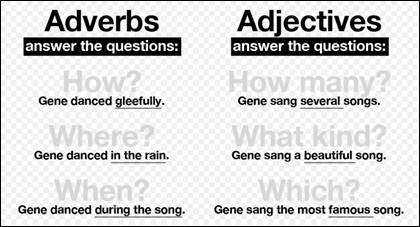
Yesterday we talked about adjectives (words that describe nouns). Today we’ll talk about adverbs. As I said yesterday, adverbs are similar to adjectives; however, adverbs modify verbs, adjectives, or other adverbs.

An adverb (or an adverbial phrase) describes the word it modifies or gives more information about it.

A lot of people assume that all adverbs end in ly. Well, that’s a good start: many do, but not all adverbs end in ly. The adverbs in the following sentences are italicized.

· When he heard the alarm, he ran quickly down the stairs.

· She ran fast despite being tired.

· The rain fell hard during the storm.

To determine if a word is an adverb, you can ask yourself these questions:

· When?

· Where?

· How?

Donna Bradley Burcher | Senior Technical Editor | Symitar®

8985 Balboa Ave. | San Diego, CA 92123 | Ph. 619.278.0432 | Ext: 765432

Posted by: Jack Henry | November 12, 2015

Editor’s Corner: Adjectives

Good morning, and happy belated Veterans Day. I’d like to thank all our veterans, all our active military, and all our military families for your sacrifices. And I’ll give a little shout out to my son in the Coast Guard.

On to the grammar question of the day. Have you wondered what the difference is between adjectives and adverbs? They serve very similar functions, so if you’re confused, you’re not alone. Today I’ll cover adjectives, and tomorrow we’ll move on to adverbs. Much of the information I will share today comes from The Only Grammar Book You’ll Ever Need (Susan Thurman, 2003).

You may remember from grammar lessons in elementary school that an adjective is a describing word. Or you may have heard adjectives described as words that modify nouns or pronouns. Both those statements are true. The adjectives in the following sentences are italicized.

· The framed picture came crashing off the wall during the recent earthquake.

· The barking dog alerted its owner that someone was at the door.

To determine if a word is an adjective, you can ask these questions:

· Which one?

· What kind of?

· How many?

The word framed in the first example answers two questions: “which picture?” and “what kind of picture?”, so it must be an adjective. Similarly, to find the adjective in the second example, you could ask “which dog?”

Just remember that adjectives describe a noun.

Until tomorrow—have fun!

Donna Bradley Burcher | Senior Technical Editor | Symitar®

8985 Balboa Ave. | San Diego, CA 92123 | Ph. 619.278.0432 | Extension: 765432

Symitar Technical Publications Writing and Editing Requests

NOTICE: This electronic mail message and any files transmitted with it are intended
exclusively for the individual or entity to which it is addressed. The message,
together with any attachment, may contain confidential and/or privileged information.
Any unauthorized review, use, printing, saving, copying, disclosure or distribution
is strictly prohibited. If you have received this message in error, please
immediately advise the sender by reply email and delete all copies.

« Newer Posts - Older Posts »

Categories