Posted by: Jack Henry | December 24, 2015

Editor’s Corner: Green, black, and prizes!

Good morning and happy (almost) holidays! Your gift for today is the final installment of Grammar Girl’s article on color-related idioms. The gift for five of you (yes, five) are some lightly used books.

I’m working from home today, so I don’t have all the titles for you, but the winner of the malapropism book is Adele Witzke Schumaker in Allen, Texas. The other books are Signspotting 3, 4, and 5, and part 2 of a book on Bad Grammer (sic). The winners of those books are:

· Alma Cayaban

· Scott Rose

· Robert Tresscott

· Jess Woodland

I’ll get your books in the mail next week. In the meantime, congratulations! Enjoy your holiday and weekend.

6. Green-Eyed Monster

Our sixth color is green and the idiom green with envy, which means jealous and dates from the mid-1800s. Shakespeare used other green-related phrases, indicating that the association between green and jealousy has been around much longer than 160 years. For example, you’ll find the phrase green-eyed monster in Othello, the green sickness in Anthony and Cleopatra, and green-eyed jealousy in Merchant of Venice. In fact, it seems we can go back to the Ancient Greeks and their humors, to propose an origin for the phrase. Remember the bile we mentioned when discussing the phrase white-livered? [KC – How could we forget, Grammar Girl? We love reading about that stuff first thing in the morning!] It seems that the Greeks thought if you were sick, the body produced too much bile, making you look green. We have probably all looked green at some point when feeling sick.

7. Black Humor

Seventh and last in our list of colors is black. Black humor, or black comedy, is a style of satire that highlights very serious issues through comedy. The term comes from the French l’humour noire and was coined by Surrealist André Breton around 1940. This phrase debuted in English around 1965, and you’ll also hear the terms dark humor and dark comedy to refer to this extreme kind of satire. Although the phrases are somewhat new to the language, the concept has been around for a few centuries.

A famous example of black comedy is Jonathan Swift’s A Modest Proposal, published in 1729. This short work “modestly” suggests how the British should eat Irish babies. [KC – Great. Just when you think it couldn’t get worse.] Of course Swift, author of Gulliver’s Travels, was not serious; his outlandish—even funny—statements brought attention to the problem of Irish poverty. Here’s a sample: “I have been assured by a very knowing American of my acquaintance in London, that a young healthy child well nursed is at a year old a most delicious, nourishing, and wholesome food, whether stewed, roasted, baked, or boiled; and I make no doubt that it will equally serve in a fricassee or a ragout.”

It is easy to see why the color black is used in this idiom, because of the horror involved—both the fiction (eating babies) and the reality (starvation).

Well, that’s all for now. We hope that our discussion of black humor at the end didn’t turn you a little green.

Kara Church

Technical Editor, Advisory

619-542-6773 | Ext: 766773

Symitar Documentation Services

NOTICE: This electronic mail message and any files transmitted with it are intended
exclusively for the individual or entity to which it is addressed. The message,
together with any attachment, may contain confidential and/or privileged information.
Any unauthorized review, use, printing, saving, copying, disclosure or distribution
is strictly prohibited. If you have received this message in error, please
immediately advise the sender by reply email and delete all copies.


Posted by: Jack Henry | December 23, 2015

Editor’s Corner: Yellow- and rose-colored idioms

It’s the second day of color-related idioms from one of my favorite folks, Grammar Girl! Let’s continue the list today with yellow journalism and rose-colored glasses. Perhaps today’s phrases will be a little more festive and peppy than those of yesterday?

4. Yellow Journalism

Color number four—yellow—moves us to a different kind of sensation: sensational journalism, also known as yellow journalism. This style of reporting, which was at its height in the late 19th century, favors sensationalism over facts. It all came about because of a rivalry between newspaper magnates Joseph Pulitzer, owner of the New York World, and William Randolph Hearst, owner of the Journal. The World published a popular cartoon that featured a character called the Yellow Kid, and this cartoon increased sales tremendously. The Journal realized this and hired the artist away, causing a bidding war. Both papers also increased circulation by focusing their reporting on the Cuban struggle for independence, sometimes bending the truth. These days, our newspapers and Internet news sites are filled with banner headlines, colorful comics, and an abundance of illustrations, and we can thank the yellow journalists of the late 1890s for developing these now-commonplace techniques.

5. Rose-Colored Glasses

Rose is our next color. We use the words rose-colored and rosy to mean optimistic, as in the expressions looking through rose-colored glasses and things are looking rosy. If someone looks at the world through rose-colored glasses, she is perhaps being overly optimistic and in denial. The idea of an idyllic worldview being rosy dates from at least the 17th century, but Merriam-Webster.com dates the idiom rose-colored glasses to 1926. Theories about why it means optimistic abound, and we’ll cover a couple.

The first takes us to Victorian times and the thought that an artist could liven up a painting by adding extra roses to it. That sounds reasonable, as does the second theory, which holds that early mapmakers paid such close attention to detail that they needed to keep their spectacles clean with rose petals.

An interesting factoid that came up during research is worth sharing, though it likely has nothing to do with the meaning of rose-colored and rosy: In the early 1900s, some farmers started to place rose-colored glasses on their chickens to reduce cannibalization. The thinking was that the glasses would keep the chickens from recognizing blood on other chickens, which apparently triggers the attack instinct. I wonder if these glasses work or if their use was overly optimistic. [KC – I am a little concerned for Grammar Girl. From roses to chicken attacks—even the chance for something cheerful has passed her by in this article.]

Pulitzer Prize

Hearst Castle

Kara Church

Technical Editor, Advisory

Symitar Documentation Services

Posted by: Jack Henry | December 22, 2015

Editor’s Corner: Color Idioms, Day 1

It’s beginning to look a lot like Christmas and a bunch of other holidays around here! I think we’re looking at the Winter Solstice on the 22nd, Festivus on the 23rd, Christmas Eve and Day on the 24th and 25th, and Kwanza on the 26th. That’s a lot of celebration and cheer (and the airing of grievances, depending on which day you celebrate). Let’s keep it a little light and fluffy by looking at Grammar Girl’s article on colorful idioms over the next few days.

1. Red-Handed

First is that fiery color red, as in the idiom caught red-handed, which has a hyphen between red and handed. This means caught in the act of a crime, as in “She was caught red-handed stealing $100.” As you might suspect, the use of the color red in the phrase originates from the color of blood. The phrase originally referred to blood on a murderer’s hands but now extends to other crimes. The noun red-hand has appeared in print in Scottish legal proceedings since 1432, but red-handed was first printed in 1819, in Sir Walter Scott’s novel Ivanhoe, which helped to popularize the phrase. [KC – And then there was the episode of
The Simpsons when Bart wrote a book report on Ivanhoe and claimed it was about “A Russian peasant and his tool.”]

2. White-Livered

Now we’ll move from red to white, and the association of white with cowardice. If you say a man is white-livered or lily-livered, you are saying that he lacks courage, or that he is pale and without vitality. It is easy to see why white is associated with being pale and unhealthy, but we need to dig a little deeper to discover what a pale liver has to do with being afraid.

It all goes back to the Ancient Greeks and Hippocrates, who proposed a theory called humorism. This theory, which was believed until the 1800s, held that the body had four humors—black bile, yellow bile, phlegm, and blood—and that those humors needed to be kept in balance. [KC – So much for the “light and fluffy” feel to this article.]

The humor that is relevant to the meaning of white-livered is yellow bile, supposedly made in the liver. Yellow bile, known as the choleric humor, is hot and dry, and it “provokes, excites and emboldens the passions.” The idiom white-livered, therefore, stems from the thought that individuals without much yellow bile lacked a bold temperament and were therefore cowardly.

3. Tickled Pink

Next on our list of colors is pink, and we’re sticking with the medical theme. We hope you’ll be tickled pink! The idiom tickled pink means delighted and first came into being in 1922. The phrase uses the color pink because your complexion becomes flushed—and pinkish—when you feel the tickling sensation. That’s great if you enjoy tickling, but parents may want to think twice when tickling their children (or other people’s kids). Laughing when being tickled is an automatic response and the child may not actually enjoy the tickling. It can be difficult to say, “Stop!” [KC – This whole phrase seems to leave out the majority of the world’s non-Caucasian complexions, but that is a discussion for another time, I guess.]

Kara Church

Technical Editor, Advisory

619-542-6773 | Ext: 766773

Symitar Documentation Services

NOTICE: This electronic mail message and any files transmitted with it are intended
exclusively for the individual or entity to which it is addressed. The message,
together with any attachment, may contain confidential and/or privileged information.
Any unauthorized review, use, printing, saving, copying, disclosure or distribution
is strictly prohibited. If you have received this message in error, please
immediately advise the sender by reply email and delete all copies.
Posted by: Jack Henry | December 21, 2015

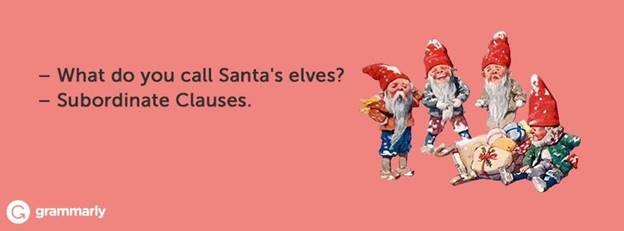
Editor’s Corner: Subordinate Clause

Good morning!

A subordinate (dependent) clause is a group of words, with a subject and a verb, that cannot stand alone as a complete sentence.

Here is an example:

· Because I woke up late this morning.

To make this fragment a complete sentence, attach it to the beginning or end of an independent clause. An independent clause is a complete sentence that can stand alone.

Examples:

· I missed the meeting because I woke up late this morning.

· Because I woke up late this morning, I missed the meeting.

Jackie Solano | Technical Editor | Symitar®

8985 Balboa Ave. | San Diego, CA 92123 | Ph. 619.542.6711 | Extension: 766711

Symitar Documentation Services

Posted by: Jack Henry | December 18, 2015

Editor’s Corner: Last Day of Malapropisms and Possible Prizes!

I hope that you’ve enjoyed Robert Alden Rubin’s collection of malapropisms from Going to Hell in a Hen Basket: An Illustrated Dictionary of Modern Malapropisms. Today is the last day I’ll be sharing from this book, but I’d like to do another give-away if anyone is interested in reading through this book or giving it as a gift! If you are interested, just email me the first few words of the title. On second thought, just send me an email that says “malapropisms” and I’ll draw a random winner by Thursday, December 24.

Just like last time, I have a couple of other books to give away as a bonus, so you really have three chances to win:

· Signspotting: The Art of Miscommunication

· More Badder Grammar!

Good luck!

· tarter sauce
Some sauces are tarter, some are sweeter, but few are made with cream of tartar (potassium hydrogen tartrate). Tartar sauce gets its name from the French sauce tartare (named after the fierce Asian Tartars for its tangy taste). Its main ingredients are mayonnaise and mustard.

· ten-yeared professor, ten-year track position, tenure tract
It usually takes four to six years for a published junior professor to get academic tenure. Tenure, from the Old French to hold, helps guarantee academic freedom and job security. A scholarly publication might be termed a tenure tract.

· rent is in the rears
Confuses behind in the rent with the rent is in arrears (owed). Or perhaps a person who pays his bill with hams.

· toe-headed child
Few people spin flax from tow (bundles of flax fibers) anymore, so the expression tow-headed child (to describe a child’s pale blond hair) may not make much sense. The confusion comes from a bald baby, or a child with short blond hair, which might resemble a pale toe to some. [KC – A child that looks like a hairy toe? Now that’s a real looker!]

· wheelbarrel
A wheelbarrow gets its name from a wheeled version of a stretcher on which cargo or human bodies were carried, known as a barrow, or a bier. A barrel can be used to carry things too, and barrels, like wheels, will roll, adding to the confusion.

Kara Church

Technical Editor, Advisory

619-542-6773 | Ext: 766773

Symitar Documentation Services

NOTICE: This electronic mail message and any files transmitted with it are intended
exclusively for the individual or entity to which it is addressed. The message,
together with any attachment, may contain confidential and/or privileged information.
Any unauthorized review, use, printing, saving, copying, disclosure or distribution
is strictly prohibited. If you have received this message in error, please
immediately advise the sender by reply email and delete all copies.
Posted by: Jack Henry | December 17, 2015

Editor’s Corner: On the lam, lazy-fare, and more

Hello there and happy Thursday!

I have a few more selected malapropisms for you from Going to Hell in a Hen Basket: An Illustrated Dictionary of Modern Malapropisms, by Robert Alden Rubin. And tomorrow? I will have the final few and the opportunity for you to enter yet another drawing for a free book!

· on the lamb
Lambs gambol [KC – run or jump playfully], so you might imagine that running joyfully to escape capture could refer to them. But on the lam literally means to beat it—to run away. It derives from Germanic words meaning to beat or to lame a person or animal.

· lazy-fare
The English lazy (to dislike work) and the French laissez-faire (leave it alone) both suggest inaction. Yet laissez-faire economic policies would work hard at keeping business un-impeded, whereas lazy policies just wouldn’t bother. The words have different origins, too: Lazy apparently derives from lay and lie, while laissez comes from let or allow.

· new leaf on life, new leash on life
Combines turn over a new leaf and get a new lease on life. Both figures of speech have to do with paper—the first the pages of a book, the second a contract. The variant may confuse the lease idiom with on a tight (or short) leash, which, like a lease, is binding.

· mind-bottling
The adjective mind-boggling and the verb boggle probably come from old words for ghosts and spirits (such as a bogey). This linkage isn’t intuitive when you want to describe amazement. The idea of capturing a mind in a bottle actually seems far more amazing.

· welcome rest bite
A rest bite might be a brief taste of rest. [KC – Or something a vampire gets while stopping along the highway in the United States.] Respite derives from the Latin for refuge, or consideration, and a welcome respite is a period of relief.

· rye expression
A rye expression might be something such as “I adore pumpernickel”—which might prompt wry expressions on the face of those who do not. Rye is an ancient word for grain that hasn’t changed much for thousands of years. Wry (meaning twisted, as with an expression that might be twisted with disgust), is almost as old.

· fairy tail, old wives’ tail, tell-tail, tattle-tail, etc.
May confuse fairies with mermaids who have tails, but this is usually just a homophone mistake. Some variants, however, are more plausible. For instance, a telltale on a sailboat is often a string of yarn that shows wind direction, and it can resemble a tail.

Kara Church

Technical Editor, Advisory

619-542-6773 | Ext: 766773

Symitar Documentation Services

NOTICE: This electronic mail message and any files transmitted with it are intended
exclusively for the individual or entity to which it is addressed. The message,
together with any attachment, may contain confidential and/or privileged information.
Any unauthorized review, use, printing, saving, copying, disclosure or distribution
is strictly prohibited. If you have received this message in error, please
immediately advise the sender by reply email and delete all copies.

Posted by: Jack Henry | December 16, 2015

Editor’s Corner: Tips on addressing holiday cards

We’ve covered some of these over the last few months, but it’s holiday card time so here are a few more reminders for you about addressing your cards. These are from Grammar Girl and a link to a follow-up article is included at the end.

Making Words That End in S or Z Plural

To make names that end in z plural, you add -es to the end of the name. So you would say you are going to visit the Alvarezes—a-l-v-a-r-e-z-E-S. The same rule applies when names end in s, so the Joneses invite you to dinner—j-o-n-e-s-E-S. You don’t use an apostrophe to make the names plural.

You use an apostrophe to make the names possessive. For example, let’s say you went to visit the Alvarezes and then you wanted to write a letter telling your mom about their wonderful house. To make Alvarezes possessive, you add an apostrophe to the end, so you would write “Mom, you should have seen the Alvarezes’ house!”

So now you’ve got that: If a name ends in s or z, add -es to make it plural and an apostrophe to make it possessive.

Punctuating Salutations

Next, if you’re writing a holiday letter, you might be interested in a bet that Laura and her husband John recently asked me to settle. Their question is how to write a salutation: How do you write something like “Hi, Squiggly”?

It seems straightforward, but it’s not. Although most people seem to think that hi is just a friendly substitute for dear, it isn’t. Dear is an adjective, but hi is an interjection just like the words indeed, yes, and oh.

So technically, Hi, Squiggly is a complete sentence that begins with an interjection, and an interjection at the beginning of a sentence is followed by a comma. So the correct way to write this is “Hi, Squiggly.” with a comma after hi and a period after Squiggly: Hi [comma] Squiggly [period]. You could also put an exclamation point at the end, depending on how excited you feel about the greeting.

The problem is that almost nobody knows that greetings should be punctuated this way, so it looks weird when you do it right. In fact, it’s extremely rare to see an e-mail salutation that uses a comma after the hi. I’m always torn about whether to use the comma. It is correct, but it seems a bit pedantic given the widespread use of the incorrect alternative—especially when you are replying to someone who has already done it the wrong way. Use your own judgment. I usually put it in, but you’ll be in good company if you leave it out. [KC – But don’t be surprised if you send a letter into our Editing department and we add that comma back in and ask you not to call yourself “Squiggly” in front of clients.]

· Dear Squiggly, (correct)

· Hi, Squiggly. (correct)

· Hi Squiggly, (widespread to the point of becoming acceptable)

Compound Possession and Apostrophes

Finally, we’ve talked about this before, but compound possession can come up in invitations, so I’ll go over it again. Imagine that Aardvark and Squiggly live in the same house and they are inviting people over for dinner. The location you are inviting people to is Aardvark and Squiggly’s house—with only one apostrophe s. Because they share the house, they share one apostrophe s.

If Aardvark and Squiggly live in different houses, and they are having a progressive dinner where they go from one house to the next, then the location on the invitation would read Aardvark’s and Squiggly’s houses. They don’t share the house, so they can’t share an apostrophe s. Both names need an apostrophe s: Aardvark’s and Squiggly’s houses.

For additional information on names and addressing mail, see Grammar Girl’s article on the Churches, Foxes, and Marshes.

Kara Church

Technical Editor, Advisory

619-542-6773 | Ext: 766773

Symitar Documentation Services

NOTICE: This electronic mail message and any files transmitted with it are intended
exclusively for the individual or entity to which it is addressed. The message,
together with any attachment, may contain confidential and/or privileged information.
Any unauthorized review, use, printing, saving, copying, disclosure or distribution
is strictly prohibited. If you have received this message in error, please
immediately advise the sender by reply email and delete all copies.

Posted by: Jack Henry | December 15, 2015

Editor’s Corner: Everyone’s Favorite Holiday Gift!

Look! I found the perfect gift for everyone on my list: a spelling test!

Here’s a fun little quiz for you from the GrammarBook.com team. The answers follow at the bottom of the email. Good luck!

The Spell of the Holidays

The year-end holidays are an alternate reality. People dress differently, act differently…and even talk differently. This time of year has its own vocabulary, and some of these old-fashioned words have eccentric spellings. So here is our holiday spelling quiz.

1. ___ the night before Christmas.

A) T’was
B) ’Twas
C) ’T’was
D) Twas

2. They have a live ___ down at the shopping mall.

A) raindeer
B) reindeer
C) raindear
D) reindere

3. It was a festive ___ gathering.

A) yueltide
B) yuletyde
C) yueltied
D) yuletide

4. Please! Go easy on the ___.

A) egg nog
B) eggnawg
C) eggnog
D) egg nogg

5. Our ___ holds nine candles.

A) menorah
B) mennorah
C) mennora
D) menorrah

6. “Santa Claus” refers to ___.

A) Saint Nicholas
B) Saint Nichlaus
C) Saint Nicalos
D) Saint Nichollas

7. In European folklore, ___ is considered magical.

A) misletoe
B) mistletoe
C) missletoe
D) misiltoe

8. The winter ___ falls on December 22 this year.

A) soulstice
B) sollstise
C) solstise
D) solstice

9. “O little town of ___.”

A) Bethlahem
B) Bethleham
C) Bethlehem
D) Bethelhem

10. Stop spinning that ___ and join us for dinner.

A) dradle
B) dreidle
C) draydel
D) dreidel

Answers come after the puppy photo!

ANSWERS

1: B) ’Twas

2: B) reindeer

3: D) yuletide

4: C) eggnog

5: A) menorah

6: A) Saint Nicholas

7: B) mistletoe

8: D) solstice

9: C) Bethlehem

10: D) dreidel

Kara Church

Technical Editor, Advisory

Symitar Documentation Services

Posted by: Jack Henry | December 14, 2015

Editor’s Corner: A few more malapropisms for Monday

Good Monday, to you!

I have a few more malapropisms for you fromGoing to Hell in a Hen Basket: An Illustrated Dictionary of Modern Malapropisms,by Robert Alden Rubin.

· dough-eyed
It’s tempting to speculate that the fairly recent term doe-eyed (meaning a look that is soft, feminine, and perhaps somewhat blankly naïve) may have been an eggcorn itself, deriving from dew or dewy.

· French benefits
Many employed in France enjoy generous fringe benefits, such as a month of paid vacation, but the French model of compensation has not become a byword in the USA. It has, however, become and eggcorn, if a rare one.

· futile lords
Seen from today, the petty warring of medieval nobles certainly seems futile—a time when might made right and literacy was rare. But scholars who’ve studied the so-called feudal system say the reasons for medieval conflicts were more logical than most people believe.

· run the gambit, run the gamete
Running the gamut
means playing the entire range of notes on a musical scale. A gambit, originally a chess term, is a strategic move. A complex gambit could run the gamut of all possible strategic options. A gamete is a haploid (half) cell that joins another to create a fertilized egg.

· holiday’s sauce, Holland Days Sauce
The deliciously creamy French butter, egg, and lemon sauce known as hollandaise is suitable for holidays, especially when served with fish. Its name means sauce of Holland, so Holland Day isn’t as wrongheaded as it seems.

· the invincible hand
Sometimes a deliberate pun about card games. Adam Smith’s classic metaphor for the laws of supply and demand in a free-market economy, an invisible hand, holdsthat such forces are more or less invincible, and will self-correct if governments don’t interfere.

Kara Church

Technical Editor, Advisory

619-542-6773 | Ext: 766773

Symitar Documentation Services

NOTICE: This electronic mail message and any files transmitted with it are intended
exclusively for the individual or entity to which it is addressed. The message,
together with any attachment, may contain confidential and/or privileged information.
Any unauthorized review, use, printing, saving, copying, disclosure or distribution
is strictly prohibited. If you have received this message in error, please
immediately advise the sender by reply email and delete all copies.

Posted by: Jack Henry | December 11, 2015

Editor’s Corner: Malapropisms and Eggcorns

Here’s a little more from a book I shared with you in the past. It is Going to Hell in a Hen Basket: An Illustrated Dictionary of Modern Malapropisms, by Robert Alden Rubin. Don’t forget what Merriam-Webster tells us a malapropism is:

a usually humorous misapplication of a word or phrase; specifically: a blundering use of a word that sounds somewhat like the one intended but is ludicrously wrong in the context”

· brunt-force trauma, brunt-force drama, blunt-force drama
Confuses a medical term, blunt-force trauma (the damage to a body from an impact that does not penetrate the skin), with a description of what accompanies the brunt (main impact) of a blow.

· cat before the horse
Cart
is pronounced like cat in such places as Boston. However, cat before the horse appears instead of cart before the horse often enough to suggest that many writers get the idiom wrong, as if one normally prioritized horses over cats.

· clusterphobia
The condition takes its name from the Latin claustrum—a lock or bolt—and describes someone nervous about being locked in a small space. But a cluster of people can indeed produce both claustrophobia and agoraphobia (fear of crowds).

· constellation prize
A common malapropism that qualifies as an eggcorn only if the runners-up get gold stars. Confused with consolation prize.

Forgot about eggcorns? Check a couple of our past articles here:

· https://episystechpubs.com/2015/03/26/editors-corner-eggcorns-3/

· https://episystechpubs.com/2015/03/27/editors-corner-more-eggcorns-for-foghorn-leghorn/

NOTICE: This electronic mail message and any files transmitted with it are intended
exclusively for the individual or entity to which it is addressed. The message,
together with any attachment, may contain confidential and/or privileged information.
Any unauthorized review, use, printing, saving, copying, disclosure or distribution
is strictly prohibited. If you have received this message in error, please
immediately advise the sender by reply email and delete all copies.

« Newer Posts - Older Posts »

Categories