Posted by: Jack Henry | January 11, 2016

Editor’s Corner: Bad or Badly?

Good morning, friends.

Someone asked me to cover this topic, and I must admit, when I’m speaking, I sometimes have to stop and think to make sure that I get this one right. I think I have a lingering fear that Mrs. Forbrag will pop up and correct me in front of everyone—again.

The question is, “How do I know if I should use the word bad or badly?”

Well, first, don’t worry about Mrs. Forbrag, she’s a bully. She made fourth grade a nightmare for many Chesterton Elementary schoolchildren.

Now, here’s the scoop. When you’re writing or talking about how you feel, use bad. For example, “I feel bad about eating my husband’s secret chocolate stash.”

And when you’re writing or talking about how you did something or about how you performed or reacted to something, use badly. For example, “My husband reacted badly when he realized all his chocolate was gone.”

I’m not saying that my husband and I won’t get over this, but the present situation is not so good (or is that goodly?).

Donna Bradley Burcher | Senior Technical Editor | Symitar®

8985 Balboa Ave. | San Diego, CA 92123 | Ph. 619.278.0432 | Ext: 765432

Posted by: Jack Henry | January 8, 2016

Editor’s Corner: Menu and Minute

Good morning and congratulations for making it through five whole workdays in a row! Today’s delicious offering is another set of etymologies from Words of a Feather: A Humorous Puzzlement of Etymological Pairs, by Murray Suid.

Menu and Minute

The word minute, referring to the unit of time, came into English from the Latin minutus, “small.” This happened in the late fourteenth century, the beginning of the era of accurate time measurement. But the concept of the minute, as a fraction of an hour, tracks back to Babylonian texts written about three thousand years earlier. The Babylonians lacked devices that could measure such small units, but they understood their theoretical importance, especially in the study of the heavenly bodies.

Menu, a French word that like minute traces back to the Latin minutus, is a nineteenth-century creation that came about to solve a practical problem: how to let restaurant customers know what items were being served—without consuming too much of the waiters’ time.

The solution was to print a list of foods, known as menu de repas. The phrase might be translated as “a small (description) of foods.” Eventually, continuing the spirit of saving space, menu de repas was shortened to menu.

KC – And as far as the adjective minute (very tiny) there is more in this etymology from the Online Etymology Dictionary:

minute (adj.)

Early 15c., "chopped small," from Latin minutus "little, small, minute," past participle of minuere "to lessen, diminish" (see minus). Meaning "very small in size or degree" is attested from 1620s. Related: Minutely; minuteness.

Kara Church

Technical Editor, Advisory

619-542-6773 | Ext: 766773

Symitar Documentation Services

NOTICE: This electronic mail message and any files transmitted with it are intended
exclusively for the individual or entity to which it is addressed. The message,
together with any attachment, may contain confidential and/or privileged information.
Any unauthorized review, use, printing, saving, copying, disclosure or distribution
is strictly prohibited. If you have received this message in error, please
immediately advise the sender by reply email and delete all copies.

Posted by: Jack Henry | January 7, 2016

Editor’s Corner: Adjective Order

Here’s a topic that’s come up more than once, but I liked how simply it was covered on this website, so I thought I’d share it with you. From the GINGER website, I introduce you to the Order of Adjectives: How to order adjectives in English.

In many languages, adjectives denoting attributes usually occur in a specific order. Generally, the adjective order in English is:

1. Quantity or number

2. Quality or opinion

3. Size

4. Age

5. Shape

6. Color

7. Proper adjective (often nationality, other place of origin, or material)

8. Purpose or qualifier

For example:

1. I love that really big old green antique car that always parked at the end of the street.

2. My sister adopted a beautiful big white bulldog.

When there are two or more adjectives that are from the same group, the word and is placed between the two adjectives:

1. The house is green and red.

2. The library has old and new books.

When there are three or more adjectives from the same adjective group, place a comma between each of the coordinate adjectives:

1. We live in the big green, white, and red house at the end of the street.

2. My friend lost a red, black, and white watch.

A comma is not placed between an adjective and the noun.

If you still find this a bit confusing, there are additional examples and a quiz on the GINGER website. Enjoy!

Kara Church

Technical Editor, Advisory

619-542-6773 | Ext: 766773

Symitar Documentation Services

NOTICE: This electronic mail message and any files transmitted with it are intended
exclusively for the individual or entity to which it is addressed. The message,
together with any attachment, may contain confidential and/or privileged information.
Any unauthorized review, use, printing, saving, copying, disclosure or distribution
is strictly prohibited. If you have received this message in error, please
immediately advise the sender by reply email and delete all copies.

Posted by: Jack Henry | January 6, 2016

Editor’s Corner: Winter Idioms and Phrases

Here are some winter idioms and phrases that have nothing to do with the weather (descriptions from thefreedictionary.com).

A snowball effect: a situation in which something increases in size or importance at a faster and faster rate

As the wind blows: as dictated by or according to fortune, circumstance, or the natural outcome of events

Break the ice: to make people feel comfortable in a social situation

Chill out: calm down or relax

Cold feet: fear of doing something; cowardice at the moment of action

Cold shoulder: an attitude of rejection

Fair-weather friend: someone who is your friend only when things are pleasant or going well for you

On thin ice: a risky situation

Perfect storm: a chance or rare combination of individual elements, circumstances, or events that together form a disastrous, catastrophic, or extremely unpleasant problem or difficulty

Rain on someone’s parade:to spoil something for someone

Ride out the storm:to continue to exist and not be harmed during a very difficult period

Snow on the mountain: silver, grey, or white hair on one’s head, as due to aging

Snowed under: overworked; exceptionally busy

Jackie Solano | Technical Editor | Symitar®

8985 Balboa Ave. | San Diego, CA 92123 | Ph. 619.542.6711 | Extension: 766711

Symitar Documentation Services

NOTICE: This electronic mail message and any files transmitted with it are intended
exclusively for the individual or entity to which it is addressed. The message,
together with any attachment, may contain confidential and/or privileged information.
Any unauthorized review, use, printing, saving, copying, disclosure or distribution
is strictly prohibited. If you have received this message in error, please
immediately advise the sender by reply email and delete all copies.

Posted by: Jack Henry | January 5, 2016

Editor’s Corner:

Today’s item didn’t make it into the month of December, where it would’ve been more fitting since we’re talking about deci and deka. Better late than never, though!

The following etymologies (from Words of a Feather: A Humorous Puzzlement of Etymological Pairs, by Murray Suid) revolve around decimal and decimate.

Decimate is a classic example of “semantic inflation.” Just like people, words can exaggerate.

The story begins with the Latin prefix deci-, “ten.” Deci- and its Greek relative deka spawned a variety of words such as decade, Decalogue (the Ten Commandments), and decimal, a fraction with an implied denominator of ten. All cut and dried meanings.

Decimate comes from the Latin decem, “ten,” and –atus, a suffix denoting an action, hence “taking of one-tenth.” The Romans used the word in two ways. First, it referred to imposing a tax of 10 percent, comparable to the meaning of the English word tithe. Second, it referred to the Roman army’s method of punishing an offending group—citizens or soldiers00by killing one in ten via a lottery. This too was a very specific operation.

However, as the word began to be applied to loss of life from other causes, such as fires, floods, famine, and plagues, it came to mean not merely a loss of one tenth, but something closer to annihilation.

Happy January!

Kara Church

Technical Editor, Advisory

619-542-6773 | Ext: 766773

Symitar Documentation Services

NOTICE: This electronic mail message and any files transmitted with it are intended
exclusively for the individual or entity to which it is addressed. The message,
together with any attachment, may contain confidential and/or privileged information.
Any unauthorized review, use, printing, saving, copying, disclosure or distribution
is strictly prohibited. If you have received this message in error, please
immediately advise the sender by reply email and delete all copies.

Posted by: Jack Henry | January 4, 2016

Editor’s Corner: Items 8, 9, and 10

Happy 2016!

I didn’t exactly time this right so we have a few more of the top ten grammar issues from 2015 today, plus we have a last-minute addition from one of you readers. Here we go!

Different Than and Different From

I’ve borrowed this description from Lit Reactor:

This is a tough one. Words like rather and faster are comparative adjectives, and are used to show comparison with the preposition than, (for example, greater than, less than, faster than, rather than). The adjective different is used to draw distinction. So, when different is followed by a preposition, it should be from (such as, separate from, distinct from, or away from). For example: My living situation in New York was different from home.

There are rare cases where different than is appropriate, if than operates as a conjunction. For example: Development is different in New York than in Los Angeles.

When in doubt, use different from.

As and Because

Here’s one we see a lot—people using the word as to mean because. The problem with this is that because isn’t always a synonym for as. For example, note how much clearer the sentence with because is:

· Your file system seems disorganized as you use the Greek alphabet to organize American names.

· Your file system seems disorganized because you use the Greek alphabet to organize American names.

May

Here’s a new one that somebody mentioned to me the other day. There are folks out there who are requesting something and trying to be nice, but instead of asking “Could you please plug in the phone?” “Would you please hand me a biscuit?” “May I please have some more gruel, Sir?” these folks are saying: “May you please call the client and help them?” To this, I say “Ay, carumba!” The word may expresses the possibility of something, like “It may rain tomorrow.” May also expresses or asks permission, so it is appropriate to ask, “May I feed your dog a pork chop?” But you aren’t asking for permission to call the client, you are asking somebody to make the call. It would be more appropriate in this case to use “Could you call” or “Would you call,” or even “Please call.” May just isn’t correct.

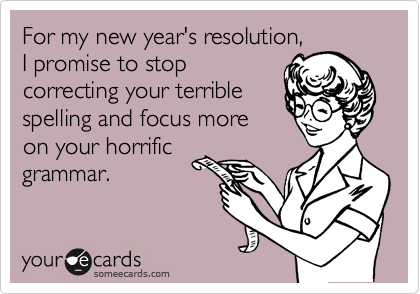
And a Happy New Year from a friend of mine:

Kara Church

Technical Editor, Advisory

619-542-6773 | Ext: 766773

Symitar Documentation Services

NOTICE: This electronic mail message and any files transmitted with it are intended
exclusively for the individual or entity to which it is addressed. The message,
together with any attachment, may contain confidential and/or privileged information.
Any unauthorized review, use, printing, saving, copying, disclosure or distribution
is strictly prohibited. If you have received this message in error, please
immediately advise the sender by reply email and delete all copies.

Posted by: Jack Henry | December 31, 2015

Editor’s Corner: 2015 Trouble Spots 5, 6, and 7

Hello and welcome to a winter wonderland where you will be schooled on the sometimes tricky combinations of the following:

· may and might

· if and whether

· since and because

I have borrowed these explanations from Litreactor, by Jon Gingerich. He has some harsh, boozy examples for you this New Year’s Eve. I must confess, I did a little bit of formatting and replace all of the e.g.s with “for example.”

5. May and Might

“May” implies a possibility. “Might” implies far more uncertainty. “You may get drunk if you have two shots in ten minutes” implies a real possibility of drunkenness. “You might get a ticket if you operate a tug boat while drunk” implies a possibility that is far more remote. Someone who says, “I may have more wine” could mean he/she doesn’t want more wine right now, or that he/she “might” not want any at all. Given the speaker’s indecision on the matter, “might” would be correct.

6. Whether and If

Many writers seem to assume that “whether” is interchangeable with “if." It isn’t. “Whether” expresses a condition where there are two or more alternatives. “If” expresses a condition where there are no alternatives. For example:

· I don’t know whether I’ll get drunk tonight. [KC – There are two alternatives that I’m not sure of. I’m not sure
whether I will or whether I won’t get drunk tonight.]

· I can get drunk tonight if I have money for booze. [KC – There is only one way I’m getting drunk tonight: I’ll get drunk
if I have money for booze.]

7. Since and Because

“Since” refers to time. “Because” refers to causation. For example:

· Since I quit drinking, I’ve married and had two children.

· Because I quit drinking, I no longer wake up in my own vomit.
[KC – Sorry, folks. These aren’t my examples. I don’t have kids and I never wake up in, well, you know.]

Have a safe holiday!

Kara Church

Technical Editor, Advisory

619-542-6773 | Ext: 766773

Symitar Documentation Services

NOTICE: This electronic mail message and any files transmitted with it are intended
exclusively for the individual or entity to which it is addressed. The message,
together with any attachment, may contain confidential and/or privileged information.
Any unauthorized review, use, printing, saving, copying, disclosure or distribution
is strictly prohibited. If you have received this message in error, please
immediately advise the sender by reply email and delete all copies.

Posted by: Jack Henry | December 30, 2015

Editor’s Corner: 2015 Top 10 Grammar Issues

I’m sticking with one single issue today because I don’t want to overwhelm you. I have borrowed this explanation from another website. I hope it helps! I’ve also included a couple of past links for you from Editor’s Corner on this topic.

4. Which and That (from Writer’s Digest)

The battle over whether to use which or that is one many people struggle to get right. It’s a popular grammar question and most folks want a quick rule of thumb so they can get it right.

Here it is:

If the sentence doesn’t need the clause that the word in question is connecting, use which. If it does, use that. (Pretty easy to remember, isn’t it?) Let me explain with a couple of examples.

Our office, which has two lunchrooms, is located in Cincinnati.
Our office that has two lunchrooms is located in Cincinnati.

These sentences are not the same. The first sentence tells us that you have just one office, and it’s located in Cincinnati. The clause “which has two lunchrooms” gives us additional information, but it doesn’t change the meaning of the sentence. Remove the clause and the location of our one office would still be clear: Our office is located in Cincinnati.

The second sentence suggests that we have multiple offices, but the office with two lunchrooms is located in Cincinnati. The phrase “that has two lunchrooms” is known as a restrictive clause because another part of the sentence (our office) depends on it. You can’t remove that clause without changing the meaning of the sentence.

Let’s look at another example:

The time machine, which looked like a telephone booth, concerned Bill and Ted.
The time machine that looked like a telephone booth concerned Bill and Ted.

In the first sentence (thanks to the use of which), the time machine concerned Bill and Ted. It also happened to look like a telephone booth. In the second sentence (which uses the restrictive clause), Bill and Ted are concerned with the time machine that looks like a telephone booth. They aren’t concerned with the one that looks like a garden shed or the one that looks like a DeLorean (Marty McFly may have reservations about that one).

· https://episystechpubs.com/2015/03/31/editors-corner-which-witch-is-which/

· https://episystechpubs.com/2015/04/01/editors-corner-whiches-and-whats/

· https://episystechpubs.com/2014/02/13/editors-corner-commas-clauses-and-nonessential-elements/

· https://episystechpubs.com/2015/09/15/editors-corner-dependent-vs-independent-clauses/

Kara Church

Technical Editor, Advisory

619-542-6773 | Ext: 766773

Symitar Documentation Services

NOTICE: This electronic mail message and any files transmitted with it are intended
exclusively for the individual or entity to which it is addressed. The message,
together with any attachment, may contain confidential and/or privileged information.
Any unauthorized review, use, printing, saving, copying, disclosure or distribution
is strictly prohibited. If you have received this message in error, please
immediately advise the sender by reply email and delete all copies.

Posted by: Jack Henry | December 29, 2015

Editor’s Corner: Top 10 Peeves for 2015 (1 through 3)

One of our dear readers asked if we could do an end-of-year review of the top ten errors or “problem children” we see in our daily editing. I have asked the editors for input, and here is a combination of things from us, from other editors, and from a few of you. I think we’ll cover the top ten over a few days so you can savor them properly.

First, let’s start with some general errors.

1. Too Many Capital Letters
This seems to bother all of us. Jackie, Donna, and I have written over 10 articles on proper nouns, common nouns, and capitalization, yet we see these errors daily. Some basic rules:

· Proper nouns are capitalized. Proper nouns name specific people, places, things, and ideas. For example: George Washington; Gibraltar; Symitar®; the Tower of London; Truth, Justice, and the American Way (when Superman uses the phrase).

· Common nouns are not capitalized. Common nouns are the generic names of people, places, things, and ideas. For example: dog, man, home, park, pizza, and truth.

· Just because something is important, does not mean it should be capitalized in a sentence.

· The dictionary is your friend. When you aren’t sure if something is a common noun or proper noun, check the dictionary.

· Want more information on this topic? Go to the Editor’s Corner and type capitalization, proper noun, or common noun in the Search field and press Enter.

2. Too Much Passive Voice
Yes, I’m sure this is a real surprise to you. This topic has been beaten mercilessly to a pulp. Or should that be, “We beat this topic to a pulp”? When you are writing, try to remember this general format:

ACTOR + ACTION + OBJECT

The operator + performs + a backup.

The teller + enters + the transaction.

From there, you can expand more on what, where, how, and why things are happening. You can add that flair that makes your day. But start here with the actor/subject—don’t start with the object and tell us what happened and completely leave out the “doer.”

The credit union’s president + buys 20-pound turkeys + for each of his stellar employees. Yay.

3. Too Many Deadwood Phrases and Redundancies
Okay, enough of the lecturing. I will just say that we try to trim our technical documentation of “deadwood,” redundant phrases, and fluff. Here are a couple of websites that will give you an idea of the things lawyers might add to your documents and that we will take away.

· Redundancies

· Deadwood

Kara Church

Technical Editor, Advisory

619-542-6773 | Ext: 766773

Symitar Documentation Services

NOTICE: This electronic mail message and any files transmitted with it are intended
exclusively for the individual or entity to which it is addressed. The message,
together with any attachment, may contain confidential and/or privileged information.
Any unauthorized review, use, printing, saving, copying, disclosure or distribution
is strictly prohibited. If you have received this message in error, please
immediately advise the sender by reply email and delete all copies.

Posted by: Jack Henry | December 28, 2015

Editor’s Corner: Card Shark or Card Sharp?

Good morning. I hope everyone enjoyed the long weekend. I enjoyed some time with my extremely loud, exuberant family.

We had a friendly family game of 31 on Boxing Day (December 26th). 31 is a card game that’s easy to learn and fun to play. If you’re interested, you can find the rules here.

I didn’t win the game, but I didn’t lose miserably either. I finished somewhere in the middle. And I made this comment: “Well, I’m not really a card sharp.”

Everyone looked at me like I’d just lit my eyelashes on fire. They all insisted that the term is “card shark” not “card sharp.” And they didn’t insist politely. They attacked like a swarm of killer bees. In my own house. Right after I fed them dinner.

And this is why I love Google. My sister whipped out her phone and informed everyone that both terms are correct. A few sources I’ve looked at since then state that a card sharp is someone who cheats at cards while a card shark is someone who spends a lot of time playing cards and is very good at it.

Turns out, I should have said “shark.” It’s more in line with what I meant, but I won’t tell them that now.

Donna Bradley Burcher | Senior Technical Editor | Symitar®

8985 Balboa Ave. | San Diego, CA 92123 | Ph. 619.278.0432 | Extension: 765432

Symitar Technical Publications Writing and Editing Requests

NOTICE: This electronic mail message and any files transmitted with it are intended
exclusively for the individual or entity to which it is addressed. The message,
together with any attachment, may contain confidential and/or privileged information.
Any unauthorized review, use, printing, saving, copying, disclosure or distribution
is strictly prohibited. If you have received this message in error, please
immediately advise the sender by reply email and delete all copies.

« Newer Posts - Older Posts »

Categories