Posted by: Jack Henry | December 26, 2017

Editor’s Corner: More Mondegreens

Many of you mentioned that you enjoyed the mondegreens I provided a week or so ago, so I thought I’d try to dig up some more. Some of these may be repeats, but some are new. Several cracked me up and I hope they bring a smile to your face, too! These are from a collection of mondegreens here. [KC – There are some naughty ones there, so beware if you decide to visit
that page.]

Song Title Artist/Group Actual Lyrics Mondegreen
Rocket Man Elton John Rocket man, burning out his fuse up here alone Rocket man, burning all the trees off every lawn
Stairway to Heaven Led Zeppelin And as we wind on down the road, our shadows taller than our souls And there’s a wino down the road, I should have stolen Oreos
Higher Love Steve Winwood Bring me a higher love Bring me an iron lung
Every Time You Go Away Paul Young Every time you go away, you take a piece of me with you Every time you go away you take a piece of meat with you
I’ve Got Two Tickets to Paradise Eddie Money I’ve got two tickets to paradise I’ve got two chickens with parrot eyes
I Wanna Be Sedated The Ramones I wanna be sedated I wanna piece of bacon
Middle of the Road Pretenders I’m standing in the middle of life with my pains behind me I’m standing in the middle of life with my pants behind me
You Don’t Bring Me Flowers Neil Diamond You hardly talk to me anymore, when I come through the door at the end of the day You hardly talk to me anymore, when I Kung Fu the door at the end of the day

Kara Church

Technical Editor, Advisory

Symitar Documentation Services

Posted by: Jack Henry | December 22, 2017

Editor’s Corner: Heart to Hart

Dear Editrix,

Where does the idiom “from the bottom of my heart” come from? I’ve sent you a photo to help with your research.

Thanks!

Man in Monett

Hey, man!

I looked around at quite a few sites for information on this idiom. None of them seemed to have a single, definite answer that I could prove, but they all indicated that the phrase has existed for hundreds of years. One site said that it was part of a hymn book from the 1500s. Several sites traced it back to Greece and Rome. Here is some information from Owlcation that seems plausible:

FROM THE BOTTOM OF MY HEART

Meaning: With sincere and deep thanks or love

Origin: The ancient Greek philosopher, Archimedes, believed that it was the brain that pumped blood and that the heart was responsible for thinking or feeling. Therefore, saying, "I love you" or "thank you", "from the bottom of my heart" would be the most meaningful because that was where most of your feelings would be.

Another theory held that the heart is like a container that fills up with feeling (again, eluding that the heart controls emotion). This would mean that the bottom of the heart is usually the fullest…kind of like a tank that continuously refills itself. The bottom is never really empty. Hence, the bottom of the heart contains the fullest of emotion.

As for the photo, it didn’t necessarily help my research, but the little buckaroo is adorable and his picture made me feel like going skiing (not hunting).

From the bottom of his hart and the heart on his bottom.

Kara Church

Technical Editor, Advisory

Symitar Documentation Services

Posted by: Jack Henry | December 21, 2017

Editor’s Corner: Bailiwick

It must be a busy day in editing world because I am relying completely on Grammar Girl to entertain and educate you today. As a big fan of British television, authors, and the English language, I thought I’d share this article with you, in hopes that you might fancy it like I did.

Have you ever asked someone for a favor and been told, “That’s not my bailiwick”?

If so, they turned you down. In short, they said, “That’s not my specialty. It’s not something I’m good at, so you should do it yourself.”

As you started to work, alone and rejected, you might have wondered, “What is a bailiwick, anyway?”

A “bailiwick” is an area that’s under the jurisdiction of a bailiff. In the US, we think of a bailiff as an official who helps to keep order in a courtroom. They’re the people who walk prisoners in and out of the room and escort the jury members to their seats. But in Britain, a bailiff is more like a sheriff. He or she can make arrests, serve court papers to a person, and seize the property of a debtor. (There’s also the term “sheriffwick,” but it seems to have fallen out of favor sometime in the 1800s.)

An example of a real-life bailiwick is the Bailiwick of Guernsey, a set of small islands in the English Channel. They’re part of England, but they have their own legislative assembly, which is presided over by — you guessed it — a bailiff.

So the “baili-” in “bailiwick” refers to a bailiff. (In fact, another form of the word “bailiff” was “bailie,” but that use is now obsolete.)

The “-wick” in “bailiwick” is also obsolete. This word used to mean a house or dwelling-place, as well as a town, village, or hamlet. It’s a very old word, derived from the Old English “wic.” We can trace it back to 900 CE and find it used in “Beowulf,” in the phrase “wica neosian,” meaning “to go home.”

Over time, the meaning of bailiwick as an administrative region was extended to mean one’s natural or proper sphere. For example, if a friend asked you to make pecan pie for Thanksgiving, you could decline, saying that baking isn’t your bailiwick.

So that’s your tidbit for today. When you say, “It’s not my bailiwick,” you mean it’s not my thing. It’s not something I’m good at or should be doing.

Kara Church

Technical Editor, Advisory

Symitar Documentation Services

Posted by: Jack Henry | December 20, 2017

Editor’s Corner: Hemi, demi, semi

Today I have a gift from our coworker M. Shepard to share with you. He sent me an article about a word I’d never heard before: hemidemisemiquaver. But before we get to the word, let’s have a look at this article from Mental Floss, which starts from the very beginning.

English has a number of prefixes that come from the concept of “half.” Why do we have so many? And what’s the difference between them?

1. SEMI

Semi-, from the Latin for “half,” is the most common and the earliest to show up in English. It was first used, with the straight sense of “half,” in the word semicircular, but soon attached to concepts that were harder to quantify. It’s easy to see what a half circle looks like, but what amount of “abstract” is “semi-abstract”? How permanent is “semi-permanent”? Through these less concrete uses, which proliferated wildly in the 1800s, semi- came to mean “virtually” or “somewhat.”

2. HEMI

Hemi- is from the Greek for “half.” It is less common than semi-, and it is associated more strongly with technical language in fields like chemistry, biology, and anatomy. Its sense of “half,” more than semi-, implies a lengthwise axis of symmetry. This is not obvious for the most common hemi- word, hemisphere (since a sphere is symmetrical all the way around), but a hemicylinder, is not just half a cylinder, it’s the half cut lengthwise, and hemiplegic doesn’t just mean half the body is paralyzed, but the right or left half (paraplegic is the term for when only the lower half is paralyzed).

3. DEMI

Demi is from the French for “half.” It was first used in English in heraldry, where things like demi-angels, demi-lions, demi-horses show up. It also held sway in other specific domains, such as military (demi-brigade) and fashion (demi-cap, demi-lustre, demi-worsted). It also picked up the sense of “virtual” or even “lesser.” A demigod, after all, is not quite the real thing.

It might seem ridiculous that English had to borrow a “half” prefix from three different places, but if it didn’t we wouldn’t get to have a word like hemidemisemiquaver—that’s a 64th note, in other words, a half of a half of a half of an eighth note, which is so much less fun to say than hemidemisemiquaver.

It’s almost winter, but not quite yet. Here’s a great sign:

Kara Church

Technical Editor, Advisory

619-542-6773 | Ext: 766773

Symitar Documentation Services

NOTICE: This electronic mail message and any files transmitted with it are intended
exclusively for the individual or entity to which it is addressed. The message,
together with any attachment, may contain confidential and/or privileged information.
Any unauthorized review, use, printing, saving, copying, disclosure or distribution
is strictly prohibited. If you have received this message in error, please
immediately advise the sender by reply email and delete all copies.


Posted by: Jack Henry | December 19, 2017

Editor’s Corner: The Twelfth Day of English

On the twelfth day of English

What a ruckus we all made

Finding 12 fantastic words

That rhyme with lemonade.

A number of words share the inflected ending -ade, which denotes an action or something that performs an action or function. The following comprehensive but not exhaustive list includes definitions of forty such words (and the meaning of each root word). [KC – For the full list of 40 words ending in -ade, check out
DailyWritingTips!]

1. ambuscade (“in forest”): an ambush

2. arcade (“arch”): an arched building, gallery, avenue, or passageway, or series of arches, or a business where coin-operated games are played

3. balustrade (“small pillar”): a row of vertical balusters, or railing supports, topped by a railing, or a low barrier

4. brocade (“little nail”): silk fabric with gold or silver weaved in (also a verb meaning “weave gold or silver with silk”)

5. cascade (“fall”): a waterfall, especially one in a series, or arrangement or occurrence of a succession of stages, or something falling or rushing (also a verb meaning “fall, pour, or rush in or as if in a cascade”)

6. cavalcade (“horse”): a parade of troops or other people mounted on horses, or simply a parade

7. chiffonade (“crumple”): finely cut or shredded herbs or vegetables

8. colonnade (“column”): a series of regularly spaced supporting columns

9. crusade (“cross”): a series of military expeditions to assert the influence of Christian nations in the Middle East (capitalized when referred to as “the Crusades”), or an enthusiastic effort to solve a problem (as a verb, meaning “engage in a crusade”)

10. escalade (“ladder”): an act of scaling fortification walls (also a verb meaning “scale fortification walls”)

11. fanfaronade (“braggart”): bluster

12. palisade (“stake”): a long, pointed stake, or a fence made of such stakes, or a line of cliffs resembling one

Kara Church

Technical Editor, Advisory

Symitar Documentation Services

Posted by: Jack Henry | December 18, 2017

Editor’s Corner: The Eleventh Day of English (2017)

On the eleventh day of English

My true love gave to me

A collection of archetypes

Like Nervous Nellie.

What is an archetype? According to Merriam-Webster, it is a “very typical example of a certain person or thing.” Today I have several of these from an article in Daily Writing Tips, where you can see the complete list of twenty, if you are interested.

Various expressions have arisen, sometimes from folkloric or historical origins, to describe types of people by assigning them with personal names. Here are twenty such appellations and their definitions and (sometimes only probable) origins.

1. Debbie Downer: a naysayer or pessimist; coined by joining an alliterative common name with a descriptive label

2. Doubting Thomas: a skeptic; inspired by the name of one of the twelve apostles of Jesus, who refused to believe in Jesus’s resurrection until he saw him

3. Gloomy Gus: (see “Debbie Downer”); based on a cartoon character named by joining an alliterative common name with a descriptive label

4. Good-Time Charlie: a hedonist; probably based on a reference in a Damon Runyon story about a speakeasy by that name

5. Handy Andy: a person with useful skills; inspired by rhyming a common name with a descriptive label

6. Jack-the-lad: an arrogant, carefree young man; probably inspired by the name of a thief who became a folk hero because of multiple escapes from prison

7. Kookaburra Kara: noisy girl with a large head; probably inspired by the Australian bird of the kookaburra and gumtree song. [KC – I’m totally kidding. Just trying to make sure you’re paying attention.]

8. Nervous Nellie: a timid, easily upset person of either gender; originally, a reference to a high-strung racehorse, influenced by Old Nell, a name associated with nags, or older horses

9. Peeping Tom: a voyeur; based on an apocryphal story of an onlooker (identified with a common name) during the based-in-fact tale of Lady Godiva

10. Simple Simon: a gullible, unintelligent person; derived from a folk character

11. Typhoid Mary: a person who spreads disease or another undesirable thing; named after Mary Mallon, an asymptomatic carrier of typhoid

A real kookaburra

Kara Church

Technical Editor, Advisory

Symitar Documentation Services

Posted by: Jack Henry | December 15, 2017

Editor’s Corner: Tenth Day of English (2017)

On the tenth day of English,

My true love did me wrong,

He forgot the pipers and sent me

Ten new ways to say “song.”

1. barcarole: a work song with a beat that alternates between strong and weak to suggest the rhythm of rowing a boat

2. canticle: a song based on scripture and performed during a church service

3. chantey/chanty/shanty: a rhythmic sailors’ work song

4. descant: a melody sung as a counterpoint to another melody

5. madrigal: a polyphonic part-song originating in the 14th century that has parts for three or more voices and is marked by the use of a secular text and a freely imitative style and counterpoint and that in its later development especially in the 16th and 17th centuries is often marked by a distinct melody in the upper voice and by being designed for accompaniment by strings that either double or replace one or more of the voice parts — compare motet [KC
– This definition is from Merriam-Webster.]

6. motet: a choral composition, usually unaccompanied, based on a sacred text

7. paean: a hymn or song of praise, thanks, or triumph

8. round: a song in which multiple singers sing the same melody and lyrics

9. roundelay: a simple song that includes a refrain

10. work song: a song structured to aid in the performance of a rhythmic group task

For an even longer list of different ways to say song, see Daily Writing Tips.

Kara Church

Technical Editor, Advisory

619-542-6773 | Ext: 766773

Symitar Documentation Services

NOTICE: This electronic mail message and any files transmitted with it are intended
exclusively for the individual or entity to which it is addressed. The message,
together with any attachment, may contain confidential and/or privileged information.
Any unauthorized review, use, printing, saving, copying, disclosure or distribution
is strictly prohibited. If you have received this message in error, please
immediately advise the sender by reply email and delete all copies.

Posted by: Jack Henry | December 14, 2017

Editor’s Corner: The Ninth Day of English (2017)

On the ninth day of English

My true love game to me

A bunch of words from the

Nineteenth century.

Today we’re taking a trip back to the 1800s, when people like Lewis Carrol, Charles Dickens, and other great writers were making up new words or redefining existing words to meet their creative needs. Today’s list is just a few of those words, but the full list of 25 in at DailyWritingTips.

This post lists a number of words that were introduced to the lexicon by novelists and other writers during the nineteenth century.

1. actualize: Poet Samuel Taylor Coleridge came up with this verb form of actual to refer to realizing a goal; self-actualization came much later.

2. chintzy: Writer George Eliot crafted the adjective meaning “cheap,” “stingy,” or “unfashionable” from chintz, the word for a Calico print originating in India.

3. chortle: Lewis Carroll came up with this mashup of chuckle and snort.

4. doormat: Novelist Charles Dickens was the first person to use the word doormat (hyphenated) to allude to someone figuratively being walked all over.

5. flummox: Dickens coined this nonsense word alluding to being bewildered or perplexed.

6. intensify: Poet Samuel Taylor Coleridge coined this term with the justification that “render intense” did not fit the meter of a poem he was writing.

7. narcissist: Coleridge, inspired by the Greek myth of the self-absorbed youth Narcissus, came up with this term to describe a person similarly afflicted with self-admiration, though the psychological condition of narcissism refers also to a lack of empathy and, paradoxical to the primary quality of a narcissist, low self-esteem.

8. psychosomatic: Coleridge came up with this term to refer to imagined maladies.

9. soulmate: Coleridge came up with this term (hyphenated) to refer to someone with whom one has a profound emotional connection.

Kara Church

Technical Editor, Advisory

619-542-6773 | Ext: 766773

Symitar Documentation Services

NOTICE: This electronic mail message and any files transmitted with it are intended
exclusively for the individual or entity to which it is addressed. The message,
together with any attachment, may contain confidential and/or privileged information.
Any unauthorized review, use, printing, saving, copying, disclosure or distribution
is strictly prohibited. If you have received this message in error, please
immediately advise the sender by reply email and delete all copies.
Posted by: Jack Henry | December 13, 2017

Editor’s Corner: The Eighth Day of English (2017)

On the eighth day of English

My true love gave to me,

Eight idioms that mean

Extremely hap-py!

An idiom is a turn of phrase that has “a meaning not deducible from those of the individual words (e.g., rain cats and dogs, see the light)” (from the Google dictionary). Today’s collection of idioms from My English Teacher, all mean happy.

1. Having a whale of a time
have a very good time, have an exciting or fun time

2. On cloud nine
very happy, cheerful

3. Tickled pink
very much pleased or entertained

4. On top of the world
feeling wonderful, glorious, ecstatic

5. Happy as a clam
very happy and comfortable

6. Buzzing
excited for something that’s going to happen

7. Over the moon
extremely pleased and happy

8. In seventh heaven
in a very happy state

Kara Church

Technical Editor, Advisory

Symitar Documentation Services

Posted by: Jack Henry | December 12, 2017

Editor’s Corner: The Seventh Day of English (2017)

On the seventh day of English

My true love sent to me

Seven bits of grammar

That you might find tricky.

Yes, I know most of you have seen these before, but they still stay at the top of the most often made errors in grammar. Many of you have sent in samples of signs you’ve seen with these errors, some of you complain that you receive emails with these mistakes, and I know that sometimes I even type the wrong word when I’m writing too fast. These are the top seven grammar errors, definitions of what they are, and examples of them being used correctly.

1) There/Their/They’re

· “There” means “in or at a place/point.”

Please put the suitcase there on the bed.

· “Their” is possessive.

John and Kat love all of the same things. Their favorite movie is Superman.

· “They’re” is a contraction of “they are.”

Bob and Dan said they’d be coming to the party. Do you know when they’re supposed to arrive?

2) Its/It’s

· “Its” is possessive.

A good dog knows its place is at the bottom of the bed, not on the pillows.

· “It’s” is a contraction of “it is.”

It’s a fact: today is the festival of the Balloon Man.

3) Your/You’re

· “Your” is possessive.

Please take your shoes off and leave them by the door.

· “You’re” is a contraction of “you are.”

Sandro saw his daughter’s Halloween costume and said, “You’re the most adorable little munchkin I’ve ever seen.”

4) Two/To/Too

· “Two” is a number.

He’s got a ticket to ride, but she’s got two tickets to paradise.

· “To” denotes an action.

I think I will wait until it is warmer to go swimming.

· “Too” means “also.”

Are you bringing a dessert to the holiday party, too?

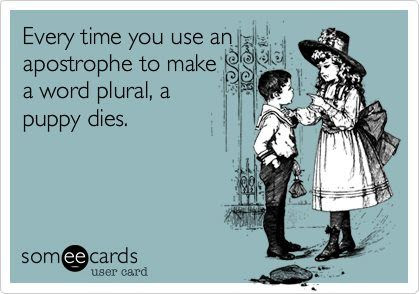
5) Apostrophes

· The boy’s dog. The girl’s guitar. Sarah’s pencil. The Three Girls’ Bakery. (possessive)

That over there is Cecil’s “new” ’67 Chevy.

· The boys are going out. Girls just want to have fun. (plural)

We have three peach trees growing in our back yard.

6) Who’s/Whose

· “Who’s” is a contraction of “who is” or “who has.”

Who’s going to the fire circle tonight?

· “Whose” is possessive.

Does anybody know whose winged shoes these are in the doorway?

7) Could have/Would have/Should have

“Seeing ‘could of’ written down is one of the more shiver-inducing grammar mistakes around. Why is this happening? What does it mean?

What they’re trying to say is ‘could’ve’ which is a contraction of ‘could have.’ This is never interchangeable with ‘could of’ which doesn’t mean anything, ever.” [KC – My apologies, I
don’t remember which website I got this quote from.]

Why did you bring two games when you could’ve brought four?

Kara Church

Technical Editor, Advisory

Symitar Documentation Services

« Newer Posts - Older Posts »

Categories