Posted by: Jack Henry | September 5, 2019

Editor’s Corner: Comparatives and Superlatives

Good morning! Today, the topic is comparatives and superlatives. Let’s start with comparatives since they sound like what they are and will make superlatives easier to digest. In grammar, a comparative is a word that is used to compare two things. For example, the word bigger is a comparative in the following sentence:

  • A condor is bigger than a hummingbird.

In contrast, a superlative is used to compare more than two things. For example, the word largest is a superlative in the following sentence:

  • The royal albatross is the largest flying bird alive today.

A common mistake that people make is to use a superlative when they should use a comparative, as in this sentence:

  • Gina is the sweetest of my two nieces. (incorrect)

Since there are only two nieces, the sentence should be written like this:

  • Gina is the sweeter of my two nieces.

Which brings me to my second point. If you are working with a one- or two-syllable word, like sweet, you add -er to make the comparative, and you add -est to make the superlative:

  • sweet, sweeter, sweetest

However, when you’re working with words that are three or more syllables, the rule changes. In that case you use the word more for the comparative and you use the word most for the superlative:

  • incredible, more incredible, most incredible

And then, of course, there are the irregulars. There are always irregulars in English. Here are some common irregulars:

  • bad, worse, worst
  • good, better, best
  • many, more, most
  • little, less, least

As with the regular comparatives and superlatives, people often make the mistake of using the superlative when they should use the comparative:

  • James is the best soccer player of the two of them. (incorrect)

Since we’re only comparing two soccer players, James is the better soccer player.

That’s it for today. Make it a good one. 😊

Donna Bradley Burcher | Senior Technical Editor | Symitar®

8985 Balboa Ave. | San Diego, CA 92123 | Ph. 619.278.0432 | Ext: 765432

About Editor’s Corner

Editor’s Corner keeps your communication skills sharp by providing information on grammar, punctuation, JHA style, and all things English. As editors, we spend our days reading, researching, and revising other people’s writing. We love to spend a few extra minutes to share what we learn with you and keep it fun while we’re doing it.

Did someone forward this email to you? Click here to subscribe.

Don’t want to get Editor’s Corner anymore? Click here to unsubscribe.

Do you have a question or an idea for Editor’s Corner? Send your suggestions or feedback to Kara, <a href="mailto:DBurcher, Jackie, or <a href="mailto:BRitter.

NOTICE: This electronic mail message and any files transmitted with it are intended
exclusively for the individual or entity to which it is addressed. The message,
together with any attachment, may contain confidential and/or privileged information.
Any unauthorized review, use, printing, saving, copying, disclosure or distribution
is strictly prohibited. If you have received this message in error, please
immediately advise the sender by reply email and delete all copies.


Posted by: Jack Henry | September 3, 2019

Editor’s Corner: Bully and Stopgap

Good morning, folks!

A couple of you have written in asking me to provide some information on words and phrases you’ve heard and where they might come from. You ask, I answer.

First, regarding an article I recently sent out about word meanings changing. One of the words was bully, which went from meaning sweetie or heartthrob to harasser. The question was, what about the phrase “Bully for you,” which means “good for you.” Is that from the older meaning? Writing Explained says:

In the 1500s and 1600s, the word bully meant an excellent person. Nowadays, bully usually means someone who hurts those weaker than oneself.

The original, positive meaning is still preserved in the idiom bully for you…which means…good for you; how brave.

Occasionally, this expression is used to praise someone sincerely. However, this usage is not incredibly common in the present day.

Nowadays, this expression is often sarcastic. A person might use this if he or she thinks that someone’s story is boring or not very good.

The other question I received was, “Where did the term ‘stopgap’ come from?” First, the meaning of stopgap, from Dictionary.com:

noun

something that fills the place of something else that is lacking; temporary substitute; makeshift. For example: Candles are a stopgap when the electricity fails.

adjective

makeshift. For example: This is only a stopgap solution.

The Online Etymology Dictionary says:

1680s, from stop (v.) + gap (n.); the notion probably being of something that plugs a leak, but it may be in part from gap (n.) in a specific military sense "opening or breach in defenses by which attack may be made (1540s). Also as an adjective from 1680s.

Kara Church

Technical Editor, Advisory

Symitar Documentation Services

Posted by: Jack Henry | August 29, 2019

Editor’s Corner: Eponyms

Have we ever discussed eponyms? I feel like we have, but I don’t see anything in our archives about them, so let’s have a look today. An eponym, put simply, is a word that is based on a person’s name. This partial collection is from a Grammar Girl blog, which I have edited a bit for time’s sake. You can click the link if you’d like to read more. I’m jumping right in and starting with the examples.

Adolphe Sax was a Belgian instrument maker who brought a new instrument to a Victorian event in 1851 called The Great Exhibition. His main job was making flutes and clarinets, and his invention, which looks like something of a mash-up of those two instruments, was dubbed the “Saxophone.”

Other things that were named after people that you might know about include:

  • Braille, the language of raised dots that blind people can use to read, invented by Louis Braille
  • Scientific terms like Fahrenheit, Celsius, pasteurize, ampere, ohm, volt, and watt, all named after famous scientists
  • Terms we’ve covered before in the podcast or in my books, like guillotine, teddy bear, and bowdlerize.

The guillotine was named after Joseph Guillotin, who was opposed to the death penalty but lobbied for the device to be used for beheadings during the French Revolution because it was more humane. Teddy bears were named after US president Teddy Roosevelt after he refused to shoot a cute, captive bear on a hunting trip. Bowdlerize came from Thomas Bowdler and his sister Harriet, who liked to edit words they found offensive out of Shakespeare’s writing.

Cardigan

Here’s one you’ll find in the dictionary that you may not have known was named after a person: cardigan. It was named after the Earl of Cardigan, who was very particular about everything related to his military unit, from drills and rules to his uniforms. In the famous battle of the Light Brigade, during the Crimean War in the 1850s, he wore a blue knitted waistcoat trimmed with gold. When he returned from the war, he was hailed as a hero, and his style of waistcoat became popular. Later, it came out that his performance in the war bordered on incompetent, but by then, it seems the sweater and the name cardigan had stuck.

With the industrial revolution, it became easier to make knitted clothes. In the 1920s, Coco Chanel made the cardigan something women could wear, too. Fashion historians say she embraced the design because she didn’t like messing up her hair by pulling on a regular sweater. But although Chanel may have expanded the market for the button-up sweater, we owe to name to Lord Cardigan.

Nicotine

I bet a lot of you didn’t know that nicotine is named after Jean Nicot, a trusted notary of the French royal family in the 1500s and the writer of one of the first French dictionaries. During his travels as the French ambassador to Portugal, he received a plant that had originated in what is now Florida in the United States. He saw that the powder from the plant greatly improved users’ moods, and he believed it had powerful healing properties. Knowing of the foul disposition and migraines of Catherine de Médici, he sent her some powdered leaves and she loved it, dubbing it “ambassador’s powder.” It made its way around Europe, becoming a popular thing to sniff with both royalty and the clergy, who also gave it the nickname “Father Superior’s powder.” Nicot began importing large quantities of tobacco to France, which gave him both fortune and fame. About 150 years after his death, the Swedish naturalist Carolus Linnaeus gave the tobacco plant the botanical name “Nicotiana.” And when the active chemical was isolated in 1828, scientists named it “nicotine.”

Mausoleum

Mausoleum, a large or stately tomb, comes from one of the Seven Wonders of the ancient world: the massive tomb of Mausolos, who was a fourth century B.C.E. king of a region that is now in Turkey.

Leotard

Leotard, the form-fitting stretchy outfit worn by athletes like gymnasts and ice skaters, comes from Jules Leotard, a 19th century trapeze artist.

leotard Leonard

Kara Church

Technical Editor, Advisory

Symitar Documentation Services

Posted by: Jack Henry | August 26, 2019

Editor’s Corner: Suffrage

Hello, my beautiful dandelions! I hope you are having a bright and cheerful day!

I’m sending this Editor’s Corner article a day early in honor of today being Women’s Equality Day. Though I like to celebrate 365 days of this, it is on this day that the United States commemorates the 1920 adoption of the Nineteenth Amendment (Amendment XIX) to the United States Constitution, which gave women in America the right to vote. Most of the JHA offices should be acknowledging this in some way—if you are in an office, check out what’s happening there!

If you are an Editor’s Corner reader, you get this special delivery to your mailbox because I love to share. So, what does the vote have to do with English?

Well, I was watching Schoolhouse Rock’s “Suffering Till Suffrage” video, and I got curious about where the word suffrage came from. Here is a nice article that answers a few questions about the word. The full article is here: “What Does Suffrage Mean” by Jone Johnson Lewis.

"Suffrage" is used today to mean the right to vote in elections, sometimes also including the right to run for and hold elected public office. It is commonly used in phrases like "woman suffrage" or "women’s suffrage" or "universal suffrage."

Derivation and History

The word "suffrage" comes from the Latin suffragium meaning "to support." It already had the connotation of voting in classical Latin, and may have been used as well for a special tablet on which one recorded a vote.

It likely came into English through French. In Middle English, the word took on ecclesiastical meanings, as well, of intercessory prayers. In the 14th and 15th centuries in English, it was also used to mean "support."

By the 16th and 17th centuries, "suffrage" was in common use in English to mean a vote in favor of a proposal (as in a representative body like Parliament) or of a person in an election. The meaning then broadened to apply to a vote for or against candidates and proposals. Then the meaning broadened to mean the ability to vote by individuals or groups….

The Enlightenment, with emphasis on equality of all persons and "consent of the governed," paved the way for the idea that the suffrage, or ability to vote, should be extended beyond a small elite group. Wider, or even universal suffrage, became a popular demand. "No taxation without representation" called for those who were taxed to also be able to vote for their representatives in government.

Universal male suffrage was a call in political circles in Europe and America by the first half of the 19th century, and then some began to extend that demand to women as well as woman suffrage became a key social reform issue through 1920.

Active suffrage refers to the right to vote. The phrase passive suffrage is used to refer to the right to run for and hold public office. Women were, in a few cases, elected to public office (or appointed) before they won the right to active suffrage.

Suffragist was used to denote someone working to extend suffrage to new groups. Suffragette was sometimes used for women working for woman suffrage.

Kara Church

Technical Editor, Advisory

Symitar Documentation Services

Posted by: Jack Henry | August 22, 2019

Editor’s Corner: Mispronounced Words

Good morning, everyone. Today I’m sharing a list of mispronounced words. Coming from a family of many varied accents, I wondered if the pronunciations would differ regionally, and my guess is that they do; however, I checked the pronunciations on the Merriam-Webster website, so whether you’re from California, Kentucky, or Maine, these are the preferred pronunciations. I was surprised by a couple of them.

This is by no means a complete list, but it gets the conversation started.

acai: should be ah-sigh-EE

conch: should be conk

espresso: should be es-PRESS-O (not ex-PRESS-o)

February: should be FEB-ru-ar-ee (we shouldn’t be dropping the first r).

forte: should be fort (not for-TAY)

foyer: should be FOY-er (not foy-YAY)

gala: should be GAY-la (not GAL-uh)

hyperbole: should be hy-PER-ba-lee (not HY-per-bowl)

liable: should be LIE-a-ble (not LIE-ble)

library: should be LIE-brare-ee (don’t drop the first r)

meme: should be meem

mischievous: should be MIS-chiv-ous (not mis-CHEEV-i-ous)

niche: should be nitch (not neesh)

nuclear: should be NEW-clee-ur (not NEW-que-lur)

often: should be OFF-en (not OFF-ten)

realtor: should be REEL-tur (not REE-la-tur)

regime: should be RAY-geem (not RUH-geem)

sherbet: should be sher-BET (not SHER-bert)

status: should be STAY-tus (not STAH-tus)

triathlon: should be tri-ATH-len (not tri-ATH-a-lon)

valet: should be VAL-it (not val-AY)

And because my son recently graduated with a degree in zoology…

zoology: should be zoh-AH-lo-jee (not zoo-AH-lo-jee)

And because my other son is in the Coast Guard…

boatswain: should be boh-sun

coxswain: should be kahk-sun

How many surprised you? I hope you have a fabulous day.

Donna Bradley Burcher | Senior Technical Editor | Symitar®

8985 Balboa Ave. | San Diego, CA 92123 | Ph. 619.278.0432 | Ext: 765432

About Editor’s Corner

Editor’s Corner keeps your communication skills sharp by providing information on grammar, punctuation, JHA style, and all things English. As editors, we spend our days reading, researching, and revising other people’s writing. We love to spend a few extra minutes to share what we learn with you and keep it fun while we’re doing it.

Did someone forward this email to you? Click here to subscribe.

Don’t want to get Editor’s Corner anymore? Click here to unsubscribe.

Do you have a question or an idea for Editor’s Corner? Send your suggestions or feedback to Kara or <a href="mailto:DBurcher.

NOTICE: This electronic mail message and any files transmitted with it are intended
exclusively for the individual or entity to which it is addressed. The message,
together with any attachment, may contain confidential and/or privileged information.
Any unauthorized review, use, printing, saving, copying, disclosure or distribution
is strictly prohibited. If you have received this message in error, please
immediately advise the sender by reply email and delete all copies.
Posted by: Jack Henry | August 20, 2019

Editor’s Corner: Greece is the word!

Καλημέρα! (Kaliméra/good morning), my little chickadees! I got back from a vacation a couple of weeks ago, and surprisingly, I haven’t forced my photos or stories on you…yet! It was a double birthday celebration for my brother and cousin, and instead of meeting here in the states, we went to my cousin’s home: Greece. It was quite an adventure with twelve family members; various homes, hotel rooms, and bungalows; three cars; and ten really stubborn, loud, opinionated people swearing in Greek. I’ll let you figure out who the two gentle people were, but I was not one of them. J

While I was going through the Acropolis Museum, I sent myself a few words to cover with you when I returned home. The top floor of the museum is built in the dimensions of the Parthenon and contains a few original marble sculptures and a lot of casts of the Parthenon’s ancient sculptures that are now in other countries. And here is where our language lesson starts.

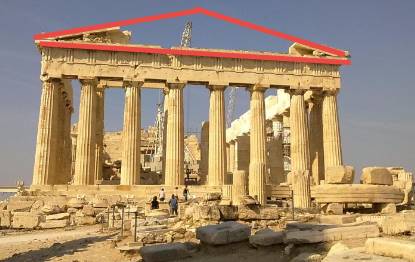
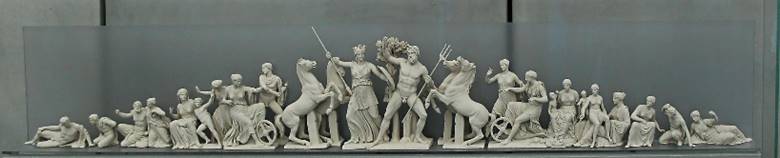
At either end of the museum’s top floor, you will see what remains of the two pediments. The pediments are the triangular areas above the columns. The pediments of the Athens Parthenon comprised two scenes from mythology: the birth of Athena from Zeus’s head, and a battle over Attica between Poseidon and Athena. Considering the name of the city below, I think we know who won that battle with her gift of the olive tree.

Today’s Parthenon (red indicates pediment placement):

Here’s a recreation of the pediment of Athena and Poseidon:

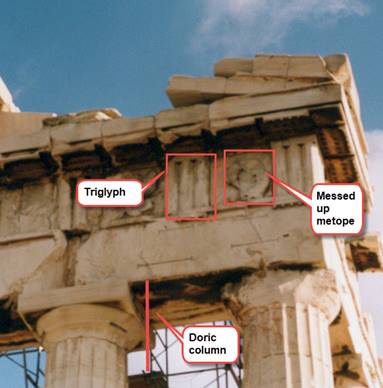
Hmm. I’m already running out of time and I’ve only covered “pediment.” Well, here’s another word for you: metope. A metope, according to Merriam-Webster is “space between two triglyphs of a Doric frieze often adorned with carved work.” Doric is the style of column used on the Parthenon, and a triglyph is

is a tablet with three vertical grooves. Put them all together and you have the next level of art beneath the pediment.

Okay, that’s it for today, except one more photo that I took far away from Athens, at the River Styx. Yes, this is where souls were supposedly ferried from the world of the living, across the Styx, to the world of the dead. You may remember seeing historical references of putting coins on the eyelids of the dead to pay the ferryman. This is where and why the Greeks did it. How did such a beautiful place get such a dark reputation?

Have a lovely day!

Kara Church

Technical Editor, Advisory

Symitar Documentation Services

Posted by: Jack Henry | August 15, 2019

Editor’s Corner: Two Tips for Clear Writing

We all struggle with putting our thoughts in writing in the most sensible, logical way. Even the best writers don’t always write perfectly in their first draft; they revise their text until they are confident it is clear.

Two challenges really hinder the legibility of a writer’s text: illogical sentence sequence (the order sentences are placed in) and missing transitions between sentences. I read a great article on GrammarBook.com that so beautifully explains these issues and how to fix them that I’m going to share it with you here. I hope you find it useful.

A challenge that any writer can run into is establishing fluent forward movement among sentences. To ensure understanding for readers, writers need to clearly connect related thoughts and properly signal when one is shifting to another.

Consider this text:

Janice is going to Nashville. She enjoys traveling. She loves rock music and concerts. Her favorite band, Heavy Medal, is performing. Janice’s family is having a reunion. The airline is lowering fares. Janice has two weeks of unused vacation from work. She wants to go to Austin, Texas, too. [dbb – You’ll find suggestions about how fix this disjointed paragraph toward the very end of the article—read on!]

These sentences convey information, but they also make us work to decipher their association. Their lack of cohesion lowers the likelihood we’ll retain them as we should.

As writers, we can help them adhere with proper arrangement and transitions. Sentence arrangement involves placing statements in a logical sequence. Transitional markers indicate the relationships among ideas.

For a better sequence of sentences, we focus on what the order of thoughts could or should be.

Scattered sequence: Brianna wrote a report. She bought more paper. She gave it to her teacher. She proofed it for typos.
Logical sequence: Brianna bought more paper. She wrote a report. She proofed it for typos. She gave it to her teacher.

For marking transitions, one way to connect different sentences is by repeating a word or an idea from a previous sentence.

Less connected: Questionable claims can spread through social media. An embezzler sits on the village board.
Better with repeated idea: Questionable claims can spread through social media. One such claim is that an embezzler sits on the village board.

Another way to achieve smoother links is by including a transitional word or phrase. These markers may also be referred to as conjuncts or conjunctive adverbs. The following table includes some of these common expressions.

Addition moreover, even more, further, furthermore, besides, and, and then, likewise, also, plus, too, as well, again, in addition, equally important, next
Comparison similarly, likewise, in like manner
Contrast but, yet, however, still, nevertheless, on the other hand, on the contrary, after all, at the same time, otherwise
Place here, there, near, beyond, beside, opposite to, adjacent to
Purpose to this end, for this purpose, with this object, because
Result hence, therefore, accordingly, consequently, thus, as a result, then
Summary in brief, in sum, in short, in other words, that is, to be sure, for example, for instance, in fact, indeed, in any event
Time meanwhile, at length, immediately, soon, in the meantime, afterward, later

Less smooth: I am a carpenter. I am a surfer. I will coach my son’s softball team.

More smooth with transitional words and phrase: I am a carpenter. I am also a surfer. I will soon coach my son’s softball team as well.

With the preceding principles in mind, let’s touch up our text about Janice by working on our sentence sequence and transitions:

Janice is going to Nashville because her family is having a reunion there. She enjoys traveling; plus, she has two weeks of unused vacation from work. Janice also loves rock music and concerts, and her favorite band, Heavy Medal, is performing in Nashville the week of the reunion. Even more, the airline is lowering fares. Janice wants to go to Austin, Texas, later too.

By focusing on the order of our thoughts and the stitches that sew them, we elevate our impact as writers who communicate with precision, clarity, and eloquence.

I hope the rest of your day is wonderful.

Donna Bradley Burcher | Senior Technical Editor | Symitar®

8985 Balboa Ave. | San Diego, CA 92123 | Ph. 619.278.0432 | Ext: 765432

About Editor’s Corner

Editor’s Corner keeps your communication skills sharp by providing information on grammar, punctuation, JHA style, and all things English. As editors, we spend our days reading, researching, and revising other people’s writing. We love to spend a few extra minutes to share what we learn with you and keep it fun while we’re doing it.

Did someone forward this email to you? Click here to subscribe.

Don’t want to get Editor’s Corner anymore? Click here to unsubscribe.

Do you have a question or an idea for Editor’s Corner? Send your suggestions or feedback to Kara, <a href="mailto:DBurcher, Jackie, or <a href="mailto:BRitter.

NOTICE: This electronic mail message and any files transmitted with it are intended
exclusively for the individual or entity to which it is addressed. The message,
together with any attachment, may contain confidential and/or privileged information.
Any unauthorized review, use, printing, saving, copying, disclosure or distribution
is strictly prohibited. If you have received this message in error, please
immediately advise the sender by reply email and delete all copies.

Posted by: Jack Henry | August 13, 2019

Editor’s Corner: Meanings Change

Today I thought I’d share part of an article from Merriam-Webster with you. The complete article contains 10 words, but for the sake of space I am just including four. If you would like to read the full article, see Words That Used to Mean Something Different.

Note: Some of the examples are quite old and the spelling rules were a little different then!

  • Bully

Original Definition:

sweetheart, darling – used of either sex

Example:

"I kiss his dirty shoe, and from heart-string I love the lovely bully. What is thy name?" – William Shakespeare, Henry V, 1600

About the Word:

The meaning of bully has been changing for almost five hundred years now, with the earliest evidence of the word dating back to the 1530s.

Along the path from heartthrob to harasser bully has also meant ‘a man of outstanding physical powers,’ ‘a hired ruffian,’ ‘the boss of a logging camp,’ ‘any of several blennioid fishes,’ and numerous other things.

  • Disappoint

Original Definition:

to remove from office

Example:

"And under this power are comprehended all the other rights and marks of soveraigntie … to proclaime warre, or to make peace: to take knowledge in the last appeale of the iudgments of all Magistrates: to appoint or to disappoint the greatest officers …" – Pierre de la Primaudaye (Translated by T. Bowes), The French Academy, 1586

About the Word:

It seems as though such a word should be quite simple; if you appoint a person to some position you can also disappoint them from it.

Yet the English language does not always work in a way that makes sense. Not only do words change meaning, but some of our prefixes do not always mean the same thing. For instance, dis- can mean ‘do the opposite of,’ as in disqualify, and also can mean ‘completely’ as in disannul.

It would certainly be pleasant if we could immediately disappoint those who disappoint us, but we generally have to wait for an election to do this.

  • Popularity

Original definition: democracy as a principle or a form of government

Example:

"For conceiving that the Prince my Father had usurped an Authority which did not belong unto him, and desiring to reduce the Government into a Popularity, and to prevent his Successors from raigning after him, see how they argued the matter amongst themselves." – Madeleine de Scudéry (translated by F.G.), Artamenes, 1653

About the Word:

While the more cynical among us might argue that our current system of government is still largely based on popularity, it is a popularity that is a bit different from the original meaning of the word.

Popularity has been in use since at least 1546, the year in which the Bishop of Winchester used it in a letter to Lord Paget, writing of ‘an inclination they have to a popularity’. The letter is concerned with grave political matters of the time, and not with who is the most liked in the schoolyard.

  • Secretary

Original Definition:

one entrusted with the secrets or confidences of a superior

Example:

"She writ to him discreetly the thoughts of her friend, leting him understand that she was the secretary; that she would serve him in all honest things he could desire." – Francisco de Quintana, The History of Don Fenise, 1651

About the Word:

Many other words that have been formed through the addition of -ary (which comes from the Latin root -arius, meaning ‘from’) have managed to keep their roots and suffixes neatly tied together: beneficiary, constabulary, and planetary.

So it seems rather obvious, when looking at a word such as secretary, that its original meaning had something to do with secrets. Yet somewhere along the way the word slipped free of its moorings and took on a not terribly secret meaning.

Kara Church

Technical Editor, Advisory

Symitar Documentation Services

Posted by: Jack Henry | August 6, 2019

Editor’s Corner: Top Spelling Searches

Hello!

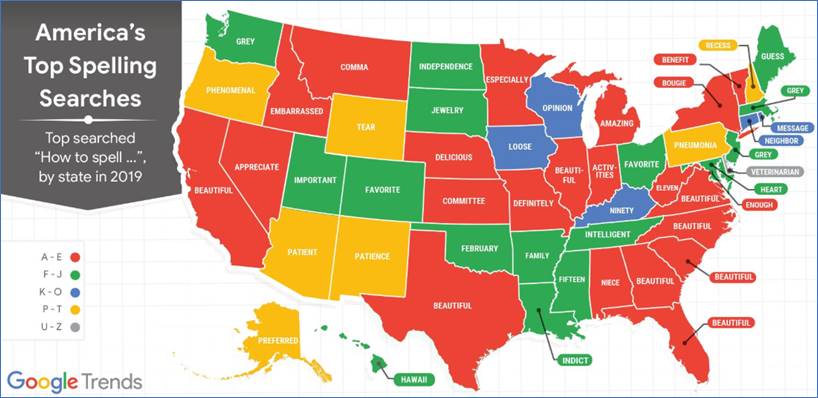
You know me—I love language and I love maps. A language map? Well, yes, I feel like I just might be in heaven. But this is a bit of a sad map, because it is about the word in each state that is “Googled” most often to see how it is spelled. Now, I have a couple of issues with this map as far as a scientific study. I see that they say in Washington and New Jersey, the word is grey, yet since we are in America, the word should be gray. Both are valid spellings, but one is more appropriate here than the other.

One of the items that made me laugh was Hawaiians looking up Hawaii…but I think that one is also suspect. It is very possible that people want to know if the correct spelling is Hawaii or Hawai‘i. (One article I read said that the Big Island is Hawai’i, the state is Hawaii. Then there are other articles about when the okina () started being used and which version is actually traditional Hawaiian. Anyway, I don’t have a definitive answer about that.)

In any case, here is the map and you can make your own observations and assumptions. It is from the article here, at inc.com. Delaware and veterinarians…interesting!

I hope you have a fantastic day!

Kara Church

Technical Editor, Advisory

Symitar Documentation Services

Posted by: Jack Henry | August 1, 2019

Editor’s Corner: Misplaced Modifiers

I love funny misplaced modifiers. Yes, they’re grammatically incorrect, but at least this is a grammar subject that provides a little humor! Look at these examples:

  • She handed out brownies to the children stored in Tupperware®.
  • With his tail held high, my father led his prize poodle around the arena.
  • I’m looking for a small table for my kid with short legs.

You can see that something is wrong with each of those sentences. The problem is that the modifier is not placed next to the word or phrase it is meant to modify. The children (hopefully) are not stored in Tupperware. And my father has never held his tail high with or without his prize poodle.

Let’s look closer at the last example: I’m looking for a small table for my kid with short legs. In this sentence, I’m actually looking for a table that has short legs, so the phrase “with short legs” should be placed next to the phrase “I’m looking for a table.” The sentence really should be written like this: I’m looking for a table with short legs for my kid.

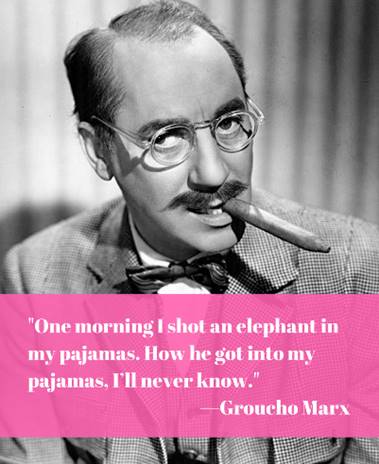
You’d be surprised how often editors need to rearrange phrases to place modifiers where they belong. This happens a lot with long, complex sentences. Unfortunately for us, the sentences we are working with are rarely as funny as these examples. You can help us out by watching for misplaced modifiers in your own writing. You don’t want to shoot an elephant in your pajamas.

Donna Bradley Burcher | Senior Technical Editor | Symitar®

8985 Balboa Ave. | San Diego, CA 92123 | Ph. 619.278.0432 | Ext: 765432

About Editor’s Corner

Editor’s Corner keeps your communication skills sharp by providing information on grammar, punctuation, JHA style, and all things English. As editors, we spend our days reading, researching, and revising other people’s writing. We love to spend a few extra minutes to share what we learn with you and keep it fun while we’re doing it.

Did someone forward this email to you? Click here to subscribe.

Don’t want to get Editor’s Corner anymore? Click here to unsubscribe.

Do you have a question or an idea for Editor’s Corner? Send your suggestions or feedback to Kara, <a href="mailto:DBurcher, Jackie, or <a href="mailto:BRitter.

NOTICE: This electronic mail message and any files transmitted with it are intended
exclusively for the individual or entity to which it is addressed. The message,
together with any attachment, may contain confidential and/or privileged information.
Any unauthorized review, use, printing, saving, copying, disclosure or distribution
is strictly prohibited. If you have received this message in error, please
immediately advise the sender by reply email and delete all copies.

« Newer Posts - Older Posts »

Categories