Posted by: Jack Henry | September 1, 2020

Editor’s Corner: Dissolving Distinctions, Pt 1

Greetings, friends, and happy September! It’s hard to believe that autumn is just around the corner.

I recently read an article about pairs of words that have dissolving distinctions—meaning that the two words originally had separate meanings, but these days they’re used interchangeably. Some of them made me sad, but I guess that’s the nature of language. It’s always evolving. Unfortunately, I don’t get to choose the course of evolution. And you should all be glad, or we might all be talking like Shakespeare or one of Jane Austen’s characters.

There are 10 word pairs all together along with information about each word’s individual meaning—in case, like me, you are interested in preserving the distinction. I’ll give you five pairs today and five on Thursday. We all need something to look forward to these days. 😊

  1. Accurate/precise: Accuracy is the degree to which an estimated measurement or a predicted result matches the actual extent or outcome, or, in the context of aiming, how close a projectile or an effect (such as a laser beam) comes to an intended target. Precision is the degree of variation between or among two or more measurements. In competition in which relative skill is determined by having competitors hit a bull’s-eye target, a competitor may demonstrate precision (all attempts are in proximity to each other) but not accuracy (the attempts are far from the center of the target).
  1. Allude/refer: The distinction between allusion and reference is one of degree of fidelity to the source. If one refers to a well-known saying, one says or writes, “The early bird catches the worm.” An allusion, however, is indirect; one might say or write, “I caught the worm this morning,” which, if one’s audience knows the saying, they will understand to mean that one was early.
  1. Anxious/eager: One who is anxious about something is, according to the source of the adjective, experiencing anxiety, while one who is eager is excited, impatient, and/or interested. Many people use the words interchangeably to refer to a positive feeling, but careful writers will maintain the distinction.
  1. Amount/number: Amount applies to uncountable nouns, such as in general reference to noise, while number pertains to a measurable quantity, such as how many decibels a sound registers. Another comparison is between a reference to an amount of money, such as a million dollars, which is a single “item,” as opposed to the count of the number of bills in a stack of currency.
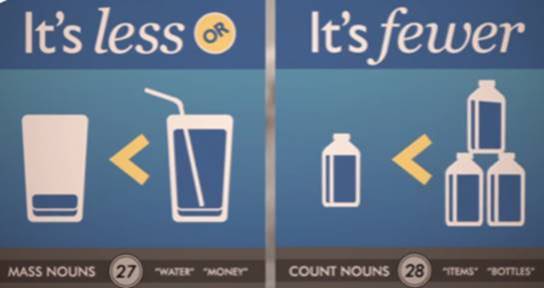
  1. Fewer/less: As with amount and number, the distinction between fewer and less is one of countable and uncountable things, in that order. For example, one would write, “Fewer houses were built this year compared to last year,” but “Less housing is available his year compared to last year”; the first sentence refers to countable structures and the second one pertains to houses collectively. [dbb – Thank you grocery stores for confusing so many people with your incorrect “15 items or less” express lane signs!]
Donna Bradley Burcher | Senior Technical Editor | Symitar®

8985 Balboa Ave. | San Diego, CA 92123 | Ph. 619.278.0432 | Ext: 765432

About Editor’s Corner

Editor’s Corner keeps your communication skills sharp by providing information on grammar, punctuation, JHA style, and all things English. As editors, we spend our days reading, researching, and revising other people’s writing. We love to spend a few extra minutes to share what we learn with you and keep it fun while we’re doing it.

Did someone forward this email to you? Click here to subscribe.

Don’t want to get Editor’s Corner anymore? Click here to unsubscribe.

Do you have a question or an idea for Editor’s Corner? Send your suggestions or feedback to Kara and <a href="mailto:DBurcher.

NOTICE: This electronic mail message and any files transmitted with it are intended
exclusively for the individual or entity to which it is addressed. The message,
together with any attachment, may contain confidential and/or privileged information.
Any unauthorized review, use, printing, saving, copying, disclosure or distribution
is strictly prohibited. If you have received this message in error, please
immediately advise the sender by reply email and delete all copies.

Posted by: Jack Henry | August 27, 2020

Editor’s Corner: People or Persons

Dear Editrix,

Would you say, “To one of the most beautiful persons I know,” or “To one of the most beautiful people I know”?

Thanks!

Feelin’ Groovy

Dear Groovy,

I wouldn’t say either of those things to anybody I know. No, I’m kidding. I’d definitely say, “To one of the most beautiful people I know.” Persons sounds very stuffy to me, which is probably the last thing you want to sound like when writing an ode to your beloved or sending a note to your boss. But your question got me researching a little on the topic, so I thought I’d share.

Merriam-Webster (M-W) has an entire article about the use of people vs. person here. I am not reviewing it with you today, however, because it doesn’t clarify the matter. It discusses the history of the two words and their plurals and how they have made their ways through time. I just want to talk about the basics.

Both words are from Latin. According to M-W, people comes from the word populus (“the people”); person comes from persona, meaning “mask,” such as worn by an actor. Which ones we should use and when, has been argued about since the 1700s. I’m going to give you information on what works today.

Okay, person means “an individual human being.” The plural of person is either persons or people. Here is your rule of thumb: persons is archaic. We use it these days in legal descriptions and documents, where a bit of stuffiness is okay. That’s about it for persons.

Examples:

Correct: There will be one person at the door and three people waiting tables.

Correct: If you invite a lot of people over, they will certainly come for the hors d’oeuvres.

Correct: The room register says: Only one to three persons permitted in the hot tub at once.

Do not use: I feel like all persons have the right to party like it’s 1999. (And boy was that party a dud!)

Now, let’s look at people. Outside of using this as the plural word for person, you might occasionally hear the plural word peoples. Here is the rule for your other thumb: use only when talking about “a body of people united by a common culture, tradition…that typically have a common language, institutions, and beliefs.”

Examples:

The peoples of Europe

Indigenous peoples

The Vulcan peoples

Yes, you can see how this might get a little confusing, but chances are you will “hear” the right option when you say it out loud, and you can always double-check the dictionary if you just aren’t sure.

If you really want to throw your audience for a loop, you could always replace the word “people” with “peep hole.” That will really get them going!

Kara Church

Pronouns: she/her/hers

Technical Editor, Advisory

Editor’s Corner Archives: https://episystechpubs.com/

Posted by: Jack Henry | August 25, 2020

Editor’s Corner: Senate and Senile

Oh boy. In this whirlwind of a year, I’m not sure we’re ready for election season. While perusing Words of a Feather, by Murray Suid, I found this pair of words, though, that I think will inform you and give you a chuckle, no matter whose side you are on. The title reminds me of a Jane Austen novel, “Senate and Senility.”

You might think that the framers of the Constitution were careless in calling the upper chamber of Congress the senate, a term related to senile. Both words derive from the Latin senex, “old man.”

But a bit of word sleuthing shows us that the founders were blameless, at least in this connection. In the seventeenth century, senile simply referred to somone old or senior. Back then, elder statesmen were held to be sources of wisdom. It wasn’t until the mid-nineteenth century that senile acquired the meaning of “weak or infirm from age.”

And what constitutes “old” in connection with serving in the U.S. Senate? The minimum age according to the Constitution is thirty years, five years more than the minimum age for serving in the House of Representatives.

There have been, however, several exceptions. The youngest person ever to serve in the Senate was John Eaten, who in 1818 was sworn in at the age of twenty-eight. Apparently, Eaton himself was not aware of his true age until much later in his life.

Even though these words are from Latin, they still fit pretty well with the crowd in the U.S. Senate today. We currently have two active senators that are 86 years old; and Strom Thurmond served almost 50 years…until he died at 91.

Kara Church

Pronouns: she/her/hers

Technical Editor, Advisory

Editor’s Corner Archives: https://episystechpubs.com/

Posted by: Jack Henry | August 20, 2020

Editor’s Corner: How Do You Pronounce That?

Hi, my friends.

I’ve written previously about commonly mispronounced words. And I often get inquiries about how to pronounce certain words—because no one wants to be the nincompoop who gives a presentation and doesn’t know how to pronounce the word asterisk or prerogative. English pronunciation is not always what you think!

So, I’ve got a tip for you today that will ensure that you don’t accidentally embarrass yourself by mispronouncing a word ever again. But first, I want to tell you about a video I came across that explained why even native speakers pronounce lots of English words incorrectly. It’s because many of us learn words from reading, not from hearing words used, and English is not a phonetic language—the letters do not correspond one-to-one with the sounds. So we may see words in writing and guess at the pronunciation, and we may even make a really good guess but just get it wrong. I know for sure that this has happened to me—sadly more than once. (Damn you, acai bowl!)

But before the tip, here’s a little good news: those of you who are worried that tweeting and texting is dumbing down the English language because it has made our attention spans shorter than a hobbit’s legs and because no one seems to care anymore about spelling and grammar and complex thoughts, I have to tell you that people had the exact same fears when AOL and email became popular back in the early ’90s. Yet people are still reading books and expanding their minds. That old argument about ruining the English language has been used about the printing press, newspapers, the internet—even slang and emojis are blamed, and here we still are, some people care about grammar and spelling, and some people don’t. (Shame on them!)

Since all of you do care, and since you want to know how to pronounce those words you’ve only seen in writing, here’s a simple tip: most online dictionaries, including Merriam-Webster, our dictionary of choice, have an audio function that gives you the correct pronunciation. Just search for the word you are curious about, and then click the audio icon (which looks like a little megaphone) and you’ll hear the standard pronunciation and maybe even an alternative pronunciation, as with the word coupon (which can start with the sound koo or kew).

We’ve said it before, but it bears repeating. The dictionary is your friend, and since you are often sitting in front of a computer, this friend is right at your fingertips. So don’t be a nincompoop— always check the spelling and the pronunciation if you’re not sure.

Donna Bradley Burcher | Senior Technical Editor | Symitar®

8985 Balboa Ave. | San Diego, CA 92123 | Ph. 619.278.0432 | Ext: 765432

About Editor’s Corner

Editor’s Corner keeps your communication skills sharp by providing information on grammar, punctuation, JHA style, and all things English. As editors, we spend our days reading, researching, and revising other people’s writing. We love to spend a few extra minutes to share what we learn with you and keep it fun while we’re doing it.

Did someone forward this email to you? Click here to subscribe.

Don’t want to get Editor’s Corner anymore? Click here to unsubscribe.

Do you have a question or an idea for Editor’s Corner? Send your suggestions or feedback to Kara and <a href="mailto:DBurcher.

NOTICE: This electronic mail message and any files transmitted with it are intended
exclusively for the individual or entity to which it is addressed. The message,
together with any attachment, may contain confidential and/or privileged information.
Any unauthorized review, use, printing, saving, copying, disclosure or distribution
is strictly prohibited. If you have received this message in error, please
immediately advise the sender by reply email and delete all copies.

Posted by: Jack Henry | August 18, 2020

Editor’s Corner

Good morning, folks!

Today I was scanning books at home for something fun or interesting to learn about the world of the English language. At some point in the past, I bought a book of Southern sayings that would help me get in touch with all y’all to the east of us here in San Diego. I paged through it and I have to say that it was complete garbage. Nothing new—no buttering body parts and calling them biscuits. It had so little pizzazz that it didn’t even make the cut for one of the local “Little Libraries” (where people create neighborhood lending stations).

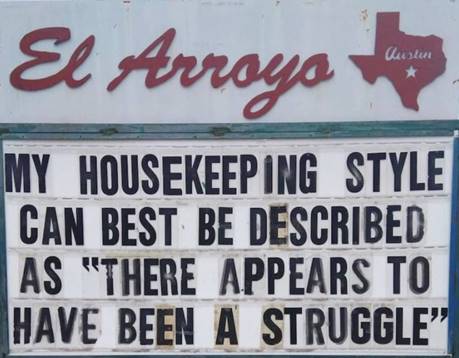
The book is now in the recycle bin. My second attempt was looking through Words of a Feather, by Murray Suid. Now that’s what I’m talking about! I’ve settled on the topic of “Room and Rummage.” And I’ve included a photo of my favorite restaurant in Austin, Texas that I’ve never been, too, but hope to visit some day.

I hope you enjoy it!

When you run out of room for your stuff and you decide it’s the perfect time for a rummage sale, your etymological intuition may be what’s inspiring you, for the two words—room and rummage—are closely connected.

Rummage, which today means “odds and ends,” and also “to search for something by going through those odds and ends,” comes from the Middle French word arrumage, “the arrangement of cargo in a ship’s hold.”

Old English had a related word rum, which referred to the space in a home. That word competed for a while with the French word chamber—which gave English chamber pot, gas chamber, and chamber music. Eventually, rum—in the form of room—won out, so now we have dining rooms, living rooms, bedrooms, and even great rooms. [KC – Not sure where this guy lives!]

But it seems that there’s never enough room, which fact led to the nineteenth-century invention of the rummage sale, which etymologically might be translated as “room-making sale.” The first rummage sale was, appropriately enough, dreamed up by a shipping company to get rid of unclaimed goods from a ship’s rum. Now of course, we hold rummage sales to raise money for worthy causes by getting rid of our unwanted possessions so that we can make room for new things that eventually can be turned into rummage. And so it goes.

Now, what about rum as related to the pirate’s life, you know, “yo ho ho and a bottle of rum”? The short answer about the alcoholic drink is that etymologists aren’t sure where it came from. Some say it is a shortening of rumbullion or other terms for liquor from sugar cane or molasses. Others say it may be from the Romany word for “excellent, fine, good, or valuable.” That is the mystery of our wonderful language!

Kara Church

Pronouns: she/her/hers

Technical Editor, Advisory

Editor’s Corner Archives: https://episystechpubs.com/

Posted by: Jack Henry | August 13, 2020

Editor’s Corner: Grimm Tales, Part 2

Today I offer part two in the “words from fairy tales” week on Wordsmith.org. We have a partnership with Sleeping Beauty and Prince Charming today.

I have been reading a book about fairy tales called The Hard Facts of the Grimms’ Fairy Tales (by Maria Tatar) because of this topic. The book is very interesting (to the English major in me), with a Game of Thrones-like back cover describing “Murder, mutilation, cannibalism, infanticide, and incest: the darker side of classic fairy tales.” So far, it is about the Brothers Grimm and their attempt to collect the folktales passed on verbally up to that point, onto the pages of their book.

Now, for today’s words:

§ sleeping beauty

noun: Someone or something that lies dormant for a long time.

Etymology

After the princess of a fairy tale who is cursed by a wicked fairy. The princess pricks her finger on a spindle and sleeps for 100 years until awakened by the kiss of a prince. Earliest documented use: 1729.

Notes:

In finance, a sleeping beauty is an asset, for example, a startup, that is an attractive target for takeover, but that has not yet been approached by someone.

Use:

“Eighty fatalities and 1,000 wounded citizens later, a pall had descended on Prague, which would now be a sleeping beauty for more than two decades.”
Amotz Asa-El; The Prague Spring at 50; Jerusalem Post (Israel); Aug 24, 2018.

§ prince charming

noun: A suitor who fulfills the expectations of his beloved.

Etymology

After Prince Charming, the fairy-tale hero of many stories, such as, Sleeping Beauty and Cinderella. Earliest documented use: 1850.

Use:

“Judith reluctantly attends a cocktail party where she meets Howard Rose, a charismatic lawyer … But Judith will come to realize Howard is no prince charming.”
Adriana Delgado; Beachy Books (Even If You’re Not Going Near the Beach); The Palm Beach Post (Florida); May 28, 2020.

I hope your day is full of wishes granted by your own personal fairy godmother!

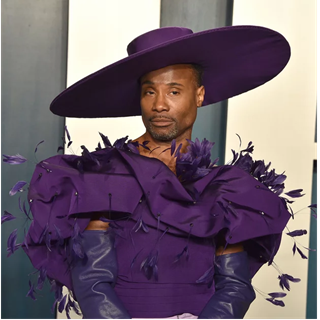
For Cinderella 2021: Billy Porter as genderless fairy godmother.

Kara Church

Pronouns: she/her/hers

Technical Editor, Advisory

Editor’s Corner Archives: https://episystechpubs.com/

Posted by: Jack Henry | August 11, 2020

Editor’s Corner: Fairy Tale Words

A few months ago, one of you suggested that I subscribe to the word of the day from Wordsmith.org. I am sorry I don’t remember who sent me the email, but you were so right! I love this email. For a recent list, the week’s words are all derived from fairy tales! How can you go wrong with a seemingly sweet, yet horrible story like the paralyzed “Sleeping Beauty,” or the hunted “Hansel and Gretel”? You can’t! I’m dividing the list to provide you enough time to start using these terms wildly in your everyday home (or home office) life.

They have been around for thousands of years. They are called fairy tales, even though most don’t have any fairies. Nor do they have anything to do with fairs. The term comes to us from French conte de feés (fairy tales). French fairy tales apparently did include fairies.

A better term might be folk tales that include talking animals with a sprinkling of magic and enchantment. We have the term “fairy-tale ending” which implies a happily-ever-after, but what we have these days is really a sanitized version of the stories. Originally, fairy tales rarely had a fairy-tale ending, a reflection of hard life in those days.

After years of telling and retelling, these stories have left a mark on the language. Many of the characters have stepped out from the pages of the books and walked into the language.

§ Goldilocks

adjective: Just right; a happy medium; optimal; not at either extreme.

Etymology

After Goldilocks, a golden-haired girl in the fairy tale “Goldilocks and the Three Bears”. In the story, she visits a bear house and chooses Baby Bear’s chair, bed, and porridge because they are just right. Papa Bear’s porridge is too hot, Mama Bear’s too cold, for example. Earliest documented use: 1949. The story was first published in 1837. The earliest documented use in the literal sense of the word is from 400 years earlier.

Use
“Swirling around a red-dwarf star about 110 light-years away from Earth the distant world sits in a so-called Goldilocks zone—not close enough to its host star to be too hot and not far enough away to be too cold—that could allow liquid water to flow across its surface.”
Blue World; The Economist (London, UK); Sep 14, 2019.

§ Cinderella

noun:
1. One who deserves success or recognition, but instead suffers from neglect or obscurity.
2. One who achieves sudden triumph or recognition, especially after a long period of neglect or obscurity.

Etymology

After Cinderella, the fairy-tale character who is mistreated by her stepmother and stepsisters. With a little help from a fairy godmother, she attends a royal ball thrown by a prince. Ultimately, she marries the prince and lives happily ever after. What’s behind the name Cinderella? It’s a pseudo-translation of the French name of the girl, Cendrillon, from cendre (cinder), perhaps an allusion to her day-to-day existence, tending to the fireplace and hearth, and as a result she has cinders all over her. It may also be a hint to the hidden spark in her otherwise dismal life. Earliest documented use: 1840.

Use

“The Badgers are the Cinderella of the Final Four thanks to toppling a national championship winner.” Ben Steele; Sconnie Final Four Is Set; Green Bay Press Gazette (Wisconsin); Apr 1, 2020.

§ ugly duckling

noun: One that seems unattractive or unpromising at first but has great potential and later turns out to be quite attractive or successful.

Etymology

From the protagonist of the story “The Ugly Duckling” by Hans Christian Andersen, in which a young bird believes himself to be a duck and is unhappy because he doesn’t look like a duck, only to later learn that (spoiler alert) he is a beautiful swan. Earliest documented use: 1877.

Use

“Nearly every transport advocacy group in Melbourne bemoans a lack of investment in our bus network. The ugly duckling of the transport network, and a mode that fails to attract attention on the front pages of newspapers, it is perhaps the cheapest and most obvious way to tackle congestion.” Stuart James; Fork in Road for Public Transport Solutions; Herald Sun (Melbourne, Australia); May 21, 2020.

I’m definitely looking forward to what the next couple of days bring. Who or what could it be?

Kara Church

Pronouns: she/her/hers

Technical Editor, Advisory

619-542-6773 | Ext: 766773

Editing: Symitar Documentation Services

Editor’s Corner Archives: https://episystechpubs.com/

NOTICE: This electronic mail message and any files transmitted with it are intended
exclusively for the individual or entity to which it is addressed. The message,
together with any attachment, may contain confidential and/or privileged information.
Any unauthorized review, use, printing, saving, copying, disclosure or distribution
is strictly prohibited. If you have received this message in error, please
immediately advise the sender by reply email and delete all copies.
Posted by: Jack Henry | August 6, 2020

What Day Is It?

Good morning from my home office. I know that many of you are also working from home now. Like me, are you having trouble remembering what day it is? I do my best to keep regular work hours, and I have a room that I use as my office, so it kind of feels like I’m “going to work” every morning. But I’m still having trouble knowing which day of the week I’m in. Some weeks I’ve been two days off!

Friends and colleagues are telling me that they also don’t know what the heck day it is—it turns out that people all over the world are experiencing this phenomena. And some people also feel like time has shifted—it has either sped up (for those who find themselves being even more busy than they used to be) or it has slowed down (for those who are experiencing more loneliness and boredom).

This kind of thing is normal when your usual routine is interrupted. And when it is interrupted for as long as this pandemic has been going on (and for as long as it looks like it will continue), the days just kind of blur into each other.

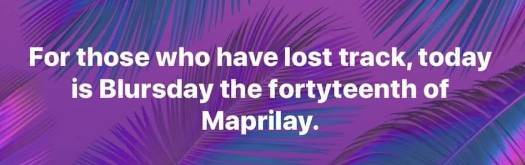
So, lots of people think we need a way to describe this feeling of not knowing what day it is. And I know a lot of you are probably way ahead of me, but last week I found a couple of possibilities on the internet. When you just don’t have a clue what day it is, why not call it Whensday? And when the day you’re having seems like all the others you’ve had recently, why not call it Blursday?

Problem solved!

Donna Bradley Burcher | Senior Technical Editor | Symitar®

8985 Balboa Ave. | San Diego, CA 92123 | Ph. 619.278.0432 | Ext: 765432

About Editor’s Corner

Editor’s Corner keeps your communication skills sharp by providing information on grammar, punctuation, JHA style, and all things English. As editors, we spend our days reading, researching, and revising other people’s writing. We love to spend a few extra minutes to share what we learn with you and keep it fun while we’re doing it.

Did someone forward this email to you? Click here to subscribe.

Don’t want to get Editor’s Corner anymore? Click here to unsubscribe.

Do you have a question or an idea for Editor’s Corner? Send your suggestions or feedback to Kara and <a href="mailto:DBurcher.

NOTICE: This electronic mail message and any files transmitted with it are intended
exclusively for the individual or entity to which it is addressed. The message,
together with any attachment, may contain confidential and/or privileged information.
Any unauthorized review, use, printing, saving, copying, disclosure or distribution
is strictly prohibited. If you have received this message in error, please
immediately advise the sender by reply email and delete all copies.

Posted by: Jack Henry | August 4, 2020

Editor’s Corner: Sneeze

Dear Editrix,

My son and I were talking and he said, “that’s nothing to sneeze at.” I’ve heard this phrase all my life but have no idea where it comes from. Any ideas?

Sincerely,

Cover Your Mouth

Dear Cover,

So much talk about sneezing and coughing these days, but this idiom doesn’t require a face mask. Let’s see what we can find out about “nothing to sneeze at.” The Grammarist has a nice article about this exact topic:

Nothing to sneeze at describes something of consequence, something important enough to be paid attention to. Originally, the term to sneeze at was an idiom used to describe something that should be held in contempt, something unimportant. In this sense, sneeze may also be interpreted as a snort of derision. By the early 1800s, the admonishment nothing to sneeze at came about. Nothing to sneeze at is the American form.

Not to be sneezed at also describes something of consequence, something important enough to be paid attention to. Also appearing in the early 1800s, not to be sneezed at is the British form of this idiom.

Examples:

Correa’s sophomore season in the majors didn’t see him make the jump to light-speed stardom, but the 20 HRs, 96 RBIs, 13 steals and .274 average he produced were nothing to sneeze at, and could easily be topped in his third year. (The Sacramento Bee)

The King William Street building was bought at a 3.65 per cent net initial yield: not astronomical, but with government bond yields coming off record lows, also not to be sneezed at. (The Financial Times)

And for your viewing pleasure, the sender of this question also sent me a great link to a community sign page where the writer of the signs is a great punster. You can see a few here and more at Indian Hills.

Kara Church

Pronouns: she/her/hers

Technical Editor, Advisory

Editor’s Corner Archives: https://episystechpubs.com/

Posted by: Jack Henry | July 30, 2020

Editor’s Corner: Unpack your adjectives

Good morning, friends! I received a question the other day about adjectives, and in my research, I learned a few things that I wanted to share with you. The question was about using the word “more” vs. using the ending “-er” with adjectives. For example, is it correct to say, “more proud” or “prouder”? Well, here are some usage rules from Grammar.com. (The content is theirs, but I’ve reformatted and changed some of the examples.)

Syllable Rule for the States of Adjectives

  • One-syllable adjectives usually use -er and -est.
  • sweet, sweeter, sweetest
  • red, redder, reddest
  • hot, hotter, hottest

Note: In some expression, even one-syllable adjectives use “more” for a comparison, such as more tart than sweet.

  • Two-syllable adjectives can use -er and -est, more and most, or either.
  • Angry, angrier, angriest
  • Silly, sillier, silliest
  • Bizarre, more bizarre, most bizarre
  • Clever, cleverer, cleverest; or, clever, more clever, most clever
  • Cruel, crueler, cruelest; or, cruel, more cruel, most cruel
  • Three-syllable adjectives use more and most.
  • Difficult, more difficult, most difficult
  • Insecure, more insecure, most insecure
  • Loveable, more loveable, most lovable

I know, the two-syllable guideline is a sketchy, chaotic solution, but these additional rules should help you write or use the correct wording.

Sounds-Weird Rule for States of Adjectives

Sometimes the ‑er and ‑est endings just sound strange.

For example, the correct comparative and superlative forms of common are commoner and commonest. But these words sound strange…thus, common, more common, and most common would be regarded as correct by most people (simply because they’re used to hearing these forms). In formal settings, however, you should choose the correct forms, commoner and commonest. [KC – Formal settings like senior prom, a business presentation, or dinner with Queen Elizabeth—though “commoner” might be a noun
to her.]

Look-It-Up Rule for States of Adjectives

[KC – I love this rule! Check the dictionary!]

You can always find the answer in the dictionary.

Look up common, and immediately following the word you’ll find the endingser and ‑est. These entries show how to form the comparative and superlative forms of the adjective.

Now look up the word different. Notice that following the entry you do not find the endingser and ‑est. The absence of these endings means that you use more for the comparative and most for the superlative.

An additional “rule” I read somewhere is that sometimes people use “more” or “most” for greater emphasis than using -er would have, which brings us back to the original question about proud, prouder, proudest, and more proud. Using that example, either of these is appropriate:

  • Meredith could not be more proud of her son, the first in her family to get a Ph.D.
  • Herschel was prouder of his strawberry jam this year than he was last year, even though last year he won first prize at the fair.

And for a smile, a few unfortunate quarantine haircuts:

Kara Church

Pronouns: she/her/hers

Technical Editor, Advisory

Editor’s Corner Archives: https://episystechpubs.com/

« Newer Posts - Older Posts »

Categories