We’re up to the I’s, guys! Today’s list of homonyms and confusing word (from grammarbook.com) follows:
| idle | not active; unemployed |
| idol | someone admired |
| idyll or idyl | interlude, breathing space; romance, fairy tale |
We’re up to the I’s, guys! Today’s list of homonyms and confusing word (from grammarbook.com) follows:
| idle | not active; unemployed |
| idol | someone admired |
| idyll or idyl | interlude, breathing space; romance, fairy tale |
Posted in Articles
Today is National Grammar Day, so I would like to guide you to some resources if you want to read up on this special holiday. Grammar Girl lists many resources on her page today: http://nationalgrammarday.com/. There are also articles in the Chicago Tribune and New York Times. The list of resources when you search Google for “National Grammar Day” is growing by the minute. But honestly, I am not in the leagues of Grammar Girl (Mignon Fogarty) or the journalists who wrote some of these articles, and certainly not the people that write grammar books and dictionaries. I’m not your 5th grade teacher who calls you out on your mistakes and embarrasses you in front of class. I’m just someone who loves our language, other languages, accents, etymologies, and learning…and I like taking you along for the ride. 🙂
The article I found most interesting is “Plea for Sanity this National (US) Grammar Day.” This is an article from a potential language snob to some of those out there who want to put people in the town square pillory for misusing apostrophes.
I love National Grammar Day. I also hate National Grammar Day. That may be surprising–after all, I’m a journeyman grammarian. I make my bread deciding whether a word is an attributive noun or adjective, parsing adverbial uses over conjunctive uses, writing those delightfully boring usage notes in your dictionary.
I love National Grammar Day for all the reasons you’d expect a massive nerd like me to love it: a chance to revel in and highlight the most-dear idiosyncrasies of my language and our feeble attempts to explain it. All you need to do is read through all the Grammar Day haiku that have been written, each falling like a cherry blossom in late Spring, to get in the spirit.
But I also hate National Grammar Day, because it ends up being less a celebration of the weirdness of English and more an annual conclave of the peeververein (as gentleman-copyeditor John E. McIntyre so eloquently calls them). I have a friend–well, a “friend”–who, every March 4th, marches forth into a variety of local stores with a black marker and corrects the signage in the name of “good grammar.” Grocer’s apostrophes are scribbled out, misspellings fixed, and good Lord the corybantic orgy of less/fewer corrections. This friend also printed up a bunch of stickers one year that read, “FIXED THAT FOR YOU. HAPPY NATIONAL GRAMMAR DAY.”
When he was finished telling me about how he observes National Grammar Day, he waited for me to break into a big smile and congratulate him. So when I didn’t–when, instead, my face compressed itself ever so slightly into a look of utter distaste–he was very confused. “Seriously,” he said, “don’t tell me that’s not awesome.”
Reader: that is not awesome.
Yes, I know, the grocer’s apostrophe is a weeping pustule on the shining face of English, and people who don’t know the difference between “less” and “fewer” should be marooned on a small, ice-covered island in the Arctic Sea. You, as a person of intelligence, are entitled to that opinion. I will defend to the death your right to think that “less” and “fewer” should only be used in very specific ways (even though history proves you wrong), and I will even agree that I don’t understand how the grocer’s apostrophe came to be (though apostrophes can be tricky, and we all know how weird English plurals can be). What I cannot defend, however, is a—hattery in the name of grammar.
You may think you are some great Batman of Apostrophes, flitting through the dark aisles of the Piggly-Wiggly, bringing Truth and Justice to tormented signs everywhere! But in reality, you are a jerk who has defaced a sign that some poor kid, or some poor non-native English speaker, or some educated and beleaguered mom who is working her second job of the day, spent time making. It’s not as though they see your handiwork and fall to their knees praising John Dryden because now they see the error of their ways. No–all they see is that the manager is going to make them do the sign again. And they may not have the education to understand why you took a Sharpie to their “2 tomato’s / $1″ sign.
Vigilante peeving does nothing to actually educate people. What it does instead is to shame them and make them feel bad about how they speak, write, and even think. Believe me, you cannot shame a person into good grammar. When I was learning Latin, I had a professor who was frustrated that I couldn’t get all the noun declensions straight within the first week of class. So whenever we’d run across a noun, she’d call out, “Kory–what declension?” And I would stammer, and say “Uh um um, third?” Then she’d smirk, or sometimes laugh, and say, “Of course not,” then tell us what declension the noun was. But I never heard, because I was shrinking in shame while a dozen smug faces turned to me and beamed at my failure.
When you work for the dictionary, people mind their grammatical p’s and q’s around you out of fear. “Oh,” someone will titter, “I hope I don’t make any grammar mistakes when I’m talking to you!” I understand the impulse to say this…but it casts a pall on the conversation, because I know the other person is worried I’m going to start smirking at some point during the conversation and they won’t know what they did wrong.
Conversely, when people take you to be an expert and you make a dumb mistake, you are called out as if you had perpetrated a war crime. I can’t tell you the times that I’ve answered an editorial email and made a dumb mistake– “it’s” for “its,” let’s say–and received a reply that is itself full of errors and misspellings but which essentially says, “OH MY GOD THEY LET YOU EDIT DICTIONARIES AND YOU DON’T KNOW THE DIFFERENCE BETWEEN ITS AND IT’S? YOU’RE A MORON: LET ME SHO U IT.”
I won’t lie: there’s some delicious schadenfreude in catching an expert in an error. I recently stumbled across an On Language column written by William Safire, language maven, that uses “who” objectively when it should have been “whom,” and I just know that my face smeared into a big ol’ smirk, haha, William Safire, you doofus. Never mind that I would have used “who” that way. Never mind that most people would have used “who” that way.
English usage and grammar is a hot mess, to be frank: rules that contradict hundreds of years of use appear out of nowhere and for no discernible reason; spelling is off the hook; and even when something is nice and tidy (“sneak” entered English in 1594 and its past tense was “sneaked”) we complicate it needlessly (“snuck” showed up in the 1800s for no good reason and is now considered a standard past tense of “sneak” in the US). The reality is that many of the bits of grammar that we think of as wrong are actually just a matter of preference.
Remember, this National Grammar Day, that there are people all around you with varying degrees of knowledge of and appreciation for the intricacies of English. Instead of calling people out on March 4th for all the usages they get wrong, how about pointing out all the thing things that people–against all odds–get right? Can you correctly pronounce “rough,” “though,” “through,” and “thought”? Congratulations, you have just navigated the Great Vowel Shift. If I ask you to come up with synonyms of “ask” and you respond with “question” and “inquire,” congratulations: you have seamlessly navigated your way through 500 years of English history. Do you end sentences in prepositions? That is awesome, because that is a linguistic and historical tie back to Old English, the dyslexic-looking Germanic language that started this whole shebang almost 1500 years ago.
There is so much to celebrate about our language. English may be a shifty wh—, but she’s our shifty wh—. Please, this National Grammar Day, don’t turn her into a bully, too.
Kara Church
Senior Technical Editor
Posted in Articles
Yesterday someone asked me how to make an acronym plural. Is it CDs or CD’s? (The plural is CDs; the possessive is CD’s. Of course, there are some exceptions as explained below.)
This article from Grammar Girl (www.quickanddirtytips.com) is about something similar.
What’s the Trouble? The spelling of do’s and don’ts is inconsistent.
Generally, you don’t use apostrophes to make words or abbreviations plural (e.g., CDs, 1970s, hats), but we have a few exceptions. For example, you can use apostrophes when they help eliminate confusion, which happens most often with single letters. Mind your p’s and q’s is the typical spelling, and we write that the word aardvark has 3 a’s, not 3 as.
Dos and don’ts is an especially unusual exception. The apostrophe in the contraction don’t seems to make people want to use an apostrophe to make do plural (do’s and don’ts) but then to be consistent, you’d also have to use an apostrophe to make don’t plural, which becomes downright ugly (do’s and don’t’s).
Style guides and usage books don’t agree.
What Should You Do? Unless your editor wishes otherwise, if you write books, spell it dos and don’ts; and if you write for newspapers, magazines, or the Web, spell it do’s and don’ts. If you’re writing for yourself, spell it any way you want. [KC – Your editors here “wish otherwise” so please use “do’s and don’ts.”]

Kara Church
Senior Technical Editor
Posted in Articles
Good morning! We’re back to the “Spelling, Vocabulary, and Confusing Words” list from grammarbook.com.
| halve | divide into two |
| have | to possess |
Posted in Articles
I was catching up on a lecture series about forensics yesterday and I ran across the word “dactylography.” I thought it was interesting since the only other time I recall hearing “dactyl” was while learning dinosaur names (pterodactyl). Since I was watching a lecture on fingerprinting, I wanted to know what the connection between fingerprints and flying dinosaurs was. It was then that I turned to my trusty dictionary. From Merriam-Webster (slightly edited):
dactylography: the scientific study of fingerprints as a means of identification
pterodactyl: any of numerous extinct flying reptiles…having no feathers, a wing membrane extending from the side of the body along the arm to the end of the greatly enlarged fourth digit, and a tail usually rather short but sometimes expanded and resembling a rudder
Once again, it turns out a little Greek goes a long way:
· ptero-: from Greek pteron (wing)
· dactyl: from Greek daktylos (finger)
· -graphy: word-forming element meaning "process of writing or recording" or "a writing, recording, or description," from French or German -graphie, from Greek -graphia "description of," from graphein "write, express by written characters….
That may be a long way to go to find out that “dactyl” relates to fingers, but now you can really impress the paleontologists and forensics experts you meet each day.
A little Greek goes a long way…

http://www.flickr.com/photos/khela/3570616386/
Kara Church
Senior Technical Editor
Posted in Articles
Good morning!
It’s time to return to our list of “Spelling, Vocabulary, and Confusing Words” from grammarbook.com. Today’s picture is from my brief vacation up in Tacoma, WA. It’s a Church Family game, where the kids swing from a tree, and the goats (Lewis and Clark) try to head-butt them. Both the children and the goats seem to enjoy it immensely.
| gait | a manner of walking or stepping, stride
Examples: trotting, galloping, limping |
| gate | barrier |
Posted in Articles
Good afternoon! Today we’re going to cover one of the questions I’ve received several times in the last month.
Dear Editrix,
Sometimes I get a little confused with the wide selection of prepositions available in English. When I am in the back yard, should I jump on to the trampoline, or should I jump onto the trampoline?
Sincerely,
Trampoline Tilly
Dear Tilly,
Here are some brief rules and examples for “on to” and “onto” from grammarbook.com. If you want even more on the subject (and pictures) try the Purdue OWL (http://owl.english.purdue.edu/owl/resource/594/02/).
On To vs. Onto
Rule 1: In general, use onto as one word to mean on top of, to a position on, upon. Use onto if you can use up before on.
Examples:
He climbed (up) onto the roof.
Let’s step onto the dance floor.
She held on to her child in the crowd.
I’m going to log on to the computer.
Rule 2: Use onto when you mean fully aware of; informed about.
Example: We canceled Julia’s surprise party when we realized she was onto our plan.
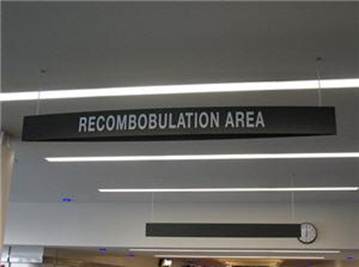
And this, from Kevin Campion, is a new word from the Milwaukee airport. It seems they have a good sense of humor.
NOTICE: This electronic mail message and any files transmitted with it are intended
exclusively for the individual or entity to which it is addressed. The message,
together with any attachment, may contain confidential and/or privileged information.
Any unauthorized review, use, printing, saving, copying, disclosure or distribution
is strictly prohibited. If you have received this message in error, please
immediately advise the sender by reply email and delete all copies.
Posted in Articles
Is it really Friday already? Well, then, I suppose it is time for the F word! Wait, no. Not that one. Since I like my job, how about going over several “F” words, including the further/farther duo and the fewer/less/under trio. Today’s letter is brought to you by the Blue Book of Grammar (http://www.grammarbook.com/homonyms/confusing-words-letter-f.asp).
| fair (adjective, noun) | impartial; an exhibition |
| fare | payment or expense for travel |
Posted in Articles
Here is my favorite question (and answer) from the February Chicago Manual of Style newsletter. (http://www.chicagomanualofstyle.org/qanda/latest.html) Somehow, they even manage to make the topic below sound a little stodgy. 🙂
Question: When referring to a zombie, should I use the relative pronoun who (which would refer to a person) or that (since, technically, the zombie is no longer living)? Essentially, does a zombie cease to become a “person” in the grammatical sense?
Answer: Let’s assume this is a serious question, in which case you, as the writer, get to decide just how much humanity (if any) and grammatical sense you wish to invest in said zombie. That will guide your choice of who or that.
Happy Valentine’s Day!

Another “demotivator” from www.despair.com
Kara Church
Senior Technical Editor
Posted in Articles
It’s only Tuesday, but how about a quick break? Way back when, in the bitter cold of January of ‘13, I sent out a few samples of mixed metaphors. Today, I’d like to share a few more with you.
First, a quick refresher from the Merriam-Webster Unabridged Dictionary:
· metaphor: a figure of speech in which a word or phrase denoting one kind of object or action is used in place of another to suggest a likeness or analogy between them: an implied comparison (For example: His heart was broken. She was drowning in a sea of grief.)
· mixed metaphor: a figure of speech combining two or more inconsistent or incongruous metaphors
The following mixed metaphors are from http://therussler.tripod.com:
· Put that in your hat and smoke it.
· She has bigger dogs to fry.
· Sometimes I feel like I’m swimming uphill against the grain.
· Sometimes you have to bite the hand that you’re dealt.
· Spare the rod; spoil the broth.
· That really hacks me to a crisp.
· They’re diabolically opposed.
· We’re cooking on all four cylinders.
· It’s like a wizard in sheep’s clothing.
· Necessity is the mother of strange bedfellows.
· What goes around, stays in Vegas.
· When life throws you curve balls, make lemonade.
· That’s using your head for something besides a footstool.
· They need to wake up and smell the music.
· I have a lot of black sheep in my closet.
NOTICE: This electronic mail message and any files transmitted with it are intended
exclusively for the individual or entity to which it is addressed. The message,
together with any attachment, may contain confidential and/or privileged information.
Any unauthorized review, use, printing, saving, copying, disclosure or distribution
is strictly prohibited. If you have received this message in error, please
immediately advise the sender by reply email and delete all copies.
Posted in Articles

