My husband and I were exploring a new park the other day and for some reason, he said, “It looks kind of like a toadstool.” I don’t remember what looked like a toadstool, in fact, I stopped in my tracks and imagined a toad sitting on top of a mushroom. Then I wondered, “Why do we call mushrooms toadstools? Is it because frogs and toads use mushrooms to sit on? Is that even a thing?” I sent myself a message and figured I’d research it later.
Well, today’s the day!
First, from the Online Etymology dictionary.
toadstool (n.)
Late 14c., tode-stole, a common name for umbrella-shaped fungi; it is apparently a fanciful name from Middle English tadde "toad" + stole "stool, seat.”
And then from Etymology World:
A toadstool is a collective term for all poisonous or doubtful mushrooms. However, the term is often used loosely to refer to any mushroom, regardless of its safety.
The origin of the term "toadstool" is rooted in folklore and superstition. In medieval Europe, it was believed that toads sat on poisonous mushrooms, making them dangerous to touch or eat. Hence, the term "toadstool" came to be associated with all mushrooms that were perceived as potentially toxic.
Over time, the use of the term has evolved, and it is now more commonly used as a general term for any mushroom, regardless of its actual toxicity. However, the original association with poisonous mushrooms still lingers in the word’s etymology.
And a new word, also from Etymology World, is toadstone.
The word "toadstone" is derived from the Old English words "tade" (toad) and "stan" (stone).
A toadstone is a legendary stone believed to have been found in the head of a toad. In folklore, it was said to possess magical properties, such as protecting against poison and evil spirits.
Origin:
The belief in toadstones originated in ancient times. In Pliny the Elder’s "Natural History," written in the 1st century CE, toadstones are mentioned as being used as amulets to ward off poison.
Over the centuries, the belief in toadstones spread throughout Europe and beyond. In medieval times, they were often carried as talismans for protection. In some cultures, toadstones were believed to have healing properties and were used in folk medicine.
The belief in toadstones declined in the 18th and 19th centuries, as science began to provide more rational explanations for natural phenomena. However, the term "toadstone" continues to be used in geology to refer to certain types of rocks that exhibit unusual or distinctive features.
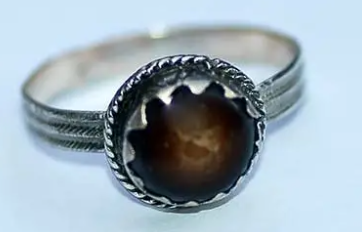
Here is a toadstone ring (or so they say). One site said that narwhal tusks and toadstones offer excellent protection against poison. Honestly, I lean toward the science of things. I don’t think I’d rely on the ring to protect you against poisonous ‘shrooms.
Kara Church | Technical Editor, Advisory | Knowledge Enablement
Pronouns: she/her | Call via Teams | jackhenry.com
Editor’s Corner Archives: https://episystechpubs.com/


Leave a Reply