Posted by: Jack Henry | May 7, 2013

Editor’s Corner: Drumroll, please!

Today I’d like to take a break from our normal fare to introduce you to a couple of my favorite people: Donna Bradley Burcher and Jacqueline “Jackie” Solano.

I’ve mentioned Donna to you before. Donna is a Technical Editor here at Symitar, and this week she’s going to be a guest star in the Editor’s Corner! Donna has a BA and Master’s degree in Literature and Writing. She’s my knight in shining armor (minus the horse) and she is the one I refer to as “the editor’s editor” (and sometimes Honey Badger). I’m looking forward to having her share her sharp wit and fascinating observations about English with us.

Jackie has recently joined Donna and me in our efforts to bring about world peace through grammar, punctuation, and editing. Jackie has a degree in Business (emphasis on Marketing), and as a seasoned Technical Writer and master of minimalist writing, she’s a terrific addition to our group. No more couples skating, we’re now the gang of three!

Keep your eyes open for these visitors to the corner in the next months (it’s a small corner, so we’re pretty easy to see) and enjoy!

Kara Church

Senior Technical Editor

619-542-6773 | Ext: 766773

www.symitar.com

NOTICE: This electronic mail message and any files transmitted with it are intended
exclusively for the individual or entity to which it is addressed. The message,
together with any attachment, may contain confidential and/or privileged information.
Any unauthorized review, use, printing, saving, copying, disclosure or distribution
is strictly prohibited. If you have received this message in error, please
immediately advise the sender by reply email and delete all copies.

Posted by: Jack Henry | May 6, 2013

Editor’s Corner: Q is for Quirky

Let’s slide into the week with a short lesson for today.

From grammarbook.com, it’s the Q portion of the “Spelling, Vocabulary, and Confusing Words” list:

quarts units of liquid measure (four quarts to a gallon)
quartz a mineral
cay a small, low island (also spelled key)
key a small, low island; instrument for opening locks
quay (pronounced key) wharf, dock, pier [KC – After all of the Scrabble games I’ve played this word in, I had no idea this was pronounced “key”!]
cue a hint; a stimulus
queue a line of people waiting

NOTICE: This electronic mail message and any files transmitted with it are intended
exclusively for the individual or entity to which it is addressed. The message,
together with any attachment, may contain confidential and/or privileged information.
Any unauthorized review, use, printing, saving, copying, disclosure or distribution
is strictly prohibited. If you have received this message in error, please
immediately advise the sender by reply email and delete all copies.
Posted by: Jack Henry | May 3, 2013

Editor’s Corner: Can I just use “it”?

It’s Friday and Cinco de Mayo weekend. If you’re in San Diego, huge events celebrating the Mexican culture are taking place in Old Town and Balboa Park—just be careful out there!

The next four suggestions are all decent, straightforward ways to avoid gender bias. In our documentation at Symitar, we use number six a lot, and as we move toward more concise task documentation, number nine is extremely useful because it not only avoids gender bias, it promotes active writing. From DailyWritingTips.com “Ten Ways to Avoid Gender Bias”:

6. Replace the Pronoun with an Article

Before: “Ask the student to prepare his presentation.”
After: “Ask the student to prepare a presentation.”

7. Revise the Sentence to Use the Pronoun One

Before: “A prepared student is more likely to succeed than if he has not done sufficient research.”
After: “A prepared student is more likely to succeed than an unprepared one.”

8. Revise the Sentence to Use the Pronoun Who

Before: “A student is more likely to succeed if he does sufficient research.”
After: “A student who does sufficient research is more likely to succeed.”

9. Revise the Sentence to the Imperative Mood

Before: “A student must be well prepared for his presentation.”
After: “Be well prepared for the presentation.”

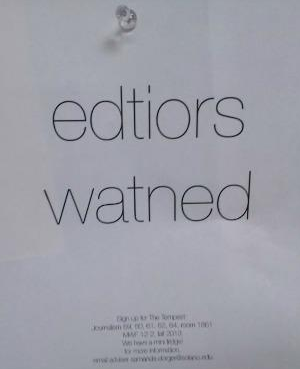
I think I might’ve said “edtiors ndeeded,” instead. 🙂

Thank you, Jolie L., for the photo!

NOTICE: This electronic mail message and any files transmitted with it are intended
exclusively for the individual or entity to which it is addressed. The message,
together with any attachment, may contain confidential and/or privileged information.
Any unauthorized review, use, printing, saving, copying, disclosure or distribution
is strictly prohibited. If you have received this message in error, please
immediately advise the sender by reply email and delete all copies.

Posted by: Jack Henry | May 2, 2013

Editor’s Corner: Yeah, boy!

I received quite a few responses to yesterday’s e-mail. They ranged from the interesting and clever to those that completely missed the point. And then there was my Mom’s solution: “Instead of he or she, I prefer babe.” I suppose we could spice up our documentation with some of that.

Scenario: A member walks into your financial institution and babe wants to deposit $12,500 to savings and $1,000 to checking. After you perform this transaction, babe asks to open a CD for $5,000.

Well, I’ve got to give her credit for trying! Now for the next three suggestions on “Ten Ways to Avoid Gender Bias” from DailyWritingTips.com:

3. Omit the Pronoun

Before: “Ask the student whether he is prepared to give a presentation.”
After: “Ask whether the student is prepared to give a presentation.”

This revision does not clearly indicate whether the student or another person is being asked; writers must recognize and respond to such lack of clarity if it affects comprehension. [KC – Depending on what precedes this sentence, this method can work well.]

4. Repeat the Noun in Place of the Pronoun

Before: “Ask the student whether he is prepared to give a presentation.”
After: “Ask the student whether the student is prepared to give a presentation.”

When the noun is repeated in the proximity shown above, the sentence is awkward; in a more complex sentence, the repetition may not seem so obvious. [KC – This is definitely stilted and sounds horrible.]

5. Use a Plural Antecedent for the Pronoun

Before: “Ask the student whether he is prepared to give a presentation.”
After: “Ask the students whether they are prepared to give their presentations.”

Employing a plural noun and a plural pronoun may change the meaning somewhat; writers must be alert as to which other nouns, if any, should be made plural as well. [KC – This can be a good solution, but sometimes you just need to talk about a
single customer or a single member. Generally people don’t come into a financial institution to do transactions as a big group.

Important:
A common error is to use “they” to avoid the gender-bias. For example, instead of “The CEO called a meeting because
he needed to deliver some fantastic news,” you might see or hear “The CEO called a meeting because
they wanted to deliver some fantastic news.” This is grammatically incorrect, since CEO is a singular noun, and “they” is a pronoun for more than one person.]

Kara Church

Senior Technical Editor

619-542-6773 | Ext: 766773

www.symitar.com

NOTICE: This electronic mail message and any files transmitted with it are intended
exclusively for the individual or entity to which it is addressed. The message,
together with any attachment, may contain confidential and/or privileged information.
Any unauthorized review, use, printing, saving, copying, disclosure or distribution
is strictly prohibited. If you have received this message in error, please
immediately advise the sender by reply email and delete all copies.

Posted by: Jack Henry | May 1, 2013

Editor’s Corner: Hey, girl!

I was indulging in a guilty pleasure on my way to work—listening to the ‘80s station on XM radio. The now 60-year-old MTV “VJ” Mark Goodman was talking about the Eurythmics and how Annie Lennox (also nearly 60 years old) wrote a riveting article about Margaret Thatcher tearing England apart. “She’s a smart girl,” he said. I nearly veered off the road after hearing that condescension. Under what circumstances would he think it was okay to say “Yeah, that Stephen Hawking is a smart boy”?

So, I don’t have tips on avoiding condescending and judgmental language, but I do have an article about avoiding gender bias in writing. No matter which way you bend, this is good information for business. We will start with the first two items from the DailyWritingTips.com article: “Ten Ways to Avoid Gender Bias”

How do you write around the outmoded usage of the pronoun he or him when a male is not necessarily the subject of the reference? Here are ten strategies—none ideal in every circumstance—for achieving gender neutrality.

1. Use He or She

Before: “Ask the student whether he is prepared to give a presentation.”
After: “Ask the student whether he or she is prepared to give a presentation.”

This solution is stiffly formal and is awkward in repetition; use sparingly. [KC – This is preferred to many options, though.]

Using he/she, s/he, or any such alternative (or an invented neutral pronoun like ze) is not advised. [KC – And is punishable by public flogging.]

2. Alternate Between He and She

Before: “Ask the student whether he is prepared to give a presentation. If he is ready, tell him that he may begin when he is ready.”
After: “Ask the student whether he is prepared to give a presentation. If she is ready, tell her that she may begin when she is ready.”

This solution works only in the case of two or more references to a hypothetical subject of either gender. In the proximity of the references in the examples, this solution is awkward, but when the references are at some distance from each other, it can be effective in moderation. [KC – This is
very unclear. Stay tuned for better options tomorrow.]

NOTICE: This electronic mail message and any files transmitted with it are intended
exclusively for the individual or entity to which it is addressed. The message,
together with any attachment, may contain confidential and/or privileged information.
Any unauthorized review, use, printing, saving, copying, disclosure or distribution
is strictly prohibited. If you have received this message in error, please
immediately advise the sender by reply email and delete all copies.

Posted by: Jack Henry | April 30, 2013

Editor’s Corner: Bowdlerize this!

I was just trolling my mailbox for something fun to discuss today (welcome to those of you who have recently joined) and I stumbled on an article from http://grammarist.com/. I guess “fun” is relative, but here’s some info on a special kind of censorship editing and a comic for fellow word nerds. Enjoy!

Bowdlerize

Henrietta and Thomas Bowdler were an English sister and brother who prepared and published an 1807 edition of Shakespeare’s works that was meant to be appropriate for women and children and for families to read together. To accomplish this, they removed or changed many words, phrases, and passages they believed to be racy or offensive. This is the origin of the verb bowdlerize, which means to remove elements considered offensive (from a literary work or other work of art).

Bowdlerization is similar to censorship, but more narrowly defined. Censorship is often official, often politically motivated, and often applied to nonartistic texts, while bowdlerization is usually done by a private individual or group seeking to make a work of art more morally acceptable. Also, censorship often involves outright removal of parts of texts, while bowdlerization often involves cleaning things up but not removing them. The word tends to have negative connotations. Bowdlerizers typically use other terms to describe what they do.

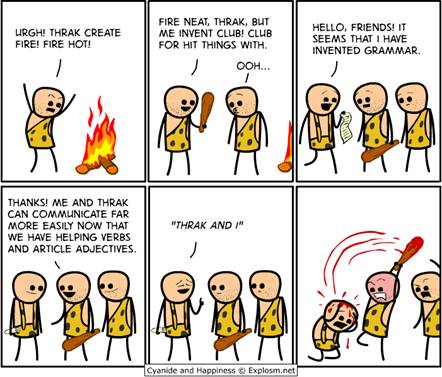
(Thank you for the comic, Jarvae!)

Kara Church

Senior Technical Editor

Posted by: Jack Henry | April 29, 2013

Editor’s Corner: Alternate vs. Alternative

Today we review a question I got back in February: What is the proper use of alternate vs. alternative? From Common Errors in English Usage, by Paul Brians:

Alternate and Alternative

Although UK authorities disapprove, in US usage, “alternate” is frequently an adjective, substituted for the older “alternative”: “an alternate route.” “Alternate” can also be a noun; a substitute delegate is, for instance, called an “alternate.” But when you’re speaking of “every other” as in “our club

And additional information from Merriam-Webster:

al·ter·nate

· adjective

: occurring or succeeding by turns : one following the other in time: not side by side <stems with alternate leaves>

Substitute for alternative <this highway is an alternate route> <copper may be used as an alternate material> <make an alternate selection>

· verb

: to perform by turns or in succession : interchange regularly <alternate the melodies>

· noun

: a choice between two or among more than two objects or courses : alternative <the port is the alternate to New York as a shipping terminus> <several basic alternates to expansion of the building>

: one that takes the place of another : one that alternates with another: such as an extra person appointed to take the place of another who is unable to perform a certain duty : substitute

al·ter·na·tive

· adjective

: offering a choice of two or more things : <several alternative plans> : expressing a choice or choices <alternative proposition>

: occurring or succeeding by turns : alternate <On alternative days, most stocks seem to be either wildly over-priced or tanking. — Linda Stern Newsweek 3 Apr. 2000>

: different from the usual or conventional: such as a : existing or functioning outside the established cultural, social, or economic system <an alternative newspaper>

· noun

: a proposition or situation offering a choice between two things wherein if one thing is chosen the other is rejected <a government facing the alternative of high taxes or poor highways>

: one of a number of things or courses offered for choice <a third alternative>

NOTICE: This electronic mail message and any files transmitted with it are intended
exclusively for the individual or entity to which it is addressed. The message,
together with any attachment, may contain confidential and/or privileged information.
Any unauthorized review, use, printing, saving, copying, disclosure or distribution
is strictly prohibited. If you have received this message in error, please
immediately advise the sender by reply email and delete all copies.

Posted by: Jack Henry | April 26, 2013

Editor’s Corner: Rules Do Change

The following excerpts are from the article “Rules Do Change” on www.grammarbook.com. I know we’ve covered not using double spaces after periods, but this takes the rule a bit further. Use the other tidbits to start a scintillating conversation at your next dinner party. 🙂

Spacing after Periods, Colons, Question Marks, and Exclamation Marks

Originally, typewriters had monospaced fonts, so two spaces after ending punctuation marks were used to make the text more legible. However, most computer fonts present no difficulty with proportion or legibility, so use just one space after a period, colon, question mark, or exclamation point at the end of a sentence. You will not be struck by lightning, I promise!

Plurals and Conjunctions

As time has gone on, we have shortened some words and dropped the former plural form.

Example: The words memo and memos used to be memorandum and memoranda.

With the word data, we no longer see the singular datum used at all. Data is now normally used in both the singular and plural form.

Example: The data are being tabulated. The data is useful to the scientists.

Yet other words still retain their original spelling and plural form.

Example: curriculum (singular) and curricula (plural).

In “the old days,” you may have been scolded for starting a sentence with but, and, or because. But you wouldn’t have deserved that scolding. Just make sure that if you start sentences with these words, you follow them with independent clauses.

Good Examples:
But she would never say such a thing!
Because of this bee sting, my arm is swollen.

Bad Examples:
And washed the car.
Because she asked.

NOTICE: This electronic mail message and any files transmitted with it are intended
exclusively for the individual or entity to which it is addressed. The message,
together with any attachment, may contain confidential and/or privileged information.
Any unauthorized review, use, printing, saving, copying, disclosure or distribution
is strictly prohibited. If you have received this message in error, please
immediately advise the sender by reply email and delete all copies.

Posted by: Jack Henry | April 25, 2013

Editor’s Corner: P is for Penguin

Hello!

Remember the homonyms? Well today we have the letter P, for Peter Piper and his peck of pickled peppers…and for these frequently confused words from The Blue Book of Grammar:

packed past tense of pack
pact an agreement or treaty
Posted by: Jack Henry | April 23, 2013

Editor’s Corner: Quick tip on commas and dates

From an e-mail to DailyWritingTips.com (Grammar Girl):

Jane wants to know how to use commas with days of the week. Which is correct?

· Tuesday, April 2, 2013

· Tuesday April 2, 2013

With dates, when you have two words next to each other or two numbers next to each other, you need a comma to separate the two items. So Jane should write, "Monday, January 5, 2009."

I hope your Tuesday is going swimmingly!

NOTICE: This electronic mail message and any files transmitted with it are intended
exclusively for the individual or entity to which it is addressed. The message,
together with any attachment, may contain confidential and/or privileged information.
Any unauthorized review, use, printing, saving, copying, disclosure or distribution
is strictly prohibited. If you have received this message in error, please
immediately advise the sender by reply email and delete all copies.

« Newer Posts - Older Posts »

Categories