Posted by: Jack Henry | April 19, 2013

Editor’s Corner: Rule 7 – Check the Dictionary

Huzzah, hurrah, it is the last day of Ben Yagoda. Why am I down on Ben? Well, here’s one reason. His article “7 grammar rules you really should pay attention to” lists this as rule seven: Words. Dude, what kind of rule is that?! Still, I’m not one to start things I can’t finish, and I must agree with his bullets, so let’s put this thing to rest. I will call it:

Rule 7: Check the Dictionary

As I noted in my previous article, the meaning of words inevitably and perennially change. And you can get in trouble when you use a meaning that has not yet been widely accepted. Sometimes it’s fairly easy to figure out where a word stands in this process. It’s become more common to use nonplussed to mean not bothered, or unfazed, but that is more or less the opposite of the traditional meaning, and it’s still too early to use it that way when you’re writing for publication. (As is spelling unfazed as unphased.) On the other hand, no one thinks anymore that astonish means "turn to stone," and it would be ridiculous to object to anyone who does so. But there are a lot of words and expressions in the middle. Here’s one man’s list of a few meanings that aren’t quite ready for prime time:

· Don’t use begs the question. Instead use raises the question.

· Don’t use phenomena or criteria as singular. Instead use phenomenon or criterion.

· Don’t use cliché as an adjective. Instead use clichéd.

· Don’t use comprised of. Instead use composed of/made up of.

· Don’t use less for count nouns such people or miles. Instead use fewer.

· Don’t use penultimate (unless you mean second to last). Instead use ultimate.

· Don’t use lead as past tense of to lead. Instead use led.

I hesitate to state what should be obvious, but sometimes the obvious must be stated. So here goes: Do not use it’s, you’re or who’s when you mean its, your or whose. Or vice versa!

Bye-bye, Ben!

Kara Church

Senior Technical Editor

619-542-6773 | Ext: 766773

www.symitar.com

NOTICE: This electronic mail message and any files transmitted with it are intended
exclusively for the individual or entity to which it is addressed. The message,
together with any attachment, may contain confidential and/or privileged information.
Any unauthorized review, use, printing, saving, copying, disclosure or distribution
is strictly prohibited. If you have received this message in error, please
immediately advise the sender by reply email and delete all copies.

Posted by: Jack Henry | April 18, 2013

Editor’s Corner: Rule 6 – Use Semicolons with Care

We’re almost there, folks! Today is rule six from Ben Yagoda’s article “7 grammar rules you really should pay attention to.” Note: The two of us in Symitar Editing do not support Mr. Yagoda’s semicolon bashing. In fact, my faithful co-editor, Donna, has declared an undying love for this punctuation mark. 🙂

Rule 6: Use Semicolons with Care

I sometimes say that when you feel like using a semicolon, lay lie down till the urge goes away. But if you just can’t resist, remember that there are really only two proper uses for this piece of punctuation. One is to separate two complete clauses (a construction with a subject and verb that could stand on its own as a sentence). I knocked on the door; no one answered. The second is to separate list items that themselves contain punctuation. Thus, The band played Boise, Idaho; Schenectady, New York; and Columbus, Ohio.

Do not use a semicolon in place of a colon, for example, There is only one piece of punctuation that gives Yagoda nightmares; the semicolon.

One more thing: Be careful when spelling the word semicolon. It is one word without a hyphen. A semi-colon is not punctuation; it is what you get when you have a bad gastrointestinal surgeon.

NOTICE: This electronic mail message and any files transmitted with it are intended
exclusively for the individual or entity to which it is addressed. The message,
together with any attachment, may contain confidential and/or privileged information.
Any unauthorized review, use, printing, saving, copying, disclosure or distribution
is strictly prohibited. If you have received this message in error, please
immediately advise the sender by reply email and delete all copies.
Posted by: Jack Henry | April 16, 2013

Editor’s Corner: Rule 5 – Avoid Dangling Modifiers

Today’s topic is based on the fifth item in the article “7 grammar rules you really should pay attention to,” by Ben Yagoda. Since his article was a little too suggestive for mixed company, I am using the description and examples of dangling modifiers from the Purdue OWL:

http://owl.english.purdue.edu/owl/resource/597/1/)

The article is a bit lengthy, but I wanted to provide you with something useful to keep as a reference. The examples below include examples of the modifiers how to un-dangle them.

Rule 5: Avoid Dangling Modifiers

A dangling modifier is a word or phrase that modifies a word not clearly stated in the sentence. A modifier describes, clarifies, or gives more detail about a concept.

Having finished the assignment, Jill turned on the TV.

"Having finished" states an action but does not name the doer of that action. In English sentences, the doer must be the subject of the main clause that follows. In this sentence, it is Jill. She seems logically to be the one doing the action ("having finished"), and this sentence therefore does not have a dangling modifier.

The following sentence has an incorrect usage:

Having finished the assignment, the TV was turned on.

"Having finished" is a participle expressing action, but the doer is not the TV set (the subject of the main clause): TV sets don’t finish assignments. Since the doer of the action expressed in the participle has not been clearly stated, the participial phrase is said to be a dangling modifier.

Strategies for revising dangling modifiers:

1. Name the appropriate or logical doer of the action as the subject of the main clause:

Having arrived late for practice, a written excuse was needed.

Who arrived late? This sentence says that the written excuse arrived late. To revise, decide who actually arrived late. The possible revision might look like this:

Having arrived late for practice, the team captain needed a written excuse.

The main clause now names the person (the captain) who did the action in the modifying phrase (arrived late).

2. Change the phrase that dangles into a complete introductory clause by naming the doer of the action in that clause:

Without knowing his name, it was difficult to introduce him.

Who didn’t know his name? This sentence says that "it" didn’t know his name. To revise, decide who was trying to introduce him. The revision might look something like this:

Because Maria did not know his name, it was difficult to introduce him.

The phrase is now a complete introductory clause; it does not modify any other part of the sentence, so is not considered "dangling."

3. Combine the phrase and main clause into one:

To improve his results, the experiment was done again.

Who wanted to improve results? This sentence says that the experiment was trying to improve its own results. To revise, combine the phrase and the main clause into one sentence. The revision might look something like this:

He improved his results by doing the experiment again.

Can’t get enough? There’s more here:

· http://grammarist.com/grammar/danglers/

· http://en.wikipedia.org/wiki/Dangling_modifier

NOTICE: This electronic mail message and any files transmitted with it are intended
exclusively for the individual or entity to which it is addressed. The message,
together with any attachment, may contain confidential and/or privileged information.
Any unauthorized review, use, printing, saving, copying, disclosure or distribution
is strictly prohibited. If you have received this message in error, please
immediately advise the sender by reply email and delete all copies.

It’s a dreary day in San Diego—my hummingbird friend is nowhere to be found outside my window, the spider webs are filled with rain, and the gray skies remind me of my home far away. (Okay, maybe that last part is from John Denver singing about some country roads in West Virginia.)

What better way to cope with a dreary day? Or 88° weather in Allen? Or thunder showers in Monett and Springfield? Grammar!

Today, I left Ben Yagoda’s article “7 grammar rules you really should pay attention to,” completely intact. Okay…I did change the title of this section since it wasn’t really a rule, but everything else is his.

Rule 4: Avoid Pronoun Problems
Let’s take a look at three little words. Not "I love you," but me, myself and I. Grammatically, they can be called object, reflexive, and subject. As long as they’re by themselves, object and subject don’t give anyone problems. That is, no one who’s an adult native English speaker would say Me walked to the bus stop or He gave the book to I. For some reason, though, things can get tricky when a pronoun is paired with a noun. We all know people who say things like Me and Fred had lunch together yesterday, instead of Fred and I… Heck, most of us have said it ourselves; for some reason, it comes trippingly off the tongue. We also (most of us) know not to use it in a piece of writing meant to be published. Word to the wise: Don’t use it in a job interview, either.

There’s a similar attraction to using the subject instead of object. Even Bill Clinton did this back in 1992 when he asked voters to give Al Gore and I [instead of me] a chance to bring America back. Or you might say, Thanks for inviting my wife and I, or between you and I… Some linguists and grammarians have mounted vigorous and interesting defenses of this usage. However, it’s still generally considered wrong and should be avoided.

A word that’s recently become quite popular is myself — maybe because it seems like a compromise between I and me. But sentences like Myself and my friends went to the mall or They gave special awards to Bill and myself don’t wash. Change the first to My friends and I… and the second to Bill and me.

NOTICE: This electronic mail message and any files transmitted with it are intended
exclusively for the individual or entity to which it is addressed. The message,
together with any attachment, may contain confidential and/or privileged information.
Any unauthorized review, use, printing, saving, copying, disclosure or distribution
is strictly prohibited. If you have received this message in error, please
immediately advise the sender by reply email and delete all copies.

Posted by: Jack Henry | April 11, 2013

Editor’s Corner: Rule 3 – Watch for Verb Problems

Woo-hoo! We’re up to the third rule from the article “7 grammar rules you really should pay attention to,” by Ben Yagoda. Again, I’d argue that the title of this “rule” (Verb Problems) isn’t a rule, but it is a problem. So let’s call this one: Rule 3 – Watch for Verb Problems.

There are a few persistent troublemakers you should be aware of.

· I’m tired, so I need to go lay lie down.

· The fish laid lay on the counter, fileted and ready to broil.

· Honey, I shrunk shrank the kids.

· In a fit of pique, he sunk sank the toy boat.

· He seen saw it coming.

The last three are examples of verbs where people sometimes switch the past and participle forms. [KC – The past participle is used with an auxiliary verb (has,
have, or had).] Thus, it would be correct to write:

· I have shrunk the kids.

· He had sunk the boat.

· He had seen it coming.

For a list of irregular verbs and their simple past and past participle forms, see:

www.englishpage.com/irregularverbs/irregularverbs.html

Whew. Now my head hurts! Nothing like a basket of puppies to make the pain go away . . .

From various sources on Google Images

Kara Church

Senior Technical Editor

Posted by: Jack Henry | April 10, 2013

Editor’s Corner: Rule 2 – Avoid Bad Parallelism

Good afternoon!

Today we have the second rule from the article “7 grammar rules you really should pay attention to,” by Ben Yagoda. He titles the rule “Bad Parallelism,” which doesn’t seem like a rule you’d want to follow. So instead, I am renaming this rule and using examples from the Purdue OWL website. (The examples are from a paper written by Dr. Linda Bergmann and Allen Brizee.)

Rule 2: Avoid Bad Parallelism

1. Merriam-Webster defines parallelism as follows: “The use of successive verbal constructions in poetry or prose that correspond in grammatical structure, sound, meter, meaning, etc.”

2.

3. To simplify parallelism: the words, phrases, clauses, and lists follow the same pattern.

From the Purdue OWL:

Words and Phrases

Remain consistent, or parallel, in your words and phrases. A common mistake is mixing patterns

with the –ing form (gerund) of words:

Not parallel: The construction manager established a protocol that includes

reviewing plans every morning, asking questions at stated intervals, and the

summarization of work at the end of the day.

Parallel: The construction manager established a protocol that includes reviewing

plans every morning, asking questions at stated intervals, and summarizing work

at the end of the day.

Another common mistake is mixing patterns of infinitive phrases:

Not parallel: A daily protocol was established to review plans, to field questions,

and summarize work.

Parallel: A daily protocol was established to review plans, to field questions, and

to summarize work.

Forms

Mixing forms is another common misstep:

Not parallel: The production manager was asked to write his report quickly,

accurately, and in a detailed manner.

Parallel: The production manager was asked to write his report quickly,

accurately, and thoroughly.

Clauses

A parallel structure that begins with clauses must continue using clauses.

Not Parallel: The coach told the players that they should get a lot of sleep, that

they should not eat too much, and to do some warm-up exercises before the

game.

Parallel: The coach told the players that they should get a lot of sleep, that they

should not eat too much, and that they should do some warm-up exercises

before the game.

Lists

Be sure to keep all the elements in a list in the same form.

Not Parallel: The dictionary can be used for these purposes: to find word

meanings, pronunciations, correct spellings, and looking up irregular verbs.

Parallel: The dictionary can be used for these purposes: to find word meanings,

pronunciations, correct spellings, and irregular verbs.

Kara Church

Senior Technical Editor

619-542-6773 | Ext: 766773

www.symitar.com

Kara Church

Senior Technical Editor

619-542-6773 | Ext: 766773

www.symitar.com

NOTICE: This electronic mail message and any files transmitted with it are intended
exclusively for the individual or entity to which it is addressed. The message,
together with any attachment, may contain confidential and/or privileged information.
Any unauthorized review, use, printing, saving, copying, disclosure or distribution
is strictly prohibited. If you have received this message in error, please
immediately advise the sender by reply email and delete all copies.

Posted by: Jack Henry | April 9, 2013

Editor’s Corner: The Subjunctive

A couple weeks ago, an article came out about a few grammar rules we should all have a look at. Many of you agreed, and sent the article to me. Today is the first of the seven rules, based on the article “7 grammar rules you really should pay attention to,” by Ben Yagoda. (Because the title and punctuation in the article do not agree with our standards, I’m paraphrasing some of Mr. Yagoda’s material to avoid questions and corrections from those of you who are really on the ball.)

Rule One: The Subjunctive

When you’re writing or talking about a situation that is not true—usually following the word if or the verb wish—the verb to be is rendered as were (subjunctive)instead of was.

Examples:

· If I was were a rich man. [Yubby dibby dibby dibby dibby dibby dibby dum. All day long I’d biddy biddy bum.
If I were a wealthy man.]

· I wish I was were an Oscar Mayer wiener.

· If Hillary Clinton was were president, things would be a whole lot different.

If you are using if for other purposes (hypothetical situations, questions), you do not use the subjunctive.

Examples:

· The reporter asked him if he were was happy.

· If an intruder were was here last night, he would have left footprints, so let’s look at the ground outside.

NOTICE: This electronic mail message and any files transmitted with it are intended
exclusively for the individual or entity to which it is addressed. The message,
together with any attachment, may contain confidential and/or privileged information.
Any unauthorized review, use, printing, saving, copying, disclosure or distribution
is strictly prohibited. If you have received this message in error, please
immediately advise the sender by reply email and delete all copies.

Posted by: Jack Henry | April 3, 2013

Editor’s Corner: Are you calling them two-faced?

Over the past year, I’ve received questions, poems, articles, and samples containing contronyms. What is a contronym? A contronym is a word that is its own opposite. For example, the word dust. You dust French toast with powdered sugar (adding tiny particles). You dust your bookcase with a rag (to remove tiny particles).

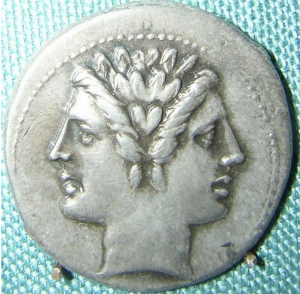
There are several other names for this sort of word, including contranym, auto-antonym, antagonym, self-anytonym, and my favorite: Janus word. (This from the Roman god Janus: god of beginnings, transitions, gates, passages, etc. The month January was named to honor him. He is usually represented with two faces: one face looking into the future, and the other face looking into the past.)

Now for some of the words! These are compiled from the articles “14 Words That Are Their Own Opposites,” by Judith B. Herman, and “75 Contronyms” at Daily Writing Tips. A big “thank you” to Chris Aston for guiding me to these resources!

1. Aught: All, or nothing

2. Bolt: To secure, or to flee

3. Buckle: To connect, or to break or collapse

4. Cleave: To adhere, or to separate

5. Consult: To offer advice, or to obtain it

6. Dollop: A large amount (British English), or a small amount

7. Enjoin: To impose, or to prohibit

8. Fast: Quick, or stuck or made stable

9. Finished: Completed, or ended or destroyed

10. Fix: To repair, or to castrate

11. Flog: To promote persistently, or to criticize or beat

12. Garnish: To furnish, as with food preparation, or to take away, as with wages

13. Handicap: An advantage provided to ensure equality, or a disadvantage that prevents equal achievement

14. Lease: To offer property for rent, or to hold such property

15. Left: Remained, or departed

16. Model: An exemplar, or a copy

17. Out: Visible, as with stars showing in the sky, or invisible, in reference to lights

18. Oversight: Monitoring, or failing to oversee

19. Puzzle: A problem, or to solve one

20. Quantum: Significantly large, or a minuscule part

21. Refrain: To desist from doing something, or to repeat

22. Sanction: To approve, or to boycott

23. Skin: To cover, or to remove

24. Splice: To join, or to separate

25. Strike: To hit, or to miss in an attempt to hit

26. Transparent: Invisible, or obvious

27. Trim: To decorate, or to remove excess from

28. Trip: A journey, or a stumble

29. Variety: A particular type, or many types

30. Weather: To withstand, or to wear away

Coin of Janus, from the Roman Republic

http://www.livius.org/ja-jn/janus/janus.html

Kara Church

Senior Technical Editor

Posted by: Jack Henry | April 2, 2013

Editor’s Corner: O is for Oh!

Good morning! We’ve passed the half-way point on the Spelling, Vocabulary, and Confusing Words from grammarbook.com. Today you can “ooh” and “aah” over the O’s.

oar a blade for rowing
or conjunction
ore metal-bearing mineral or rock
Posted by: Jack Henry | April 1, 2013

Editor’s Corner: April Fools’ Day

Random fourth-grader: “Did you know the word gullible is not in the dictionary?”

Young Miss Church: “Really?”

Oh no! It was already too late to come back from that. My heart sunk when I realized I’d just been bamboozled in front of the other kids on the playground. Kids laughed and I turned bright red, knowing I’d been had. April Fools’ Day, and I was not only gullible but I was a fool. I haven’t liked this day since!

Unfortunately, my husband loves this day and is the type of guy that will go to great lengths to trick people. A faked mushroom allergy? A website outlining some crazy new philosophy he’s invented? A new Facebook page where he is suddenly a champion of My Little Pony toys and has started a fan club? Yes, this is my life.

So today, I give in. I looked up synonyms for the word gullible, and they sure aren’t pretty. The Wikipedia definition of gullibility makes me feel like I should just give up and become a hermit.

Synonyms for gullible:

· believing

· biting

· credulous

· deceivable

· easily taken in

· easy mark

· exploitable

· foolish

· genuine

· green

· guileless

· innocent

· naive

· silly

· simple

· sucker

· susceptible

· swallowing whole

· taken in

· taking the bait

· trusting

· uncritical

· unsophisticated

· unsuspecting

· unwary

· unworldly

· wide-eyed

And from Wikipedia:

Gullibility is a failure of social intelligence in which a person is easily tricked or manipulated into an ill-advised course of action. It is closely related to credulity, which is the tendency to believe unlikely propositions that are unsupported by evidence.

Classes of people especially vulnerable to exploitation due to gullibility include children, the elderly, and the developmentally disabled.

NOTICE: This electronic mail message and any files transmitted with it are intended
exclusively for the individual or entity to which it is addressed. The message,
together with any attachment, may contain confidential and/or privileged information.
Any unauthorized review, use, printing, saving, copying, disclosure or distribution
is strictly prohibited. If you have received this message in error, please
immediately advise the sender by reply email and delete all copies.

« Newer Posts - Older Posts »

Categories