Posted by: Jack Henry | December 22, 2014

Editor’s Corner: Sixth Day of English

On the sixth day of English

My true love gave to me

Six basic tenses

And a circus made up of fleas

You can regard this as a tale of English future, where we will cover these tenses and more in the year 2015. For now it is just a simple preview from my friends at the Purdue OWL.

Strictly speaking, in English, only two tenses are marked in the verb alone, present (as in "he sings") and past (as in "he sang"). Other English language tenses, as many as thirty of them, are marked by other words called auxiliaries. Understanding the six basic tenses allows one to re-create much of the reality of time in their writing.

Simple Present: They walk

Present Perfect: They have walked

Simple Past: They walked

Past Perfect: They had walked

Future: They will walk

Future Perfect: They will have walked

Problems in sequencing tenses usually occur with the perfect tenses, all of which are formed by adding an auxiliary or auxiliaries to the past participle, the third principal part.

ring, rang, rung

walk, walked, walked

The most common auxiliaries are forms of "be," "can," "do," "may," "must," "ought," "shall," "will," "has," "have," "had.”

That’s enough to absorb for now. Until next time, here’s to the South for coming up with a plural version of the second person.

Kara Church

Technical Editor, Advisory

Posted by: Jack Henry | December 19, 2014

Editor’s Corner: Fifth Day of English

On the fifth day of English

My true love gave to me

Five uses for the infinitive form of verbs…

And I said, “True love, not only does that not rhyme, but I think you’re supposed to give me five golden rings or something that isn’t going to put me into a coma before the weekend gets started.”

So, instead I have been given the gift of a new website to explore and I’m sharing five words that have been added to the Oxford English Dictionary in 2014. (Thanks, Jane!)

· handsy (adjective)

informal

Tending to touch other people, typically in a way that is inappropriate or unwanted: another participant is getting a bit handsy

· al desko (adverb & adjective)

humorous

While working at one’s desk in an office (with reference to the consumption of food or meals): [as adverb]: limpsandwicheseaten al desko [as adjective]: an al-desko lunch

· keyboard warrior (noun)

informal

A person who makes abusive or aggressive posts on the Internet, typically one who conceals their true identity:she seems a down-to-earth person who does not deserve to be vilified by keyboard warriors

· lolcat (noun)

(On the Internet) a photograph of a cat accompanied by a humorous caption written typically in a misspelled and grammatically incorrect version of English: whether it’s flicking through Facebook, giggling at lolcats, or snooping on shopping sites, there’s always something to pull your attention away from work

· Canadian tuxedo (noun)

North American humorous

A denim jacket worn with a pair of jeans:if you can weardenim to the office, then you can wear a Canadian tuxedo

More example sentences

· We’ve put together eight denim-on-denim looks that are a bit of a departure from the traditional Canadian tuxedo.

· The way to make your denim-on-denim a little more elevated than the average Canadian tuxedo is with cooler accessories.

Photos from http://www.lolcats.com/

Kara Church

Technical Editor, Advisory

Posted by: Jack Henry | December 18, 2014

Editor’s Corner: Fourth Day of English

On the fourth day of English

My true love gave to me

Four verbs containing “ure”

(But we’ll start with the most confusing three.)

Assure, ensure, and insure often confuse folks because they share the general meaning “to make sure.” While they share a similar meaning, I would argue that their use depends on context. Let’s have a look.

· assure – convince; remove doubt. Often used to assuage anxiety in another individual.

Example: Dino assured me that he would be there for the presentation.

· ensure – guarantee; make certain; make safe. Focused around guaranteeing a specific condition or event.

Example: To ensure the health of the convalescent home residents, the staff ordered one case of Ensure® per person.

· insure – to protect against financial loss; to provide insurance.

Example: I have insured my home for damage caused by a plague of fire ants, flooding caused by the rise of Atlantis, and the return of Godzilla.

And for the fourth related “ure” word:

· secure – to take possession of; to stabilize; to make safe.

Example: The guards secured the castle by closing the gates, raising the bridge, and filling the moat with crocodiles.

For an entire article on this topic, see Grammar Girl’s Quick and Dirty Tips.

Kara Church

Technical Editor, Advisory

Posted by: Jack Henry | December 17, 2014

Editor’s Corner: The Third Day of English

On the third day of English

My true love gave to me

The articles “a,” “an,” and “the.”

There are three articles in English, but only two types: definite and indefinite.

· Definite Article: The
Use the word the to signal that you are talking about a particular noun or nouns.

Examples:

o The quiche that Joe brought was as light and as fluffy as his chef’s hat. (In this case, we are talking about a specific quiche, the quiche that Joe brought.)

o Jane Marie says she always goes to the teller with the dark hair and blue eyes because he’s handsome and he smiles at her. (Jane Marie doesn’t know the name of her dreamy teller, but she is still talking about a specific guy—the one who smiles at her.)

· Indefinite Articles: A and An
Use the words a or an to indicate that the noun you are talking about is not specific.

Examples:

o Sandy asked us to bring a dessert to the party. (In this case, the noun is dessert, but we don’t know what specific type of dessert. We could bring a cake, a pie, or even figgy pudding!)

o After falling down the stairs, Richard screamed, “I need a medic!” (Richard isn’t asking for a particular medic, he just needs some help—stat!)

Example of definite and indefinite articles together:

o I found an egg in the Christmas tree and realized Grandpa had mixed up his holidays again. Ten minutes later, Grandma was worriedly rushing around the house, asking if I’d seen the egg.

“Which egg, Grandma?” I asked. Then I told her, “There’s one in the tree.”

“You know,” she said on the verge of tears, “the Fabergé egg.”

Note: Whether you use a or an before a noun depends on the sound the noun begins with.

From the Purdue OWL:

· a + singular noun beginning with a consonant: a boy; a car; a bike; a zoo; a dog

· an + singular noun beginning with a vowel: an elephant; an egg; an apple; an idiot; an orphan

· a + singular noun beginning with a consonant sound: a user (sounds like ‘yoo-zer,’ i.e. begins with a consonant ‘y’ sound, so ‘a’ is used);a university; a unicycle

· an + nouns starting with silent "h": an hour

· a + nouns starting with a pronounced "h": a horse

· In some cases where "h" is pronounced, such as "historical," you can use an. However, a is more commonly used and preferred.

Kara Church

Technical Editor, Advisory

Posted by: Jack Henry | December 16, 2014

Editor’s Corner: The second day of English

On the second day of English

My true love gave to me

Two seasonal etymologies.

These brief explanations and etymologies are from Grammar Girl’s Quick and Dirty Tips about seasons.

Equinox

An equinox, which literally means an “equal night,” occurs when the sun’s path crosses the plane of the earth’s equator, making day and night of about equal length throughout the earth. This happens twice a year — about March 21 (for the spring equinox) and about September 23 (for the autumnal equinox); those are the dates for the Northern Hemisphere; they’re switched for the Southern Hemisphere.

Solstice

The word “solstice” means “sun standing.” There are two solstices: the summer solstice (on about June 21) and the winter solstice (on about December 21). The solstices refer to the times in the year when the sun’s rays reach their southernmost point on the planet (the Tropic of Capricorn) and their northernmost point on the planet (the Tropic of Cancer).

Kara’s quick and dirty tip:

The names of seasons are not capitalized unless they are part of a proper noun. Examples:

· We’re camping at Spring River when the leaves start turning colors next autumn.

· I prefer the Winter Olympics because I love skiing!

· The Princeton Summer Course Catalog is actually published at the end of spring break.

Kara Church

Technical Editor, Advisory

619-542-6773 | Ext: 766773

www.symitar.com

NOTICE: This electronic mail message and any files transmitted with it are intended
exclusively for the individual or entity to which it is addressed. The message,
together with any attachment, may contain confidential and/or privileged information.
Any unauthorized review, use, printing, saving, copying, disclosure or distribution
is strictly prohibited. If you have received this message in error, please
immediately advise the sender by reply email and delete all copies.

Posted by: Jack Henry | December 15, 2014

Editor’s Corner: 10 Words That Are Older Than You Might Think

As I was trying to think of something to share with you today, I came across this top ten list from Merriam-Webster: “10 Words That Are Older Than You Might Think.”

Before you send me an email arguing that some of these are not legitimate words, be aware that they are all listed in the dictionary. We may not like it, but these words have made the cut. Below, I have listed each word and the year of its earliest known usage. The date is not the date that the word was added to the dictionary. It’s the earliest date that they can verify that the word was used. The words were likely in use for years before the date listed.

1. Hipster, 1938 [dbb – I went to a hipster wedding last month in San Diego. So many beards, tattoos, and big-framed glasses—and the guys looked cool too.]

2. Credit card, 1888

3. Rap, 1787

4. Ginormous, 1942

5. Irregardless, 1795 [dbb – I hear your shouts of outrage! I’m sad to report that
irregardless is listed in the dictionary; however, it is listed as a nonstandard word. I don’t know who added it. Maybe it’s not too late to fire that guy.]

6. Online, 1950

7. Energy drink, 1904

8. Friend, 13th century [dbb – We are talking about friend as a verb here, as when you friend someone on Facebook®.]

9. D-oh, 1945

10. Wiretap, 1902

If you’d like to read more about any of ten words above, click here.

Donna Bradley Burcher | Technical Editor, Adv. | Symitar®

8985 Balboa Ave. | San Diego, CA 92123 | Ph. 619.278.0432 | Ext: 765432

Posted by: Jack Henry | December 12, 2014

Editor’s Corner: The first day of English

To start off the Editor’s Corner seasonal Twelve Days of English, I’m giving you Friday mondegreens (misheard song lyrics) with a twist! Today’s mondegreens are from Deck the Halls with Buddy Holly, and Other Misheard Song Lyrics, by Gavin Edwards.

DAY ONE

(To the tune of The Twelve Days of Christmas)

On the first day of English, my true love gave to me

A table of mondegree—eens.

Okay, so I’m not a poet. Enjoy!

Song Title Mondegreen Actual Lyrics
O Come All Ye Faithful O come, hoggy faithful

O come, froggy faithful

O come all ye faithful
The Twelve Days of Christmas Nine lazy Hansons Nine ladies dancing
We Wish You a Merry Christmas Bring us some friggin’ pudding Bring us some figgy pudding
The Christmas Song Chipmunks roasting on an open fire Chestnuts roasting on an open fire
We Three Kings King forever, seasoned leather King forever, ceasing never
Feliz Navidad Police have my dad

Police Doggy Dog

Feliz Navidad
The Twelve Days of Christmas Seven warts on women Seven swans a-swimmin’
Good King Wenceslas Good King Wenceslas looked out on the feet of heathens Good King Wenceslas looked out on the feast of Stephen
O Tannenbaum Oh tanned and bound

Oh, atom bomb

O Tannenbaum
Feliz Navidad Got fleas on my dog

Got fleas on my dog

Toss spittle on you and a freezing dog

Feliz Navidad

Feliz Navidad

Prospero año y felicidad

While Shepherds Watched Their Flocks While shepherds washed their socks at night While shepherds watched their flocks by night
The Twelve Days of Christmas Six geezers laying Six geese a-laying
Sleigh Ride Outside the snow is falling

And friends are calling, “You fool!”

Outside the snow is falling

And friends are calling, “Yoo-hoo!”

Kara Church

Technical Editor, Advisory

619-542-6773 | Ext: 766773

www.symitar.com

NOTICE: This electronic mail message and any files transmitted with it are intended
exclusively for the individual or entity to which it is addressed. The message,
together with any attachment, may contain confidential and/or privileged information.
Any unauthorized review, use, printing, saving, copying, disclosure or distribution
is strictly prohibited. If you have received this message in error, please
immediately advise the sender by reply email and delete all copies.

Posted by: Jack Henry | December 11, 2014

Editor’s Corner: Pronouns and Possessive Adjectives Answers

Better late than never!

Pronouns and Possessive Adjectives Answers

1. After she visited Grandma, my mom gave an heirloom to Kay and me.

The phrase "Kay and me" is the object of a preposition, so the object form me is required.

2. Neither I nor Amy remembered to feed the cat at dinnertime.

The usual order would be "Neither Amy nor I remembered." The pronoun is the subject of "remembered," so the subject form I is required.

3. Each of the Boy Scouts set fire to his tent at least once.

The singular possessive adjective his agrees with the singular pronoun each. Because the gender is clearly stated, the politically correct conundrum does not arise.

4. At least one of the women in the diamond store was living beyond her means.

The singular her agrees in number with one.

5. We men must refuse to be exploited for our good looks and horseback riding abilities!

The subject form is required because we, together with men, is the subject of the verb.

Kara Church

Technical Editor, Advisory

619-542-6773 | Ext: 766773

www.symitar.com

NOTICE: This electronic mail message and any files transmitted with it are intended
exclusively for the individual or entity to which it is addressed. The message,
together with any attachment, may contain confidential and/or privileged information.
Any unauthorized review, use, printing, saving, copying, disclosure or distribution
is strictly prohibited. If you have received this message in error, please
immediately advise the sender by reply email and delete all copies.
Posted by: Jack Henry | December 11, 2014

Editor’s Corner: Pronouns and Possessive Adjective Quiz

As promised, today I have a quiz for you. Here are the directions:

· Today I will provide you with some questions based on our lessons from the past few days.

· Complete the questions on your own. Please, do not send me your answers.

· This afternoon, I will send you the answers and a brief explanation behind them.

You won’t be forced to wear a pointy hat and face the wall if you get any wrong.

Pronouns and Possessive Adjectives

Pick the correct sentence from the pairs below.

1. After she visited Grandma, my mom gave an heirloom to Kay and me.
After she visited Grandma, my mom gave an heirloom to Kay and I.

2. Neither I nor Amy remembered to feed the cat at dinnertime.
Neither me nor Amy remember to feed the cat at dinnertime.

3. Each of the Boy Scouts set fire to their tent at least once.
Each of the Boy Scouts set fire to his tent at least once.

4. At least one of the women in the diamond store was living beyond their means.
At least one of the women in the diamond store was living beyond her means.

5. We men must refuse to be exploited for our good looks and horseback riding abilities!
Us men must refuse to be exploited for our good looks and horseback riding abilities!

Kara Church

Technical Editor, Advisory

619-542-6773 | Ext: 766773

www.symitar.com

NOTICE: This electronic mail message and any files transmitted with it are intended
exclusively for the individual or entity to which it is addressed. The message,
together with any attachment, may contain confidential and/or privileged information.
Any unauthorized review, use, printing, saving, copying, disclosure or distribution
is strictly prohibited. If you have received this message in error, please
immediately advise the sender by reply email and delete all copies.

Posted by: Jack Henry | December 10, 2014

Editor’s Corner: Joint Possessives

We are cruising this week! You’ve had your taste of pronouns and now it’s time for a little bit of information on joint possessives. First, what the heck am I talking about? I’m talking about writing about jointly owned objects, such as “Dylan and Darla’s swimming pool,” or “Rosy and Robert’s jet ski.”

Here are a few rules:

1. The standard way of treating joint possessives it to treat the owners as a single unit and add the apostrophe after the last name only.

· Teddy and Terry and Persephone’s party bus

· Pat and Oscar’s restaurants

2. When you are talking about several individuals and each one has their own (insert object here), then each owner gets an apostrophe.

· Bella’s and Buster’s T-bones (Each one has their own bone—they would certainly not share one!)

· Annie’s and Chris’s xylophones (They each have their own instruments.)

3. When you start to use pronouns in place of one of the individuals, be careful! Often it is best to rephrase sentences to avoid awkwardness.

· Rainbow and Rascal’s doghouse (Clear.)

· Rainbow and his doghouse (Unclear. Are you talking about Rainbow and a doghouse? Or are you talking about a doghouse that belongs to Rainbow and Rascal?)

· Rainbow’s and his doghouse (Debatable. Chicago Manual of Style says okay. Several grammar resources say it is incorrect but acceptable. The same goes for “His and Rainbow’s doghouse.”)

4. When you have two or more possessive pronouns, it’s time to go back to the drawing board.

· Her and his party was really exciting! (Their party was really exciting! Joe and Katrina’s party was really exciting!)

· Please come to my husband and my house for dinner. (Please come to our house for dinner.)

· We should take your and my chips to the roulette table. (We should take your chips and mine to the roulette table. We should take our chips to the roulette table.)

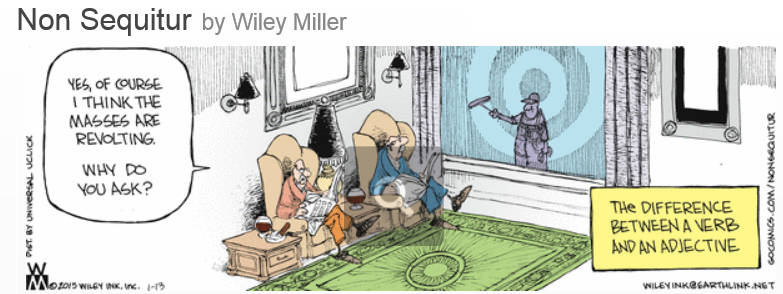
And now for some comic relief:

Kara Church

Technical Editor, Advisory

« Newer Posts - Older Posts »

Categories