Posted by: Jack Henry | February 25, 2016

Editor’s Corner: Wonnot

The other day, I told you I would find out why the words will not are combined into the crazy contraction won’t instead of win’t or willn’t. This is a nice article from Mental Floss, promising to answer our questions.

Most contractions in English are pretty straightforward: they are, they’re; he would, he’d; is not, isn’t; we will, we’ll. The two words join together, minus a few sounds. Put it together, and shorten it up. What could be easier? But that isn’t the case for "will not" which becomes "won’t" instead of "willn’t." Why does the "will" change to "wo"?

It doesn’t really. Which is to say, we don’t change it, our linguistic ancestors did. We just inherited it from them as a unit. But there was a reason for the "wo" in the beginning. In Old English there were two forms of the verb willan (to wish or will)—wil- in the present and wold- in the past. Over the next few centuries there was a good deal of bouncing back and forth between those vowels (and others) in all forms of the word. At different times and places "will" came out as wulle, wole, wool, welle, wel, wile, wyll, and even ull, and ool.

There was less variation in the contracted form. From at least the 16th century, the preferred form was wonnot from "woll not," with occasional departures later to winnot, wunnot, or the expected willn’t. In the ever changing landscape that is English, "will" won the battle of the "woles/wulles/ools," but for the negative contraction, "wonnot" simply won out, and contracted further to the "won’t" we use today. When you think about what it takes to actually pronounce the word "willn’t," this isn’t so surprising at all.

Kara Church

Technical Editor, Advisory

619-542-6773 | Ext: 766773

Symitar Documentation Services

NOTICE: This electronic mail message and any files transmitted with it are intended
exclusively for the individual or entity to which it is addressed. The message,
together with any attachment, may contain confidential and/or privileged information.
Any unauthorized review, use, printing, saving, copying, disclosure or distribution
is strictly prohibited. If you have received this message in error, please
immediately advise the sender by reply email and delete all copies.
Posted by: Jack Henry | February 24, 2016

Editor’s Corner: Wont and Won’t

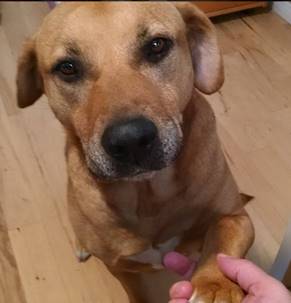
The other day, my husband and I were driving home from the vet with Buster, and my husband asked me, “Is Buster going to stand during the whole ride, as he is wont to do?” Before I could answer, Ray then asked, “And what about the word wont? What’s that all about?” I quickly found the etymology on my phone and read it to him, but I also thought I’d do a quick article about it since it’s likely to get mixed up with one of our odder contractions, won’t.

Wont is pronounced like want and it means “in the habit of doing something” or “accustomed.” Indeed, Buster is wont to stand in the back of the car with his nose poking out of the window and his eyes searching the world to keep us safe from squirrels.

Won’t is a contraction for will not. Why isn’t the contraction win’t? I have no idea…but I’ll find out and tell you next time!

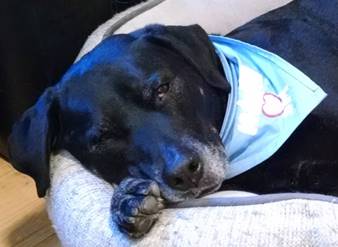
Buster naps after a day at the park.

Kara Church

Technical Editor, Advisory

Symitar Documentation Services

Posted by: Jack Henry | February 23, 2016

Editor’s Corner: In the doghouse

This past weekend, my husband and I went to two beach outings. We visited the sunken ship on Coronado, and we attended a doggy birthday beach party. Richard Lederer, our local English expert, wrote this article in honor of the Westminster Kennel Club Dog Show, and I thought now would be the perfect time to talk more about dogs in our language. Enjoy!

Note: Newspapers use a different style guide than we do, so some of this punctuation (or lack thereof) seems a bit off.

This is a good time, then, to talk about how the canine expressions trot, scamper and bark through our English language.

We call a tenacious person a bulldog, a showoff a hot dog, a fortunate person a lucky dog, a man with an active social life a gay dog who puts on the dog and a rapscallion a cur or dirty dog. A dominant person is a top dog who can run with the big dogs, while his counterpart is an underdog. Some of us lead a dog’s life going to the dogs in the doghouse. Others are young pups in puppy love.

As long ago as AD 1150, the learned St. Bernard of Clairvaux said, "Qui me amat, amat et canem meam." That translates to Love me, love my dog, an expression of the astonishing interspecies bond between dogs and human beings. In Geoffrey Chaucer’s 14th century tale of "Troilus and Creseyde," the poet writes, "It is nought good a sleping hound to wake," which comes down to us as Let sleeping dogs lie. These are dog-eared phrases, so-called because a page in a well-worn book can get folded over like the ear of a dog.

Another phrase derived from literature is in the doghouse, which means "to be out of favor." This phrase was born in James Barrie’s 1904 play "Peter Pan." Mr. Darling, the father of the three children, is punished for his shabby treatment of Nana, the Newfoundland dog who is also the children’s nurse. And where does he spend his exile? In Nana’s doghouse, of course.

There abound a number of explanations for it’s raining cats and dogs, including the fact that felines and canines were closely associated with the rain and wind in Norse mythology. In Odin days, dogs were often pictured as the attendants of Odin, the storm god, and cats were believed to cause storms. Another theory posits that during heavy rains in 17th-century England, some city streets became raging rivers of filth carrying many drowned cats and dogs. But the truth appears to be more mundane. Cats and dogs make a lot of noise when they fight (hence, fighting like cats and dogs), so they have become a metaphor for a noisy rain or thunderstorm. Sometimes dogs fight with other dogs over a single bone, a dust-up that gives us the phrase bone of contention.

A three-dog night is not only a popular music group of the 1970s, but a night so cold that one must sleep with three dogs in order to generate enough body heat to be comfortable.

In the early 19th century in American English, barker came to signify the person who stands outside a carnival or circus to shout (bark) out its attractions to passersby. From the same period arose the expression barking up the wrong tree because hunting dogs can mistakenly crowd around the base of a tree thinking they have treed a raccoon that has actually taken a different route. The phrase is still used to mean wasting one’s energy by pursuing the wrong path.

Another classic Americanism is hot dog. In the 19th century United States, some folks suspected that sausages were made from dog meat. When hot sausages in a bun became popular, it was but a short leap to the term hot dog. Cartoonist Tad Dorgan featured the hot dog in some of his sports cartoons, helping to popularize the new name. That the sausage looks a little like the body of a dachshund also helped hot dog to cleave to the American palate.

That’s all I have for you today. To read the article in its entirety, click here: Richard Lederer and the San Diego U-T.

Happy Bella

Kara Church

Technical Editor, Advisory

Symitar Documentation Services

Posted by: Jack Henry | February 22, 2016

Editor’s Corner: Keep it short

Donna is out of the office, but she left us lessons for the next few Mondays. Here is the first installment!

******************************************************************

Good Monday morning, folks.

While reviewing one of my editing books, I came across this superb advice for everyone who is writing professionally—including all of us who write emails and other communications. The text below (except for my asides) is from The Editor’s Companion by Steve Dunham (pp. 34−35).

How can you write more clearly?

· Use short sentences.
[dbb – This is some of the best writing advice you’ll ever get. Short sentences are the most effective way to convey highly technical, challenging material.]

· Write to one person, not a group.

· Use the simplest tense you can.

· Use “must” to convey requirements.

How can you make your documents visually appealing? [dbb – Rather than “visually appealing,” I’d say, “easier to process.”]

· Use lots of informative headings.

· Write short sections.
[dbb – This advice goes along with the advice to write short sentences. It is much easier to digest information in small chunks.]

· Include only one issue in each designated paragraph.
[dbb – Yes! This is crucial to your organization and your readers’ understanding.]

· Use vertical lists.
[dbb – We’re talking bulleted and numbered lists here. They are very helpful in presenting detailed information.]

“Those who write clearly have readers; those who write obscurely have commentators.” ~Albert Camus

Kara Church

Technical Editor, Advisory

619-542-6773 | Ext: 766773

Symitar Documentation Services

NOTICE: This electronic mail message and any files transmitted with it are intended
exclusively for the individual or entity to which it is addressed. The message,
together with any attachment, may contain confidential and/or privileged information.
Any unauthorized review, use, printing, saving, copying, disclosure or distribution
is strictly prohibited. If you have received this message in error, please
immediately advise the sender by reply email and delete all copies.
Posted by: Jack Henry | February 19, 2016

Editor’s Corner: Assume and Presume

Dear Ms. Editrix,

Are the words assume and presume interchangeable? Please advise.

With hugs,

G

Dear G,

What an interesting question! I tried to define them in my head, but then I got a bit lost. I turned to the Internet to see if maybe someone had already dealt with the difference between the two, and I stumbled on this article from Vocabulary.com. I hope it helps!

Sincerely,

Editrix

Assume and presume both mean to believe something before it happens, but when you assume you’re not really sure. If someone bangs on your door in the middle of the night, you might assume (and hope!) it’s your crazy neighbor. If your neighbor knocks on your door every night at 6:30, at 6:29 you can presume she’s coming over in a minute.

To assume is to suppose or believe something without any proof. It also means to take over, usually responsibilities and duties, such as with a job, or to take on a look or attitude:

Receiving no reply, three days later he sent a second missive, in which he assumed that his first letter had gone astray. (Elizabeth S. Kite)

"I won’t have him," said Sir Henry at once, his eyes assuming their most prawnlike expression. (Mary Cholmondeley)

Presume is from the Latin pre "before" and sumere "to take," like taking something for granted. It means to be sure of something before it happened. When you presume, you suppose something without proof, based on probability:

In her latest video, Britney Spears arrives on earth — an alien, we presume — to spread the message of consumerism. (Washington Post)

I favor the latter explanation, also known as a sensibly presumed truth, just as I believe William Shakespeare wrote a few plays in his day. (Time)

People don’t love it when you assume… because you’re basically making a guess. When you assumed it was your neighbor knocking on your door and you told her to go away, you found out later it was your mom! There’s no funny phase about presume, because you’re usually right.

Kara Church

Technical Editor, Advisory

619-542-6773 | Ext: 766773

Symitar Documentation Services

NOTICE: This electronic mail message and any files transmitted with it are intended
exclusively for the individual or entity to which it is addressed. The message,
together with any attachment, may contain confidential and/or privileged information.
Any unauthorized review, use, printing, saving, copying, disclosure or distribution
is strictly prohibited. If you have received this message in error, please
immediately advise the sender by reply email and delete all copies.
Posted by: Jack Henry | February 18, 2016

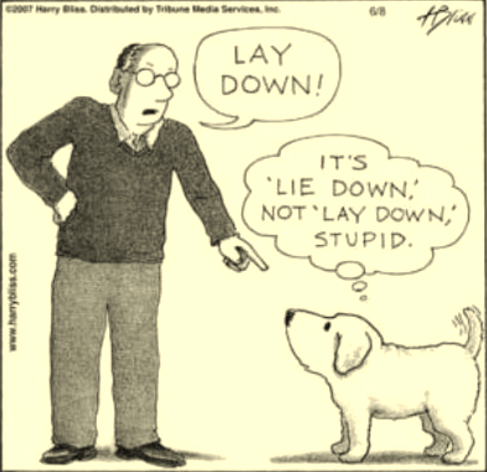
Editor’s Corner: Lay Versus Lie

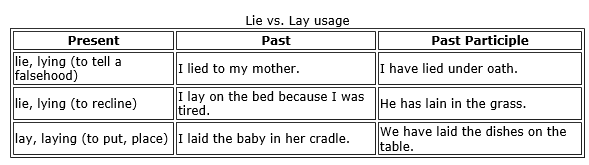
Lay and lie are frequently confused words. In present tense, lay means to put or set something down (and it requires a direct object). For example:

· Every morning I lay the student manuals on the desks before class starts.

Lie means to be, to stay, or to assume rest in a horizontal position; it does not require a direct object. For example:

· Every afternoon I lie on the hammock.

Things get tricky with past tense because lay is the past tense of lie.

· Examples in past tense:

o When I taught the class, I laid out the manuals before class started.

o I lay on the hammock after class.

· Examples with a participle (has, have):

o I have laid the student manuals on the desks.

o I have lain on the hammock every day this week.

Don’t worry if you are still a little confused. Here’s a chart from the Purdue Owl to help you remember.

Jackie Solano | Technical Editor | Symitar®

8985 Balboa Ave. | San Diego, CA 92123 | Ph. 619.542.6711 | Extension: 766711

Symitar Documentation Services

Posted by: Jack Henry | February 17, 2016

Editor’s Corner: The Revenant, Deadpool, and Dead Pool

This past Presidents’ Day, I thought I’d see a couple of movies. Well, I wanted to see Deadpool, but I was talked into seeing The Revenant, too. Ay carumba! This year’s Academy Awards promise to be grim and depressing, unless Mr. Deadpool hosts them, and I don’t think he’s on the list of welcome presenters.

Since several of you have asked me what the word revenant means, I will tell you this:

· The movie The Revenant means almost three hours of lovely but fierce film about a man who lives a cold, lonely, stinky, vicious, hard life.

· The word revenant, from Merriam-Webster, means “one that returns: such as the ghost of a dead person.” Revenant is derived from revenir (Middle French for “to come back, to return”).

So there you have it. I vote for Deadpool.

P.S. And if you want the definition of a dead pool, it is a morbid game where you and your fellow gamers bet on when specific people (usually celebrities) are going to die. (See The Dead Pool [1988] with Clint Eastwood as Dirty Harry.)

Kara Church

Technical Editor, Advisory

619-542-6773 | Ext: 766773

Symitar Documentation Services

NOTICE: This electronic mail message and any files transmitted with it are intended
exclusively for the individual or entity to which it is addressed. The message,
together with any attachment, may contain confidential and/or privileged information.
Any unauthorized review, use, printing, saving, copying, disclosure or distribution
is strictly prohibited. If you have received this message in error, please
immediately advise the sender by reply email and delete all copies.
Posted by: Jack Henry | February 16, 2016

Editor’s Corner: Stormy Weather–Snow, Part 2

Well, by golly! You would think I live in Southern California for all of the emails I received about additional snow terms that weren’t on the Daily Writing Tips list I sent last week! Who knew there were so many more?

While many of you sent me additional terms, I want to thank Yreka Sisson for her research and this submission from the Farmers’ Almanac. I hope you stay warm and cozy, you frostbitten fiends!

· Barchan: A horseshoe-shaped snowdrift.

· Blizzard: A violent winter storm that combines subfreezing temperatures, strong winds, and snowfall. To officially qualify as a blizzard, a storm must reduce visibility to less than a quarter of a mile and last for at least three hours.

· Corn: Coarse, granular wet snow formed by cycles of melting and refreezing.

· Cornice: An overhanging accumulation of ice and wind-blown snow, such as might be found on a cliff face.

· Column: A type of snowflake that is shaped like a six-sided column.

· Crust: A hard, frozen layer of snow over top of a softer, less-supportive layer.

· Dendrite: A type of snowflake that has six points. This is the archetypal “snowflake” shape.

· Finger drift: A narrow snowdrift across a roadway. So named because several of them together resemble the fingers on a hand.

· Firn: Snow that is more than a year old, but that has not yet consolidated into ice.

· Flurry: A brief snowfall that produces little to no accumulation.

· Graupel: Also called snow pellets, graupel refers to round, opaque snowflakes. They form when regular snowflakes fall through ice-cold liquid clouds. Droplets from the clouds freeze onto the crystals, forming a solid mass. Graupel is similar to hail, but is smaller and less dense.

· Ground blizzard: A windstorm that is not accompanied by snowfall, but which reduces visibility by lifting existing snow from the ground.

· Hoarfrost: Frost that resembles spiky hairs. This type of frost gets its name from the word “hoar,” which means “ancient,” because it resembles an old man’s bushy, white beard. It happens when water vapor freezes instantly after coming into contact with a very cold surface. It occurs because the moisture in the air goes directly from vapor to solid, skipping the liquid phase. It tends to form on small surfaces, such as wires, tree branches, plant stems, and leaf edges, and sometimes over existing snowfall.

· Lake-effect snow: Snow produced when icy winds move across a large body of warmer lake water. Common in the Great Lakes region of the U.S. and Canada.

· Needle: A type of snowflake that is much longer than it is wide.

· New snow: Recent snowfall in which individual ice crystals can still be seen.

· Old snow: Snowpack in which individual snow crystals can no longer be recognized.

· Penitents: Tall, thin, spikes of hardened snow. They can range from a few inches to a several feet in height.

· Perennial snow: Snow that remains on the ground for more than a year.

· Pillow drift: A wide, deep snowdrift across a roadway.

· Polycrystal: A formation made up of several snowflakes that fuse into one massive flake.

· Powder: New snow composed of loose, fresh crystals.

· Rimed snow: Snowflakes coated in tiny frozen water droplets called rime.

· Ripples: Marks on the surface of snow, similar to the ripples in sand, caused by wind.

· Roller: A naturally occurring cylinder of snow formed by the wind.

· Sastrugi: Irregular grooves and ridges in snow caused by the wind.

· Seasonal snow: The amount of snow that accumulates during one season.

· Sleet: Rain mixed with snow.

· Slush: Partially melted snow on the ground.

· Snirt: Snow mixed with dirt.

· Snow bridge: An arch formed by snow and wind.

· Snow drift: Snow on the ground that has been blown by the wind to a height greater than the actual amount of snow that has fallen.

· Snow squall: A brief, intense snow shower that does not qualify as a blizzard due to its short duration.

· Snowburst: An intense snow shower that produces a lot of accumulation in a short period of time.

· Snowflake: A cluster of ice crystals that falls from a cloud.

· Snowpack: Also called snow cover, this term refers to the total amount of all snow and ice on the ground, including both recent snowfall and previous snow and ice that have not melted.

· Snowstorm: Any weather event that features large amounts of snowfall.

· Sun cups: Shallow, bowl-shaped hollows formed by irregular patches of intense sunlight.

Kara Church

Technical Editor, Advisory

619-542-6773 | Ext: 766773

Symitar Documentation Services

NOTICE: This electronic mail message and any files transmitted with it are intended
exclusively for the individual or entity to which it is addressed. The message,
together with any attachment, may contain confidential and/or privileged information.
Any unauthorized review, use, printing, saving, copying, disclosure or distribution
is strictly prohibited. If you have received this message in error, please
immediately advise the sender by reply email and delete all copies.

Posted by: Jack Henry | February 12, 2016

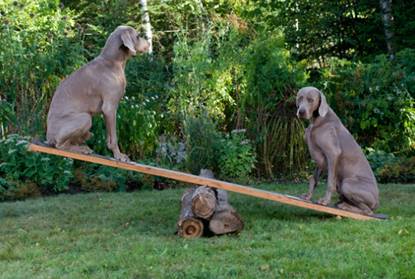
Editor’s Corner: See, Saw, Seen, and Seesaw

I have to say this topic surprised me a bit. One of our co-workers asked me to do an article on misusing the words see, saw, and seen…and included examples in her email. These errors are like fingernails on a chalkboard, so consider yourself warned!

· And I seen where the printer had a message that needed to be answered…

· I seen the date on…

· I seen at 5:16 you had this…

And the list continued. Here are some pointers for those wayward souls who are scratching that chalkboard.

The present tense of the verb “to see” is see (or sees):

· I see you are wearing red today.

· He sees you when you’re sleeping; he knows when you’re awake.

· We see flowers on your desk. Is it your anniversary?

The simple past tense of the verb “to see” is saw:

· I saw Fiddler on the Roof last night.

· She saw a seesaw on the seashore.

· They said they saw you at the park two days ago.

The past participle of the verb “to see” is seen, and it requires a helping verb when you use it. To use “seen” alone would be incorrect.

Correct(notice the helping verb):

· I have seen some crazy things at the circus.

· Joan has seen the musical Wicked 12 times!

· We have seen the biggest change in our roads since the old mayor left office.

Incorrect (notice, no helping verb):

· I seen Murray cheat on all five of his wives.

· He seen it was me despite my elegant disguise.

· They seen better days.

Enjoy your three-day weekend!

Kara Church

Technical Editor, Advisory

Symitar Documentation Services

Posted by: Jack Henry | February 11, 2016

Editor’s Corner: …And Sometimes W?

Kara’s post, Why Y?, reminded me of something my dad once told me. When he was in school, he learned the vowels: "A, E, I, O, U, and sometimes Y… and sometimes W."

In the pre-Internet days of my dad’s childhood, kids had to rely on the wisdom of their teachers. So, although my dad never saw W used as a vowel, he remembered this "fact" well into adulthood.

But my dad’s teacher was right. The letter W is used—infrequently—as a vowel. Merriam-Webster’s Collegiate Dictionary includes two such words (both borrowed from Welsh):

  • crwth: an ancient Celtic stringed instrument that is plucked or bowed
  • cwm: a deep steep-walled basin on a mountain usually forming the blunt end of a valley

In both cases, W is pronounced like the double O in loot.

The more permissive Oxford Dictionaries website also includes the Welsh word cwtch and the video gamer slang pwn (a deliberate misspelling of own):

  • cwtch: a cupboard or cubbyhole; a cuddle or hug
  • pwn: utterly defeat (an opponent or rival)

Nevertheless, the rule "A, E, I, O, U, and sometimes Y" is usually sufficient, unless you’re a Scrabble® player or a Welsh mountaineer.

Ben Ritter | Technical Editor | Symitar®
8985 Balboa Avenue | San Diego, CA 92123
619-682-3391 | or ext. 763391 | www.Symitar.com

NOTICE: This electronic mail message and any files transmitted with it are intended
exclusively for the individual or entity to which it is addressed. The message,
together with any attachment, may contain confidential and/or privileged information.
Any unauthorized review, use, printing, saving, copying, disclosure or distribution
is strictly prohibited. If you have received this message in error, please
immediately advise the sender by reply email and delete all copies.

« Newer Posts - Older Posts »

Categories