Posted by: Jack Henry | April 21, 2016

Editor’s Corner: Perfect Pangrams

A pangram is a sentence that uses every letter of the alphabet at least once. Kara previously discussed pangrams here and here.

The most well-known pangram, “The quick brown fox jumps over the lazy dog,” has 35 letters, including two H’s, two R’s, two T’s, two U’s, three E’s, and four O’s.

A perfect pangram is a sentence that uses every letter of the alphabet exactly once. Language aficionados have suggested several perfect pangrams. Are they valid sentences or incomprehensible gibberish? Judge for yourself from the following examples:

Squdgy fez, blank jimp crwth vox (by Claude Shannon)

What it means: Squat, pudgy (squdgy) brimless hat (fez), obstruct (blank) the voice (vox) of a slender (jimp) Celtic violin (crwth).

Note: Vox is Latin for voice. It is not found in Merriam-Webster, except as part of the phrase vox populi (voice of the people).

Bortz waqf glyphs vex muck djin (by Ed Spargo)

What it means: Symbols (glyphs) indicating an Islamic endowment (waqf) of inferior diamonds (bortz) annoy (vex) dirt genies (muck djin).

Jink cwm, zag veldt, fob qursh pyx (by Stephen Wagner)

What it means: Move quickly with sudden turns (jink and zag) across mountain hollow (cwm) and African grassland (veldt) to deceitfully obtain (fob) a box (pyx) of Saudi coins (qursh).

Ben Ritter | Technical Editor | Symitar®
8985 Balboa Avenue | San Diego, CA 92123
619-682-3391 | or ext. 763391 | www.Symitar.com

Symitar Documentation Services

NOTICE: This electronic mail message and any files transmitted with it are intended
exclusively for the individual or entity to which it is addressed. The message,
together with any attachment, may contain confidential and/or privileged information.
Any unauthorized review, use, printing, saving, copying, disclosure or distribution
is strictly prohibited. If you have received this message in error, please
immediately advise the sender by reply email and delete all copies.

Posted by: Jack Henry | April 20, 2016

Editor’s Corner: Redundant Adjectives

Oh my darlings,

It must be close to vacation time because I am stressed out and I have too much to do to really settle down and write you something super-fantastic before I go. I just read an article about jargon and vogue words, but I’m too low on energy to start on another rant about that! So instead, I give you this small gift of redundant adjectives to avoid, from Daily Writing Tips.

1. free gift
A gift is a thing given willingly to someone without payment. The adjective free is redundant.

2. closed fist
A fist is by definition a hand with the fingers folded inward toward the palm and held there tightly, typically in order to strike a blow or grasp something. The adjective closed is redundant.

3. verdant green
The adjective verdant derives from a Latin word meaning “green.” Verdant came into English from a French word meaning “becoming green.” The English meaning of verdant is “green” or “green with vegetation.” An enthusiastic fertilizer manufacturer advertises a product that will provide the consumer with “a verdant green lawn.” Either verdant or green will do.

4. rubicund red
The adjective rubicund derives from a Latin verb meaning, “to be red.” Something that is rubicund is red or reddish. This description from fan fiction can do without one of the adjectives: “Drawing rivulets of blood, his fingertips glowed a rubicund red.”

5. overused cliché
The blogger who wrote this sentence could have saved an adjective: “The overused cliché I hate the most is ‘off the beaten path.’” In reference to language, a cliché is an overused expression.

6. unexpected surprise
A surprise is an unexpected occurrence. The phrase is not uncommon on the Ngram Viewer, and is frequent online:

An unexpected surprise greeted us upon our arrival home.

Life is full of unexpected surprises.

A foreigner in the dining hall was an unexpected surprise.

As “unexpectedness” is part of the definition, it’s enough to say that something is a surprise.

7. universal panacea
Panacea derives from a Greek word meaning, “cure-all” and is defined in English as “a universal remedy.” Because panacea contains the meaning universal, it’s not necessary to tack universal onto it, as in this sentence written by a journalist: “When Henry Grady was inviting Northern capital South, we were much more certain that industrialization was the universal panacea for all economic and social ills.”

Panacea is sufficient.

Kara Church

Technical Editor, Advisory

619-542-6773 | Ext: 766773

Symitar Documentation Services

NOTICE: This electronic mail message and any files transmitted with it are intended
exclusively for the individual or entity to which it is addressed. The message,
together with any attachment, may contain confidential and/or privileged information.
Any unauthorized review, use, printing, saving, copying, disclosure or distribution
is strictly prohibited. If you have received this message in error, please
immediately advise the sender by reply email and delete all copies.

Posted by: Jack Henry | April 19, 2016

Editor’s Corner: You Say To-May-Toe, I Say To-Mah-Toe

The other day, I was reading something here and someone used the word either and then mentioned three things. This struck me as odd and incorrect. For example, “He told me to wear either my black hot pants, my blue Daisy Dukes, or my red capris.” How can you wear one or the other of three things?

I found this tidbit from The American Heritage Dictionary of the English Language (4th ed.):

The traditional rule holds that either should be used only to refer to one of two items and that any is required when more than two items are involved: Any (not either) of the three opposition candidates still in the race would make a better president than the incumbent.

Huzzah, hurrah, I thought. I love being right. But, unfortunately, either isn’t that easy. For example, you could say that Willy Wonka’s chocolate flows in either direction, and it is correct because either is being used as an adjective to mean “each” or “one and/or the other” direction.

You might recognize when it is disguised as an adverb, too, meaning “also”: “John isn’t into the circus, and I’m not either.”

Either can be a lot of things, but I will stick by my rule of removing it when you use it to talk about more than two options. If you’re still not certain if it is okay, check the dictionary before you use it. I might even give you a gold star.

Kara Church

Technical Editor, Advisory

619-542-6773 | Ext: 766773

Symitar Documentation Services

NOTICE: This electronic mail message and any files transmitted with it are intended
exclusively for the individual or entity to which it is addressed. The message,
together with any attachment, may contain confidential and/or privileged information.
Any unauthorized review, use, printing, saving, copying, disclosure or distribution
is strictly prohibited. If you have received this message in error, please
immediately advise the sender by reply email and delete all copies.

Posted by: Jack Henry | April 18, 2016

Editor’s Corner: Mood Changers

Don’t let the subject line fool you. This is not going to be an article about that sinking feeling you get when you open your email to find an urgent, panicked message from your boss. This is about grammar; so give a sigh of relief, and let’s talk moods.

The term mood changers refers to words that alert readers to a change in mood from the previous clause or sentence. We also call these words transitions.

The list below is a partial list of mood changing words from William Zinsser’s book, On Writing Well (Zinsser 1998, 74):

Yet

However

Nevertheless

Still

Instead

Thus

Therefore

Meanwhile

But

Later

Subsequently

Zinsser points out that it is much easier for readers to process a sentence when writers use one of these words to shift direction.

Here are some examples showing how these mood-changing transitions can signify a shift:

· She said she raised her son to be independent, yet she continued to do his laundry and pack his lunch.

· The house was reported to be haunted by an evil spirit; nevertheless, he decided to spend the night.

· The police officers patrolled the main street; meanwhile, the robbers broke in from the alley.

· The software program had not been updated in years. Subsequently, it crashed.

Notice that the mood-changing words can be used to transition within one sentence or to begin a second sentence. Either way, they mark a shift in the mood of the text.

I haven’t had my tea yet and I feel a shift in my mood coming on, so I’ll sign off before this turns into the Cranky Editor’s Corner.

Donna Bradley Burcher | Senior Technical Editor | Symitar®

8985 Balboa Ave. | San Diego, CA 92123 | Ph. 619.278.0432 | Extension: 765432

Symitar Technical Publications Writing and Editing Requests

NOTICE: This electronic mail message and any files transmitted with it are intended
exclusively for the individual or entity to which it is addressed. The message,
together with any attachment, may contain confidential and/or privileged information.
Any unauthorized review, use, printing, saving, copying, disclosure or distribution
is strictly prohibited. If you have received this message in error, please
immediately advise the sender by reply email and delete all copies.

Posted by: Jack Henry | April 15, 2016

Editor’s Corner: April Q&A from CMOS

Good morning and happy Friday!

I’m getting quite a few fun photos from you with errors on signs and public punctuation problems. You have until May 13 (midday, Pacific Time), so keep your eyes open for more and send them to my email address. You get one point for each submission. I’ll pick a “Best in Show” winner and a random winner, so the more you send in, the better your chances are.

Today, I have a few items for you from the April Q&A in the Chicago Manual of Style.

Q. If a sentence is a question and ends with a quote which is not a question, should a question mark be used, and if so, where should it be placed?

A. Put a sentence-ending question mark outside the quoted statement: Can you believe he said “I like your face-lift”?

Q. Dear wise and knowledgeable CMOS person, a fellow writer and editor and I can’t agree. She insists that “well-trained dog” shouldn’t have a hyphen. I think it must have that hyphen. We were both pretty tired when this cropped up, so we ended up barking a bit at each other. We’d like to resolve this bone of contention by appealing to you, whom we both respect and trust. Whatever you say, we’ll abide by.

A. If the dog is well trained (no hyphen), it is a well-trained dog.

KC – To break that down:

· This dog is well trained. (Well is an adverb.)

· Your fluffy Doodle-Poodle is a well-trained dog! (Well-trained is an adjective.)

Kara Church

Technical Editor, Advisory

619-542-6773 | Ext: 766773

Symitar Documentation Services

NOTICE: This electronic mail message and any files transmitted with it are intended
exclusively for the individual or entity to which it is addressed. The message,
together with any attachment, may contain confidential and/or privileged information.
Any unauthorized review, use, printing, saving, copying, disclosure or distribution
is strictly prohibited. If you have received this message in error, please
immediately advise the sender by reply email and delete all copies.

Posted by: Jack Henry | April 14, 2016

Editor’s Corner: Rewriting

I recently read an article that included this quote from author James Michener: “I’m not a very good writer, but I’m an excellent rewriter.” I’ve heard several people say that they are not good writers. Writing isn’t easy for everyone, but the key to good writing is rewriting.

People (regardless of their writing skills) should revise and edit their writing with the goal of making it easy for others to understand. Remember that a first draft is a step in the writing process that allows writers to get out their ideas; it can take several drafts to ensure that the writing is clear and concise. And if you really want to make sure that your message is clear, ask a co-worker to review your documentation and to provide feedback.

Jackie Solano | Technical Editor | Symitar®

8985 Balboa Ave. | San Diego, CA 92123 | Ph. 619.542.6711 | Extension: 766711

Symitar Documentation Services

Posted by: Jack Henry | April 13, 2016

Editor’s Corner: Dibs

Now and then when I’m walking the dogs or daydreaming, I’ll think of a word or phrase or song from childhood that I never questioned at the time. The more I think of London Bridge falling down or the monkey chasing the weasel or “Jinx, buy me a Coke!” the more odd these memories seem. The other day, I came across one of those words in an article from The Grammarist, and I thought I’d pass it along to you.

Dibs and Calling Dibs

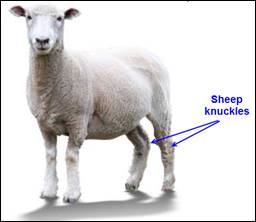
Dibs is a word used when laying claim to something. Calling dibs on something is an assertion of one’s rights. The idea of dibs, calling dibs or calling first dibs goes back to an eighteenth century children’s game called dibstones. Dibstones was a game akin to jacks, played with sheep knuckles. Children would announce “Dibs!” as they picked up each sheep knuckle, or called dibs. Eventually the term grew to include any instance when someone laid claim to something or asserted his right to possess it. For a time, dibs also referred to money.

After reading that and looking for a photo of a sheep, I stumbled upon more information about this sort of game in Wikipedia.

Knucklebones, Fivestones, or Jacks, is a game of ancient origin, usually played with five small objects, or ten in the case of jacks. Originally the "knucklebones" (actually the astragalus, a bone in the ankle, or hock[1]) were those of a sheep, which were thrown up and caught in various manners. Modern knucklebones consist of six points, or knobs, proceeding from a common base, and are usually made of metal or plastic. The winner is the first player to successfully complete a prescribed series of throws, which, though similar, differ widely in detail. The simplest throw consists in tossing up one stone, the jack, and picking up one or more from the table while it is in the air. This continues until all five stones have been picked up. Another throw consists in tossing up first one stone, then two, then three and so on, and catching them on the back of the hand. Different throws have received distinctive names, such as "riding the elephant," "peas in the pod," and "horses in the stable."

I have dibs on this sheep’s knuckles!

Kara Church

Technical Editor, Advisory

Symitar Documentation Services

Posted by: Jack Henry | April 12, 2016

Editor’s Corner: Casing

No, I’m not talking about sausage casing—I’m talking about letter casing. More specifically, I have a passage from The Grammar Devotional, by Mignon Fogarty (Grammar Girl) on camel case.

CamelCase

CamelCase (also known as medial capitals, intercaps, hump-backing, CapWords, and BiCapitalials, among other names) is the practice that has now become trendy of promoting a letter in the middle of a word to uppercase. Most often the capital letter in the middle seems to result from squishing two words together that would normally be separated by a space (e.g., MySpace), but occasionally the capital just seems to pop up at a convenient syllable (e.g., OutKast).

Although the phenomenon can be traced back to at least the 1950s, it gained steam among computer programmers (probably because spaces are often discouraged or disallowed in programming, so a convenient way to highlight multiple words in a file name or variable is to capitalize the first letter of each squished-together word). More recently, marketers decided it was a trendy way to make a company name stand out.

If a formal company name uses CamelCase (e.g., YouTube, PayPal, TiVo), use that form in your writing. But other than honoring official names, leave the camel at the zoo—don’t go around calling a plain old help desk a HelpDesk. It is definitely unnecessary!

Thanks to Pam W. for this photo. I’m afraid I paid after I existed!

Kara Church

Technical Editor, Advisory

Symitar Documentation Services

Posted by: Jack Henry | April 11, 2016

Editor’s Corner: Punctuation of Appositives

Good morning.

I imagine your first question after reading the subject line is, what the heck is an appositive? I’m right there with you. So, let’s start with a definition. An appositive is a word or phrase that is equivalent and has the same meaning as another word or phrase in the same sentence. For example, the appositive in the following sentence is in italics:

· Yahoo’s CEO, Marissa Mayer, was the company’s first female engineer and became the youngest CEO when she took over at age 37.

In the example, Marissa Mayer is an appositive for Yahoo’s CEO. In other words, Marissa Mayer and Yahoo’s CEO are the same person.

And here’s some information on how to punctuate appositives. When you use an appositive in the middle of your sentence, you need to encase it in commas as in the example above. Here are a couple more examples:

· My dog, Rover, doesn’t like other dogs. [my dog = Rover]

· During dinner, John, the loudest person at the table, told an off-color joke. [John = the loudest person at the table]

And if you use an appositive at the end of your sentence, place a comma before the appositive and a period after it, like this:

· No one wanted to sit next to John, the loudest person at the table.

Donna Bradley Burcher | Senior Technical Editor | Symitar®

8985 Balboa Ave. | San Diego, CA 92123 | Ph. 619.278.0432 | Ext: 765432

Posted by: Jack Henry | April 8, 2016

Editor’s Corner: Loose the Jargon

Do you sometimes feel like the editors badger you about using jargon and business-speak? Do you feel stifled because we want you to use simple language?

We badger out of love—for your readers. The problem is that every business sector creates their own jargon—abbreviations, acronyms, and buzzwords—that everyone else in their field knows, but outsiders don’t. A good example is legalese. If you’re not a lawyer, you probably have a hard time deciphering any legal document. Can I get an amen?

One of my colleagues (thanks, Ron!) recently shared an article called Did the IRS Flunk English? A Rant About Why You Can’t Do Your Taxes from the Acrolinx website, and I’m sharing an excerpt today as a warning and as a reminder of what not to do.

Read this paragraph from an IRS income tax form, and weep. And then, please (I would get on my knees and beg, but I’m dressed up today), think twice before using jargon and business-speak. You don’t want to make others feel like you are about to feel.

In case bond as provided in section 7324(3) shall have been executed and the property returned before seizure thereof by virtue of process in the proceedings in rem authorized in subsection (a) of this section, the marshal shall give notice of pendency of proceedings in court to the parties executing said bond, by personal service or publication, and in such manner and form as the court may direct, and the court shall thereupon have jurisdiction of said matter and parties in the same manner as if such property had been seized by virtue of the process aforesaid.

Donna Bradley Burcher | Senior Technical Editor | Symitar®

8985 Balboa Ave. | San Diego, CA 92123 | Ph. 619.278.0432 | Ext: 765432

« Newer Posts - Older Posts »

Categories