Posted by: Jack Henry | June 17, 2016

Editor’s Corner: Always and Forever

In English, we have a lot of single words that sound (and look) like two-word phrases, such as everyday and every day. These words may sound the same, but they are different parts of speech and serve different purposes. Today we’re going to have a look at always and all ways.

always: Always is an adverb that means at all times or every time. For example: Bernie is always late to football practice. Other definitions for this adverb are “as a last resort,” “no matter what,” or “in any event.” For example: If this job isn’t delightful, you can always go back to selling candy corn at the stadium.

all ways: All ways is an adjective and a noun that means in every way, from every direction. For example: He looked at the situation in all ways, and each solution he came up with seemed impossible.

For some additional information on these words, see The Grammarist.

Kara Church

Technical Editor, Advisory

619-542-6773 | Ext: 766773

Symitar Documentation Services

NOTICE: This electronic mail message and any files transmitted with it are intended
exclusively for the individual or entity to which it is addressed. The message,
together with any attachment, may contain confidential and/or privileged information.
Any unauthorized review, use, printing, saving, copying, disclosure or distribution
is strictly prohibited. If you have received this message in error, please
immediately advise the sender by reply email and delete all copies.

Posted by: Jack Henry | June 16, 2016

Editor’s Corner: Charming Words for Unpleasant People

If you have ever needed a word to describe an unpleasant person, here is a list, courtesy of Merriam-Webster. Some of these words may be outdated, but they are still fun to say.

ruffian: a brutal person; bully

scalawag: a mischievous and often morally corrupt person

smellfungus: a captious critic

knave: a tricky deceitful fellow

rapscallion: rascal, an idle worthless person

backfriend: a seeming friend who is secretly an enemy

anonymuncule: an insignificant anonymous writer

reprobate: a morally corrupt or depraved person

gobemouche: a credulous person; especially : one who believes everything he or she hears

mammothrept: a spoiled child

cad: a man who acts with deliberate disregard for another’s feelings or rights

mumpsimus: a bigoted adherent to exposed but customary error

scapegrace: a reckless unprincipled person; an incorrigible rascal

gillygaupus: a stupid awkward person

hooligan: a usually young man who does noisy and violent things as part of a group or a gang; hoodlum

choplogic: an absurdly argumentative person

scamp: rascal; rogue

guttersnipe: one belonging to or suited to the lowest moral or economic condition of usually urban civilization : a street urchin

wretch: a base, despicable, or vile person; a miserable person

blellum: a lazy talkative person

mawworm: a mealymouthed sanctimonious hypocrite

purse-leech: one that is excessively greedy for money

Jackie Solano | Technical Editor | Symitar®

8985 Balboa Ave. | San Diego, CA 92123 | Ph. 619.542.6711 | Extension: 766711

Symitar Documentation Services

NOTICE: This electronic mail message and any files transmitted with it are intended
exclusively for the individual or entity to which it is addressed. The message,
together with any attachment, may contain confidential and/or privileged information.
Any unauthorized review, use, printing, saving, copying, disclosure or distribution
is strictly prohibited. If you have received this message in error, please
immediately advise the sender by reply email and delete all copies.

Posted by: Jack Henry | June 15, 2016

Editor’s Corner: Druggist, Chemist, or Pharmacist?

I thought this was an interesting article from Grammarphobia, and I’d love to hear from any of you who refer to the pharmacist as a druggist (or have heard that before).

Druggist or chemist?

Q: In a pharmacy in the US, the person filling the prescriptions is often called a druggist. In England, that person is often called a chemist. How did this come about? [KC – I wonder if this is regional; I’ve never heard anyone talk about the druggist, only the pharmacist. I couldn’t find anything specific, but I’m guessing
New Englanders might use the term druggist.]

A: “Druggist” is one of many old words that Americans have preserved and the English have lost. Others include “stove,” “skillet,” “sidewalk,” “apartment” (now a “flat” in the UK), “merry-go-round,” and “fall” (the season).

In the 17th century, English speakers in both America and England used the word “druggist” for someone who prepares and dispenses medicine (the Scots still do), but the English began switching to “chemist” in the 18th century. (A somewhat older term, “drugger,” is rarely seen now.)

English borrowed the word “druggist” from the French droguiste in the early 1600s….

In the 1600s, according to the OED, a “chemist” was someone who practiced chemistry or alchemy…In the mid-1700s, the English began referring to pharmacists as “chemists.”

…(T)he word “pharmacist,” which is used on both sides of the Atlantic, comes from pharmacia, classical Latin for the preparation of drugs.

For the complete article, with samples of each word in literature, see Grammarphobia.

Photo Contest
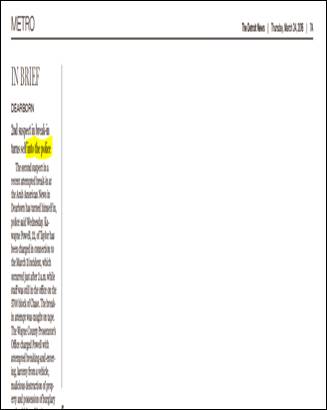
I have several entries from Robert Trescott, whose local paper seems to be in need of a copyeditor.

Kara Church

Technical Editor, Advisory

Symitar Documentation Services

Posted by: Jack Henry | June 14, 2016

Editor’s Corner: Fliers vs. Flyers

The other day, I was sending an email to some writers I call “frequent fliers” because they often use our editing services (and we love our frequent fliers). Of course, when I went to type fliers, I got a little confused and sidetracked, which leads me to today’s topic: fliers vs. flyers.

I wanted to make sure I wasn’t referring to people as those annoying paper handouts you find under your windshield wipers, but I wasn’t sure which flier was which. Here’s what I found.

Some sources say that in America, both people and things who fly are called fliers; they also claim that Americans refer to handbills as fliers. Okay, easy enough: always spell it with an “i”. In Britain, a flier is the person or thing who flies; the paper handbill is a flyer.

But then I read that both Americans and Brits use both spellings. Grammar Girl said that it just depends which resource you are looking at. Our preferred dictionary is Merriam-Webster, and it provides this definition:

fli·er

1: one that flies with wings (as a bird or insect) or as if with wings: such as a: fugitive b: aerialist c: aircraft d: airman

7: usually flyer a: a handbill or circular for mass distribution (as one bearing a political advertisement or the announcement of a coming sale) b: a supplementary catalog (as of a mail-order house)

Common sense says to pick which spelling you want for which, and then be consistent. Our Standards Committee says to go with Merriam-Webster. Therefore, let’s go with fliers for those of you who fly, and flyers for those paper handouts that we rarely look at as we carry them to the recycle bin.

Poster Contest
This sounds like a lovely symptom—I wonder if diabetes makes you enjoy show tunes? Thank you, Rhonda Harrison!

Kara Church

Technical Editor, Advisory

Symitar Documentation Services

Posted by: Jack Henry | June 13, 2016

Editor’s Corner: Weasel Words

Good morning to you.

I just discovered a new term: weasel words. I read about it in one of the blogs I subscribe to. Also called anonymous authority, a weasel word is a form of manipulation. It is a vague word or phrase that is intended to mislead or confuse the audience into thinking something big, important, or admirable is going on.

An everyday example is the claim retailers make in advertisements that offer “up to 50% off.” When you get to the store, you realize that very little is reduced by 50 percent. Yet, the claim is not false because it literally means that no discount will exceed 50 percent. We’ve all gotten used to it, but it is deceiving.

The article also discussed words like resistance fighters or freedom fighters to refer to people that many would call terrorists.

The term weasel words first appeared in a short story called “Stained Glass Political Platform,” written by Stewart Chaplin in 1900. He referred to weasel words as “words that suck the life out of the words next to them, just as a weasel sucks the egg and leaves the shell."

We’ve heard many weasel words during recent presidential campaigns, and we are bound to hear many more in the coming months. Keep your ears and eyes open!

If you’d like to read more about weasel words, click here.

Donna Bradley Burcher | Senior Technical Editor | Symitar®

8985 Balboa Ave. | San Diego, CA 92123 | Ph. 619.278.0432 | Ext: 765432

Posted by: Jack Henry | June 10, 2016

Editor’s Corner: To Be- or Not to Be-

Last month, one of our beloved readers, Steve Jones, sent us an email beseeching us to write about the prefix be-.

Steve noted that some be- words can lose their prefix without changing their meaning (like beloved/loved and bedazzled/dazzled), while others cannot (like bemused and betrothed).

I was befuddled. I hadn’t considered this bewildering word behavior, so I went to my dictionary.

The prefix be- has a long history. It is probably related to the Old High German word b (meaning near), which survives as the Modern English word by.

Over the centuries, be- has picked up a variety of meanings. Merriam-Webster lists seven, including:

  • to a great or greater degree : thoroughly <befuddle>
  • make : cause to be : treat as <belittle> <befriend>

Steve is right that beloved and bedazzled mean essentially the same thing as loved and dazzled. In these words, be- is an intensifier; it indicates that the loving and dazzling are happening "to a great degree." Consider the following definitions (emphasis mine):

  • beloved: dearly loved
  • bedazzle: to impress forcefully

In words like befriend and belittle, be- indicates causation, not intensity. When you befriend someone, you cause someone to be a friend. When you belittle someone, you cause someone to be little (or, at least, to feel little).

Bemused is this kind of word, too. When something bemuses you, it causes you to be in a muse (a state of deep thought or dreamy abstraction).

You can "behead" (remove the be- from) befriend, belittle, and bemuse, but you change the meaning (and the part of speech). Although friend, little, and muse are words on their own, they are not usually transitive verbs. You cannot little someone or muse someone (but you can now friend someone on social media).

Not to belabor the point, but thanks again to Steve for suggesting this bewitching topic. We encourage all our readers to keep the language questions coming.

Ben Ritter | Technical Editor | Symitar
8985 Balboa Avenue | San Diego, CA 92123
619-682-3391 | or ext. 763391 | www.Symitar.com

Symitar Documentation Services

NOTICE: This electronic mail message and any files transmitted with it are intended
exclusively for the individual or entity to which it is addressed. The message,
together with any attachment, may contain confidential and/or privileged information.
Any unauthorized review, use, printing, saving, copying, disclosure or distribution
is strictly prohibited. If you have received this message in error, please
immediately advise the sender by reply email and delete all copies.

Posted by: Jack Henry | June 9, 2016

Editor’s Corner: Get it girl!

Get It, Girl!

My apologies for the length of this email, but this is a topic many of you have asked about and commented on, so I want to be thorough. I did a little bit of nipping and tucking, but it’s still a long article. The consideration is whether get and got are proper English. (For the fuller piece, see Grammar Girl.)

No style guide I checked bans the use of “get.” In fact, most authorities laud how useful the word is. The New Fowler’s Modern English Usage provides a list of “natural uses in which it passes virtually unnoticed:

· get a job

· get my book for me

· get rich

· get one’s feet wet

· flattery will get you nowhere

· get going

· get the upper hand, etc.”

A search for “get” on Dictionary.com yields one group of meanings that is 63 items long. You can even use “get” instead of “be” in passive constructions if you want to put more emphasis on who did the action. [KC – Symitar Editing would call you out on this!] The American Heritage Dictionary compares these two sentences: “The demonstrators were arrested” and “The demonstrators got arrested”. In the first sentence, using the verb “to be” implies that the police were the driving force behind the arrest. In the second sentence, using the verb “to get” places more emphasis on the demonstrators themselves.

Tenses of “Get”

Now let’s get to the question of tense. “Get” and “gets” are the present-tense forms of “to get,” as in “She gets mad at herself when she’s late.” The past tense is “got,” as in “She got mad.”

Now comes the tricky part: we have two choices when it comes to the past participle. A past participle is a word like “broken” in this sentence: “She has broken her wrist twice.” If you speak American English, you will use “gotten” as the past participle, as in “He has gotten the same gift three years in a row.” Users of British English, on the other hand, will say “got”: “He has got the same gift three years in a row.”

When You Might Choose Another Word Instead of “Get”

As we’ve already said, “get” is normal English, and there’s no need to substitute another word for it. However, if you’re writing a very formal paper, or know that someone in your audience will object to the word “get” for some reason, you can use more formal words such as “receive,” “purchase,” and “obtain.” It’s up to you to decide when to be formal.

“Have Got”

Many listeners have been wondering if the phrase “have got” is acceptable English. Well, you have got to check out our previous episode on that topic. It’ll tell you that the answer is yes, you can use this expression, though it is considered informal.

Non-Standard Uses

Before we get going, you should get up to speed on which expressions are considered non-standard. Some colloquial or informal uses of “get” and “got” are controversial, and you wouldn’t want to write them unless you’re writing a character who speaks slang. For example, it would not be Standard English to say, “You got to try this” if you mean “You must try this” or “You have got to try this.” “You got to try this” would be acceptable only if you mean “You had the opportunity to try this.” Still, you will hear people use “got” in this manner.

Another common use of “got” that is not technically grammatically correct is the advertising slogan “Got milk?” Nevertheless, you’ll still hear takeoffs of this expression. At a recent dentist appointment, I saw a shirt that read “Got braces?”

Thus is the unholy power of advertising.

Summary

In this episode, we got friendly with the useful word “get.” You get to use it whenever you want, unless you must conform to formality.

Kara Church

Technical Editor, Advisory

619-542-6773 | Ext: 766773

Symitar Documentation Services

NOTICE: This electronic mail message and any files transmitted with it are intended
exclusively for the individual or entity to which it is addressed. The message,
together with any attachment, may contain confidential and/or privileged information.
Any unauthorized review, use, printing, saving, copying, disclosure or distribution
is strictly prohibited. If you have received this message in error, please
immediately advise the sender by reply email and delete all copies.


Posted by: Jack Henry | June 8, 2016

Editor’s Corner: Episys Terms

Dear Editrix,

Have we retired the term RepGen or is it still acceptable to use? How about PowerOn? Is it okay to refer to a PowerOn or PowerOns?

Sincerely,

Curious in Colorado

Dear Curious,

For the love of humanity, no! RepGen is not acceptable. Using RepGen in front of an editor is punishable with 20 lashes and a stay in our grammar dungeon. We have been trying to get people to stop using that term for specfiles for as long as I can remember.

Similarly, referring to a specfile or specfiles as a PowerOn or PowerOns is also verboten, forbidden, incorrect, and not acceptable. PowerOn is not a noun, so please don’t use it that way.

PowerOn is the name of a work area in Episys. PowerOn can be used as an adjective to describe a noun, as follows:

· Write a PowerOn specfile to generate a report of gold members with January birthdays.

· Navigate to the PowerOn toolbar and click the New icon.

· JHA Banking has a delightful new PowerOn solution to offer customers.

Thank you, and know that punishment awaits the disobedient!

Kara Church

Technical Editor, Advisory

619-542-6773 | Ext: 766773

Symitar Documentation Services

NOTICE: This electronic mail message and any files transmitted with it are intended
exclusively for the individual or entity to which it is addressed. The message,
together with any attachment, may contain confidential and/or privileged information.
Any unauthorized review, use, printing, saving, copying, disclosure or distribution
is strictly prohibited. If you have received this message in error, please
immediately advise the sender by reply email and delete all copies.
Posted by: Jack Henry | June 7, 2016

Editor’s Corner: Salt

Today I have some idioms for you related to salt. “Why,” you ask, “would you provide us with idioms and definitions related to salt?” “Well,” I might answer, “because I like salt.” I might also mention that a friend of mine sent me this link and I found it interesting and worth sharing. Thanks, Kat!

From The Free Dictionary:

· above the salt

Of or in a position of high standing, rank, regard, or repute. The term is derived from the social hierarchy of nobility in medieval times, in which salt, a precious commodity then, was set in the middle of the dining table. Those of high noble rank were seated "above the salt," that is, closer to the lord and lady of the house, while those in lower social standing were seated "below" it.

· covenant of salt

1. An agreement or union between two or more parties meant to be binding and long lasting. An allusion to such a covenant mentioned in the Bible (especially in II Chronicles 13:15), which is itself a reference to salt’s function as a preservative.

2. A traditional ceremony of marriage, in which each person exchanges a pinch of salt into a single receptacle, symbolizing an eternal and binding union.

· pound salt

To engage in pointless, menial efforts or labor. Used as an imperative to express disdain, contempt, or dismissal. A variant of the more common expression "pound sand.”

· throw salt on someone’s game

To mess up someone’s plans.

Photo Contest

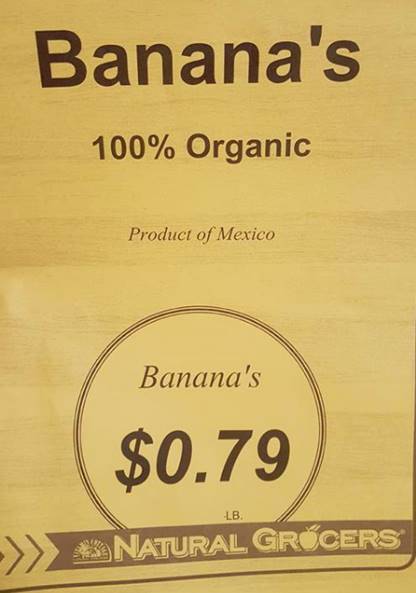
Today’s photo is from Tiffany Lumley. She and I both appreciate the organic bananas, but the misused apostrophes are not our favorites.

Kara Church

Technical Editor, Advisory

Symitar Documentation Services

Posted by: Jack Henry | June 6, 2016

Editor’s Corner: Chip In

Good morning. I have something light-hearted for you today.

Recently I wanted to buy something for a friend and someone offered to chip in some money. And, like I tend to do, I started thinking about the term chip in. I couldn’t find much information about the etymology, but I found out that the first known use of the term was in 1861. And I found out that the primary meaning of the term here in the United States is different than it is in the United Kingdom.

In the United States, we typically use the term to mean “to contribute a small amount of money to a fund that will be used to buy something.” For example, “Yes, I’ll chip in $10.00 to buy a birthday gift for Michelle.”

In the United Kingdom, they primarily use it to mean “to interrupt a conversation in order to say something.” For example, “While we’re in the meeting, please chip in with your opinion.”

I like to be diverse in my usage of idioms; so, I’d like to invite you all to chip in with your feedback about this article and then chip in to my retirement fund. Thank you!

Donna Bradley Burcher | Senior Technical Editor | Symitar®

8985 Balboa Ave. | San Diego, CA 92123 | Ph. 619.278.0432 | Extension: 765432

Symitar Technical Publications Writing and Editing Requests

NOTICE: This electronic mail message and any files transmitted with it are intended
exclusively for the individual or entity to which it is addressed. The message,
together with any attachment, may contain confidential and/or privileged information.
Any unauthorized review, use, printing, saving, copying, disclosure or distribution
is strictly prohibited. If you have received this message in error, please
immediately advise the sender by reply email and delete all copies.

« Newer Posts - Older Posts »

Categories