Posted by: Jack Henry | November 4, 2016

Editor’s Corner: Pound

My fabulous coworker Donna and I were chatting the other day about the local animal shelters and our own “pound puppies.” The second I said pound, I asked myself (since Donna was no longer listening to me), “I wonder why it’s called the pound?” Days later, Ben saw the note I wrote to myself and he said he had a guess. “I bet it’s related to the word impounded.” What a smart man our dear Ben is. He was on the right track, but pound actually came before impound. Here’s what I discovered:

From Wikipedia:

An animal pound was a place where stray livestock such as pigs were impounded in a dedicated enclosure until claimed by their owners or sold to cover the costs of impounding. The terms pinfold and pound are Saxon in origin. Pundfald and pund both mean an enclosure. There appears to be no difference between a pinfold and a village pound. The term pinfold seems to be more popular in the north and east of England, whilst in the south and west the term pound is more popular.

The village pound was a feature of most English medieval villages, and they were also found in the English colonies of North America and in Ireland.

A high-walled and lockable structure served several purposes; the most common use was to hold stray sheep, pigs, and cattle until they were claimed by the owners, usually for the payment of a fine or levy. Early pounds had just briar hedges, but most were built in stone or brick, making them more stock-proof.

From my friends at the Online Etymology Dictionary:

· pound: "enclosed place for animals," late 14c., from a late Old English word attested in compounds (such as pundfald "penfold, pound"), related to pyndan "to dam up, enclose (water)," and thus from the same root as pond. Ultimate origin unknown; some sources indicate a possible root *bend meaning "protruding point" found only in Celtic and Germanic.

· pond: c. 1300 (mid-13c. in compounds), "artificially banked body of water," variant of pound "enclosed place.” Applied locally to natural pools and small lakes from late 15c. Jocular reference to "the Atlantic Ocean" dates from 1640s.

· impound (v.): early 15c., "to shut up in a pen or pound," from assimilated form of in- "into, in" (see in-) + pound (n.). Originally of cattle seized by law.

The town pound of Glocester, Rhode Island, c. 1748

Kara Church

Technical Editor, Advisory

Symitar Documentation Services

Posted by: Jack Henry | November 2, 2016

Editor’s Corner: Awhile vs A While

Here’s a set of words I get mixed up all of the time: a while and awhile. I think I even wrote an article on this years ago, but until I found this information in the Grammarist, I could never remember when to use two words or one.

Awhile vs. A While

Awhileis an adverb meaning for a while, and it only works where it would bear replacement with that three-word phrase. Where for a while wouldn’t work in its place, it is probably not an adverb, so it should be two words: a while.

For instance, in the sentence, “Guests waited awhile for food,” awhile is one word because it is an adverb modifying the verb waited (note also that for a while would work in its place). In the sentences, “We have a while left to wait,” and, “I saw her a while ago,” a while is two words because while functions as a noun.

Awhile has existed in various spellings since the days of Old English, but there is a mistaken belief among some English speakers that the word is a new form and thus questionable. That’s why it is so often unnecessarily rendered as two words. And in fact, if you are not comfortable with the word and are unsure if you’re using it correctly, making it two words is always safe because no one will consider it wrong. But careful writers who understand where to deploy the adverbial awhile need not fear it.

Examples

· But if they give him The Tonight Show back, maybe it ends up all right after a while. [Hollywood.com]

· Starlings foray across the land and rest awhile on the sunlit twigs of ash. [Guardian]

· After a while, Rawls came in to let another set of children have a chance. [Washington
Post
]

· Crazy Horse watched this awhile and then rode down the river where some men were going out to repair the talking wires. [Crazy
Horse: The Strange Man of the Oglalas
]

· We’ve been talking for a while when Baroness Campbell of Surbiton suddenly cuts to the chase, and leaves me speechless. [Telegraph]

· Beyond the bar, soft white leather booths beckon you to sit, take off your coat and stay awhile. [In
Arkansas
]

Kara Church

Technical Editor, Advisory

619-542-6773 | Ext: 766773

Symitar Documentation Services

NOTICE: This electronic mail message and any files transmitted with it are intended
exclusively for the individual or entity to which it is addressed. The message,
together with any attachment, may contain confidential and/or privileged information.
Any unauthorized review, use, printing, saving, copying, disclosure or distribution
is strictly prohibited. If you have received this message in error, please
immediately advise the sender by reply email and delete all copies.

Posted by: Jack Henry | November 2, 2016

Editor’s Corner: Mancy-Pants

I missed Halloween and El Dia de los Muertos, but I guess this is better late than never. Today, I have some words for you from page 600 of I Never Knew There Was a Word for It, by Adam Jacot de Boinod.

· onychomancy (1651) fortune-telling using reflected light on oiled fingernails

· pessomancy (1727) divination by throwing pebbles

· belomancy (1646) divination using arrows marked with symbols or questions, guidance being sought by firing the arrows or drawing them at random from a bag or quiver

· planchette (French 1920s) a small, heart-shaped board on casters with a pencil attached; when participants in a séance touched it lightly the planchette allegedly wrote messages from the dead

And let’s throw necromancy in there just for fun! From Merriam-Webster:

a (1) : the art or practice of magically revealing the future, of magically influencing the course of natural events, or of magically attaining other purposes especially through communication with and the intervention of the dead (2) : the art or practice of magically conjuring up the souls of the dead b : magic in general especially when directed toward the attainment of evil purposes : witchcraft, sorcery

planchettes

Kara Church

Technical Editor, Advisory

Symitar Documentation Services

Posted by: Jack Henry | November 1, 2016

Editor’s Corner: Long Words

I know, we spend a lot of time telling you to use basic English to get your ideas across in a technical environment. Today, however, I have a list of longer, fancier, unusual words for you from Tom Sterns (at GrammarBook.com). I know there are a lot of creative writers and word lovers out there in the audience. This one’s for you!

Pareidolia You know how every so often you read about people who see Jesus Christ in a tree trunk? Or some woman in Ohio who keeps a swirl of moldy Cheez Whiz in a vault because she sees the visage of Elvis? That’s pareidolia: the phenomenon of finding the familiar in an improbable place.

Misology This is a word for our times. It means hatred of reason, logic, enlightenment. People who oppose higher learning and progress used to be dismissed as fools. Now a potential voter’s misology is something many politicians pander to.

Billingsgate Foul or abusive language. It derives from a rowdy fish market in seventeenth century London. It’s innocuous-sounding and obscure enough to work to your advantage if you’re ever sitting with your family near a foul-mouthed sot who won’t shut up. “Please, dude, go easy on the billingsgate, huh?” OK, that probably wouldn’t work, but you tried, and let’s hope it sounded mild enough to avoid a drubbing.

Prelapsarian If you describe a garden as prelapsarian, you’re praising its unspoiled loveliness, not criticizing it for being dated or out of fashion. We get this word from theology. It’s meant to evoke the state of innocence before the Fall of Man.

Paraprosdokian One or more sentences that end in an unexpected way. Here’s a fine example: “The car stopped on a dime—which unfortunately was in a pedestrian’s pocket.” Bet you never saw that coming. (Neither did the pedestrian.)

Orthoepy It’s supposed to be or-THO-a-pee, and by telling you that, I sort of defined the word: it’s the study of proper pronunciation.

Callipygian Here’s a strikingly euphonious alternative to leering-frat-boy language. It means “having shapely buttocks.” I think I prefer it to badonkadonk.

And here’s a fantastic photo from Frank W., via Facebook. It’s about time someone trained us to act like the 16th century Welsh and English!

Kara Church

Technical Editor, Advisory

Symitar Documentation Services

Posted by: Jack Henry | October 31, 2016

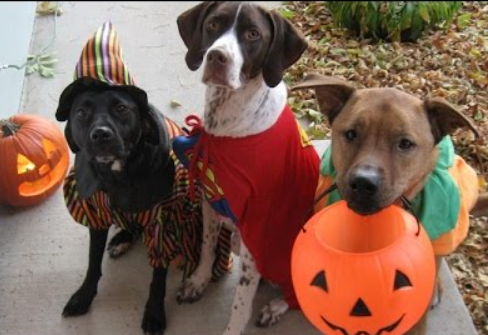
Editor’s Corner: Happy Hallowe’en

My friend, Kara, is always thinking ahead, and last week, she suggested that I might want to dedicate today’s Editor’s Corner to the topic of Halloween. Since we focus on grammar, not haunts and ghouls, I’ll concentrate on a spelling- and punctuation-related issue.

Did you know that until the end of the 18th century, Halloween was spelled Hallow-E’en, Hallow E’en, or Hallowe’en? The Online Etymology Dictionary has this entry:

…the word and the magical lore about the date were popularized by [Robert] Burns’ poem (1785, and he attached a footnote explaining it), but it probably dates to 17c. in Scotland and is attested as the name of a tune in 1724. The tune is mentioned again in an English-Scots songbook ("The Chearful Companion") in 1783, and Burns was not the first to describe the customs in print.

Hallow-E’en, or Holy Eve, is the evening previous to the celebration of All Saints. That it is propitious to the rites of divination, is an opinion still common in many parts of Scotland. [John Main, footnote to his poem "Hallow-E’en," Glasgow, 1783]

Hallow is a noun that means holy person or saint. E’en is a shortening of the noun even, and it means the end of the day or evening, which we have shortened even further to eve. We use eve to designate celebrations that take place in the evening of the day before another holiday.

Halloween takes place on the night before All Saints’ Day, also known as All Hallows’ Day (November 1). And, therefore, Halloween is also sometimes referred to All Saints’ Eve or as All Hallows’ Eve.

If you want to know where the dressing up and begging for candy comes from, Wikipedia has an interesting article. You may not be surprised to learn that it’s another delicious idea that we got from our British forebears.

Donna Bradley Burcher | Senior Technical Editor | Symitar®

8985 Balboa Ave. | San Diego, CA 92123 | Ph. 619.278.0432 | Ext: 765432

Posted by: Jack Henry | October 28, 2016

Editor’s Corner: Gaslighting

Some days I come up with ideas for Editor’s Corner based on an article I read or a conversation I have with someone. Other times, I hear it is “Talk Like a Pirate Day,” or I see that a certain holiday is coming up, and I want to tie in our lessons with that. Today’s fodder is just based on an odd occurrence. I was reading an advice column and the advisor told the writer he was being gaslighted. I wasn’t that interested in his problem to start with, so I just skipped to the next letter and then decided I’d had enough of other peoples’ problems.

Fast forward an hour or two, and I opened one of my grammar emails. At the top of the email was the term gaslighting. Well, if that wasn’t a message from beyond to include this in Editor’s Corner, I don’t know what is. So, without further ado, I have the following article from The Grammarist.

Gaslighting

Gaslighting is the process by which a person manipulates another person into doubting his own sanity. For instance, an employee might ask a boss why he gave a plum assignment to a colleague who is less talented or competent than herself. Instead of giving a rational explanation, the boss counters by telling the employee that she’s too sensitive. This is a form of gaslighting.

Another gaslighting example is a parent who accidentally steps on his child’s foot. When the child cries, instead of apologizing and comforting the child, the parent trivializes that child’s pain.

Gaslighting can be insidious as individual examples of manipulation may seem inconsequential, but the effect is cumulative. The victim of gaslighting begins to second-guess himself, to not trust his own perceptions, to doubt his memory and finally, his sanity.

The term gaslighting is derived from the 1938 play Gas Light, written by Patrick Hamilton. In the play, a woman is nearly driven mad by her manipulative husband who is after her inherited jewels. One of the ways in which the husband makes his wife doubt her sanity is to deny that the gas-powered lighting occasionally dims, though in truth, it does. The popular play was adapted into two movies; Ingrid Bergman won an academy award for her portrayal of the harried wife in the American version, Gaslight. The verb form is gaslight; related words are gaslights and gaslighted. Note that the term is now rendered as one word.

Kara Church

Technical Editor, Advisory

619-542-6773 | Ext: 766773

Symitar Documentation Services

NOTICE: This electronic mail message and any files transmitted with it are intended
exclusively for the individual or entity to which it is addressed. The message,
together with any attachment, may contain confidential and/or privileged information.
Any unauthorized review, use, printing, saving, copying, disclosure or distribution
is strictly prohibited. If you have received this message in error, please
immediately advise the sender by reply email and delete all copies.

Posted by: Jack Henry | October 27, 2016

Editor’s Corner: Fossil Words, Part 2

Fossil words are words that are not widely used outside of one or two well-known phrases. For example, the word ado has been fossilized in the phrases "without further ado" and "much ado about nothing."

Here are 14 more fossil words, along with the phrases in which you can still find them. The definitions are from Merriam-Webster.

· amok: in an undisciplined, uncontrolled, or faulty manner ("run amok")

· bate: reduce the force or intensity of ("bated breath")

· beck: summons, bidding ("beck and call")

· bygone: gone by; past ("let bygones be bygones")

· craw: the stomach ("stick in one’s craw")

· desert: deserved reward or punishment ("just deserts")

· dint: force, power ("by dint of")

· eke: to get with great difficulty ("eke out")

· fro: back, away ("to and fro")

· hale: retaining exceptional health and vigor ("hale and hearty")

· hither: to this place ("hither and yon")

· immemorial: extending or existing since beyond the reach of memory, record, or tradition ("time immemorial")

· jetsam: the part of a ship, its equipment, or its cargo that is cast overboard to lighten the load in time of distress and that sinks or is washed ashore ("flotsam and jetsam")

· ken: the range of perception, understanding, or knowledge ("beyond one’s ken")

Bonus Spelling Tips

The phrases "bated breath" and "just deserts" trip up many spellers who mistake the fossil words bated and deserts for the more common homophones baited and desserts. Here are some tips to help you remember the correct spellings.

Bate is a shortened form of the verb abate (meaning "to reduce in intensity"). When you’re excited, you might reduce the intensity of your breathing.

Tip: Think of "abated breath," and then drop the a.

Desert (in the sense of "just deserts") and deserve come from the same Anglo-French word: deserver.

Tip: A just desert is deserved.

In my next post, I’ll list 13 more fossil words and warn you about two more common spelling traps. I know you’ll be waiting with bated breath.

Ben Ritter | Technical Editor | Symitar®
8985 Balboa Avenue | San Diego, CA 92123
619-682-3391 | or ext. 763391 | www.Symitar.com

Symitar Documentation Services

NOTICE: This electronic mail message and any files transmitted with it are intended
exclusively for the individual or entity to which it is addressed. The message,
together with any attachment, may contain confidential and/or privileged information.
Any unauthorized review, use, printing, saving, copying, disclosure or distribution
is strictly prohibited. If you have received this message in error, please
immediately advise the sender by reply email and delete all copies.

Posted by: Jack Henry | October 26, 2016

Editor’s Corner: Denouement and Noose

Today I have two etymologically related words for you from Words of a Feather: A Humorous Puzzlement of Etymological Pairs, by Murray Suid. It may seem a bit grim, but I’m just trying to get you in the mood for Halloween.

Denouement and Noose

Noose sounds like the sort of word that grew up in the Old West, a dusty term suited to frontier justice.

Denouement, on the other hand, has a wonderfully sophisticated feel about it, especially if—like the French—you pronounce the final syllable nasally. If you’re not confident about your pronunciation, try pinching your nose shut as you say the word while imagining yourself chatting with the literati at the Algonquin Hotel, circa 1920.

Yet strange as it seems, the two words are closely related. Noose comes not from the American West but the south of France. It derives from Old Provincial nous, “knot,” which traces back to the Latin nodus, “knot.”

Denouement comes from the same knotty root by way of the Old French desnouer, “to untie.” In other words, denouement is the place in the story where the plot is unraveled.

The word is in the long tradition of fiber-based literary expressions. The most memorable example is clue, from the Old English cleowen, “ball of yarn,” an allusion to the story of Theseus, a Greek hero who escaped from the Labyrinth by following a long thread. The same idea is contained in the nineteenth-century sailors’ phrase “spinning a yarn.”

The complex etymology you just read may itself seem like a yarn. But why shouldn’t truth be stranger than fiction? “Fiction, after all,” explained Mark Twain, “has to make sense.”

Kara Church

Technical Editor, Advisory

Symitar Documentation Services

Posted by: Jack Henry | October 25, 2016

Editor’s Corner: Coroner

Last week, someone inquired about the words coronate and coroner. If the coronation of the king or queen is their “crowning,” why would it be done by the coroner, the man or woman we know as the investigator of “violent, sudden, or suspicious deaths”? Here is what I found as far as definitions and etymologies.

From the Online Etymology Dictionary:

· coroner (noun)
late 12c., from Anglo-French curuner, from Latin custos placitorum coronae, originally the title of the officer with the duty of protecting the property of the royal family, from Latin corona, literally "crown" (see crown (n.)). The duties of the office gradually narrowed and by 17c. the chief function was to determine the cause of death in cases not obviously natural.

· crown (verb)late 12c., from Old French coroner, from corone (see crown (n.)). Related: Crowned; crowning. The latter in its sense of "that makes complete" is from 1650s.

· crown (noun)
early 12c., "royal crown," from Anglo-French coroune, Old French corone (13c., Modern French couronne), from Latin corona "crown," originally "wreath, garland," related to Greek korone "anything curved, kind of crown." Old English used corona, directly from Latin.

Extended to coins bearing the imprint of a crown (early 15c.), especially the British silver 5-shilling piece. Also monetary units in Iceland, Sweden (krona), Norway, Denmark (krone), and formerly in German Empire and Austria-Hungary (krone). Meaning "top of the skull" is from c. 1300. Crown-prince is 1791, a translation of German kronprinz.

From Merriam-Webster:

· coronate (verb)
To crown. Latin coronatus, past participle of coronare to crown, from corona
First Known Use: circa 1623

Kara Church

Technical Editor, Advisory

619-542-6773 | Ext: 766773

Symitar Documentation Services

NOTICE: This electronic mail message and any files transmitted with it are intended
exclusively for the individual or entity to which it is addressed. The message,
together with any attachment, may contain confidential and/or privileged information.
Any unauthorized review, use, printing, saving, copying, disclosure or distribution
is strictly prohibited. If you have received this message in error, please
immediately advise the sender by reply email and delete all copies.

Good morning, all.

In honor of my brother’s recent retirement from the San Diego Sheriff’s Department, I have a list of terms (not all of them complimentary) for law enforcement personnel. The list and the definitions come from the Daily Writing Tips website.

20 Slang Terms for Law Enforcement Personnel

A variety of more or less colorful colloquialisms referring to police officers and similar authority figures have developed in American English, sometimes inspired by other languages. Here is a list of such terms.

1. barney: This gently derogatory term refers to Barney Fife, a bumbling small-town deputy sheriff in the classic 1960s sitcom The Andy Griffith Show.

2. bear: This term, from truckers’ slang, alludes to a style of hat worn by some law enforcement personnel—one that resembles the one worn by fire-safety icon Smokey the Bear. (See also Smokey.)

3. the boys in blue: This folksy phrase refers to the frequent use of blue as the color of a police officer’s uniform—and harks back to a time when only men could become police officers.

4. bull: a term prevalent in the first half of the twentieth century, primarily referring to railroad police but pertaining to regular police officers as well and alluding to the aggressiveness of these officials.

5. cop: A truncation of copper from British English usage, referring to someone who cops, or captures.

6. dick: A derogatory abbreviation of detective.

7. federales: Originally a Spanish term for federal police in Mexico, but jocularly used in the United States to refer to police in general.

8. the feds: A truncation of federal, referring to federal law enforcement personnel.

9. five-O: A term for police derived from the title of the television series Hawaii Five-O, about a special police unit by that name.

10. flatfoot: A reference to a police officer, with several possible origins, including the association that police who walked a beat supposedly would get the medical condition of flat feet.

11. fuzz: Originally a British English term referring to felt-covered helmets worn by London police officers, later borrowed into American English.

12. G-man: A term (derived from “government man”) from the mid-twentieth century, referring to FBI agents.

13. gendarmes: Originally a French term for rural police officers, borrowed into American English as jocular slang.

14. gumshoe: A term alluding to soft-soled shoes worn by detectives that are more comfortable than hard-soled shoes and/or enable them to follow suspects surreptitiously.

15. the heat: A reference to the pressure that law enforcement officials apply to suspects.

16. the law: A collective term for law enforcement.

17. the man: A term alluding to the imposing authority of law enforcement personnel.

18. pig: A derogatory term dating back to the 1800s that fell into disuse but was revived during the civil rights era.

19. po-po: A reduplicative term referring to police officers.

20. Smokey: A term for law enforcement personnel, derived from an association of the style of hat worn by some state troopers with the one worn by Smokey the Bear.

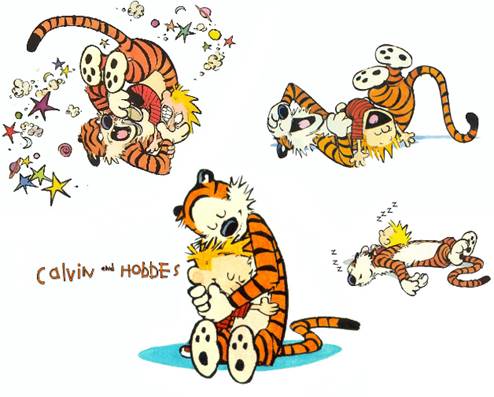
I was a kid when my brother went through the academy, and with or without my permission, he practiced his chokeholds and other submission tactics on me. You can bet I did not play the part of a cooperative perp. This Calvin and Hobbes comic kind of sums up our “practice sessions.”

Donna Bradley Burcher | Senior Technical Editor | Symitar®

8985 Balboa Ave. | San Diego, CA 92123 | Ph. 619.278.0432 | Ext: 765432

« Newer Posts - Older Posts »

Categories