On the ninth day of English
My true love gave to me
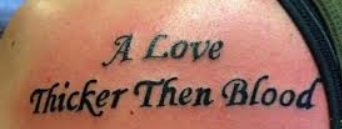
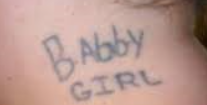
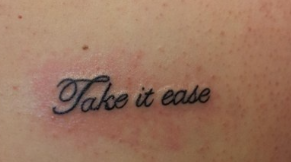
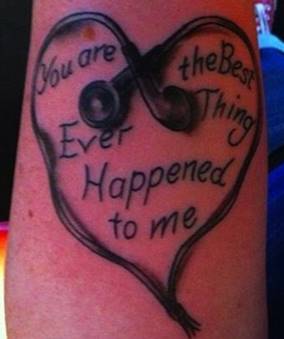
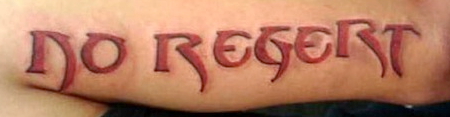
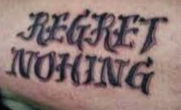
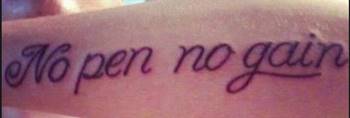
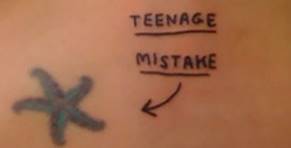
Nine tattoo failures
And a dictionary for spell-ing.

Kara Church
Technical Editor, Advisory
Symitar Documentation Services

On the ninth day of English
My true love gave to me
Nine tattoo failures
And a dictionary for spell-ing.
Kara Church
Technical Editor, Advisory
Symitar Documentation Services
On the eighth day of English
My true love gave to me
Eight phrases from the Bard
And a bit about what they mean.
From The Phrase Finder:
Quotation |
Meaning |
Origin |
A rose by any other name would smell as sweet |
What matters is what something is, not what it is called. |
Romeo and Juliet, 1600 |
All that glitters is not gold |
Not everything that is shiny and superficially attractive is valuable. |
The Merchant of Venice, 1596The original form of this phrase was ‘all that glisters is not gold’. The ‘glitters’ version long ago superseded the original and is now almost universally used. |
All of a sudden |
Suddenly |
‘All of a sudden’ sounds like the kind of poetic version of ‘suddenly’ that would do justice to Shakespeare. In fact, that’s what Shakespeare thought too, as it was he who coined the phrase in The Taming of the Shrew. |
Salad days |
The days of one’s youthful inexperience. |
Anthony and Cleopatra, 1606 CLEOPATRA: My salad days, |
Green-eyed monster |
Jealousy. |
Used in The Merchant of Venice and Othello.Green is a color associated with sickness, possibly because people’s skin sometimes takes on a slightly yellow/green tinge when they are seriously ill. Green is also the color of many unripe foods that cause stomach pains. |
I will wear my heart upon my sleeve |
Display your feelings openly, for all to see. |
From Shakespeare’s Othello, 1604: |
Makes your hair stand on end |
Something frightening. |
This is first found in Shakespeare’s Hamlet, 1602:"I could a tale unfold, whose lightest word would harrow up thy soul, freeze thy young blood, make thy two eyes, like stars, start from their spheres, thy knotted and combined locks to part and each particular hair to stand an end, like quills upon the fretful porpentine." |
Like the dickens |
A lot; as in ‘hurts like the dickens’. |
This phrase has nothing to do with Charles Dickens. Dickens is a euphemism, specifically a minced-oath, for the word devil, possibly via devilkins. Shakespeare used it in The Merry Wives of Windsor, 1600:I cannot tell what the dickens his name is my husband had him of. |
Kara Church
Technical Editor, Advisory
619-542-6773 | Ext: 766773
Symitar Documentation Services

NOTICE: This electronic mail message and any files transmitted with it are intended
exclusively for the individual or entity to which it is addressed. The message,
together with any attachment, may contain confidential and/or privileged information.
Any unauthorized review, use, printing, saving, copying, disclosure or distribution
is strictly prohibited. If you have received this message in error, please
immediately advise the sender by reply email and delete all copies.
Posted in Articles
On the seventh day of English
My true love gave to me
Seven wordy phrases that
You can change with ease.
These lovely revised phrases come from the book Comma Sutra, by Laurie Rozakis, Ph.D. (p. 224).
| Wordy | Revised |
| at this point in time | now |
| for the purpose of | for |
| in the event that | if |
| because of the fact that | because |
| due to the fact that | because |
| weather event | rain, sleet, snow, etc. |
| experience some discomfort | hurt |
Kara Church
Technical Editor, Advisory
619-542-6773 | Ext: 766773
Symitar Documentation Services

NOTICE: This electronic mail message and any files transmitted with it are intended
exclusively for the individual or entity to which it is addressed. The message,
together with any attachment, may contain confidential and/or privileged information.
Any unauthorized review, use, printing, saving, copying, disclosure or distribution
is strictly prohibited. If you have received this message in error, please
immediately advise the sender by reply email and delete all copies.
Posted in Articles
On the sixth day of English
My true love gave to me
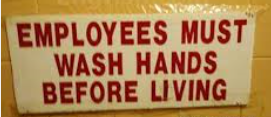
Six sad reminders to check
Facts, punctuation, and spell-ing.





Kara Church
Technical Editor, Advisory
Symitar Documentation Services

Posted in Articles
On the fifth day of English
My true love gave to me
Five rare insults
From our dictionary.
Forget the five golden rings of the song—won’t these rare insults from Merriam Webster get you into the more interesting parties this season? Or get you kicked out? Either way, you’ll have a story to tell!
1. loblolly: lout; a stupid, rude or awkward person
Loblolly was originally a British word for "a thick gruel." Riffing on this, apparently, Americans later used the word to refer to an ugly, boggy mess.
It’s unclear how the word developed its insulting sense, but perhaps the evolution was similar to the current use of words like thick and dense to mean "stupid."
2. blatherskite: a person who talks foolishly at length
It’s alteration of the Scottish compound blather skate (skate means "a contemptible person").
3. crepehanger: killjoy; someone who takes a pessimistic view of things
Black crepe fabric was once an important part of mourning ritual. It was sewn into dresses and veils, wrapped in bands around hats and arms, and draped over doors.
We can speculate that to those who started using this insult, a crepehanger was a "killjoy" almost in a literal sense—the sort of person who took pleasure in a funeral.
4. slubberdegullion: a dirty rascal; scoundrel; wretch
This seventeenth-century coinage even sounds nasty; the word’s probable history backs it up. Slubber, an English dialectal word, means "stain" or "sully," and most likely comes from an obsolete Dutch word meaning "to walk through mud or mire."
5. cacafuego: a swaggering braggart or boaster
The Cacafuego was a Spanish ship captured in 1579 by the English admiral Sir Francis Drake.
The word may have developed its insulting sense because some sailors—either the ones who lost the ship or the ones who won it—did some serious bragging.
Cacafuego, by the way, comes from the Spanish word fuego, meaning "fire," and, ultimately, the Latin cacare. [KC – I’ll let you look this up yourself so that I don’t offend the squeamish.] The word probably referred to the ship’s cannon fire.
Kara Church
Technical Editor, Advisory
619-542-6773 | Ext: 766773
Symitar Documentation Services

NOTICE: This electronic mail message and any files transmitted with it are intended
exclusively for the individual or entity to which it is addressed. The message,
together with any attachment, may contain confidential and/or privileged information.
Any unauthorized review, use, printing, saving, copying, disclosure or distribution
is strictly prohibited. If you have received this message in error, please
immediately advise the sender by reply email and delete all copies.
Posted in Articles
On the fourth day of English
My true love gave to me
Four building terms
From our dictionary.
Today’s architectural terms and photos are brought to you by Merriam-Webster.
1. balustrade: a kind of low wall that is placed at the sides of staircases, bridges, etc., and that is made of a row of short posts topped by a long rail
Both balustrade and baluster (which refers to the one of the vertical supports of a balustrade) come from the Italian word for the flower of the wild pomegranate, whose vase-like shape perhaps resembles that of some balusters.
2. corbel: an architectural member that projects from within a wall and supports a weight; especially one that is stepped upward and outward from a vertical surface (such as the supports beneath the balcony shown below)
The beaklike shape of the corbel inspired an unknown, fanciful Frenchman to give that architectural feature a name that translated from Middle French means "little raven."

3. newel: an upright post about which the steps of a circular staircase wind; or a post at the foot of a straight stairway, or one at a landing
Is a newel post the heart of a staircase? If you look at the story behind that word, you might well think so. Newel comes from the Anglo-French word nuel or noel, meaning "stone of a fruit."
4. pediment: a triangular area on the face of a building below the roof, above an entrance, etc.
There’s no connection between the impediment that means "hindrance" and the pediment that is a feature of classic architecture. This pediment is believed to trace back to the word pyramid.
The pediment shown here appears on the Supreme Court Building in Washington, D.C.
Kara Church
Technical Editor, Advisory
Symitar Documentation Services

Posted in Articles
On the third day of English
My true love gave to me
Three items he found fu-u-u-ny.
I remember when I lived in Seattle and the winter would finally break. The sun would come out and my friend Dylan would take that as a signal that it was shorts weather. Never mind that it was only 40 degrees out and he was wearing a parka up top. Well, these words and phrases from Lifehack reminded me of how differently things are defined, depending on where you are.
shorts
· In the North: a garment that is worn as soon as it is 40 degrees.
· In the South: a garment that is worn as soon as it is 70 degrees.
A big difference between the North and South is our wardrobe. In the North the first day that is warmer than 40 degrees, girls are wearing hot pants. In the South, the girls are a bit classier and hold off until it’s at least 70 to put on the daisy dukes.
Snow
· In the North: white precipitation that comes in increments of feet and might cause schools to close when there is a wind chill of -40.
· In the South: white precipitation that causes entire states to close down with a total snowfall of two inches.
Another example of geographic difference—the winter of 2013/14, the South was shut down several times when they received 1-2 inches of snow. In the North, I drove 20 miles to work in -40 degree weather, with close to a foot of snow on the ground.
“Bless your heart”
· In the North: a way of showing sincerity and appreciation.
· In the South: a way of telling someone they are an idiot.
I have heard plenty of northerners say “bless your heart” and generally it came off as a way of saying “thank you,” but in the South it basically means the opposite.
Kara Church
Technical Editor, Advisory
619-542-6773 | Ext: 766773
Symitar Documentation Services

NOTICE: This electronic mail message and any files transmitted with it are intended
exclusively for the individual or entity to which it is addressed. The message,
together with any attachment, may contain confidential and/or privileged information.
Any unauthorized review, use, printing, saving, copying, disclosure or distribution
is strictly prohibited. If you have received this message in error, please
immediately advise the sender by reply email and delete all copies.
Posted in Articles
Good morning!
You can thank Maria D. for today’s topic. Maria has a specific question about bullet points and punctuation. She wants to know whether bullet points should end in a period.
I wish I could give Maria and you a simple yes or no, but as is usually the case, there’s not a black-and-white answer to this question. I will say, however, that consistency is very important.
The rules for creating bulleted lists are laid out in the JHA Style Guide. I’ve copied the pertinent rules here for you.
Lists
Use a bulleted list for an unordered series of items. Use a numbered list for procedures or sequential items.
Avoid using single-item lists. That is, a numbered list should not have a 1 without a 2, a bulleted list should not have a single bullet, and a procedure should not have a Step 1 without a Step 2. Exceptions are allowed when necessary; for example, to retain visual continuity across multiple lists.
End each entry in a list with a period if:
· Each entry is a complete sentence.
· The entries are a mixture of fragments and sentences.
· Each entry completes the introductory sentence or fragment.
I hope that makes things a little clearer. Thanks for the suggestion, Maria!
Donna Bradley Burcher | Senior Technical Editor | Symitar®
8985 Balboa Ave. | San Diego, CA 92123 | Ph. 619.278.0432 | Extension: 765432
Symitar Technical Publications Writing and Editing Requests
NOTICE: This electronic mail message and any files transmitted with it are intended
exclusively for the individual or entity to which it is addressed. The message,
together with any attachment, may contain confidential and/or privileged information.
Any unauthorized review, use, printing, saving, copying, disclosure or distribution
is strictly prohibited. If you have received this message in error, please
immediately advise the sender by reply email and delete all copies.
Posted in Articles
Welcome to all of you new subscribers, and a hearty hello to everyone else! Particular thanks to those of you who already submitted idioms to my contest.
On the second day of English,
My true love gave to me,
Two idiomatic phrases
Coined in thi-i-is country.
From The Phrase Finder:
The natural assumption is that this phrase derives from the wearing of woolen wigs, which were fashionable for both men and women in the 16th and 17th centuries. The phrase itself is of 19th century American origin.
The ‘wig’ derivation is probably correct but there must be an element of doubt about it as the wearing of wigs had largely died out in the USA by the early 19th century. The tradition has continued in Europe where the judiciary of several countries wear wigs in court.
We use phrases all the time without really giving their meaning a great deal of thought. You may well know that dead ringer means exact duplicate, but why is that? To a non-English speaker the two terms appear to have nothing in common. So, why dead; why ringer?
…A ringer is a horse substituted for another of similar appearance in order to defraud the bookies. This word originated in the US horse-racing fraternity at the end of the 19th century. The word is defined for us in a copy of the Manitoba Free Press from October 1882:
"A horse that is taken through the country and trotted under a false name and pedigree is called a ringer."
…that’s ringer: what about dead? Dead, in the sense of lifeless, is so commonly used that we tend to ignore its other meanings. The meaning that’s relevant here is exact or precise. This is demonstrated in many phrases; dead shot, dead center, dead heat, etc.
So, dead ringer is literally the same as exact duplicate. It first came into use soon after the word ringer itself, in the US at the end of the 19th century.
Kara Church
Technical Editor, Advisory
619-542-6773 | Ext: 766773
Symitar Documentation Services

NOTICE: This electronic mail message and any files transmitted with it are intended
exclusively for the individual or entity to which it is addressed. The message,
together with any attachment, may contain confidential and/or privileged information.
Any unauthorized review, use, printing, saving, copying, disclosure or distribution
is strictly prohibited. If you have received this message in error, please
immediately advise the sender by reply email and delete all copies.
Posted in Articles
On the first day of English
My true love gave to me
A contest to keep me busy!
Yepper, it is time for another Editor’s Corner contest! Here are the details:
You can enter two different ways: by sending me the name of a new subscriber (including your own name if you don’t currently subscribe) or by sending me one of your favorite idiomatic phrases. What do I mean by an idiomatic phrase? Well, Donna gave me a great one that her dad says when she asks how he is. Daddy Bradley’s response is, “Finer than a frog hair split four ways and tied up in bow knots.” Someone else emailed me and said, “When I was knee-high to a corn cob…”
You will be entered into a drawing one time for each expression or each new subscriber you recommend. Send your entries directly to me at kchurch@jackhenry.com.
The prizes?
Since we will have a new president next year, the first prize is Richard Lederer’s book American Trivia. The second prize is your choice of t-shirt (I have couple of them with funny grammar sayings). Everyone who sends an expression my way will have it published in a future blog, unless it isn’t fit to print, so try to be nice!
Submissions are due by the 12th day of this celebration, which is actually December 23. I will announce the winners on December 27 and send your gifts then.
Good luck!
Kara Church
Technical Editor, Advisory
619-542-6773 | Ext: 766773
Symitar Documentation Services

NOTICE: This electronic mail message and any files transmitted with it are intended
exclusively for the individual or entity to which it is addressed. The message,
together with any attachment, may contain confidential and/or privileged information.
Any unauthorized review, use, printing, saving, copying, disclosure or distribution
is strictly prohibited. If you have received this message in error, please
immediately advise the sender by reply email and delete all copies.
Posted in Articles



 Editor's Corner