Posted by: Jack Henry | February 22, 2017

Editor’s Corner: Alpha, Bravo, Charlie

The other day as I was reading my car’s vehicle identification number to the insurance company over my cell phone, I came to some letters that I wanted to make clear over the static. I was okay with some of the letters, like “M as in Mike,” or “Z as in Zulu,” but when I got to U I said, “U as in, well, underwear.” He read it back to me and said, “U as in Uniform.” We both started cracking up when I said, “I guess U includes a little bit more than just the underwear.”

That got me wondering about the military alphabet. Actually, here is a better description from Military.com:

“Currently, the U.S. military uses the same phonetic alphabet adopted by NATO. More accurately, the alphabet is known as the International Radiotelephony Spelling Alphabet (IRSA).”

I thought this historical chart of the phonetics and Morse code was pretty cool, so I’ve included it for your enjoyment.

Over and out,

Kilo Alpha Romeo Alpha

Letter 1957-Present Morse Code 1913 1927 1938 World War II
A Alfa (or Alpha) . _ Able Affirmative Afirm Afirm (Able)
B Bravo _ . . . Boy Baker Baker Baker
C Charlie _ . _ . Cast Cast Cast Charlie
D Delta _ . . Dog Dog Dog Dog
E Echo . Easy Easy Easy Easy
F Foxtrot . . _ . Fox Fox Fox Fox
G Golf _ _ . George George George George
H Hotel . . . . Have Hypo Hypo How
I India . . Item Interrogatory Int Int (Item)
J Juliett . _ _ _ Jig Jig Jig Jig
K Kilo _ . _ King King King King
L Lima . _ . . Love Love Love Love
M Mike _ _ Mike Mike Mike Mike
N November _ . Nan Negative Negat Negat (Nan)
O Oscar _ _ _ Oboe Option Option Option (Oboe)
P Papa . _ _ . Pup Preparatory Prep Prep (Peter)
Q Quebec _ _ . _ Quack Quack Queen Queen
R Romeo . _ . Rush Roger Roger Roger
S Sierra . . . Sail Sail Sail Sugar
T Tango _ Tare Tare Tare Tare
U Uniform . . _ Unit Unit Unit Uncle
V Victor . . . _ Vice Vice Victor Victor
W Whiskey . _ _ Watch William William William
X X-ray _ . . _ X-ray X-ray X-ray X-ray
Y Yankee _ . _ _ Yoke Yoke Yoke Yoke
Z Zulu _ _ . . Zed Zed Zed Zebra

Kara Church

Technical Editor, Advisory

619-542-6773 | Ext: 766773

Symitar Documentation Services

NOTICE: This electronic mail message and any files transmitted with it are intended
exclusively for the individual or entity to which it is addressed. The message,
together with any attachment, may contain confidential and/or privileged information.
Any unauthorized review, use, printing, saving, copying, disclosure or distribution
is strictly prohibited. If you have received this message in error, please
immediately advise the sender by reply email and delete all copies.


Posted by: Jack Henry | February 21, 2017

French to English, Part Deux

Voila! Here is the second part of the list I’m sharing with you from DailyWritingTips. As I mentioned Friday, here’s how the list goes: first, the French word, followed by the definition we created for it in English, and then in parentheses the French definition of the word.

16. entrée: an entrance, or the main course of a meal (an entrance, or appetizers preceding a meal or before the main course)
17. épée: a specific fencing sword (a sword)
18. exposé: published material pertaining to a fraud or scandal (a report or talk)
19. hors d’oeuvre: a snack (the first course of a meal)
20. outré: unusual (exaggerated or extravagant, or outraged)
21. précis: a summary (accurate, precise; also, an abridged textbook)
22. premiere: a first performance or presentation (first)
23. recherché: obscure, pretentious (sophisticated, studied)
24. rendezvous: a clandestine meeting, or a location for an appointed meeting or reunion or a joining of two spacecraft (an appointment, date, or meeting)
25. reprise: a repetition of a piece of music during a performance (an alternate version or cover version, or rebroadcast)
26. résumé: an employment history with a list of qualifications (a summary)
27. risqué: sexually provocative (risky)
28. seance: a gathering to communicate with spirits (a meeting or session)
29. touché: acknowledgment of a point made, or of a hit in fencing (emotionally touched)
30. vignette: a brief description or scene (a small picture)

Kara Church

Technical Editor, Advisory

619-542-6773 | Ext: 766773

Symitar Documentation Services

NOTICE: This electronic mail message and any files transmitted with it are intended
exclusively for the individual or entity to which it is addressed. The message,
together with any attachment, may contain confidential and/or privileged information.
Any unauthorized review, use, printing, saving, copying, disclosure or distribution
is strictly prohibited. If you have received this message in error, please
immediately advise the sender by reply email and delete all copies.
Posted by: Jack Henry | February 17, 2017

Editor’s Corner: French to English

A few weeks ago, I came home from Mexico and shared some Spanish words we adopted into English. Today, I have some French words that we’ve adopted into English (though these weren’t inspired by any traveling on my part). Today’s half of the list is brought to us by DailyWritingTips. First, you have the word, followed by our definition in English, and then in parentheses the French definitions of the words. Ooh la la!

1. accoutrement: accompanying items or accessories (a ludicrous costume or tasteless attire)

2. après-ski: socializing after skiing (snow boots)

3. auteur: a film director or other artist who artistically dominates a creative endeavor (an author)

4. au naturel: naked (acting or looking natural, unaltered or unadulterated)

5. bête noire: someone or something avoided or disliked out of fear (someone or something hated)

6. boutique: a shop selling designer or distinctive clothing, or, as an adjective, describing a small, exclusive business (a shop)

7. boutonnière: a flower placed in a buttonhole (a buttonhole)

8. chef: a professional cook (a boss)

9. claque: a group of admirers (a group of theatergoers paid either to applaud or to criticize a performance)

10. corsage: flowers worn on a woman’s dress or around her wrist (a woman’s chest, and attire covering this area)

11. coup: a forced change of government (a hit)

12. coup de main: surprise attack (give a hand)

13. debut: a first performance by an artist or entertainer (a beginning)

14. décolletage: a low neckline, cleavage (lowering a neckline, or, in agricultural and technical contexts, cutting)

15. en masse: a group or mass moving as one entity (a collection or crowd)

Kara Church

Technical Editor, Advisory

619-542-6773 | Ext: 766773

Symitar Documentation Services

NOTICE: This electronic mail message and any files transmitted with it are intended
exclusively for the individual or entity to which it is addressed. The message,
together with any attachment, may contain confidential and/or privileged information.
Any unauthorized review, use, printing, saving, copying, disclosure or distribution
is strictly prohibited. If you have received this message in error, please
immediately advise the sender by reply email and delete all copies.

Posted by: Jack Henry | February 16, 2017

Editor’s Corner: Words Added to Merriam-Webster, Part 1

Merriam-Webster recently added some words to the dictionary. In my next few posts, I’ll talk about some of these words.

boo-hoo: to weep loudly and with sobs

face-palm: to cover one’s face with the hand as an expression of embarrassment, dismay, or exasperation

side- eye: a sidelong glance or gaze especially when expressing scorn, suspicion, disapproval, or veiled curiosity

walk back: to retreat from or distance oneself from (a previously stated opinion or position)

weak sauce: something inferior, ineffective, or unimpressive

And the word shade now includes this definition:

throw shade (US slang): to express contempt or disrespect for someone publicly especially by subtle or indirect insults or criticisms

Jackie Solano | Technical Editor | Symitar®

8985 Balboa Ave. | San Diego, CA 92123 | Ph. 619.542.6711 | Extension: 766711

Symitar Documentation Services

Posted by: Jack Henry | February 15, 2017

Editor’s Corner: Sig-Alert

If you’ve ever spent time here in Southern California, you know that we refer to the freeways as “the 5” or “the 15,” as if they were royalty. I wrote about that last year in this article The I-5. We also tend to spend a lot of time on the road and in traffic, often listening to the radio to find out which paths to avoid.

Today I’d like to talk about something that is also related to traffic and SoCal: the Sig-Alert.

When you’re driving here, you might hear something like, “A Sig-Alert is reported on the I-8 toward Yuma, due to a brush fire.” So what does it mean? Does it mean a signal? Does it stand for “Stay In Garage”? According to the California Department of Transportation, this is the official history and meaning of the Sig-Alert:

“Sig-Alerts” are unique to Southern California. They came about in the 1940s when the L.A.P.D. got in the habit of alerting a local radio reporter, Loyd Sigmon, of bad car wrecks on city streets. These notifications became known as “Sig-Alerts.” Later Mr. Sigmon developed an electronic device that authorities could use to alert the media of disasters. Caltrans latched on to the term “Sig-Alert” and it has come to be known as any traffic incident that will tie up two or more lanes of a freeway for two or more hours.

So there you have it! Now you know that you definitely don’t want to drive towards any place that is announcing a Sig-Alert.

Kara Church

Technical Editor, Advisory

619-542-6773 | Ext: 766773

Symitar Documentation Services

NOTICE: This electronic mail message and any files transmitted with it are intended
exclusively for the individual or entity to which it is addressed. The message,
together with any attachment, may contain confidential and/or privileged information.
Any unauthorized review, use, printing, saving, copying, disclosure or distribution
is strictly prohibited. If you have received this message in error, please
immediately advise the sender by reply email and delete all copies.

Posted by: Jack Henry | February 14, 2017

Editor’s Corner: Happy Valentine’s Day!

Happy Valentine’s Day, everyone!

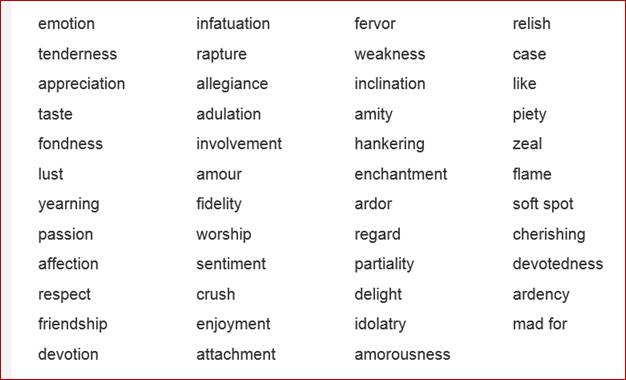
I know, I know…I probably interrupted you as you were signing a card to your sweetheart. Not to worry, I’m here to help. According to the thesaurus, here are almost fifty words that mean something similar to love and adoration. Be careful that you understand the subtleties of these synonyms so that your fifty shade of fondness and fifty shades of gray go to the right addressees!

From Thesaurus.com:

Kara Church

Technical Editor, Advisory

Symitar Documentation Services

Posted by: Jack Henry | February 13, 2017

Editor’s Corner: Words Coined by Samuel Taylor Coleridge

Good morning! Last week, I shared words coined by novelist Charles Dickens. This week I want to share words coined by another English writer, poet Samuel Taylor Coleridge (The Tale of the Ancient Mariner and Kubla Khan are two of his most famous works). Along with Walt Whitman, Coleridge founded the Romantic Movement in England in the 19th century.

I compiled this list from a Daily Writing Tips article.

· Actualize: Refers to realizing a goal

· Bisexual: Originally used to refer to androgyny

· Impact: Refers to the act of collision in a figurative sense of “the effect of one thing on another”
[dbb – Notice that this word is meant to be used to refer to a collision. If you want to discuss “producing an effect upon” or “acting on and causing a change,” the preferred term is
affect, as in “The credit union will not be affected by this change.”]

· Intensify: To make more intense or intensive; Coleridge coined this term because “render intense” did not fit the meter of a poem he was writing

· Psychosomatic: Refers to imagined maladies
[dbb – Psst! Don’t tell my sister that her symptoms could be psychosomatic. Something about that word gives her superhuman anger and extreme potty mouth…I was just trying to be helpful.]

· Relativity: Refers to the concept of one thing having a relation to another

· Selfless: Unselfish

· Soulmate: Refers to someone with whom one has a profound emotional connection (originally hyphenated)

Donna Bradley Burcher | Senior Technical Editor | Symitar®

8985 Balboa Ave. | San Diego, CA 92123 | Ph. 619.278.0432 | Extension: 765432

Symitar Technical Publications Writing and Editing Requests

NOTICE: This electronic mail message and any files transmitted with it are intended
exclusively for the individual or entity to which it is addressed. The message,
together with any attachment, may contain confidential and/or privileged information.
Any unauthorized review, use, printing, saving, copying, disclosure or distribution
is strictly prohibited. If you have received this message in error, please
immediately advise the sender by reply email and delete all copies.
Posted by: Jack Henry | February 10, 2017

Editor’s Corner: Email Subject Lines

Your subject line is the first impression you make on potential readers. A good subject line can get people to open something that they might normally skip. As a business, we would like our clients to read what we send them. In the case of SLAs and other alerts, it is sometimes crucial that they read our correspondence.

The question is, what do we do to get people to open their emails? After reading five or six articles on the subject, I’ve come up with the following do’s and don’ts. I’ve left out things like using comedy, sex, political controversy, and panicky calls to action. I’m pretty sure those would work, but we have a good reputation to consider!

DO

· Keep it short and concise. Use six to ten words, under 50 characters. Make sure that your message can be read on smart phones, laptops, tablets—whatever the reader might be using.

· Write several subject lines and use the best one.

· Focus on verbs, action-oriented words.

· Create a sense of urgency using words like “today” or “this Thursday”

· Use numbers. (For example, “Seven Reasons to Start Surfboarding.”)

· Use compelling questions, such as “Interested in Being a PowerOn Programmer?”

· Use alliteration. (For example, “Find Five Fantastic Features in Future Releases”)

· Use words that provoke enthusiasm, such as:

o Join us!

o Provide your opinion!

o Let us know what you think!

DON’T

· Use the word “newsletter,” which prevents almost 20 percent of the population from even considering opening the email.

· Stay away from all capital letters, which come across as yelling.

For more assistance with your subject lines, or just for the entertainment value, check out the Title Generator.

Kara Church

Technical Editor, Advisory

619-542-6773 | Ext: 766773

Symitar Documentation Services

NOTICE: This electronic mail message and any files transmitted with it are intended
exclusively for the individual or entity to which it is addressed. The message,
together with any attachment, may contain confidential and/or privileged information.
Any unauthorized review, use, printing, saving, copying, disclosure or distribution
is strictly prohibited. If you have received this message in error, please
immediately advise the sender by reply email and delete all copies.

Posted by: Jack Henry | February 9, 2017

Editor’s Corner: How to Describe Keys, Part 1

Letter Keys

There are (fittingly) 26 letter keys on a standard keyboard. When you are telling someone to press a letter key, describe the key using an uppercase letter in bold type (for example, “Press Y”).

Number Keys

There are 10 number keys on a standard keyboard (and 10 more on the numeric keypad). It is not usually necessary to distinguish between the keyboard and the numeric keypad. When you are telling someone to press a number key, describe the key using a numeral in bold type (for example, “Press 1”).

Tip: You do not need to say the and key in phrases like “Press the Y key” or “Press the 1 key,” but you may do so if it helps with clarity (for example, if you’re switching back and forth between keyboard and mouse input).

Modifier Keys

The modifier keys (Alt, Ctrl, and Shift) modify other keys. For example, the Shift key switches the letter keys from lowercase to uppercase. Pressing a modifier key by itself usually has no effect.

Capitalize only the first letter of the modifier keys, and abbreviate as shown:

· Alt, not ALT or Alternate

· Ctrl, not CTRL or Control

· Shift, not SHIFT

Tip: This probably matches how these keys are labeled on your keyboard.

Keyboard Shortcuts

Modifier keys are commonly used in keyboard shortcuts. For example, holding down Ctrl while pressing C copies data to the Clipboard.

When you are telling someone to use a keyboard shortcut, combine the key names with a plus sign (for example, “Press Ctrl+C”). Do not put a space before or after the plus sign.

Do not combine keyboard and mouse actions as if they were keyboard shortcuts. For example, say, “Hold down Shift and click the cell.” Do not say, “Shift+click the cell.”

Ben Ritter | Technical Editor | Symitar®
8985 Balboa Avenue | San Diego, CA 92123
619-682-3391 | or ext. 763391 | www.Symitar.com

Symitar Documentation Services

NOTICE: This electronic mail message and any files transmitted with it are intended
exclusively for the individual or entity to which it is addressed. The message,
together with any attachment, may contain confidential and/or privileged information.
Any unauthorized review, use, printing, saving, copying, disclosure or distribution
is strictly prohibited. If you have received this message in error, please
immediately advise the sender by reply email and delete all copies.

Posted by: Jack Henry | February 8, 2017

Editor’s Corner: Brass Monkey

Today we have some interesting idioms and articles about monkeys!

Idiom Meaning
One monkey don’t stop the show One setback should not impede your progress.
Not my circus, not my monkey. If the situation doesn’t really involve you, it’s wise to think about why you are considering getting involved.

Two articles on the topic of this Polish saying:

· Not my circus, not my monkeys, Huffingon Post.

· Not my circus, not my monkeys. Psychology Today

I’ll be a monkey’s uncle From Wikipedia:

The term monkey’s uncle, most notably seen in the idiom "(well) I’ll be a monkey’s uncle", is used to express complete surprise, amazement or disbelief. It can also be used to acknowledge the impossibility of a situation, in the same way that "pigs might fly" is used. An example is if one says: "I may agree that if two plus two equals five, then I am a monkey’s uncle".

"I’ll be a monkey’s uncle" has been said to date from after 1925, the date of the widely publicized Scopes Trial in the United States, where the term first appears. The Oxford English Dictionary’s earliest example is the phrase If that’s a joke I’m a monkey’s uncle, from an Ohio newspaper on 8 February 1925. It was originally a sarcastic remark made by creationists. The notion "that [people] were descended from apes was considered blasphemous…by Darwin’s contemporaries", and it was for this reason that the sarcastic phrase came into use.

Kara Church

Technical Editor, Advisory

619-542-6773 | Ext: 766773

Symitar Documentation Services

NOTICE: This electronic mail message and any files transmitted with it are intended
exclusively for the individual or entity to which it is addressed. The message,
together with any attachment, may contain confidential and/or privileged information.
Any unauthorized review, use, printing, saving, copying, disclosure or distribution
is strictly prohibited. If you have received this message in error, please
immediately advise the sender by reply email and delete all copies.

« Newer Posts - Older Posts »

Categories