Posted by: Jack Henry | July 28, 2017

Editor’s Corner: Worn-Out Words

Good morning folks! The other day I had an interesting email “conversation” with one of you about phrases and jargon that we’re increasingly tired of hearing in meetings. The next day, I received an article from one of my favorite grammar websites going over some similar items.

The following is a selection of phrases you might hear in conversations or read in email, from the GrammarBook.com website article “Worn-Out Words and Phrases: 2017 (Follow-up)”. Even though we understand what most of the phrases mean, we try to avoid idioms and jargon to present our ideas more directly and clearly. As the author of this article says, “Together, as guardians of good grammar and writing, we can lead in keeping a lush linguistic landscape free of what can sap it of its beauty and strength.”

Worn-Out Word/Phrase Alternatives
24/7 (adv) always; all of the time
absolutely (interj) yes; of course
amazing (adj) stunning, wondrous
at the end of the day (prep. phrase) in the end, ultimately
by the same token (prep. phrase) similarly
cutting-edge (adj) leading, innovative
drop(ped) the ball (verb phrase) bungle, botch, fail to follow up
from the get-go (prep. phrase) from the start, beginning
high-impact (adj) forceful, powerful, productive
holistic (adj) comprehensive, integrated
impact(ed) (v) affect(ed), influence(d)
it’s not rocket science (idiomatic clause) it’s simple, easy
a lot/too much on plate
(noun phrase)
busy, occupied, swamped (adj)
on the same page (prep. phrase) agree, concur (v)
paradigm shift (noun phrase) radical change, new belief
perfect storm (noun phrase, idiom) crisis, ordeal, quagmire
proactive (adj) diligent, motivated, thinking ahead
reach out (verb with particle) contact, connect
safe haven (tautological noun phrase) haven, refuge, sanctuary
synergy (n) teamwork, harmony, unity
think outside the box (verb phrase) be creative, think differently

Kara Church

Technical Editor, Advisory

619-542-6773 | Ext: 766773

Symitar Documentation Services

NOTICE: This electronic mail message and any files transmitted with it are intended
exclusively for the individual or entity to which it is addressed. The message,
together with any attachment, may contain confidential and/or privileged information.
Any unauthorized review, use, printing, saving, copying, disclosure or distribution
is strictly prohibited. If you have received this message in error, please
immediately advise the sender by reply email and delete all copies.

Posted by: Jack Henry | July 27, 2017

Editor’s Corner: Backronyms

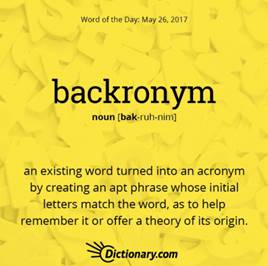
We all know about acronyms: abbreviations that are formed from the initial letters of other words and that are pronounced as a word (not as individual letters)—for example, NASA and NATO. Well, a backronym is an existing word that is turned into an acronym.

In other words, the acronym does not create a new word (like NATO), the acronym is a word we already know and use. The example Dictionary.com gives is the word rap, which is said to be a backronym of “rhythm and poetry.” Rap was already a word meaning “a quick, sharp blow” before it became the label for an entire musical genre.

We’ve all heard of the AMBER alert; it’s a backronym too. AMBER stands for America’s Missing: Broadcast Emergency Response and is named after Amber Hagerman, a child kidnapped in 1996.

Another backronym you might recognize is USA PATRIOT Act, which stands for “Uniting and Strengthening America by Providing Appropriate Tools Required to Intercept and Obstruct Terrorism Act.”

These examples show how backronyms are created purposefully, with a specific word in mind.

Of course, there are many other backronyms, and now when you hear them, you’ll know what to call them.

Donna Bradley Burcher | Senior Technical Editor | Symitar®

8985 Balboa Ave. | San Diego, CA 92123 | Ph. 619.278.0432 | Ext: 765432

Posted by: Jack Henry | July 26, 2017

Editor’s Corner: Migrants, Emigrants, and Immigrants

You’ve probably heard the word immigrant almost daily since last year’s presidential election. I’m not getting into politics, but I thought it might be interesting to look at the word immigrant, and two related words: emigrant and migrant.

Let’s start with some definitions and etymologies, from the Online Etymology Dictionary.

migrant: “one who migrates”

1670s, from Latin migrantem (nominative migrans), present participle of migrare "to remove, depart, to move from one place to another"

emigrant: "one who quits a country or region to settle in another,"
1754, from Latin emigrantem (nominative emigrans), present participle of emigrare "move away" (see emigration).

immigrant: "one who immigrates," 1792, American English, perhaps based on French immigrant, from Latin immigrantem (nominative immigrans), present participle of immigrare "to remove, go into, move in" (see immigrate). Emigrant is older. First used in English in Jeremy Belknap’s history of New Hampshire, and he generally is credited with having coined it.

And, from Daily Writing Tips, I found this interesting description about the emigrant/immigrant perspective:

The distinction between the nearly identical-sounding first two terms is that emigrant describes a person from the perspective of coming from somewhere else, and immigrant refers to someone in the context of arrival at his or her destination. Simply said, emigrants come from somewhere, and immigrants go to somewhere.

Kara Church

Technical Editor, Advisory

619-542-6773 | Ext: 766773

Symitar Documentation Services

NOTICE: This electronic mail message and any files transmitted with it are intended
exclusively for the individual or entity to which it is addressed. The message,
together with any attachment, may contain confidential and/or privileged information.
Any unauthorized review, use, printing, saving, copying, disclosure or distribution
is strictly prohibited. If you have received this message in error, please
immediately advise the sender by reply email and delete all copies.
Posted by: Jack Henry | July 25, 2017

Editor’s Corner: Happy National Hot Fudge Sundae Day

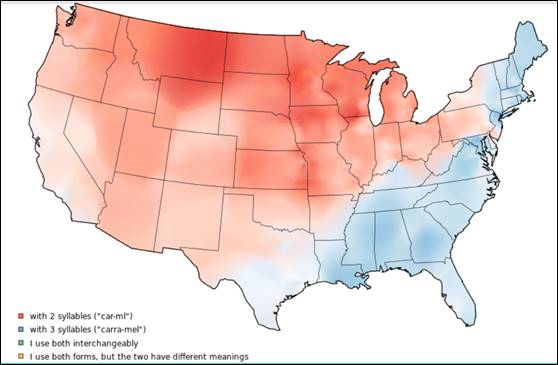
On my way to work this morning, the radio DJs were discussing National Hot Fudge Sundae Day and having a debate over the best ice cream topping. I noticed that one DJ pronounced the word caramel as CAR-MULL and another DJ pronounced it as CARE-UH-MELL.

I found caramel on this pronunciation map, which shows that the pronunciation of the word varies by state.

Here’s the etymology for caramel:

caramel (n.)

1725, from French caramel “burnt sugar” (17c.), via Old Spanish caramel (modern caramello), ultimately from Medieval Latin cannamellis, traditionally from Latin canna (see cane (n.)) + mellis, genitive of mel “honey” (see Melissa). But some give the Medieval Latin word an Arabic origin, or trace it to Latin calamus “reed, cane.”

On a side note, the word Carmel, is a geographical name and is pronounced as kär-ˈmelˈor kär-məl.

Jackie Solano | Technical Editor | Symitar®

8985 Balboa Ave. | San Diego, CA 92123 | Ph. 619.542.6711 | Extension: 766711

Symitar Documentation Services

Posted by: Jack Henry | July 24, 2017

Editor’s Corner: Indirect Questions

Today I’m going to talk to you a little about questions: specifically, indirect questions.

Most of us can identify a direct question—something we might ask a family member, a coworker, a friend, a Roman, or a countryman. For example:

· Who is coming to Joaquin’s party?

· What is the theme of this year’s autumn parade?

· Where is Julius holding today’s meeting?

· When will you be coming over to go swimming?

· Why are you being so insistent?

· How do you expect to climb this mountain wearing 5-inch heels?

Indirect questions might be described as more formal or polite, and they are missing something very distinctive: question marks. Indirect questions do not have question marks because they are not really questions; they are statements. For example:

· I wonder if Don is coming to work today.

· I asked my brother if he wanted to go paddle boarding.

· I wonder if Gobi knows he’s a dog.

· The coach asked each child what their preferred position was.

So, next time you find yourself writing something that seems a bit like a question but you aren’t sure about the punctuation, consider whether it is a direct or indirect question. Direct = question mark; indirect = period.

Kara Church

Technical Editor, Advisory

619-542-6773 | Ext: 766773

Symitar Documentation Services

NOTICE: This electronic mail message and any files transmitted with it are intended
exclusively for the individual or entity to which it is addressed. The message,
together with any attachment, may contain confidential and/or privileged information.
Any unauthorized review, use, printing, saving, copying, disclosure or distribution
is strictly prohibited. If you have received this message in error, please
immediately advise the sender by reply email and delete all copies.

Posted by: Jack Henry | July 21, 2017

Editor’s Corner: CMOS for July

Good morning! Today’s Q&A couplet is from the Chicago Manual of Style. I chose the first item because I had no idea about the niceties in funeral planning. I chose the second item because, well, it mentions hyphens and worms!

Q. Are pallbearer names and honorary pallbearer names supposed to be alphabetized by last name in a funeral service program?

A. There is no rule, but if the names are alphabetized, readers may assume that the people are equally important. If the names are out of order, readers may assume they are listed in order of honor or importance.

Q. Dear Chicago experts, can you please help resolve this hyphenation issue? Should it be “worm composting expert” or “worm-composting expert”? Should it be “worm composting master” or “worm-composting master”? Thank you very much.

A. Use a hyphen; it makes it clear that the expert or master is not a worm.

Kara Church

Technical Editor, Advisory

619-542-6773 | Ext: 766773

Symitar Documentation Services

NOTICE: This electronic mail message and any files transmitted with it are intended
exclusively for the individual or entity to which it is addressed. The message,
together with any attachment, may contain confidential and/or privileged information.
Any unauthorized review, use, printing, saving, copying, disclosure or distribution
is strictly prohibited. If you have received this message in error, please
immediately advise the sender by reply email and delete all copies.

Posted by: Jack Henry | July 20, 2017

Editor’s Corner: 10 Words to Make You Sound Wicked Smart

Today I’m sharing a list of words I found on Your Dictionary. I think you’ll recognize all the words, and you may know many or most of the definitions. You’re all such smart cookies.

First, a caveat—these are not words we typically use in our documentation or in our communication with clients because our goal is to be clear and concise, not to use the “wickedest” words we know. However, you can use these words to impress your friends and family. I plan to use them to annoy my husband and sons—they may all be bigger than I am, but who knows more words? Bam!

In case you want to test yourself, I’ve listed the words alone first. See how many you can define on your own.

· elucidate

· malaise

· non sequitur

· obfuscate

· perfunctory

· quid pro quo

· scintillating

· quintessential

· vitriol

· sycophant

Now scroll down to see the definitions and sentence examples provided by Your Dictionary.

· elucidate: to explain or make something clear (part of speech: verb)

Sentence example: Could you elucidate on that concept so that I know what you are talking about?

· malaise: physical discomfort of a general feeling or being under the weather (part of speech: noun)

Sentence example: She suffered from a malaise that kept her from enjoying the party.

· non sequitur: a statement or something that has nothing to do with a previous statement or its surroundings (part of speech: noun)

Sentence example: The comment was a real non sequitur after what had already been said.

· obfuscate: to confuse someone, or to obscure the meaning of something (part of speech: verb)

Sentence example: The teenagers used a lot of texting code to obfuscate their messages from their parents.

· perfunctory: something done without much care or attention (part of speech: adjective)

Sentence example: The customer made a perfunctory review of the sales agreement before he signed.

· quid pro quo: giving something in exchange for getting something; origin: Latin meaning "this for that" (part of speech: noun)

Sentence example: He gave her food from his garden as a quid pro quo for her cutting his hair.

· scintillating: something fascinating or brilliantly clever (part of speech: adjective)

Sentence example: She created a scintillating presentation for the meeting

· quintessential: a typical example of a particular person or characteristic. (part of speech: adjective)

Sentence example: It was the quintessential chocolate chip cookie with a chewy texture and giant chips of chocolate.

· vitriol: bitter feelings expressed in writing or speaking (part of speech: noun)

Sentence example: Their reactions to his comments were pure vitriol.

·
sycophant: a person who tries to gain attention by flattering wealthy or influential people. (part of speech: noun)

Sentence example: She became a real sycophant when she tried to convince her boss to give her a good referral.

Donna Bradley Burcher | Senior Technical Editor | Symitar®

8985 Balboa Ave. | San Diego, CA 92123 | Ph. 619.278.0432 | Extension: 765432

Symitar Technical Publications Writing and Editing Requests

NOTICE: This electronic mail message and any files transmitted with it are intended
exclusively for the individual or entity to which it is addressed. The message,
together with any attachment, may contain confidential and/or privileged information.
Any unauthorized review, use, printing, saving, copying, disclosure or distribution
is strictly prohibited. If you have received this message in error, please
immediately advise the sender by reply email and delete all copies.

Posted by: Jack Henry | July 19, 2017

Editor’s Corner: Underbar

Dear Editrix,

We were discussing the words underscore and underbar. Are they the same thing? Is one British English and one American English?

Sincerely,

Wondering About Underbars

Dear Underbar,

The underbar is wunderbar! Actually, I don’t really have an opinion on underscores or underbars, but I have a very strong opinion on underlines. Let’s have a look at Wikipedia’s definitions:

The symbol underscore [_] (also called underline, underbar, low line, or low dash) is a character that originally appeared on the typewriter and was primarily used to underline words. To produce an underlined word, the word was typed, the typewriter carriage was moved back to the beginning of the word, and the word was overtyped with the underscore character. [KC – I know this “technology” is unknown to some of you kids. A typewriter looks something like the following photo.]

The underscore … is sometimes used to create visual spacing within a sequence of characters, where a whitespace character is not permitted (e.g., in computer filenames, email addresses, and in internet URLs).

Some computer applications will automatically underline text surrounded by underscores: _underlined_ will render underlined. It is often used in plain text-only media (IRC, instant messaging, classical email) for this purpose. When the underscore is used for emphasis in this fashion, it is usually interpreted as indicating that the enclosed text is underlined (as opposed to being italicized or bold, which is indicated by /slashes/ or *asterisks*, respectively).

As far as British and American English, I couldn’t find anything that marked one word as more common than another, though Merriam-Webster did not like underbar, low dash, or low line.

When it comes to using the underscore for file names, email addresses, and URLs, go for it. When it comes to writing and trying to emphasize something? Do NOT use underlines. Use italics or bold according to the JHA Style Guide or whichever style guide you use. If you are tempted to underline something, remember that went away with the typewriter. Using underlines in this computer age is considered passé. You want to be wunderbar and au courant. Trust me!

Kara Church

Technical Editor, Advisory

Symitar Documentation Services

Posted by: Jack Henry | July 18, 2017

Editor’s Corner: Mind over Matter

This week I’m working from afar, visiting my dad who’s had some nasty health findings over the past two months. As we drove home from his ninth or tenth MRI, I asked him if they gave him a punch card where the eleventh one was free. He started telling me different jokes about his brain cancer surgery and I thought I’d look into some idioms about the mind. (Yes, we find fun where we can, even while wheeling each other through hospital hallways.)

Here are a few idioms he mentioned, plus some extras. For more, see The Free Dictionary.

· be of one mind: To be in agreement about something.

· be of two minds: To experience indecision and/or conflicting emotions.

· blow one’s mind: To surprise, shock, or amaze.

· frame of mind: A person’s outlook or mood.

· have a mind like a steel trap: To be able to think very quickly, clearly, and intelligently.

· have half a mind: If you have half a mind to tell someone something unpleasant, you are very seriously thinking about telling them. For example, I’ve half a mind to tell her to rewrite the whole report it’s so bad.

· in my mind’s eye: In one’s mind or imagination. (Alludes to visualizing something in one’s mind.)

· mind over matter:[An
instance where
there
are] intellectual powers overriding threats, difficulties, or problems. Or, thought is stronger than physical things.

· presence of mind: The ability to act sensibly, promptly, and appropriately, especially in a difficult situation or emergency.

· slip one’s mind: Be overlooked or forgotten.

Kara Church

Technical Editor, Advisory

619-542-6773 | Ext: 766773

Symitar Documentation Services

NOTICE: This electronic mail message and any files transmitted with it are intended
exclusively for the individual or entity to which it is addressed. The message,
together with any attachment, may contain confidential and/or privileged information.
Any unauthorized review, use, printing, saving, copying, disclosure or distribution
is strictly prohibited. If you have received this message in error, please
immediately advise the sender by reply email and delete all copies.

Posted by: Jack Henry | July 17, 2017

Editor’s Corner: How to Write About Panes

Panes are probably the simplest user interface element, but their simplicity is deceptive—writing about panes is tricky. Here are some tips for describing panes, and some pitfalls to avoid.

What Is a Pane?

The Microsoft Manual of Style defines panes as “the separate areas of a split or single window.” The IBM Style Guide defines pane as “a framed section of a window or web page.”

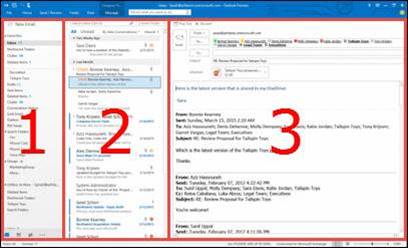
For example, in the mail area of Microsoft® Outlook®, you might see three panes:

1. The navigation pane on the left

2. The message pane in the middle

3. The preview pane on the right

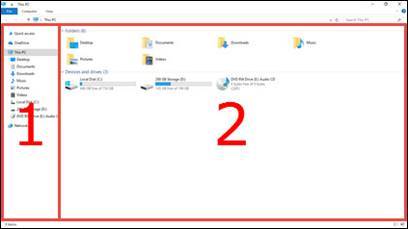
In File Explorer (formerly known as Windows® Explorer), you might see two panes:

1. The navigation pane on the left

2. The files pane on the right

How to Describe Panes

If a pane has a title that appears in the user interface, refer to it using the title (capitalized and in italics), followed by the word pane.

Example: Tracked changes appear in the Revisions pane.

Tip: Writers sometimes use the words pane and panel interchangeably, but the Microsoft Manual of Style and The IBM Style Guide both use the word pane.

If a pane does not have a title, refer to it by a descriptive name (lowercase and not italicized), followed by the word pane. Choose a name based on the pane’s contents, not its location within the window.

Example: In the preview pane, click Reply.

It can be helpful to describe a pane’s location in addition to giving it a descriptive name, but watch out! Many programs allow users to choose where panes appear. For example, in Outlook, the preview pane might appear at the bottom of the window instead of on the right side.

Tip: As always, consider the technical sophistication of your audience. For experienced Outlook users, it’s sufficient to refer to “the preview pane.” For novice users, you might say, “the preview pane, which appears on the right side of the window or at the bottom of the window.”

Ben Ritter | Technical Editor | Symitar®
8985 Balboa Avenue | San Diego, CA 92123
619-682-3391 | or ext. 763391 | www.Symitar.com

Symitar Documentation Services

NOTICE: This electronic mail message and any files transmitted with it are intended
exclusively for the individual or entity to which it is addressed. The message,
together with any attachment, may contain confidential and/or privileged information.
Any unauthorized review, use, printing, saving, copying, disclosure or distribution
is strictly prohibited. If you have received this message in error, please
immediately advise the sender by reply email and delete all copies.

« Newer Posts - Older Posts »

Categories