Posted by: Jack Henry | November 6, 2017

Editor’s Corner: A big fuss over two letters

Dear Editrix,

I know you aren’t really there for every little question everyone on earth has, but I’m a little confused. [KC – Ha ha! If you only knew!] I was writing a document this week, and Microsoft® Word suggested that “all of” was unnecessary, and that “all” was more succinct. So I changed it to “all” and then my reviewer commented that I had grammar issues in my document and sent it back for me to add the “of” back in.

I must admit, adding the “of” seems more natural to me. Could you please help me understand?

Here’s an example:

  • Our goal is to make hot air balloons available to all of JHA by the end of the year.

Of Mice and Men

Dear Of Mice and Men,

You always have the best questions! I have been wondering about the use of “of” in this case and in other cases, so let’s talk about your example today. According to some interesting information, the word “of” comes with lots of rules. For example, you always say “a couple of” something. “A couple dogs ran my way,” is incorrect. “A couple of porcupines chased me,” is correct.

And from the Cambridge website, here is some information about other times to use (or not use) “of.”

All of

We use all of before personal pronouns (us, them), demonstrative pronouns (this, that, these, those) and relative pronouns (whom, which). The personal pronoun is in the object form:

I need to speak to all of you for a few minutes.

He brought gifts for all of us.

We had to contact the insurance firm and the airline, all of which took a lot of time. (all of which = ‘contacting the insurance firm and the airline’)

With demonstratives (this, that, these, those), we can say all of or all without of:

[talking about a pile of kitchen waste]

All (of) this has to go out into the rubbish bin.

We often use of after all in definite noun phrases (i.e., before the, possessives and demonstratives), but it is not obligatory:

All (of) the workers were given a pay-rise at the end of the year.

I gave all (of) my old books to my sister when she went to university.

What shall we do with all (of) this cardboard? Throw it out?

All without of

We use all, not all of, before indefinite plural nouns referring to a whole class of people or things:

All cats love milk.

Not: All of cats love milk.

This book was written for all children, everywhere.

We use all, not all of, before uncountable nouns:

All junk food is bad for you.

Not: All of junk food is bad for you.

I love all music, not just classical.

So, after all of that, I am thinking that, in your original example, if you translate “JHA” to “employees,” you would just say: “We plan to make hot air balloons available to all employees.” You would not say: “We plan to make hot air balloons available to all of employees.”

If you translate JHA to “the company,” you would say: “We plan to make hot air balloons available to all of the company (a bit awkward).” We would not say: “We plan to make hot air balloons available to all the company.”

I guess in this case it depends what “JHA” is. Is it the people? Is it the buildings? Is it the company? Or is it an “indefinite plural noun referring to a whole class of people”? I think you could make an argument either way.

Perhaps if there is doubt, it’s time to rewrite the sentence altogether?

Kara Church

Technical Editor, Advisory

619-542-6773 | Ext: 766773

Symitar Documentation Services

NOTICE: This electronic mail message and any files transmitted with it are intended
exclusively for the individual or entity to which it is addressed. The message,
together with any attachment, may contain confidential and/or privileged information.
Any unauthorized review, use, printing, saving, copying, disclosure or distribution
is strictly prohibited. If you have received this message in error, please
immediately advise the sender by reply email and delete all copies.

Posted by: Jack Henry | November 3, 2017

Editor’s Corner: Use

Last week I sent out an article that contained a peeve of mine about the word impactful. Several of you wrote in to share your peeves with me, and asked me to put out some reminders to others about these topics. Today’s peeve is the use of the word utilize in place of use.

You may recognize this topic since we’ve written about it before. “What is wrong with the word utilize? It means use. It’s in the dictionary. What’s the problem?”

The problem is that the word use does mean the same thing, yet people ignore it and employ its more complicated counterpart utilize. Use is straightforward. It’s short. It doesn’t add syllables just to make your papers longer or more fancy. We editors like the word use. It seems most of your coworkers prefer it, too.

It seems that utilize is almost like a drug to some people. It might be okay once in a while when you have come down with something or you need a word version of NoDoz® to keep you awake. But once people start to use it, they become addicted. They tell their kids to “utilize the big fork for your entrée.” Or perhaps, they utilize dried fruit in their granola. Maybe they even utilize blue pencils for fun.

Be a pal. Choose use.

Kara Church

Technical Editor, Advisory

619-542-6773 | Ext: 766773

Symitar Documentation Services

NOTICE: This electronic mail message and any files transmitted with it are intended
exclusively for the individual or entity to which it is addressed. The message,
together with any attachment, may contain confidential and/or privileged information.
Any unauthorized review, use, printing, saving, copying, disclosure or distribution
is strictly prohibited. If you have received this message in error, please
immediately advise the sender by reply email and delete all copies.
Posted by: Jack Henry | November 2, 2017

Editor’s Corner: Accents

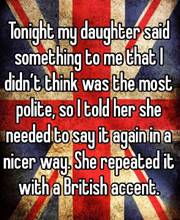
My husband was born and raised on the outskirts of London, England, and after many years in the United States, he still has a strong accent. We have many friends from different parts of the United Kingdom, and they have unique accents of their own. Even though some of the cities they come from seem relatively close to each other (by American standards), the accents are very different.

We have our own fair share of accents here in the United States. San Diegans sound different from Bostonians. People in Wisconsin sound different from people in Alabama.

As we cooked dinner the other night, my husband and I were wondering, how do accents develop?

So, I got busy researching, and I found an interesting article called “The Science of Accents,” written by Esther Inglis-Arkell, which discusses how accents evolve among different groups. Interestingly, the article states that animals have accents too: “Goats say bahhhh with different accents, depending on where they live. Gibbons sing different songs, depending on which groups they’re raised in.”

It appears that, over time, pronunciation simply deviates when groups are isolated from each other. So though the Pilgrims spoke with an English accent, as time passed, their pronunciation shifted away from their English ancestors. And as they moved about and settled in different parts of the country, their accents diverged even more.

So now we are left with a bunch of different accents all over the United States (and all over the world). Everyone has an accent except San Diegans. It’s so weird.

Donna Bradley Burcher | Senior Technical Editor | Symitar®

8985 Balboa Ave. | San Diego, CA 92123 | Ph. 619.278.0432 | Ext: 765432

Posted by: Jack Henry | November 1, 2017

Editor’s Corner: Done versus Finished

Dear Editrix,

When I was in elementary school, as children often do when completing assignments, someone would often shout out, “Teacher, I’m done.” My teacher’s response was always “How long have you been in the oven?” I never knew if she was correcting the student’s grammar or if she was being glib. It raises the question of whether the term applies only to cooking, or is it proper to use done when one is finished with a task?

Curious in Missouri

Dear Curious,

I read a lot of information about this topic, and I also remember on What Not to Wear hearing Stacy always say, “Stick a fork in me, I’m done.” I just figured her use of that (instead of finished), was a joke. Now I see that it was probably something her teacher used to say.

What I could find, overall, is that teachers used to say that “done” is for food, and “finished” is for people completing a task. But that is more “old school.” What Grammar Girl reports is this:

Done vs. Finished

When you push back from the Thanksgiving table and say, "I’m done," a cranky relative may attempt to correct you by replying, "A turkey is done; you’re finished."

Although done has been used to mean "finished" for centuries, admonitions against it started surfacing in the early 1900s. The first style guide that advised against using done to mean "finished” didn’t give a reason for the declaration, and the current Merriam-Webster Dictionary of English Usage speculates that the advice was based on bias against the usage’s "Irish, Scots, and U.S." origin.

The "rule" against done has been widely taught in schools, but no historical pattern or logic supports it, and most credible modern usage guides either don’t address it at all (e.g., AP Stylebook, Chicago Manual of Style, The Cambridge Guide to English Usage) or simply note that done and finished are interchangeable (e.g., Garner’s Modern American Usage, Merriam-Webster Dictionary of English Usage, The Columbia Guide to Standard American English).

Take that, Aunt Ruth!

Go forth, be free, and be done or finished. It’s up to you! I promise I won’t come back and nag you with jokes from your third-grade teacher about being a piece of food in the oven and “done.”

Stick a fork in me…I’m done!

Kara Church

Technical Editor, Advisory

Symitar Documentation Services

Posted by: Jack Henry | October 31, 2017

Editor’s Corner: Crackerjack and Cracker Jacks

When I was young, one of my dad’s less salty insults to other drivers was, “Where’d you get your license? A Cracker Jack box?” I supposed it was an insult when comparing someone’s driver’s license to a plastic toy or fake tattoo in a box of candy, so I figured the term crackerjack was something insulting. But recently, I read this article from The Grammarist and had a surprise.

Crackerjack is an American word that has been adopted the world over.

Crackerjack means having a quality of excellence. Crackerjack may be used as an adjective or a noun. It is a closed compound word, which is a word composed of two words that are joined without a space or hyphen between them.

The word crackerjack has its roots in the world of American horse racing in the 1880s. At that time, it was usually rendered as two words as in cracker jack to mean a top quality horse. The term migrated to other sports, and eventually, mainstream English. Today, the term is usually written as two words when referring to the American snack of candied popcorn and peanuts that comes in a box. Traditionally, Cracker Jack included a small toy trinket in each box, but the company recently replaced the toy trinket with a QR code. [KC – What a swindle! I’d rather have a fake tattoo!] Note that the term crackerjack was in use before the snack was invented in 1893.

From there, I went to the Online Etymology Dictionary and found similar information supporting The Grammarist’s article:

cracker-jack (n.)

also crackerjack, "something excellent," 1893, U.S. colloquialism, apparently a fanciful construction, earliest use in reference to racing horses. The caramel-coated popcorn-and-peanuts confection was said to have been introduced at the World’s Columbian Exposition (1893). Supposedly a salesman gave it the name when he tasted some and said, "That’s a cracker-jack," using the then-popular expression. The name was trademarked 1896. The "Prize in Every Box" was introduced 1912.

"Your brother Bob is traveling, isn’t he?"

"Yep. He’s with one of the big racing teams. I tell you, he’s a cracker-jack! Wins a bushel of diamonds and gold cups every week." ["Life," Aug. 1, 1895]

Kara Church

Technical Editor, Advisory

Symitar Documentation Services

Posted by: Jack Henry | October 30, 2017

Editor’s Corner: Graveyard

It’s been some time since we’ve had a tidbit from Grammar Girl. I couldn’t resist this topic on the words cemetery vs. graveyard, since we are celebrating Halloween tomorrow.

Cemetery is the much older word, going back to Roman times. Today, a cemetery refers to a large burial ground, typically not associated with a church.

The first citation in the Oxford English Dictionary for graveyard comes from 1767, and a graveyard is typically smaller than a cemetery and is often associated with a church. It is part of the churchyard.

Cemetery appears to be the more commonly used word today, perhaps because it’s been around longer, perhaps because people like the sound of it better, or perhaps because there are so many more people buried in cemeteries because they’re so much bigger than graveyards. It was actually the population growth in Europe that led to the creation of large cemeteries because the small churchyards could no longer hold all the dead, so I’m inclined to think their popularity as a resting place is also the reason the word it more popular.

And here’s a bonus—do you know why sailors called the late shift the “graveyard watch”? It’s not because you feel like you’re going to die, although that may be true while you’re adjusting to the odd hours. According to the Oxford English Dictionary, sailors called the shift from midnight to 4:00 a.m. the graveyard watch because of the silence and because of the number of disasters that occurred during these hours.

And from my favorite Online Etymology Dictionary, some additional information on the histories of these two words.

cemetery:

"Place set aside for burial of the dead," late 14c., from Old French cimetiere "graveyard" (12c.), from Medieval Latin cemeterium, Late Latin coemeterium, from Greek koimeterion "sleeping place, dormitory," from koiman "to put to sleep," keimai "I lie down," from PIE root *kei- (1) "to lie," also forming words for "bed, couch."

Early Christian writers were the first to use it for "burial ground," though the Greek word also had been anciently used in reference to the sleep of death. In Middle English simeterie, cymytory, cimitere, etc.; forms with cem- are from late 15c. An Old English word for "cemetery" was licburg (see lich (n.). In 19c. typically a large public burial ground not attached to a church.

graveyard:

1683, from grave (n.) + yard (n.1). Graveyard shift "late-night work" is c. 1907, from earlier nautical term, in reference to the loneliness of after-hours work.

Kara Church

Technical Editor, Advisory

619-542-6773 | Ext: 766773

Symitar Documentation Services

NOTICE: This electronic mail message and any files transmitted with it are intended
exclusively for the individual or entity to which it is addressed. The message,
together with any attachment, may contain confidential and/or privileged information.
Any unauthorized review, use, printing, saving, copying, disclosure or distribution
is strictly prohibited. If you have received this message in error, please
immediately advise the sender by reply email and delete all copies.

Posted by: Jack Henry | October 27, 2017

Editor’s Corner: Commonly Mispronounced Food Words

Have you ever stopped yourself from ordering something on a menu because you didn’t know how to pronounce it? Don’t worry, you’re not alone.

This article from Merriam Webster provides a list of some menu items that can be difficult to pronounce (like andouille and gnocchi). The list also includes audio pronunciation of each word.

I knew that a few of my favorite foodies would not be satisfied with Merriam Webster’s list because it doesn’t include a lot of other food words that are hard to pronounce, so I found another list.

Take a gander at these lists. You’ll be ordering acai bowls like a pro in no time.

Jackie Solano | Technical Editor | Symitar®

8985 Balboa Ave. | San Diego, CA 92123 | Ph. 619.542.6711 | Extension: 766711

Symitar Documentation Services

NOTICE: This electronic mail message and any files transmitted with it are intended
exclusively for the individual or entity to which it is addressed. The message,
together with any attachment, may contain confidential and/or privileged information.
Any unauthorized review, use, printing, saving, copying, disclosure or distribution
is strictly prohibited. If you have received this message in error, please
immediately advise the sender by reply email and delete all copies.

Posted by: Jack Henry | October 26, 2017

Editor’s Corner: Ghost Words

Good morning! I heard a new term (new to me, anyway) that piqued my interest: ghost words. Since Halloween is just around the corner, this seems like the perfect time to share what I learned!

My first thought was that ghost words must be something eerie, unearthly, or maybe just vague. I was a little off-track, but I think you’ll be interested in what they actually are.

Ghost words are words that are formed by error. They are misreadings, mispronunciations, typos, transcription errors, etc. They occur because someone made a mistake, and the incorrect word was entered into a dictionary or other reference (if only for a short time). Interestingly, some ghost words made it into the dictionary, stayed there, and are still used today.

One word that is mentioned repeatedly in articles about ghost words is dord. The Online Etymology Dictionary provides this description:

dord

1934, a ghost word printed in "Webster’s New International Dictionary" and defined as a noun used by physicists and chemists, meaning "density." In sorting out and separating abbreviations from words in preparing the dictionary’s second edition, a card marked "D or d" meaning "density" somehow migrated from the "abbreviations" stack to the "words" stack. The "D or d" entry ended up being typeset as a word, dord, and defined as a synonym for density. The mistake was discovered in 1939.

Following is an alphabetized list of other ghost words and a little information about each one (I found the list on the Grammar Girl website, but I shortened the lengthy descriptions so you’d have time to get your actual work done).

abacot
This word is a misprint of “bycoket,” a kind of cap or head-dress. It appeared in reference books for approximately 300 years before the error was discovered by James Murray, editor of the Oxford English Dictionary.

derring-do
Chaucer wrote “in durring don that longeth to a knight” meaning “in daring to do what is proper for a knight.” The phrase was misprinted in a later work by John Lydgate as “derrynge do,” and then taken by Edmund Spenser to mean “brave actions” or “manhood and chevalrie.” Sir Walter Scott used it in Ivanhoe in the manner of Spencer, using the spelling we use today, writing, “if there be two who can do a deed of such derring-do!”

esquivalience
This word was invented purposefully by an editor at the New Oxford American Dictionary and included in the 2001 edition to help the company track copyright violators who were lifting entries from the dictionary. If the made-up word appeared in another dictionary, it would be clear that it had been copied from the New Oxford American Dictionary.

foupe
Multiple sources say that Samuel Johnson’s 1755 dictionary had the word “foupe” when it should have been “soupe” (another word for “swoop”) because the archaic long “s” so closely resembled the letter “f.”

gravy

Gravy became a word because a 14th century translator misread a French cookbook. The word was originally spelled with an “n”: “grane” (also sometimes spelled “graine”), and it was related to the word “grain,” which meant “anything used in cooking”; but English cookbooks translated from French in the 14th century and later nearly always have a “v” or a “u” instead of the “n,” leading to the word “gravy.” Researchers believe it was simply a scribal error. If the word had been transcribed properly, we’d be having “grany” on our mashed potatoes at Thanksgiving.

Imogene
The name of the character in Shakespeare’s Cymbeline is hypothesized to be a misspelling of the name Innogen.

sane
In Middle English, “sane” was a verb that meant “to cure” or “to heal.” A work titled Middle English Word Studies: A Word and Author Index lists a 1986 paper by Lister Matheson, and summarizes it as hypothesizing that “sane” was a misreading of the verb “save” (also spelled “saue”) that came from the Latin “sanare,” which meant “to cure” or “to heal.”

syllabus

This word was crated due to a misprint in the 15th century. The Roman philosopher Cicero died in 43 BC, but his work has been read ever since. Two of his “Letters to Atticus” (one, two) have the word “sittybas” (possibly “sittubas”—sources disagree), which was a Greek word meaning “a label for a book or parchment” or “title-slip”; but one printing of this work mistakenly spelled the word as “syllabus.”

People apparently thought “syllabus” was Latin, and the spelling stuck so well that “syllabus” took on its new meaning in the mid-1600s and now even has a fake Latin plural: “syllabi.”

tweed

We got the word “tweed”—a type of wool—from a misunderstanding of the Scottish word “tweel,” which was how the Scots said “twill.” That mistake may have happened because there’s a Tweed river in Scotland, so when people heard or saw “tweel,” they thought of the Tweed River.

Donna Bradley Burcher | Senior Technical Editor | Symitar®

8985 Balboa Ave. | San Diego, CA 92123 | Ph. 619.278.0432 | Extension: 765432

Symitar Technical Publications Writing and Editing Requests

NOTICE: This electronic mail message and any files transmitted with it are intended
exclusively for the individual or entity to which it is addressed. The message,
together with any attachment, may contain confidential and/or privileged information.
Any unauthorized review, use, printing, saving, copying, disclosure or distribution
is strictly prohibited. If you have received this message in error, please
immediately advise the sender by reply email and delete all copies.
Posted by: Jack Henry | October 25, 2017

Editor’s Corner: Spelling

Today, I have a pre-Halloween spell for you…but nothing involving eyes of newt. Here is an article from Richard Lederer that might help make you appreciate the crazy spellings of English words a little bit more. Enjoy!

Must our English language remain under a spell?

Dear Richard Lederer: Why doesn’t the U.S. government do something proactively for once? Millions of people struggle to learn English. Why doesn’t the government commission a team of American English experts to recommend changes to the language to make it easier to understand, learn, teach and promulgate? For starters, all words that rhyme, like hair and dare, should be spelled the same. Second, silent letters should be totally removed for being useless. –Dane Marolt, Rancho Penasquitos

In “The Devil’s Dictionary,” Ambrose Bierce defines orthography (spelling) as “the science of spelling by the eye instead of the ear. Advocated with more heat than light by the outmates of every asylum for the insane.” “English spelling,” declares linguist Mario Pei, “is the world’s most awesome mess,” while Edward Rondthaler, the inventor of the Soundspel System, labels spelling “a sort of graphic stutter we’ve tolerated for generations.” My Haverford College classmate David Grambs adds, “Three things you can be sure of in life are death, taxes and misspelling.”

Nowhere is the chasm that stretches between phonology (the way we pronounce words) and orthography (the way we spell them) better illustrated than the demonic letter combination -ough, which can be sounded at least 10 different ways, as in bough (ow), bought (aw), cough (off), dough (oh), hiccough (up), lough (ock), thoroughbred (uh), through (oo), tough (uff) and trough (oth).

If the road to language heaven is paved with good intentions, why haven’t we Americans followed the succession of well-intentioned spelling reforms proposed by the likes of Benjamin Franklin, George Bernard Shaw, Upton Sinclair and Theodore Roosevelt? Because, as in most matters linguistic, simplified spelling is no simple matter.

For one thing, spelling reform would plunder the richness of homophones in the English language. Rain, rein and reign were once pronounced differently, but time has made them sound alike. Knight was a logical spelling in Geoffrey Chaucer’s day, when the k, n and gh were distinctly sounded. Today its pronunciation matches that of night. In John Milton’s time, colonel was spoken with all three syllables. Now it sounds the same as kernel. Thus, the bizarre spellings that the reformers would excise are actually an aid to differentiation in writing. Think, for example, of the chaos that would be wrought by spelling the same-sound antonyms raise and raze identically.

Such transformations raise the specter of losing the rich etymological history that current spelling generally preserves. We cannot deny that seyekaalogee, Wenzdae, nite and troosoe are accurate visualizations of the sounds they represent. But do we really want to banish the Greekness from psychology (from the Greek goddess Psyche), the Scandinavianness from Wednesday (from the Norse god Woden), the Old Englishness from knight and the romantic Frenchness from trousseau?

Another telling fret in the armor of simplified spelling is that even its most ardent adherents acknowledge that many words, such as skejl/skejl, are pronounced differently in the United States and the United Kingdom, necessitating divergent spellings of the same words. Moreover, when we acknowledge the existence of Irish English, Scottish English, Welsh English, Australian English, South African English. West Indian English and all the other world Englishes, we must wonder how many variant spellings we would have to live with.

In the Middle Atlantic states, whence I hail, cot and caught are sounded distinctly as kaat and kaut. In New Hampshire, to which I moved, I often heard kaat for both words. Not far to my south, many Bostonians say kaut for both words. I say gurl, in Brooklyn they say goil (as in the charmingly reversed “The oil bought some earl”), and farther south and west they say gal and gurrel. Because our present system of spelling is as much hieroglyphic as it is phonetic, speakers of English can gaze upon cot, caught and girl and pronounce the words in their richly diverse ways.

Even if our spelling were altered by edict, a feat that has never been accomplished in a predominantly literate country, pronunciation would continue to change. As the great lexicographer Samuel Johnson proclaimed more than 250 ago, “Sounds are too volatile and subtle for legal restraints; to enchain syllables and to lash the wind are equally undertakings of pride.” No surprise, then, that Johnson predicted that spelling reformers would be shaping “a model which is changing while they apply it.” The phoneticizing process of spelling reform would itself have to be reformed again and again.

Kara Church

Technical Editor, Advisory

619-542-6773 | Ext: 766773

Symitar Documentation Services

NOTICE: This electronic mail message and any files transmitted with it are intended
exclusively for the individual or entity to which it is addressed. The message,
together with any attachment, may contain confidential and/or privileged information.
Any unauthorized review, use, printing, saving, copying, disclosure or distribution
is strictly prohibited. If you have received this message in error, please
immediately advise the sender by reply email and delete all copies.

Posted by: Jack Henry | October 24, 2017

Editor’s Corner: Peeve Alert

Dear readers,

Over the years, Donna and I have written several articles about the word impactful and pleaded with you not to use it. Often it is just the word impacted that makes me cry, because growing up, only two things I ever heard of got “impacted.” One of those things was a tooth; the other thing was part of your heinie. Neither of those are things I want to think about when reading business emails or articles.

So, we edit out that word and people argue with us. Here is a little something from the Chicago Manual of Style in our defense. (The highlighting is mine, and yes, I am yelling out the highlighted words and having a hissy fit.)

Q. Is impactful a word and can it be used in place of influential?

A. Absolutely. Impactful is a word, and it is often used in place of influential. But like irregardless, ain’t, and alright (all of which are words in the dictionary), impactful is frowned upon as nonstandard English. Please see CMOS 5.250 (17th ed.), under impact; impactful: “Avoid impactful, which is jargon (replacements include influential and powerful).”

Kara Church

Technical Editor, Advisory

619-542-6773 | Ext: 766773

Symitar Documentation Services

NOTICE: This electronic mail message and any files transmitted with it are intended
exclusively for the individual or entity to which it is addressed. The message,
together with any attachment, may contain confidential and/or privileged information.
Any unauthorized review, use, printing, saving, copying, disclosure or distribution
is strictly prohibited. If you have received this message in error, please
immediately advise the sender by reply email and delete all copies.

« Newer Posts - Older Posts »

Categories