Posted by: Jack Henry | November 22, 2017

Editor’s Corner: Gravy Train

Oh, how I love Thanksgiving! Eating delicious food, enjoying the company of friends and family, and celebrating the good things in life. I was trying to find something related to Thanksgiving for the Editor’s Corner, but looking at my backlog of topics, I just didn’t run into anything appropriate. Peeves, words ending in -ade, song-related words…none of them seemed quite right.

Here’s where I ended up: gravy train. Nope, it isn’t really about that delicious brown sauce we put on our turkey and mashed potatoes, but it’s all I’ve got.

I hope you all enjoy your holiday!

From the Grammarist:

Gravy train is an idiom with its roots sometime around the turn of the twentieth century. An idiom is a figure of speech that is a word, group of words or phrase that has a figurative meaning that is not easily deduced from its literal definition. We will examine the definition of the term gravy train, where it came from and some examples of its use in sentences.

A gravy train is a job or other source of income that generates abundant money with little effort. One may be said to be riding the gravy train, in such a situation. Gravy train is an American term, dating back to the early 1900s. It is popularly believed to have originally been a railroad term, referring to a train run that paid well with little effort on the part of the crew. However, so far there have been no examples found of its use to mean a literal train. At around the same time of the appearance of the term gravy train, the word gravy came to mean something easy to accomplish or something unexpectedly beneficial. The plural form of gravy train is gravy trains.

· ‘I cut off the gravy train,’ Trump boasted during a meeting with his Cabinet, calling the payments a ‘disgrace’ because they pad the pockets of insurers instead of helping poor people. (The Daily Mail)

· High auto insurance premiums are a “boot on the throat of progress” in Detroit and the medical expenses have become “a gravy train” for business interests entangled in the business of treating injured drivers, Love said. (Crain’s Detroit Business)

· Instead of relying on a gravy train of union and corporate donations—worth over $500,000 in the last elections in 2014—they’ll have to find other ways to get voters’ attention and cash. (The Tri-City News)

Kara Church

Technical Editor, Advisory

619-542-6773 | Ext: 766773

Symitar Documentation Services

NOTICE: This electronic mail message and any files transmitted with it are intended
exclusively for the individual or entity to which it is addressed. The message,
together with any attachment, may contain confidential and/or privileged information.
Any unauthorized review, use, printing, saving, copying, disclosure or distribution
is strictly prohibited. If you have received this message in error, please
immediately advise the sender by reply email and delete all copies.


Posted by: Jack Henry | November 21, 2017

Editor’s Corner: Odd Abbreviations

Dear Editrix,

I know that the Symitar editorial staff regulates the use of our abbreviations in our software and our documentation. And I know that the editors use established abbreviations found in the various style guides that we base our standards on. But what bathtub were abbreviators drinking gin out of when they came up with the following “abbreviations” that are commonly used:

· pound = lb. (There’s no L or B in pound although when you put on too many pounds it might feel like you’re in L.)

· number = no. (They got the N right, but they were O so wrong with the rest.)

· ounce = oz. (Ignore the man behind the curtain.)

Mr. Dachshund in San Diego

Dear Mr. D,

As I responded to you personally, I figured these abbreviations were related to Latin, especially considering the Periodic Table of Elements (such as Na for sodium and Fe for iron) and how many of those abbreviations come from Latin. Here are some really interesting details about all three, especially the information about using no. for number.

From The Week:

Lb is an abbreviation of the Latin word libra. The primary meaning of libra was balance or scales (as in the astrological sign), but it also stood for the ancient Roman unit of measure libra pondo, meaning "a pound by weight." We got the word "pound" in English from the pondo part of the libra pondo but our abbreviation comes from the libra. The libra is also why the symbol for the British pound is £ — an L with a line through it.

"Ounce" is related to the Latin uncia, the name for both the Roman ounce and inch units of measurement. The word came into English from Anglo-Norman French, where it was unce or ounce, but the abbreviation was borrowed from Medieval Italian, where the word was onza.

From Wikipedia: [KC – See the link for unedited material.]

The numero sign or numero symbol, , is a typographic abbreviation of the word number(s) indicating ordinal numeration, especially in names and titles. For example, with the numero sign, the written long-form of the address "Number 22 Acacia Avenue" is shortened to "№ 22 Acacia Avenue", yet both forms are spoken long.

In English, the abbreviation "No." of "numero" is often used in place of the word "number".

Yours truly,

Editrix

Kara Church

Technical Editor, Advisory

Symitar Documentation Services

Posted by: Jack Henry | November 20, 2017

Editor’s Corner: Vocabulary Quiz

Here’s a vocabulary quiz from Daily Writing Tips, of some slang terms associated with criminal activity. Replace the slang term in the following five sentences, and then scroll down to see the correct answers and explanations.

1. The movie was about a notorious train heist that occurred in the 1960s.

2. Come on, Pete. Give me the lettuce you owe me.

3. Is this the piece he used to shoot Brokavich?

4. The perp was identified by two witnesses who were at the scene of the robbery.

5. The police were able to bust the leaders of the drug cartel by pretending to be customers.

Answers and Explanations

1.
Original: The movie was about a notorious train heist that occurred in the 1960s.
Correct: The movie was about a notorious train robbery that occurred in the 1960s.

Heist is probably a version of the standard word hoist, “to lift.” The word entered the language as a noun. A heister was a shoplifter, a person who steals things from a retail store.

2.
Original: Come on, Pete. Give me the lettuce you owe me.
Correct: Come on, Pete. Give me the money you owe me.

Both lettuce and U.S. paper currency are green.

3.
Original: Is this the piece he used to shoot Brokavich?
Correct: Is this the gun he used to shoot Brokavich?

Here’s an example of a once standard word having turned into slang. Beginning in the 16th century to refer to cannon and other large artillery, “piece” has been used to refer to gunpowder weapons. The term seems to have become slang in the 20th century.

4.
Original: The perp was identified by two witnesses who were at the scene of the robbery.
Correct: The perpetrator was identified by two witnesses who were at the scene of the robbery.
Alternative: The criminal was identified by two witnesses who were at the scene of the robbery.

Short for perpetrator, perp refers to a person who is known to have committed a crime. The word suspect is often used incorrectly in the media to refer to a known perpetrator.

5.
Original: The police were able to bust the leaders of the drug cartel by pretending to be customers.
Correct: The police were able to arrest the leaders of the drug cartel by pretending to be customers.

Bust is an altered form of burst, “to break.” In addition to its slang use to mean arrest, it’s commonly used in colloquial speech to mean break, but is still considered nonstandard in any but the most informal context.

Jackie Solano | Technical Editor | Symitar®

8985 Balboa Ave. | San Diego, CA 92123 | Ph. 619.542.6711 | Extension: 766711

Symitar Documentation Services

NOTICE: This electronic mail message and any files transmitted with it are intended
exclusively for the individual or entity to which it is addressed. The message,
together with any attachment, may contain confidential and/or privileged information.
Any unauthorized review, use, printing, saving, copying, disclosure or distribution
is strictly prohibited. If you have received this message in error, please
immediately advise the sender by reply email and delete all copies.

Posted by: Jack Henry | November 17, 2017

Editor’s Corner: More Resting Places

Hello warriors!

The other day I decided to write to you about different names for “final resting places.” At first I thought the topic might be too creepy, but my mailbox showed me otherwise. I have three more terms that several of you mentioned, along with some definitions, pictures, and etymologies.

What a great way to start the weekend!

The following definitions are from the folks at Merriam-Webster. The etymologies are from the Online Etymology Dictionary.

charnel house

· definition: a building, chamber, or other area in which bodies or bones are deposited b : a mortuary chapel

charnel (adjective)

· etymology: "common repository for dead bodies," late 14c., from Old French charnel (12c.) "fleshly," from Late Latin carnale "graveyard," properly neuter of adjective carnalis, from Latin carnis "of the flesh," genitive of caro "flesh, meat," "flesh," originally "a piece of flesh," from PIE root *sker- (1) "to cut." As an adjective from 1813. The Late Latin word was glossed in Old English as flæschus "flesh-house." Charnel house is attested from 1550s.

columbarium

· definition: a structure of vaults lined with recesses for cinerary [KC – Ash, crematory remains.] urns.

· etymology "subterranean sepulchre in ancient Roman places with niches for urns holding remains," neuter of Latin columbarius, "dove-cote" (so called from resemblance), literally "pertaining to doves;" from columba "dove." Literal sense of "dove-cote" is attested in English from 1881.

niche

· definition: a recess in a wall

· etymology 1610s, "shallow recess in a wall," from French niche "recess (for a dog), kennel" (14c.), perhaps from Italian nicchia "niche, nook," from nicchio "seashell," said by Klein and Barnhart to be probably from Latin mitulus "mussel," but the change of -m- to -n- is not explained. Watkins suggests that the word is from an Old French noun derived from nichier "to nestle, nest, build a nest," via Gallo-Roman *nidicare from Latin nidus "nest" (see nidus), but that has difficulties, too. Figurative sense is first recorded 1725. Biological use dates from 1927.

Kara Church

Technical Editor, Advisory

Symitar Documentation Services

Posted by: Jack Henry | November 16, 2017

Editor’s Corner

A couple of weeks ago I wrote a post about accents, and I got a lot of responses. Some of you mentioned your love of accents, and some of you shared how you feel about the way our language and our accents are evolving.

I got a wonderful response from Mike S. that I want to pass on because what he shared with me is both amazing and heart-warming.

My original post referenced an article called “The Science of Accents,” which states that animals have accents too: goats in different regions make different sounds, and gibbons sing different songs depending on the group they live with. But Mike let me know about a nature article, posted on 10/26/2017, in United News International (UNI). It’s about a beluga whale in Crimea that learned the language of another species!

The article tells about a female beluga whale that was living with a pod of dolphins, and within two months, “…recording sessions revealed she had ditched her own species’ unique calls and was making the same whistling noises as the dolphins in her pool.”

I find that amazing! I knew whales and dolphins were smart, but holy moly!

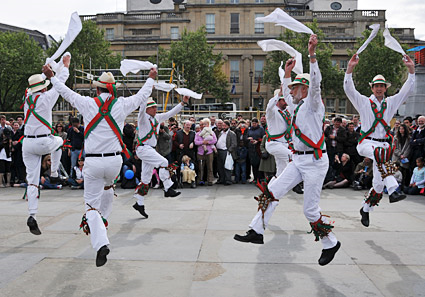
We all (humans and animals) have a need to communicate and connect with others. And humans do it in so many ways: writing, speaking, sign language, body language, facial expressions, art, singing, and one of my favorites: Morris dancing. (Oh, you should see it in person; what a spectacle!)

Donna Bradley Burcher | Senior Technical Editor | Symitar®

8985 Balboa Ave. | San Diego, CA 92123 | Ph. 619.278.0432 | Ext: 765432

Posted by: Jack Henry | November 15, 2017

Editor’s Corner: We’re back to haunt you!

Yes, I completely blew the timing on this. I would love to have read it before Halloween so I could share it with you then—but things happen, people change, and sometimes mistakes are made.

Being interested in all aspects of life (including death), I couldn’t let this collection of creepy words wait until next year. From The Grammarist, I offer you four alternative terms for our final resting places. (Photos collected and added by yours truly.)

Sepulcher, crypt, catacomb and mausoleum are all places where the dead are laid to rest. However, there are some differences between the terms. We will examine the definitions of the words sepulcher, crypt, catacomb, and mausoleum, where these words came from.

A sepulcher (American spelling) or sepulchre (British spelling) is a small room in which a dead body is laid to rest. Most properly, a sepulcher is cut out of rock and is in more of a natural setting, though the word has been expanded to be a synonym for tomb or mausoleum. The word sepulcher is derived from the Latin word sepulcrum, meaning place where someone is buried.

A crypt is a small room or a vault in which a dead body is laid to rest, situated under a church. A crypt may be a room that is large enough to function as a chapel or simply an area large enough to hold a coffin. Crypts are often located in the wall or under the floor of a church. The word crypt is derived from the Greek word krypte which means hidden.

A catacomb is an underground cemetery, especially referring to the tunnels built by the ancient Romans. The catacombs under Paris, France and Rome, Italy are famous and extensive. The word catacomb is perhaps derived from the Latin term cata tumbas which translates as at the graves.

A mausoleum is an above-ground tomb or building composed of granite or marble. A mausoleum usually has doors and a vestibule, as it houses more than one set of remains. The word mausoleum comes from Greek name Mausoleion, which is the enormous tomb built around 350 BC for Mausolos, a self-appointed king of Caria. Mausoleums may hold either coffins or urns or boxes containing ashes.

Kara Church

Technical Editor, Advisory

Symitar Documentation Services

Posted by: Jack Henry | November 13, 2017

Editor’s Corner: “Onto” and “On To”

In my previous post (about phrasal verbs), I used the phrase “logging on to your computer.” Some of you noticed that I wrote on to as two words (“logging on to” instead of “logging onto”) and asked whether it’s ever correct to write onto as one word.

Great question! Sometimes onto is correct, and other times, on to is correct. They are not interchangeable, and choosing between the two is not simply a personal preference.

When to Use Onto

Onto is a preposition meaning “to a position or point on or upon” (thanks, Merriam-Webster).

Use onto when you’re writing about putting something on top of something else. For example, when you put a vase onto a table, the vase is physically on top of the table. When you climb onto your roof, you are physically on top of your roof.

You should also write onto as one word when you’re using it to mean “in or into a state of awareness or knowledgeability about.” (Imagine an undercover agent saying, “I think they’re onto me.”) Unless you’re writing the next great spy thriller, you probably don’t use the word in this sense very often.

When to Use On To

Use on to when on is part of a phrasal verb (like log on).

When you’re deciding between onto and on to, it’s possible to look for phrasal verbs, but it’s probably easier to ask yourself, “Am I talking about putting something on top of something else?” If the answer is yes, use onto. If the answer is no, use on to.

Ben Ritter | Technical Editor | Symitar®
8985 Balboa Avenue | San Diego, CA 92123
619-682-3391 | or ext. 763391 | www.Symitar.com

Symitar Documentation Services

NOTICE: This electronic mail message and any files transmitted with it are intended
exclusively for the individual or entity to which it is addressed. The message,
together with any attachment, may contain confidential and/or privileged information.
Any unauthorized review, use, printing, saving, copying, disclosure or distribution
is strictly prohibited. If you have received this message in error, please
immediately advise the sender by reply email and delete all copies.

Posted by: Jack Henry | November 9, 2017

Editor’s Corner: Test

Apologies. I am testing the email addresses for Editor’s Corner.

NOTICE: This electronic mail message and any files transmitted with it are intended
exclusively for the individual or entity to which it is addressed. The message,
together with any attachment, may contain confidential and/or privileged information.
Any unauthorized review, use, printing, saving, copying, disclosure or distribution
is strictly prohibited. If you have received this message in error, please
immediately advise the sender by reply email and delete all copies.

Posted by: Jack Henry | November 8, 2017

Editor’s Corner: Indubitably v. Undoubtedly

To whom it may concern, I apologize if you are receiving this email and weren’t on our list before. I just recreated the list, and with one eye out of commission and a 1400-person list, so some things may be out of whack. Let me know if you DO NOT want you daily fix of Editor’s Corner. (But it’s great, so you should want to take a little break each day to read it.)

Thanks!

**************************************************************

Dear Editrix,

What is the difference between indubitably and undoubtedly? Is one better than the other? I’ve seen them both and I don’t know if there’s a subtle difference or why we have two words for what appears to be the same thing.

Doubting Thomasina

Dear Thomasina,

What an interesting question! I tried to answer this question in my head as I drove home, and I couldn’t think of a difference in use of the words. I definitely hear undoubtedly more often. Indubitably seems like one of those words that is reserved for Arthur Conan Doyle (Sherlock Holmes), and I seem to recall it as the last word in the Schoolhouse Rock lyrics for “Lolly, Lolly, Lolly (Get Your Adverbs Here!).”

Here is part of an article from The Grammarist that sounds like it was made for us!

Indubitably and undoubtedly are two words that are sometimes found confusing.

Indubitably means beyond a doubt, without question, plainly true. The word indubitably first appeared in the mid-1400s, it is derived from the Latin word indubitabilis which means that which is not doubtable.

Undoubtedly also means beyond a doubt, without question, plainly true. The word undoubtedly also first appeared in the mid-1400s, it is derived from the Old French word douter meaning to be afraid or doubtful and the prefix un- which means not. Indubitably and undoubtedly are synonyms, which are two words that mean the same thing. The word undoubtedly is used much more often than the word indubitably, as the word indubitably carries the connotation of a more formal word.

Kara Church

Technical Editor, Advisory

619-542-6773 | Ext: 766773

Symitar Documentation Services

NOTICE: This electronic mail message and any files transmitted with it are intended
exclusively for the individual or entity to which it is addressed. The message,
together with any attachment, may contain confidential and/or privileged information.
Any unauthorized review, use, printing, saving, copying, disclosure or distribution
is strictly prohibited. If you have received this message in error, please
immediately advise the sender by reply email and delete all copies.
Posted by: Jack Henry | November 7, 2017

Editor’s Corner: Kiddies, kitties, caddies, or catties

From: Kara Church
Sent: Tuesday, November 7, 2017 8:21 AM
To: kchurch@symitar.com
Subject: Editor’s Corner: Kiddies, kitties, caddies, or catties

One of you asked me a few weeks ago about the term kiddie-corner. Because of the spelling, I was thinking it must be something like a corner where you sit Beaver Cleaver when he misbehaves in class. And then I realized it was the spelling that was throwing me off and you were asking about the term kitty-corner!

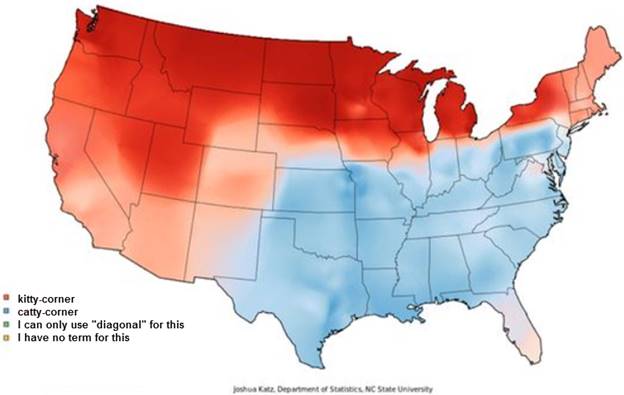
This expression (kitty-corner, catty-corner, and cater-corner) means diagonally opposite. According to Common Errors in English Usage, the term comes from misspelling the French word quatre (“four”) prefixed to “corner.” Although the word has nothing to do with cats or kittens, in various dialects all three spellings are acceptable: “catty,” “cater” or “kitty.”

(As the author notes, “caddy-corner” is not acceptable unless you are talking about somebody in a corner holding your golf bags, and I would add that “kiddie-corner” is not an appropriate spelling unless someone has been stuck in the corner for being naughty.)

Kara Church

Technical Editor, Advisory

Symitar Documentation Services

« Newer Posts - Older Posts »

Categories