Posted by: Jack Henry | January 19, 2018

Editor’s Corner: Honcho

I know I wrote about C-Level management before and I could swear I put an article out some time ago about different terms used to mean leader or manager, like top dog or big cheese or honcho. I found this cute article from Jackie about Top Dogs (https://episystechpubs.com/2014/08/29/nifty-nuggets-dog-terms/) but nothing about the other items. Heres a brief article from The Grammarist, about the word honcho and where it came from. It just might surprise you!

Honcho is a term that dates back to the late 1940s. The origin of the word honcho may surprise you. We will examine the definition of honcho, where it came from and some examples of its use in sentences.

Honcho is a word used to mean the leader of a squad or the leader of a group, the boss. Honcho is often used in the term head honcho, though this is actually a tautology. A tautology is a phrase or idiom in which the same idea is expressed twice using different words. Many believe that honcho has its roots in the Spanish language, but the word honcho entered the English language in the late 1940s when it was brought back to America by the servicemen who had occupied post-war Japan. Honcho is derived from a Japanese word, hanch, which means group leader. The plural form of honcho is honchos.

Kara Church

Technical Editor, Advisory

619-542-6773 | Ext: 766773

Symitar Documentation Services

NOTICE: This electronic mail message and any files transmitted with it are intended
exclusively for the individual or entity to which it is addressed. The message,
together with any attachment, may contain confidential and/or privileged information.
Any unauthorized review, use, printing, saving, copying, disclosure or distribution
is strictly prohibited. If you have received this message in error, please
immediately advise the sender by reply email and delete all copies.

Posted by: Jack Henry | January 18, 2018

Editor’s Corner: Vocabulary Quiz

Good morning! It’s time for another vocabulary quiz. This quiz covers five pairs of commonly confused words and is brought to you by Daily Writing Tips. Pick the word you think fits best in each sentence, and then scroll down to see the correct answers. Remember, no prizes are involved unless you count that amazing feeling of pride you experience when you get them all (or most of them) right. Good luck, my fellow language lovers.

1. The roll-top desk was made by an exceptionally skilled ________.

a) artist

b) artisan

2. Drink, drank, (have) drunk are the ________ parts of the verb “to drink.”

a) principal

b) principle

3. Pliny the _______ died in the eruption of Vesuvius. [dbb – This is a give-away for many of you craft beer fans]

a) older

b) Elder

4. Aaron Burr killed Alexander Hamilton in a _______.

a) dual

b) duel

5. I saw the detective ________ his fists, but he refrained from striking the suspect.

a) clinch

b) clench

Answers and Explanations

1. The roll-top desk was made by an exceptionally skilled artisan.

b) artisan

An artisan is a worker in a skilled trade. An artist practices a creative art such as painting, sculpting, or writing.

2. Drink, drank, (have) drunk are the principal parts of the verb “to drink.”

a) principal

As an adjective, principal means “first in order of importance.” Principle is a noun that means “a fundamental truth,” or “a rule or a belief that governs one’s behavior.”

3. Pliny the Elder died in the eruption of Vesuvius.

b) Elder

As an adjective, elder is sometimes interchangeable with older, as in “Jane is Sally’s elder sister.” Capitalized, Elder is used to distinguish between two family members of different generations, as in Pliny the Elder and Pliny the Younger.

4. Aaron Burr killed Alexander Hamilton in a duel.

b) duel

Used historically, a duel is a ritualized killing contest between two men armed with deadly weapons. Dual is an adjective meaning “consisting of two parts.”

5. I saw the detective clench his fists, but he refrained from striking the suspect.

b) clench

When speaking of ones’ fingers, clench means to make a fist. One can also clench other body parts. To clench one’s teeth is to press them closely together. Clinch means to embrace or grapple at close quarters.

Donna Bradley Burcher | Senior Technical Editor | Symitar®

8985 Balboa Ave. | San Diego, CA 92123 | Ph. 619.278.0432 | Extension: 765432

Symitar Documentation Services

NOTICE: This electronic mail message and any files transmitted with it are intended
exclusively for the individual or entity to which it is addressed. The message,
together with any attachment, may contain confidential and/or privileged information.
Any unauthorized review, use, printing, saving, copying, disclosure or distribution
is strictly prohibited. If you have received this message in error, please
immediately advise the sender by reply email and delete all copies.

Posted by: Jack Henry | January 17, 2018

Editor’s Corner: Keep it fresh in 2018

I know, a lot of you dislike it when I send out lists of words or phrases that are considered overused or jargon. But then again, I don’t like it when I have to read a lot of jargon or worn-out phrases, so I guess we’re even! This list is from a GrammarBook.com email that I subscribe to. It’s part of their resolution to “Keep Writing Fresh in 2018.”

Original Problem Beyond Overuse Alternatives in Careful Writing
on a daily/weekly basis (prep. phrase) wordy daily, weekly
going/moving forward
(adv. phrase)
inaccurate idiom meaning in continuance in the future, from here, from now on
most importantly
(adv. phrase)
incorrect usage as adverb most important (adj), above all
I feel like (verb clause) subjective insertion before a statement
(e.g., I feel like the book is too long)
(strike as unnecessary)
bad optics
(noun phrase)
“buzz” phrase pertaining to the public’s view of something through the media bad perception, bad impression
ubiquitous (adj) big-word-itis (a clinical condition) all over, all around, everywhere
proactive (adj) often redundant modification of an action in progress (e.g. proactively seeking) (strike as unnecessary)
just (adv) intrusive insertion of thought
(e.g., Why don’t we just go tomorrow?)
(strike as unnecessary)
right? (interrogative) highly catch-phrase in nature (meaning: Isn’t that true/correct? Isn’t that so?) (strike as unnecessary)

Kara Church

Technical Editor, Advisory

619-542-6773 | Ext: 766773

Symitar Documentation Services

NOTICE: This electronic mail message and any files transmitted with it are intended
exclusively for the individual or entity to which it is addressed. The message,
together with any attachment, may contain confidential and/or privileged information.
Any unauthorized review, use, printing, saving, copying, disclosure or distribution
is strictly prohibited. If you have received this message in error, please
immediately advise the sender by reply email and delete all copies.

Posted by: Jack Henry | January 16, 2018

Editor’s Corner: Noggin

I know we’re done with yuletide caroling, snuggling up by the fire, and drinking eggnog, but I can’t wait another year to share this with you. I was looking up something about eggnog that was not very interesting—so I’ll skip that. But then I started to wonder about the etymology of the word eggnog, and I found something fascinating, which I would love to share with you. From The Word Detective:

Noggin

From drink to think.

Dear Word Detective: My kids think the word “noggin” is hilarious. I have used it, in reference to their heads, and wondered about its history. Where, when and how did this word come into being? — Juliet.

Well, it was a dark and stormy night in the 1930s as Elwood Noggin, a retired stoat salesman in northern Nebraska, tinkered in his basement with his latest invention, an electric divining rod for locating lost car keys. As Noggin reached for the switch to test his invention, suddenly…. One moment please. I have just been informed that the foregoing story is not true. Oh well, that sort of fable almost never is. One might (as I sometimes do) view human history itself as being one long dark and stormy night, but few of our words have identifiable “moments of origin.” Like Topsy, they just sort of grow.

But the results in cases such as “noggin” are nonetheless splendid. As slang for the human head (or any creature’s head, I suppose, although references to a cat’s noggin in classic literature seem rare), “noggin” is a wonderfully silly word. It’s difficult to imagine using “noggin” when genuine anger is involved, and “noggin” seems far more likely to crop up in an S.J. Perelman story or a Three Stooges episode than in a crime report.

Oddly enough, when “noggin” first appeared in English in the late 16th century, it had nothing to do, at least directly, with the human head. It meant “small cup or mug,” and by a hundred years later, had taken on the meaning of “a small drink of alcohol.” The roots of “noggin” are a mystery, but that second meaning of “small drink” may provide a clue. “Nog” at that time was a term used in England for a type of strong ale (or, by extension, any sort of alcoholic drink). It’s that “nog,” in fact, that underlies our modern “eggnog,” which combines (in its proper form) eggs, cream, sugar, nutmeg and rum. It’s possible that, since liquor affects primarily the head, that “noggin” was originally meant to refer to a head made woozy by drink. In any case, by the mid-18th century “noggin” had come into use as slang for the head, at first as a boxing term, but by the 19th century as a generalized slang term.

It is also possible that the transferred use of “noggin” from “cup” to “head” paralleled the evolution of “mug” in slang. In the 16th century, a “mug” was, as it is today, a heavy cup used for warm drinks. But in the 17th century it became common to decorate mugs with grotesque caricatures of human faces (such creations are still found in many curio and souvenir shops). By the early 18th century, “mug” had become popular slang for the actual human face, a sense we still use in “mugshot” (as well as in “to mug,” which originally referred to hitting a person in the face).

Kara Church

Technical Editor, Advisory

Symitar Documentation Services

Posted by: Jack Henry | January 12, 2018

Editor’s Corner: Churchill

Thank you to Ron F., who supplies me with the newsprint versions of Richard Lederer’s columns each week. This column is about Sir Winston Leonard Spencer-Churchill—a little bit of history and a little bit about how he ruled the English language. From the Verbivore:

Currently playing in theaters is the powerful film “Darkest Hour,” in which Gary Oldman portrays the titanic Winston Churchill in 1940. Against all odds, the new prime minister rallied Britain with soaring oratory against the might of Adolf Hitler. As President John F, Kennedy once said, “Churchill mobilized the English language and sent it into battle.”

Churchill evinced both a lisp and a stutter that made him an almost unintelligible figure of ridicule. Yet his mastery of writing and public speaking became his stairway to success. Many believe him to be the greatest orator and hero of the 20th century.

Just before the coronation of Queen Elizabeth in June 1953, Churchill attended the Commonwealth Banquet in London. The prime minister, then in his 80th year, was introduced to an 18-year-old exchange student. Churchill advised the young man: “Study history, study history — in history are all the secrets of statecraft.”

That student was my friend James Humes, and he did study history and wrote five books about Winston Churchill. In “The Wit & Wisdom of Winston Churchill,” Humes observes that some of Churchill’s minted creations have become the language of world diplomacy. Churchill was master not only of crafting ringing orations but also of coining words and phrases. By sculpting significance from air, he changed the world by changing the word.

In his first address as prime minister on May 10, 1940, Churchill thundered, “I have nothing to offer you but blood, toil, tears and sweat.” This, his most famous coinage, is generally foreshortened to “blood, sweat and tears.” Scarcely a month later he added to English oratory one of its finest hours with the statement “If the British Empire and its Commonwealth last for a thousand years, men will still say, ‘This was their finest hour’.”

The great man also bequeathed us Iron Curtain in his speech at Westminster College, in Fulton, MO, on March 5, 1946. There he told his audience “From Stettin in the Baltic to Trieste in the Adriatic, an iron curtain has descended across the continent.” In a World War I speech at the Guildhall in London, Churchill also coined the phrase “business as usual.”

As First Lord of the Admiralty, Churchill asked that areoplane be changed to airplane and hydroplane to seaplane. They have been called such ever since. He also designated the word destroyer for what had been a “light search and destroy vessel.”

Vidkun Quisling was the name of a Norwegian Nazi collaborator. In 1943, Churchill made the man’s name an eponym when he complained about “those vile Quislings in our midst.”

Here’s a sampler of Winston Churchill’s spot-on observations:

alcohol. All I can say is that I have taken more out of alcohol that alcohol has taken out of me.

appeaser. One who feeds the crocodile hoping it will eat him last.

cigars. Smoking cigars is like falling in love. First you are attracted to its shape. You stay with it for its flavor. And you must always remember never, never let the flame go out.

courage. Going from failure to failure without losing enthusiasm.

criticism. Eating my words has never given me indigestion.

democracy. The worst form of government except for all other forms that have been tried from time to time.

egotism. Of course I am an egotist. Where do you get if you aren’t?

enemies. You have enemies? Good. That means you’ve stood up for something sometime in your life.

exercise. I get my exercise by being a pallbearer for those of my friends who believe in regular running and calisthenics.

history. We cannot say “the past is past” without surrendering the future.

medicine. The only way to swallow a bitter mixture is to take it in a single gulp.

old age. The young sow wild oats. The old grow sage.

war. War is horrible, but slavery is worse.

words. Old words are best and old words that are short are best of all.

writing. Writing a book is an adventure. To begin with, it is a toy, an amusement. Then it becomes a mistress, then a master and then a tyrant.

It may be that Winston Churchill’s most telling aphorism is about life itself: “What is the use of living, if not to strive for nobler causes and to make this world a better place for those who will live in it after we are gone?”

Kara Church

Technical Editor, Advisory

619-542-6773 | Ext: 766773

Symitar Documentation Services

NOTICE: This electronic mail message and any files transmitted with it are intended
exclusively for the individual or entity to which it is addressed. The message,
together with any attachment, may contain confidential and/or privileged information.
Any unauthorized review, use, printing, saving, copying, disclosure or distribution
is strictly prohibited. If you have received this message in error, please
immediately advise the sender by reply email and delete all copies.


Posted by: Jack Henry | January 11, 2018

Editor’s Corner: “Silly Old-Timey” Words

I love the information I dig up while researching topics to write about—I hope you do too. Today, I’m sharing a list of “silly, old-timey” words that I found on BuzzFeed. I think we should start using these words again. (I’m not providing the BuzzFeed link because of an inappropriate explanation for a word that I omitted. BuzzFeed is interesting, but not always work appropriate.)

My family was already at their wit’s end after I wrote about, and started using, historical swear words and words that make you sound “wicked smart.” They’re going to run away crying after I throw down some of these. I’m so excited!

All of the following information comes directly from BuzzFeed. (And they like to play with language, so not everything below is as grammatically correct as we’re used to!) BuzzFeed put the words together, and they also wrote the “How to use it” sentences. I take no credit (or blame) for their creativity (or lameness).

  1. Flapdoodle: foolish words

First known use: 1878

How to use it: Henry thinks he’s a genius, but everything he tweets is pure flapdoodle!

  1. Claptrap: pretentious nonsense

First known use: 1799

How to use it: Oh, Ethel, we all know you’re a trust fund baby—your constant complaining about how hard it is being an artist is just claptrap.

  1. Tommyrot: utter foolishness or nonsense

First known use: 1884

How to use it: Every Tinder conversation I have is full of tommyrot and goes nowhere—maybe I should just join Match instead.

  1. Fiddle-faddle: nonsense (often used as an interjection)

First known use: 1577

How to use it: Oh, fiddle-faddle, William! (throws hands in the air) How many times did I tell you that I do NOT look good in the Mayfair filter?

5. Monkeyshine: mischievous or playful activity; a prank

First known use: circa 1832

How to use it: Quite frankly, Florence, I’m growing tired of all your monkeyshines, and you need to start acting like an adult.

6. Horsefeathers: foolish or untrue words; often used as an interjection

First known use: 1927

How to use it: I can’t believe Edna canceled on me at the last minute and used the late-at-work-again excuse—she just Instagrammed a selfie with her cat. Horsefeathers, I tell ya!

7. Applesauce: nonsense

First known use: 1704

How to use it: Yeah, we broke up—I just couldn’t take all his applesauce anymore, especially after I found out he still had an active OkCupid account.

8. Codswallop: nonsense (British)

First known use: 1963

How to use it: I was deathly hungover on Friday and said I had a stomach virus, but everyone knew it was 100% codswallop— I should’ve never geotagged myself at the bar Thursday at midnight!

9. Blatherskite: a person who blathers a lot; nonsense

First known use: circa 1650

How to use it: Johnny’s a real blatherskite on Facebook but I never hear two peeps outta him IRL.

10. Bafflegab: gibberish; gobbledygook

First known use: 1952

How to use it: Cut the bafflegab already, Beatrice, and talk to me in plain English instead of cryptic texts. I have no idea what smh means. [dbb: “smh” means “shaking my head.”]

11. Stultiloquence: senseless or silly talk

First known use: circa 1913

How to use it: I went on a date with this smart and witty dude I follow on Tumblr, but our conversation was full of a bunch of stultiloquence. Maybe he was just nervous?

12. Taradiddle: a fib; pretentious nonsense

First known use: circa 1796

How to use it: Listen, Carl, I’ve had it up to here with all this taradiddle about how you’re best friends with Harry Styles. He favorited your tweet, like, eight months ago and THAT’S IT.

13. Piffle: trivial nonsense

First known use: 1890

How to use it: I am SO over Mildred’s Snapchats! They’re total piffle — I could not care less about what she has for dinner every night.

14. Humbuggery: false or deceptive behavior

First known use: 1750

How to use it: I fell for this hottie’s humbuggery on Tinder—and ended up being catfished by my best friend. Sigh.

Donna Bradley Burcher | Senior Technical Editor | Symitar®

8985 Balboa Ave. | San Diego, CA 92123 | Ph. 619.278.0432 | Extension: 765432

Symitar Documentation Services

NOTICE: This electronic mail message and any files transmitted with it are intended
exclusively for the individual or entity to which it is addressed. The message,
together with any attachment, may contain confidential and/or privileged information.
Any unauthorized review, use, printing, saving, copying, disclosure or distribution
is strictly prohibited. If you have received this message in error, please
immediately advise the sender by reply email and delete all copies.
Posted by: Jack Henry | January 10, 2018

Editor’s Corner: Janus

Being a January baby, I’ve always loved Janus words. This year, lucky me, Grammar Girl wrote about this very topic and included a cool photo of the Roman god Janus. Here is most of her article, but if you want to read the entire thing, you can find it here.

In this dark first month of the year, it seems like a good time to talk about Janus words, also known as contronyms and auto-antonyms, because January gets its name from the two-faced Roman god named Janus as well.

Words that have two opposite meanings such as “dust” (which can mean both “to add a light layer” as in “I dusted the cake with powdered sugar,” and “to remove dust,” as in “I dusted the baseboards before everyone came over for dinner,) are called Janus words because the god Janus is usually shown with two faces looking in opposite directions, and that “oppositeness” represents the opposite word meanings.

January gets its name from the same Roman god because as the god of doorways and archways, he’s also thought of as looking into the past and the future and representing transitions such as the transition from the old year to the new year.

What Are Auto-Antonyms?

These words are also called auto-antonyms because an antonym is a word with an opposite meaning. For example, “wiggly” is an antonym of “still.” A wiggly baby is the opposite of a still baby. Most words can have lots of antonyms, not just one, so “thrashing” is also an antonym of “still.” A thrashing baby is also the opposite of a still baby.

When you add the prefix “auto,” which means “self,” you get “auto-antonym”: a word that is its own antonym.

“Sanction”: Approve and Punish

“Sanction is a common example. A few years ago I told you that the Associated Press had sanctioned the use of “hopefully” as a sentence adverb, meaning that it’s OK to write a sentence like “Hopefully, Squiggly saved some chocolate for the rest of us.” That meant the Associated Press put its stamp of approval on such sentences, but if I had written that the Associated Press sanctioned writers it found using “hopefully” in this way, it would mean it had punished its writers—taken action against “hopefully” instead of supporting it.

“Sanction” can mean “to approve or ratify something,” but it can also mean to “punish or penalize someone.” However, you’re safer using it to mean “approve.” The “penalize” meaning is much, much newer: people only began using it in the 1950s. The Oxford English Dictionary sniffs its nose at the “penalize” meaning, calling it of “doubtful acceptability,” and Bryan Garner, who trains lawyers to write and is the author of Garner’s Modern English Usage, says that lawyers who use the “penalize” meaning risk being misunderstood since the “approve” meaning is dominant in legal circles. So even though “sanction” has two meanings, one is more common, and people could be confused if you use the uncommon one

“Seed”: Add and Remove

Another contronym that, like “dust,” can mean both “to add” and “to remove” is “seed.” When you seed a tomato, you remove the seeds; but when you seed a lawn, you add seeds.

“Trim”: Add and Remove

And a third verb that can mean both “to add” and “to remove” is “trim.” You can trim your bangs to shorten them or trim a tree to add decorations to it.

Kara Church

Technical Editor, Advisory

Symitar Documentation Services

Posted by: Jack Henry | January 9, 2018

Editor’s Corner: Anticlockwise

Dear readers,

Have I told you lately how much I love you? Well, I think you are all just splendid! I’ve received some very smart questions lately, which have led me to some interesting research. I want to thank you for your input and your questions because they keep this blog pertinent and interactive. Today’s items are a perfect example. Both of the following words were sent in by employees who have been reading the British classics (Jane Eyre) and other books from “across the pond.”

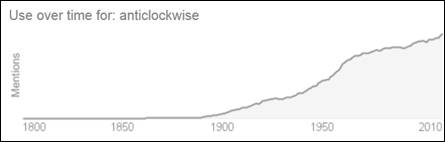
The first word is anticlockwise. You might guess that this means the same as counterclockwise (“to move in the opposite direction to the way the hands of an analog clock move”), and you’d be right. What you might not know is that anticlockwise is used chiefly in Britain, Australia, and New Zealand.

Both words are close to the same age, though anticlockwise is a tad bit older, with its first known use in 1879. Counterclockwise, the preferred term in the United States, was first used in 1888.

According to this graph, it looks like anticlockwise is becoming more popular lately:

The other word today, from our Jane Eyre fan, is unclose. Again, you might guess that this means “open,” and you’d be correct, though it has a little more flair to it than that. Unclose also means to unclench, to disclose, or to reveal. It has been around since the 14thcentury, but it is considered rare. One of the items I read about it describe it as a “poetic” way to say open.

Unlcose has recently seen a rise in use, but it was definitely more popular when Charlotte Brontë published Jane Eyre in 1847.

And a funny from one of our readers:

Kara Church

Technical Editor, Advisory

Symitar Documentation Services

Posted by: Jack Henry | January 8, 2018

Editor’s Corner: Spelling Quiz

When I was in the fourth grade, my class had a weekly spelling bee on every Friday, and I lived for it! Every Monday my teacher would pass out the words for the quiz on Friday, and we would practice memorizing the words all week. For the more difficult words, my mom used to help me create sentences that started with each letter of the word so that I could remember how to spell the words. For example, Arithmetic (A rat in the house may eat the Italian cheese).

Click here for a fun spelling quiz from Merriam-Webster. Click the audio button on the right-side of the words “Hear it” to hear the word. Once the audio starts, you’ll have 15 seconds to spell the word.

Jackie Solano | Technical Editor | Symitar®

8985 Balboa Ave. | San Diego, CA 92123 | Ph. 619.542.6711 | Extension: 766711

Symitar Documentation Services

NOTICE: This electronic mail message and any files transmitted with it are intended
exclusively for the individual or entity to which it is addressed. The message,
together with any attachment, may contain confidential and/or privileged information.
Any unauthorized review, use, printing, saving, copying, disclosure or distribution
is strictly prohibited. If you have received this message in error, please
immediately advise the sender by reply email and delete all copies.

Posted by: Jack Henry | January 5, 2018

Editor’s Corner: Moose, Mousse, but no Moussaka

Good morning, dear readers.

It is our department’s tradition to bring in a dessert to share on our birthday. It works well because, on your birthday, you always get something you like, nobody else has to collect money from coworkers to pay for it, and if you don’t get a birthday treat, you only have yourself to blame for forgetting.

I worked from home on my birthday yesterday, but next week I hope to bring in something chocolatey to celebrate. In honor of chocolate mousse cake, here is an article about mousse and moose!

From The Grammarist:

Moose and mousse are two words that are pronounced in the same manner but are spelled differently and have different meanings, which makes them homophones. We will examine the definitions of moose and mousse, where these words came from and some examples of their use in sentences.

A moose is a large animal with antlers that is found in the northern forests of America, Europe, and Asia. It is of the deer family. The plural form is moose, not mooses or meese. The word moose is derived from the Algonquian language, probably from the Eastern Abnaki word, mos.

A mousse is a culinary dish that is whipped with egg white and cream, making it light and smooth. Mousse may be sweet or savory, served as a side dish, main dish or dessert. Today, the term mousse is often applied to makeup and hair products. The word mousse is a borrowed or loan word, taken from the Old French mousse meaning froth. Borrowed words and loan words are terms that have been taken from other languages and used as English words and phrases.

Moussaka is a delicious Greek dish made with eggplant, but that’s for another day.

Kara Church

Technical Editor, Advisory

Symitar Documentation Services

« Newer Posts - Older Posts »

Categories