Posted by: Jack Henry | April 3, 2018

Editor’s Corner: Tuesday Church Bloopers

Good morning! I’ve been scraping the bottom of the barrel to find new church bulletin bloopers for you. Here are a few more for you from Pastors.com and Angelfire (no, I did not make that up). Enjoy!

  1. Don’t miss this Saturday’s exhibit by Christian Martian Arts.
  2. We are grateful for the help of those who cleaned up the grounds around the church building and the rector.
  3. A worm welcome to all who have come today.
  4. The ushers will come forward and take our ties and offerings.
  5. Applications are now being accepted for 2-year-old nursery workers.
  6. Let us join David and Lisa in the celebration of their wedding and bring their happiness to a conclusion.
  7. Helpers are needed! Please sign up on the information sheep.
  8. Diana and Don request your presents at their wedding.
  9. The 1991 Spring Council Retreat will be hell May 10 and 11.
  10. Hymn: “I Love Thee My Ford.”
  11. We would like to congratulate Tony and Renee on the birth of their 4th child this week.
  12. Revival Friday night with Jack Daniels!
  13. The Little Mothers Group will be meeting on Thursday mornings at 10:00 a.m. Anyone interested in becoming a Little Mother please see the Pastor in his study.
  14. A new loudspeaker system has been installed in the church. It was given by one of our members in honor of his wife.
  15. Glory of God to all and peas to his people on earth.
  16. Men’s Prayer Breakfast. No charge, but your damnation will be gratefully accepted.
  17. Instructions:
  • The pastor will light his candle from the altar candles.
  • The ushers will light their candle from the pastor’s candle.
  • The ushers will turn and light each worshipper in the first pew.

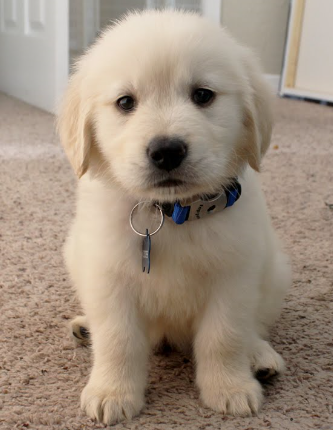
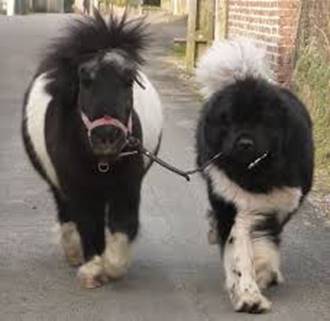
I had a funny church sign photo, but my editor said it might offend some, so instead I will send you a photo of Harvey, my dog, who graduated from basic training a week ago. Hopefully this is not disturbing to you!

The Graduate

Kara Church

Technical Editor, Advisory

Symitar Documentation Services

Posted by: Jack Henry | April 2, 2018

Editor’s Corner: Contronyms

A contronym is a word with two meanings that can contradict each other depending on the context. Here is a list of contronyms from Daily Writing Tips.

1. Apology: A statement of contrition for an action, or a defense of one
2. Aught: All, or nothing
3. Bill: A payment, or an invoice for payment
4. Bolt: To secure, or to flee
5. Bound: Heading to a destination, or restrained from movement
6. Buckle: To connect, or to break or collapse
7. Cleave: To adhere, or to separate
8. Clip: To fasten, or detach
9. Consult: To offer advice, or to obtain it
10. Continue: To keep doing an action, or to suspend an action
11. Custom: A common practice, or a special treatment
12. Dike: A wall to prevent flooding, or a ditch
13. Discursive: Moving in an orderly fashion among topics, or proceeding aimlessly in a discussion
14. Dollop: A large amount (British English), or a small amount
15. Dust: To add fine particles, or to remove them
16. Enjoin: To impose, or to prohibit
17. Fast: Quick, or stuck or made stable
18. Fine: Excellent, or acceptable or good enough
19. Finished: Completed, or ended or destroyed
20. First degree: Most severe in the case of a murder charge, or least severe in reference to a burn
21. Fix: To repair, or to castrate
22. Flog: To promote persistently, or to criticize or beat
23. Garnish: To furnish, as with food preparation, or to take away, as with wages
24. Give out: To provide, or to stop because of a lack of supply
25. Go: To proceed or succeed, or to weaken or fail
26. Grade: A degree of slope, or a horizontal line or position
27. Handicap: An advantage provided to ensure equality, or a disadvantage that prevents equal achievement
28. Help: To assist, or to prevent or (in negative constructions) restrain
29. Hold up: To support, or to impede
30. Lease: To offer property for rent, or to hold such property
31. Left: Remained, or departed
32. Let: Allowed, or hindered
33. Liege: A feudal lord, or a vassal
34. Literally: Actually, or virtually
35. Mean: Average or stingy, or excellent
36. Model: An exemplar, or a copy
37. Off: Deactivated, or activated, as an alarm
38. Out: Visible, as with stars showing in the sky, or invisible, in reference to lights
39. Out of: Outside, or inside, as in working out of a specific office
40. Overlook: To supervise, or to neglect
41. Oversight: Monitoring, or failing to oversee
42. Peer: A person of the nobility, or an equal
43. Presently: Now, or soon
44. Put out: Extinguish, or generate
45. Puzzle: A problem, or to solve one
46. Quantum: Significantly large, or a minuscule part
47. Quiddity: Essence, or a trifling point of contention
48. Quite: Rather (as a qualifying modifier), or completely
49. Ravel: To entangle, or to disentangle
50. Refrain: To desist from doing something, or to repeat
51. Rent: To purchase use of something, or to sell use
52. Rock: An immobile mass of stone or figuratively similar phenomenon, or a shaking or unsettling movement or action
53. Sanction: To approve, or to boycott
54. Sanguine: Confidently cheerful, or bloodthirsty
55. Scan: To peruse, or to glance
56. Screen: To present, or to conceal
57. Seed: To sow seeds, or to shed or remove them
58. Shop: To patronize a business in order to purchase something, or to sell something
59. Skin: To cover, or to remove
60. Skinned: Covered with skin, or with the skin removed
61. Splice: To join, or to separate
62. Stakeholder: One who has a stake in an enterprise, or a bystander who holds the stake for those placing a bet
63. Strike: To hit, or to miss in an attempt to hit
64. Table: To propose (in British English), or to set aside
65. Temper: To soften, or to strengthen
66. Throw out: To dispose of, or to present for consideration
67. Transparent: Invisible, or obvious
68. Trim: To decorate, or to remove excess from
69. Trip: A journey, or a stumble
70. Unbending: Rigid, or relaxing
71. Variety: A particular type, or many types
72. Wear: To endure, or to deteriorate
73. Weather: To withstand, or to wear away
74. Wind up: To end, or to start up
75. With: Alongside, or against

Jackie Solano | Technical Editor | Symitar®

8985 Balboa Ave. | San Diego, CA 92123 | Ph. 619.542.6711 | Extension: 766711

Symitar Documentation Services

NOTICE: This electronic mail message and any files transmitted with it are intended
exclusively for the individual or entity to which it is addressed. The message,
together with any attachment, may contain confidential and/or privileged information.
Any unauthorized review, use, printing, saving, copying, disclosure or distribution
is strictly prohibited. If you have received this message in error, please
immediately advise the sender by reply email and delete all copies.


Posted by: Jack Henry | March 30, 2018

Editor’s Corner: Stigma, Stigmata, and Astigmatism

Good Friday, everyone!

I wasn’t intending to get religious on you, but I was going through some of my Editor’s Corner “to do” list and I found an article on the word stigmata. It wasn’t very interesting, so I won’t bore you with it, but I thought the timing was about right with Easter coming, so instead of that article, I have some etymologies and related words for you instead. From the Online Etymology Dictionary:

stigma (n.)

1590s (earlier stigme, c. 1400), "mark made on skin by burning with a hot iron," from Latin stigma (plural stigmata), from Greek stigma (genitive stigmatos) "mark of a pointed instrument, puncture, tattoo-mark, brand," from root of stizein "to mark, tattoo," from PIE root *steig- "to stick; pointed" (see stick (v.)).

Figurative meaning "a mark of disgrace" in English is from 1610s. Stigmas "marks resembling the wounds on the body of Christ, appearing supernaturally on the bodies of the devout" is from 1630s; earlier stigmate (late 14c.), from Latin stigmata.

stigmatism (n.)

1660s, "a branding," from Greek stigmatizein, from stigmat-, stem of stigma (see stigma). Meaning "condition of being affected with stigmata" is from 1897.

astigmatism (n.)

"defect in the structure of the eye whereby the rays of light do not converge to a point upon the retina," 1849, coined by the Rev. William Whewell, English polymath, from Greek a- "without" (see a- (3)) + stigmatos genitive of stigma "a mark, spot, puncture," from PIE root *steig- "to stick; pointed" (see stick (v.)).

Okay, that was pretty dark, though interesting. I never knew that stigmata was just the plural form of stigma—I thought they were completely different words. And that astigmatism is related is also interesting. I just thought it meant “lop-sided eyeball,” not “without a mark.”

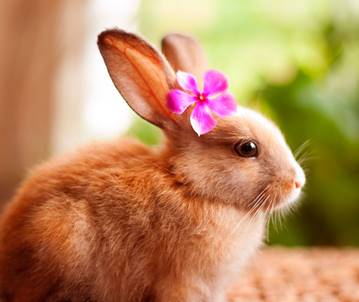
Here is a little something more chipper, with a wish for you to have a Happy Easter!

Kara Church

Technical Editor, Advisory

Symitar Documentation Services

Posted by: Jack Henry | March 29, 2018

Editor’s Corner: Pronoun Quiz

It’s quiz time! Today’s quiz (brought to you by Daily Writing Tips) is about pronouns. But before we start, a little review.

I hear from many of you that it’s hard to know whether to use I or me. Likewise, it can be difficult to know when to use us or we. We don’t have as much trouble with he vs. him or they vs. them, but the same rule applies to all.

I, we, he, and they are all subject pronouns, while me, us, him, and them and are all object pronouns. Maybe it’s easier to look at it this way:

Subject pronouns Object pronouns
I me
we us
she/he her/him
they them

Basically, you just need to remember that we use subject pronouns to refer to the subject of the sentence (the subject is the person or thing doing the action). Object pronouns are a little harder to define, but it might help to think of them this way: an object pronoun is not the subject of the sentence. It is usually the object that is affected in some way by the subject of the sentence.

Examples:

  • I threw the ball. (I is a subject pronoun; I am the person doing the action.)
  • The ball was thrown at me. (Me is an object pronoun; “me” is the person the ball was thrown at.)

Typically, figuring out which pronoun to use gets harder when a second person is involved, but if you imagine the sentence without the second person, it is easier to determine the correct pronoun.

Examples:

  • He threw the ball at John and me. (Remove John, and you are left with “He threw the ball at me.” We would not say, “He threw the ball at I.”)
  • John and I played catch. (Remove John, and you’re left with “I played catch.” We would not say, “Me played catch.”)

And with that, you are now fully prepared to take the test. As I usually do, I’ve provided the answers, but you’ll need to scroll down to see them. Best of luck, buckaroos!

Choose the correct pronoun to fill the blank.

1. Neither Bill nor _______ showed up for the concert.
a) him
b) he

2. The boys brought _______ girls flowers that they’d picked in the meadow.
a) us
b) we

3. Just between you and _______ let’s not repeat the rumor that’s going around.
a) me
b) I

4. Why don’t you give the dollar that you found to _______?
a) her
b) she

5. The Thompsons and _______ both appeared in photos on the society page.
a) they
b) them

Answers and Explanations

1. Neither Bill nor he showed up for the concert.

b) he

He is the subject (nominative case). When a personal pronoun is the second name in the compound subject, a good way to check is to say only the pronoun along with the rest of the sentence. Probably your ears would object to hearing “Him showed up for the concert.”

2. The boys brought us girls flowers that they’d picked in the meadow.

a) us

The pronoun us is in apposition to the noun girls. Because girls is an object (indirect object of the verb brought), the pronoun must also take the object form.

3. Just between you and me let’s not repeat the rumor that’s going around.

a) me

The pronoun is the object of the preposition between, and me is the object form.

4. Why don’t you give the dollar that you found to her?

a) her

The pronoun is the object of the preposition to, and her is the object form.

5. The Thompsons and they both appeared in photos on the society page.

a) they

Because the pronoun is part of the subject, it takes the subject form they.

Donna Bradley Burcher | Senior Technical Editor | Symitar®

8985 Balboa Ave. | San Diego, CA 92123 | Ph. 619.278.0432 | Extension: 765432

Symitar Documentation Services

NOTICE: This electronic mail message and any files transmitted with it are intended
exclusively for the individual or entity to which it is addressed. The message,
together with any attachment, may contain confidential and/or privileged information.
Any unauthorized review, use, printing, saving, copying, disclosure or distribution
is strictly prohibited. If you have received this message in error, please
immediately advise the sender by reply email and delete all copies.
Posted by: Jack Henry | March 28, 2018

Editor’s Corner: Capitalization

I know, we’ve talked about what to capitalize and what not to capitalize countless times before, but reminders can be helpful. The original version of this article is lengthy, so I decided to cut out the things you are less likely to run into here, such as animal names. You are welcome to see the original article here: A Capitalization Cheat Sheet.

Academic degrees: Lowercase—“bachelor’s degree”; capitalize entirety of most abbreviations (with a few exceptions, including PhD and DLitt)

Academic disciplines: Capitalize only proper names—“Asian studies” (except as part of a full name of an entity (“the School of Business,” “the Department of Philosophy,” “the Commission on the Liberal Arts,” etc.)

Acronyms and initialisms: Capitalize most abbreviations of proper names—NATO, FBI [KC – When in doubt, check your style guide.]

Brand names and trademarks: Follow capitalization as used by the brand owner, but ignore logo format—for example, the brand names Lego and Time (the magazine) are treated as all-caps in the respective company logos; companies discourage genericization of trademarks such as kleenex and xerox, but writers have no obligation to honor such usage as “Kleenex Brand Facial Tissue”

Compass points: Generally lowercase, but capitalize in geopolitical contexts—“the Pacific Northwest,” “customs prevalent in the East”)

File formats: The Chicago Manual of Style recommends capitalizing names of formats, but do so only in such usage as “I made a GIF from the video,” and lowercase (and precede with a dot) in references to files such as “The latest version of Microsoft Word uses the file extension .docx”

Geographical names: Capitalize in proper names, but lowercase in generic usage—“the Mississippi River,” but “the river”; check style guides for variations such as “the Pacific coast”/“the West Coast”; lowercase metaphorical and nonliteral use of proper names—“manila envelope,” “They set out to create a utopia”

Key commands: Capitalize words denoting switch, keyboard, and command functions—“the Pause button,” “the Command key,” “the Save command,” etc.

Organizational entities: Capitalize in proper names, but lowercase in generic usage—“the Federal Bureau of Investigation,” but “the bureau”—and “the federal government”); lowercase generic versions of entity names—“the company,” “the museum,” “the committee,” etc.; lowercase the preceding entities’ names (unless house style allows exceptions)

Seasons: Lowercase—winter, spring, summer, fall

Titles of compositions: Capitalize key words—“Pride and Prejudice” (check a style guide for specifics)

Titles of jobs and offices: Capitalize key words before the name (except when modified) and lowercase after the name or in isolation—“Director of Marketing John Smith,” “Pastor Jane Jones” (but “former director of marketing John Smith,” “John Smith, director of marketing,” and “the director of marketing,” as well as “the pastor”); capitalize in direct address (“As you were, Sergeant”) or in formal written contexts or in a ceremonial or promotional list [KC – This is a rule that we often ignore, particularly when we have clients participating in presentations. Most people are proud of their titles and don’t care about capitalization rules, so
we always capitalize their titles.]

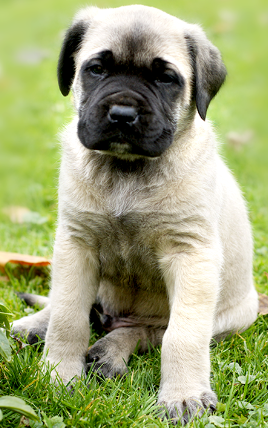
English mastiff [Partially capitalized since England is a place]

golden retriever [Not capitalized since “golden” is an adjective, and “retriever” is a common noun]

Kara Church

Technical Editor, Advisory

Symitar Documentation Services

Posted by: Jack Henry | March 27, 2018

Editor’s Corner: March 2018 Q&A from CMOS

Good morning! Today I’m delivering some words of wisdom from the Chicago Manual of Style on prepositions, spaces in sentences, and using texting abbreviations in other forms of writing. This comes with the standard CMOS snark alert!

Q. When did Chicago Manual of Style first state that ending a sentence with a preposition is not wrong (section 5.180 in current CMOS)?

A. CMOS has never prohibited a preposition at the end of a sentence in any of its versions and editions since 1906. The first edition to state positively that a preposition may end a sentence was the 15th, in 2003, the first edition of the Manual to contain a chapter on grammar.

Q. OK, so the one-space-between-sentences debate has been beaten to death. However, are there any instances where putting two spaces between two things is appropriate?

A. Nope! Not in Chicago style. One of the steps our editors include in their final manuscript cleanup before typesetting is to run a macro that changes every instance of two spaces to one. Where extra space is needed (such as for indentations), it is created with tabs or paragraph settings, not by entering multiple spaces. Sometimes a writer uses spaces to create complex content (such as poetry or “word pictures”) that the editor wants to preserve. In that case, the editor must send special instructions to prevent the typesetters from messing everything up with their own macros.

Q. When, if ever, is it acceptable to use the abbreviation for To Whom It May Concern (TWIMC) in a letter?

A. As a form of address? Let’s say never.

Kara Church

Technical Editor, Advisory

619-542-6773 | Ext: 766773

Symitar Documentation Services

NOTICE: This electronic mail message and any files transmitted with it are intended
exclusively for the individual or entity to which it is addressed. The message,
together with any attachment, may contain confidential and/or privileged information.
Any unauthorized review, use, printing, saving, copying, disclosure or distribution
is strictly prohibited. If you have received this message in error, please
immediately advise the sender by reply email and delete all copies.

Posted by: Jack Henry | March 26, 2018

Editor’s Corner: How Words Get Added to the Dictionary

This is a follow up to the article that I sent last week regarding the new words added to Merriam-Webster. I received lots of inquires asking how words get added to the dictionary. First, let me start by saying that Merriam-Webster doesn’t just add words willy-nilly. The dictionary editors, or lexicographers, spend several hours a day researching changes in the English language.

If you are interested, here is an article from Merriam-Webster that describes their process for adding words and new definitions of words to the dictionary.

Here is a fun diagram that breaks down their process.

Jackie Solano | Technical Editor | Symitar®

8985 Balboa Ave. | San Diego, CA 92123 | Ph. 619.542.6711 | Extension: 766711

Symitar Documentation Services

NOTICE: This electronic mail message and any files transmitted with it are intended
exclusively for the individual or entity to which it is addressed. The message,
together with any attachment, may contain confidential and/or privileged information.
Any unauthorized review, use, printing, saving, copying, disclosure or distribution
is strictly prohibited. If you have received this message in error, please
immediately advise the sender by reply email and delete all copies.
Posted by: Jack Henry | March 23, 2018

Editor’s Corner: Turtles

During my last night in Mexico, I was eating dinner with my family after an exciting Segway ride. We’d been down to the beach to see the baby turtles that were born that day, and we got to “play” with them before they were sent to sea.

As my brother grabbed a tortilla from the basket on the table, he said, “Do you think the word tortuga (Spanish for turtle) and the word tortilla are from the same root?” I responded, “I don’t think so, but I’ve never looked up any Spanish etymologies.”

My brother said he thought they must be related, because when you make tortillas, they rise up in the middle sometimes and look like a turtle shell. I’ll believe almost anything, but this sounded suspicious, so I promised I’d look into it.

First, from a new website, the Online Etymological Dictionary of Spanish:

torta f. (noun) "pie," "cake"

13th cent. From Late Latin torta "bread loaf." Of unknown origin.

tortilla f. (noun) "tortilla;" "omelet"

17th cent. More literally "little pie," a diminutive of torta.

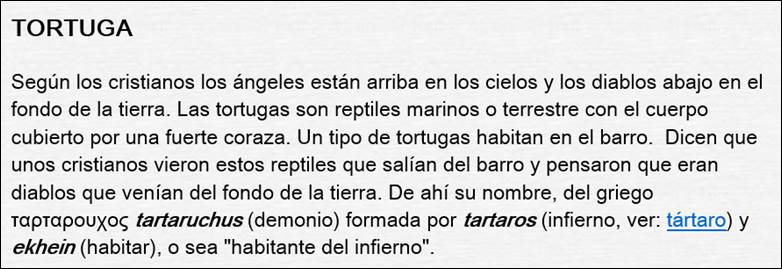
Okay. Those aren’t terribly helpful etymologies. I decided to look for Tortuga elsewhere. This time I went for Etymologias and I found this:

For those of you non-Spanish speakers, this is my best attempt at a translation. I’m sure fluent speakers could offer you something prettier, but at least it is an interesting etymology.

According to Christians, angels are up in the sky and devils are deep in the earth. Turtles are marine or terrestrial reptiles with a body covered by a strong shell. One type of turtles lives in the mud. The say Christians saw these reptiles that came from the mud and thought that they were devils from the depths of the earth. The name is from the Greek tartaruchus (demon) from tartaros (hell) and ekhein (inhabit), or “inhabitant of hell.” [KC – Maybe hell-dweller?]

And finally, the etymology of turtle from my favorite folks at the Online Etymology Dictionary:

turtle

“tortoise,” c. 1600, originally “marine tortoise,” from French tortue, tortre (13c.) “turtle, tortoise” (often associated with diabolical beasts, of unknown origin. The English word perhaps is a sailors’ mauling of the French one, influenced by the similar sounding turtle (from turtledove – Old English turtle from Latin turtur “turtledove”). Later extended to land tortoises; sea-turtle is attested from 1610s.

So, to my brother—I’m afraid they aren’t related, but we are, and I had a great time in Mexico with you!

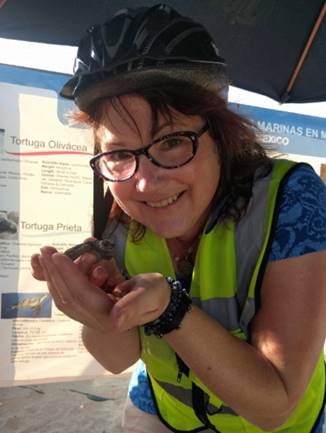
Me holding my newborn friend, the sea turtle.

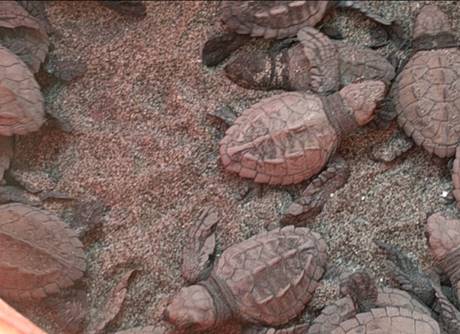
Bucket full o’ newborns

Kara Church

Technical Editor, Advisory

Symitar Documentation Services

Posted by: Jack Henry | March 22, 2018

Editor’s Corner: Crocodiles and Alligators

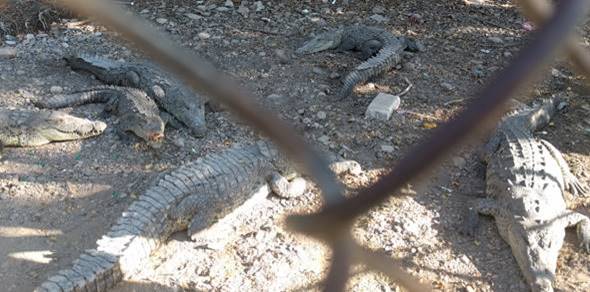
While down in Mexico for a few days, I was fortunate enough to spend time with some newborn sea turtles and some crocodiles. Luckily, the sea turtles were in my hand and the crocodiles were on the other side of a fence, rather than the other way around.

Here is some interesting information about the biological differences between crocodiles and alligators, along with the etymologies of both words.

From Live Science:

The two reptile groups are close relatives, so their physical similarities are expected.

Upon closer inspection, not recommended out in the wild, you’d spot glaring differences:

  • Snout shape: Alligators have wider, U-shaped snouts, while crocodile front ends are more pointed and V-shaped.
  • Toothy grin: When their snouts are shut, crocodiles look like they’re flashing a toothy grin, as the fourth tooth on each side of the lower jaw sticks up over the upper lip. For alligators, the upper jaw is wider than the lower one, so when they close their mouths, all their teeth are hidden.
  • Home base: Crocodiles tend to live in saltwater habitats, while alligators hang out in freshwater marshes and lakes.

From the Online Etymology Dictionary:

alligator (noun)

1560s, “large carnivorous reptile of the Americas,” lagarto, aligarto, a corruption of Spanish el lagarto (de Indies) “the lizard (of the Indies),” from Latin lacertus (see lizard), with Spanish definite article el, from Latin ille.

Internet photo of an alligator

crocodile (noun)

1560s, restored spelling of Middle English cokedrille, kokedrille (c. 1300), from Medieval Latin cocodrillus, from Latin crocodilus, from Greek krokodilos, word applied by Herodotus to the crocodile of the Nile, apparently due to its basking habits, from kroke “pebbles” + drilos “worm.”

Kara’s vacation photo of some crocodiles (cocodrilos) near the ocean in Puerto Vallarta. These guys were waiting for us to feed them raw chicken. The largest ones (not pictured) were 14–15 feet long.

Kara Church

Technical Editor, Advisory

Symitar Documentation Services

Posted by: Jack Henry | March 21, 2018

Editor’s Corner: Names

During my recent trip south of the border, I was sitting at breakfast with my dad, and he was reminding me of the waiters’ names at the place where he hangs out. When he got to Francisco (nicknamed Paco) he called him “Tocayo.” “I thought that was Paco, Dad.” I said. My dad goes by Frank, but his real name is Francis. He explained that in Mexico, if two people go by the same name, they call each other “Tocayo” (or “Tocaya” if they are female).

I asked if that meant “brother from another mother,” but Dad explained it as someone sharing the same name, or namesake.

Today, I have some other terms for you related to names. These are the ones I could think of off the top of my head, but there are probably more. The definitions are brought to you by Merriam-Webster.

  • namesake: one that has the same name as another; especially: one named after another
  • nickname

1: a usually descriptive name (as Shorty, Tex) given instead of or in addition to the one belonging to a person, place, or thing

2: a familiar form of a proper name (as Bill, Tommy)

  • pseudonym: a fictitious name assumed (as by an author) for the time: pen name
  • alias: another name: an assumed name
  • nom de guerre: a fictitious name: pseudonym [KC – French. Translates as “war name.”]
  • nom de plume: a pseudonym assumed by a writer: pen name [KC – French. Translates as “pen name.”]
  • pen name: an author’s pseudonym

Brothers from another mother

Kara Church

Technical Editor, Advisory

Symitar Documentation Services

« Newer Posts - Older Posts »

Categories