Posted by: Jack Henry | April 13, 2018

Editor’s Corner: Illeism

Good day, folks! This is on the long side, but I didnt want to edit the article. The article was written by Samantha Enslen, from Dragonfly Editorial. It was read on a podcast by Grammar Girl (Mignon Fogarty).

Recently, Grammar Girl listener Mark J. Yevchak wrote in with an interesting question. Hed been watching the HBO miniseries Generation Kill, about the first days of the war in Iraq, and he noticed that one of the characters, Lt. Col. Stephen Godfather Ferrando, often uses his own name when speaking.

Here are a few examples:

The general has asked this battalion to be America’s shock troops, and Godfather can’t tell the general we don’t do windows."

Godfather doesn’t like being told what to do by the enemy.

Godfather needs an airfield.

Mark wanted to know what its called when someone talks like this. And he wondered if he was alone in thinking it made the speaker sound self-righteous.

Mark, here are your answers.

Illeism Is the Habit of Referring to Yourself in the Third Person

This verbal tic is known as "illeism." That’s the habit of referring to yourself in the third person.

It can make the speaker sound egotistical. Think of Dwayne Johnson as "The Rock" asking, "Can you smell what The Rock is cooking?"

He used illeism deliberately to exaggerate his self-importance.

Think also of the character Hercule Poirot in Agatha Christies mysteries. Christie often portrayed the detective as referring to himself in the third person, as a way of depicting his self-grandeur. In one of her books, another character asks him about it:

Dr. Lutz: Tell me, why do you insist on referring to yourself in the third person? It’s intensely irritating!

Hercule Poirot: It helps Poirot to keep a distance from his genius.

In the real world, speakers sometimes also revert to illeism when they want to create some distance between themselves and their actions. For example, when basketball player LeBron James was criticized for leaving the Cleveland Cavaliers to join the Miami Heat, he responded using illeism: One thing I didnt want to do was make an emotional decision I wanted to do what was best for LeBron James what would make him happy.

James was lampooned for speaking this way and accused of being narcissistic. He might have been, or he might have been trying to control his emotions in a positive way.

Illeism Can Be a Positive Form of Self-Talk

You see, a 2017 study in the journal Nature showed that using illeism can actually be helpful. The study found that using your own name when youre speaking to yourself, rather than the pronoun I, can help you better control your feelings and behavior when youre under stress.

The scientists theorized that third-person self-talk leads people to think about the self similar to how they think about others. This provides them with the psychological distance needed to facilitate self-control.

In other words, if you give yourself a command using the word you or your own name, youre more likely to do it than if you use the word I.

Weird, huh?

Heres an example. If youve ever watched Serena Williams play tennis, youve probably heard her shout come on! Shes talking to herself, but she uses a second-person imperative command, with an implied subject: (You) come on! Williams tends to do this after difficult points or at critical moments in the match. Shes talking to herselfbut at a slight distance, as if she were her own coach or cheerleader.

The scientists in the Nature study call this type of self-talk a relatively effortless form of self-control.

Id suggest nearly all of us could try this, bringing illeism to bear in our day-to-day lives. For example:

  • Instead of saying Im totally going to fail this math test, say Youre going to study like a champ, and youre going to ace this math test.
  • Instead of saying Theres no way I can run a mile, say Youre tough. You can make it. Keep going.
  • Instead of saying It will take me forever to wash these dishes, say Nate, just wash one dish at a time. Get started and youll get it done.

Dont Let Illeism Become Hulk Speak

One cautionyou may want to say these encouragements in your head or whisper them quietly to yourself.

Otherwise, you could be accused of another variation of illeism"Hulk Speak. Thats when a speaker refers to him- or herself in the third person and strips out most of the prepositions and articles.

Heres an example from the movie Thor: Ragnarok.

Hulk: Hulk always angry.

Thor: I know. We’re the same, you and I. Just a couple of hot-headed fools.

Hulk: Yeah, same. Hulk like fire, Thor like water.

Thor: Well, we’re kind of both like fire.

Hulk: But Hulk like real fire. Like … raging fire. Thor like smoldering fire.

So when youre trying to finish that 5K, rather than shouting You got this, Monica, you might want to whisper. If people still look at you funny, just explain youre using a literary device known as illeism, and that its derived from the Latin word ille, meaning "he or that man. That should keep them quiet.

Kara Church

Technical Editor, Advisory

Symitar Documentation Services

Posted by: Jack Henry | April 12, 2018

Editor’s Corner: Gift as a Verb

Good morning to you. I recently read an interesting article on the Grammar Girl website that discussed whether it’s acceptable to use the word “gift” as a verb (for example, “Anne was thrilled to be able to gift her daughter with a lovely pair of pearl earrings”).

I know many of you are internally yelling “No!” However, the article points to a long history (nearly 400 years) of using gift as a verb. In the beginning, it was most often used to mean endow, which is a more formal type of giving (think dowry).

Apparently, it was common in the 1800s to use the words gift and gifting “for formal giving that cements reciprocal or patronage relationships.” Grammar Girl cites an example in which Europeans and indigenous people used the practice of gifting to establish relationships.

Using gift and gifting as verbs fell out of favor until the 1930s, when people started talking about the gift tax. Because of the term gift tax, people started using the term gifting money rather than giving money.

And more recently, in 1995, an episode of Seinfeld airedthatmay be responsible for repopularizing the use of gift as a verb. In the episode, a character was accused of regifting, and after the episode aired, there seems to have been an increase in the use of gift as a verb, likely as a back formation of regifting.

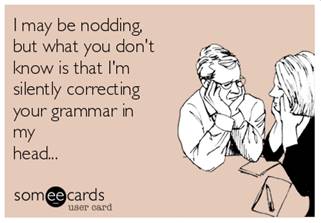
Before you send me an angry email, please know that I am not condoning the use of gift and gifting instead of the more commonly accepted verbs give and giving (which I wholeheartedly prefer). I am just pointing out that you might not want to judge people too harshly who do use gift as a verb. This is not new-fangled terminology. (But you do have my support if you choose to silently correct them in your head.)

Donna Bradley Burcher | Senior Technical Editor | Symitar®

8985 Balboa Ave. | San Diego, CA 92123 | Ph. 619.278.0432 | Ext: 765432

Posted by: Jack Henry | April 11, 2018

Editor’s Corner: Invite vs. Invitation

Dear Editrix,

When did the word “invite” become a noun? More and more, I hear people using it this way. It’s a verb in my book. Please advise.

Tense in Tennessee

Dear Tense,

I’m with you. The verb is “invite,” and the noun is “invitation.” The same goes with the couple “install” (the verb) and “installation” (the noun). I often hear people saying that they will send an “invite” instead of an invitation. Or perhaps you’ll hear someone asking for an update on the “install” instead of the installation.

Most resources still agree that when you are writing or talking to people in a serious or formal setting, you should use these words as they were intended and skip using “installs” and “invites” as nouns.

But, language changes, and we may be witnesses as these words become more acceptable as different parts of speech. (One of the references I found online said that the shortcut, “invite” as a noun, has been around since the mid-seventeenth century, and he provided two examples from the OED.)

When you hear “invite” used as a noun, you can still disagree. I’ll support you. We’re at work, and that is “formal” enough. Keep fighting the good fight!

Editrix

Kara Church

Technical Editor, Advisory

Symitar Documentation Services
Posted by: Jack Henry | April 10, 2018

Editor’s Corner: Comma Splices

Way back in February, we talked a little bit about run-on sentences and how to fix them (Editor’s Corner 02/20/2018). Today’s topic of discussion is the comma splice, the run-on sentence’s crazy cousin.

Comma splices are related to run-ons in that they both connect independent clauses incorrectly. With a comma splice, a comma connects the two independent clauses.

For example: We make popcorn after dinner every night, we then watch a movie and eat snacks together. (Incorrect)

Let’s have a look at some different ways to fix the problem.

  1. Break the two clauses into separate sentences.

Correct: We make popcorn after dinner every night. We then watch a movie and eat snacks together.

  1. Add a coordinating conjunction and a comma.

Correct: We make popcorn after dinner every night, and we then watch a movie and eat snacks together.

  1. Change the comma to a semicolon.

Correct: We make popcorn after dinner every night; we then watch a movie and eat snacks together.

Kara Church

Technical Editor, Advisory

Symitar Documentation Services

Posted by: Jack Henry | April 9, 2018

Editor’s Corner: How to Write About Combo Boxes

Drop-down lists allow users to select one option from a list. Text fields allow users to enter free-form text. A combo box is a combination of a drop-down list and a text field. It allows users to select a value from a list or enter another value that isn’t listed.

The Font Size combo box in Microsoft® Word is a good example. At first glance, it looks like a drop-down list:

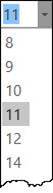
If you click the drop-down arrow, you can select from a list of options:

However, you can also enter a font size that isn’t listed. For example, you can type 13:

How to Describe Combo Boxes

The phrase “combo box” may not be familiar to all readers. It is not worth using a potentially confusing term when it’s not necessary.

If you are just telling readers to type something into a combo box, call it a field. If you are telling them to select something, call it a drop-down list.

Example: In the Font Size field, type 13.

Example: In the Font Size drop-down list, select 11.

If you are giving readers a choice between typing something or selecting something from the list, call it a field.

Example: In the Font Size field, enter or select the font size you want to use.

When You Can’t Avoid Saying “Combo Box”

If you are writing about the user interface itself, it is sometimes necessary to distinguish between a drop-down list and a combo box. Define combo box the first time you mention it, as you would with any unfamiliar term.

Example: This button places a drop-down list or a combo box on your form. A combo box allows you to select a value from a list or enter another value that is not listed.

Ben Ritter | Technical Editor | Symitar®
8985 Balboa Avenue | San Diego, CA 92123
619-682-3391 | or ext. 763391 | www.Symitar.com

Symitar Documentation Services

NOTICE: This electronic mail message and any files transmitted with it are intended
exclusively for the individual or entity to which it is addressed. The message,
together with any attachment, may contain confidential and/or privileged information.
Any unauthorized review, use, printing, saving, copying, disclosure or distribution
is strictly prohibited. If you have received this message in error, please
immediately advise the sender by reply email and delete all copies.

Posted by: Jack Henry | April 6, 2018

Editor’s Corner: Spodie

Christine, this one’s for you!

Last week I was talking to one of my fellow former Washingtonians. We were talking about the clothes we grew up wearing, but somehow, we ended up on a completely different topic: Spodie. What is Spodie? Well, you may know it by a different name, such as Hairy Buffalo, Jungle Juice, Graveyard Punch, Wapatoola, Purple Jesus, Trashcan Punch, Hunch Punch, Purple Death, Colorless Death… and the list goes on.

This concoction, whatever you call it, is a potent cocktail. One of the “recipes” starts out with “Go out and buy a brand-new plastic garbage receptacle.” Yes, we’re already in danger with that, and we haven’t even put anything in there yet.

From there, you’re supposed to grab a block of ice, fruit punch, possibly some club soda, and then the games begin. Each guest brings whatever alcohol they have handy (Everclear and wine are mentioned in many “recipes”). Or, if you’re underage, you can bring whatever fruit you have handy and add it to the garbage can.

As the night progresses, so does the delicate bouquet of your spodie. Grab your red Solo cup or an empty jar, and scoop up a mouthful. Yee haw!

Here’s a Wiki recipe for “Dirty Hunch Punch,” though I think they all qualify as pretty dirty:

1 750 ml bottle Everclear

1 750 ml bottle coconut rum

½ 750 ml bottle vodka

16 ounces (473ml) pineapple juice

1 gallon (3.8 l) fruit punch

Orange and pineapple slices

Ice

Do you remember such a drink or event from your young adulthood? I think we might need to contact those guys who do the maps of different terms across America. Until then, here’s a little about the history of this drink from the article “The Twisted History of Jungle Juice” by Kenzi Wilbur.

They [KC – World War II U.S. servicemen] turned to fermenting anything they could with sugar in everything from coconuts to gasoline drums to homemade, patchwork stills. Depending on the “distiller,” the resulting beverage ranged from a fermented brew tinted golden-green from swamp water to a pale, 100-proof distillate. In any iteration, it was a ferociously potent liquid that, though less classy, was not unlike the punches of our lawn parties. It was a mixture vastly greater than the sum of its parts, consumed in quantity, drunk down quickly and with purpose. In what Anderson declares one of “the American service man’s greatest contributions,” jungle juice was born.

Kara Church

Technical Editor, Advisory

619-542-6773 | Ext: 766773

Symitar Documentation Services

NOTICE: This electronic mail message and any files transmitted with it are intended
exclusively for the individual or entity to which it is addressed. The message,
together with any attachment, may contain confidential and/or privileged information.
Any unauthorized review, use, printing, saving, copying, disclosure or distribution
is strictly prohibited. If you have received this message in error, please
immediately advise the sender by reply email and delete all copies.

Posted by: Jack Henry | April 5, 2018

Editor’s Corner: Cavalier

Good morning!

I was scanning through some of the newsletters I get each day, and the word cavalier in the Grammarist email caught my eye. I know what cavalier means, but I thought, “Boy, that looks like the French word for knight (chevalier).” Wondering if there were a connection, I decided to read on. Here are my findings!

From the Grammarist:

Cavalier is a term that has been in use since the 1600s, and has its roots in a political rivalry.

The word cavalier is currently most often used as an adjective to mean without proper care or concern, in a disdainful or dismissive manner. The word cavalier originally meant a horseman, and particularly a loyal follower of the British King Charles I. The term cavalier was used as a kind of insult, insinuating that the Cavaliers were men who were pompous and overbearing. The Cavaliers took back the term as a title of honor and loyalty, the same way that the LGBT community has worked to change the word queer from a slur to a proud appellation. The word cavalier is derived from the Latin word caballarius, meaning horseman. When used to mean the historical followers of Charles I, the term is capitalized as in Cavalier.

Ah ha! So there is definitely a connection in that Latin root caballarius. The Spanish words caballo (horse) and caballero (gentleman) are even closer than the French word chavalier. Of course, I couldn’t just stop there. I thought I’d see what the Online Etymology Dictionary had to say, too.

cavalier (adj.)

"disdainful," by 1817, from earlier sense "easy, offhand" (1650s); originally "gallant, knightly, brave" (1640s), from cavalier (n.) in its Elizabethan senses.

cavalier (n.)

1580s, "a horseman," especially if armed, from Italian cavalliere "mounted soldier, knight; gentleman serving as a lady’s escort," from Late Latin caballarius "horseman," from Vulgar Latin caballus, the common Vulgar Latin word for "horse" (and source of Italian cavallo, French cheval, Spanish caballo, Irish capall, Welsh ceffyl), displacing Latin equus (from PIE root *ekwo-).

In classical Latin caballus was "work horse, pack horse," sometimes, disdainfully, "hack, nag." This and Greek kaballion "workhorse," kaballes "nag" probably are loan-words, perhaps from an Anatolian language. The same source is thought to have yielded Old Church Slavonic kobyla.

The sense was extended in Elizabethan English to "a knight; a courtly gentleman," but also, pejoratively, "a swaggerer." Meaning "Royalist, adherent of Charles I" is from 1641.

And last, but not least, we can’t forget the Chevy Cavalier!

Enjoy your day!

Kara Church

Technical Editor, Advisory

Symitar Documentation Services

Posted by: Jack Henry | April 4, 2018

Editor’s Corner: CMOS April 2018

I chose today’s items from the Chicago Manual of Style because they’re both related to hyphens and dashes. As a reminder, the three symbols people often confuse are:

  • Hyphen (-)
  • En dash (–)
  • Em dash (—)

A more detailed refresher is here: Editor’s Corner.

From the CMOS:

Q. In cases where a single short quotation stands completely on its own (such as in the front matter of a book or in a social media post), I generally see it attributed using a dash and the person’s name (“—Albert Einstein,” for example). Is this format accepted by Chicago, or is it strictly informal? Also, is it an em dash, en dash, or hyphen?

A. The use of an em dash with the source of an epigraph indeed fits with Chicago style.

Q. If someone has a compound surname like “De Chicago-Smith,” do we use an en dash? I understand the rationale, but I think it looks weird (but who cares what I think?). What about “De Chicago-Von Suedkurve Auf Der CSS&SBRR,” for example?

A. Although a simple hyphenated name normally takes (no surprise) a hyphen, a name with multiple appendages might be able to pull off the slightly longer en dash. Anyone with such a dazzling name as “De Chicago–Von Suedkurve Auf Der CSS&SBRR” deserves all the dashes and doodads they want. (And we care what you think.)

[KC – Yes, of course they care. They care so much they basically called the writer an ignoramus in the first sentence. Thanks, CMOS, for always following through with the superior
attitude!]

And an old favorite:

Kara Church

Technical Editor, Advisory

Symitar Documentation Services

Posted by: Jack Henry | April 3, 2018

Editor’s Corner: Tuesday Church Bloopers

Good morning! I’ve been scraping the bottom of the barrel to find new church bulletin bloopers for you. Here are a few more for you from Pastors.com and Angelfire (no, I did not make that up). Enjoy!

  1. Don’t miss this Saturday’s exhibit by Christian Martian Arts.
  2. We are grateful for the help of those who cleaned up the grounds around the church building and the rector.
  3. A worm welcome to all who have come today.
  4. The ushers will come forward and take our ties and offerings.
  5. Applications are now being accepted for 2-year-old nursery workers.
  6. Let us join David and Lisa in the celebration of their wedding and bring their happiness to a conclusion.
  7. Helpers are needed! Please sign up on the information sheep.
  8. Diana and Don request your presents at their wedding.
  9. The 1991 Spring Council Retreat will be hell May 10 and 11.
  10. Hymn: “I Love Thee My Ford.”
  11. We would like to congratulate Tony and Renee on the birth of their 4th child this week.
  12. Revival Friday night with Jack Daniels!
  13. The Little Mothers Group will be meeting on Thursday mornings at 10:00 a.m. Anyone interested in becoming a Little Mother please see the Pastor in his study.
  14. A new loudspeaker system has been installed in the church. It was given by one of our members in honor of his wife.
  15. Glory of God to all and peas to his people on earth.
  16. Men’s Prayer Breakfast. No charge, but your damnation will be gratefully accepted.
  17. Instructions:
  • The pastor will light his candle from the altar candles.
  • The ushers will light their candle from the pastor’s candle.
  • The ushers will turn and light each worshipper in the first pew.

I had a funny church sign photo, but my editor said it might offend some, so instead I will send you a photo of Harvey, my dog, who graduated from basic training a week ago. Hopefully this is not disturbing to you!

The Graduate

Kara Church

Technical Editor, Advisory

Symitar Documentation Services

Posted by: Jack Henry | April 2, 2018

Editor’s Corner: Contronyms

A contronym is a word with two meanings that can contradict each other depending on the context. Here is a list of contronyms from Daily Writing Tips.

1. Apology: A statement of contrition for an action, or a defense of one
2. Aught: All, or nothing
3. Bill: A payment, or an invoice for payment
4. Bolt: To secure, or to flee
5. Bound: Heading to a destination, or restrained from movement
6. Buckle: To connect, or to break or collapse
7. Cleave: To adhere, or to separate
8. Clip: To fasten, or detach
9. Consult: To offer advice, or to obtain it
10. Continue: To keep doing an action, or to suspend an action
11. Custom: A common practice, or a special treatment
12. Dike: A wall to prevent flooding, or a ditch
13. Discursive: Moving in an orderly fashion among topics, or proceeding aimlessly in a discussion
14. Dollop: A large amount (British English), or a small amount
15. Dust: To add fine particles, or to remove them
16. Enjoin: To impose, or to prohibit
17. Fast: Quick, or stuck or made stable
18. Fine: Excellent, or acceptable or good enough
19. Finished: Completed, or ended or destroyed
20. First degree: Most severe in the case of a murder charge, or least severe in reference to a burn
21. Fix: To repair, or to castrate
22. Flog: To promote persistently, or to criticize or beat
23. Garnish: To furnish, as with food preparation, or to take away, as with wages
24. Give out: To provide, or to stop because of a lack of supply
25. Go: To proceed or succeed, or to weaken or fail
26. Grade: A degree of slope, or a horizontal line or position
27. Handicap: An advantage provided to ensure equality, or a disadvantage that prevents equal achievement
28. Help: To assist, or to prevent or (in negative constructions) restrain
29. Hold up: To support, or to impede
30. Lease: To offer property for rent, or to hold such property
31. Left: Remained, or departed
32. Let: Allowed, or hindered
33. Liege: A feudal lord, or a vassal
34. Literally: Actually, or virtually
35. Mean: Average or stingy, or excellent
36. Model: An exemplar, or a copy
37. Off: Deactivated, or activated, as an alarm
38. Out: Visible, as with stars showing in the sky, or invisible, in reference to lights
39. Out of: Outside, or inside, as in working out of a specific office
40. Overlook: To supervise, or to neglect
41. Oversight: Monitoring, or failing to oversee
42. Peer: A person of the nobility, or an equal
43. Presently: Now, or soon
44. Put out: Extinguish, or generate
45. Puzzle: A problem, or to solve one
46. Quantum: Significantly large, or a minuscule part
47. Quiddity: Essence, or a trifling point of contention
48. Quite: Rather (as a qualifying modifier), or completely
49. Ravel: To entangle, or to disentangle
50. Refrain: To desist from doing something, or to repeat
51. Rent: To purchase use of something, or to sell use
52. Rock: An immobile mass of stone or figuratively similar phenomenon, or a shaking or unsettling movement or action
53. Sanction: To approve, or to boycott
54. Sanguine: Confidently cheerful, or bloodthirsty
55. Scan: To peruse, or to glance
56. Screen: To present, or to conceal
57. Seed: To sow seeds, or to shed or remove them
58. Shop: To patronize a business in order to purchase something, or to sell something
59. Skin: To cover, or to remove
60. Skinned: Covered with skin, or with the skin removed
61. Splice: To join, or to separate
62. Stakeholder: One who has a stake in an enterprise, or a bystander who holds the stake for those placing a bet
63. Strike: To hit, or to miss in an attempt to hit
64. Table: To propose (in British English), or to set aside
65. Temper: To soften, or to strengthen
66. Throw out: To dispose of, or to present for consideration
67. Transparent: Invisible, or obvious
68. Trim: To decorate, or to remove excess from
69. Trip: A journey, or a stumble
70. Unbending: Rigid, or relaxing
71. Variety: A particular type, or many types
72. Wear: To endure, or to deteriorate
73. Weather: To withstand, or to wear away
74. Wind up: To end, or to start up
75. With: Alongside, or against

Jackie Solano | Technical Editor | Symitar®

8985 Balboa Ave. | San Diego, CA 92123 | Ph. 619.542.6711 | Extension: 766711

Symitar Documentation Services

NOTICE: This electronic mail message and any files transmitted with it are intended
exclusively for the individual or entity to which it is addressed. The message,
together with any attachment, may contain confidential and/or privileged information.
Any unauthorized review, use, printing, saving, copying, disclosure or distribution
is strictly prohibited. If you have received this message in error, please
immediately advise the sender by reply email and delete all copies.

« Newer Posts - Older Posts »

Categories