Posted by: Jack Henry | July 12, 2018

Editor’s Corner: Summertime, Part 2

Hello, and happy Thursday!

Today I have the other five words from the article “9 Words for the Wild and Carefree” for you. Again, if you would like more information about each of the words, click the link above.

  • lightsome (adjective) free from care: lighthearted

  • kamikaze (adjective) having or showing reckless disregard for safety or personal welfare

The adjective kamikaze has its origin in a weather event: in the 13th century, Kublai Khan, the Mongol emperor of China, tried to conquer Japan by sending out great fleets of ships—on two separate occasions. Both times, the efforts were thwarted by storms, which the Japanese took to be protection from the gods. They dubbed their inclement salvation kamikaze, "divine wind." Six and a half centuries later, during World War II, Japanese members of a special air corps assigned to make suicidal crashes on targets were called kamikaze, after the storms that had saved the country from their 13th century would-be invaders. English speakers readily adopted both the noun, which refers to those Japanese pilots or the planes they flew, and the adjective, which can describe kamikaze pilots or people or things having or showing reckless disregard for safety or personal welfare.

  • slaphappy (adjective) buoyantly or recklessly carefree or foolish: happy-go-lucky

  • insouciant (adjective) lighthearted unconcern: nonchalance

  • hellbender (noun, slang) one who is exceedingly reckless or otherwise extreme

Kara Church

Technical Editor, Advisory

Symitar Documentation Services

Posted by: Jack Henry | July 11, 2018

Editor’s Corner: Summertime!

Summertime, and the living is easy…at least that’s what the song says! In the real world, it is hot as blazes and some of us spent too much time in the sun without our hats. (I had a hat, I just left it on the dining room table.)

Beth Y. shared a great article with me called “9 Words for the Wild and Carefree,” and I thought it was perfect for these summer days. Today I’ll share the first four with you; tomorrow you get the next five. Merriam-Webster goes into more detail for each word, but here you get the abbreviated version, along with some of the pictures illustrating the words. Enjoy!

  • daredevil (adjective) recklessly and often ostentatiously daring

  • madcap (adjective) marked by capriciousness, recklessness, or foolishness

Your thinking cap helps you think and your madcap makes you mad—as in "like the Hatter from Alice’s Adventures in Wonderland," not "angry." Although madcap is more familiar as an adjective, Shakespeare liked the noun version of this word, which in fact never applied to a literal cap, but referred to a madcap person: "Come on, you madcap; I’ll to the alehouse with you presently; where, for one shot of five pence, thou shalt have five thousand welcomes" (The Two Gentlemen of Verona). As an adjective the word typically describes schemes and antics and zany movie plots.

  • happy-go-lucky (adjective) blithely unconcerned: carefree

  • foolhardy (adjective) foolishly adventurous and bold: rash

Kara Church

Technical Editor, Advisory

Symitar Documentation Services
Posted by: Jack Henry | July 10, 2018

Editor’s Corner: Cut and Dried

Dear Editrix,

I just heard a person in this video say, “It’s not always cut and dried.” I always thought I was hearing “cut and dry” and so now I’m wondering which one is it and what does it mean? Is a cut and blow dry from a barber supposed to be simple or something?

Curious in California

Dear Curious,

Here’s what I found on this topic. First, from The Grammarist:

The phrasal adjective cut and dried describes things that are (1) prepared and arranged in advance, or (2) ordinary or routine. The phrase’s exact origins are mysterious, but it seems to date from the early 1700s—when it was used in roughly the same manner as today—and it presumably comes from agriculture.

Cut and dried is often written cut and dry, which isn’t a serious error because dry works as an adjective with essentially the same meaning as dried.

The phrase can take hyphens when it precedes what it modifies—for example:

It appears to be a cut-and-dried tale; noble activists and caring government come together to do something positive. [The
Daily Star
]

When I tell people that I study engineering, they often assume it is a cut-and-dried trajectory. [WSJ]

This hyphenation is normal for phrasal adjectives that precede what they modify, but we can also think of cut and dried as a pair of coordinate adjectives separately modifying their noun, in which case there is no need for the hyphens.

When the phrase is a predicate adjective, as below, there is no reason to hyphenate it:

“I thought it was pretty cut and dried,” said Ms. Long, who is a registered nurse. [NYT]

Second, some synonyms from Merriam-Webster:

average, common, commonplace, everyday, garden-variety, normal, ordinary, prosaic, routine, run-of-the-mill, standard, unexceptional, unremarkable, usual, workaday

Speaking of synonyms, here is a one-liner someone sent me:

“I own the world’s worst thesaurus. Not only is it awful, it’s awful.”

Kara Church

Technical Editor, Advisory

Symitar Documentation Services
In my previous post about parenthetical phrases, I talked about commas, parentheses, and em dashes. This week, I’ll discuss the once-common practice of using two hyphens instead of an em dash.

Typewriters

Typewriters don’t have em dash keys, so typists used two hyphens to visually approximate an em dash.

This practice declined in popularity along with the typewriter itself. However, the double hyphen is still used in some situations where a true em dash is not available (for example, in ASCII-encoded text).

Monospaced Fonts

Most fonts are “proportional fonts,” meaning that some characters are wider than others. For example, a capital letter W is usually wider than a lowercase letter l.

In proportional fonts, em dashes, en dashes, and hyphens can are easily distinguished by their varying widths. An em dash (—) is as wide as the letter M, an en dash (–) is as wide as the letter N, and a hyphen (-) is about half as wide as an en dash.

In monospaced fonts, such as Courier New and Lucida Console, every character is the same width. Although these fonts do have an em dash character, it’s hard to tell it apart from the en dash and the hyphen.

Although I couldn’t find an applicable rule in any of our style guides, if you’re using a monospaced font (for example, if you’re writing a screenplay), I think you would be forgiven for using two hyphens to help the reader’s understanding.

Use an Em Dash the Rest of the Time

Whenever you’re using a proportional font (which is most of the time), forget the double hyphen—use an em dash instead.

In Microsoft® Word and Outlook, if you type two hyphens (without spaces before or after), they’re automatically replaced with an em dash.

Alternatively, you can hold down the Alt and Ctrl keys, and then press on the number pad.

Ben Ritter | Technical Editor | Symitar®
8985 Balboa Avenue | San Diego, CA 92123
619-682-3391 | or ext. 763391 | www.Symitar.com

Symitar Documentation Services

NOTICE: This electronic mail message and any files transmitted with it are intended
exclusively for the individual or entity to which it is addressed. The message,
together with any attachment, may contain confidential and/or privileged information.
Any unauthorized review, use, printing, saving, copying, disclosure or distribution
is strictly prohibited. If you have received this message in error, please
immediately advise the sender by reply email and delete all copies.

Good morning. I hope you had a happy 4th. It was so nice to have a day off in the middle of the week! Time to get back to work. 😊

We’ve written many Editor’s Corner articles about acronyms and initialisms. Acronyms are abbreviations that are pronounced like words (NASA, PETA, MADD) and initialisms are abbreviations that are pronounced by saying each letter (FBI, PTA, SEDB).

When you use an acronym or initialism that is not commonly known, the JHA rule is to spell it out the first time and put the abbreviation in parentheses. After that, you can use the abbreviation alone. For instance, you might need to spell out Mothers Against Drunk Drivers (MADD) the first time you use it, but almost everyone knows that FBI stands for Federal Bureau of Investigation, so you do not need to spell out each word even on the first mention.

What I want to focus on today, however, is whether you should use an article (the, a, an) when using an acronym or initialism in your writing.

First, let’s talk about acronyms. Because they are treated like words, you usually do not need to use an article. You would write, “NASA was established in 1958,” not “The NASA was established in 1958.” The exception to this rule is when the acronym is used as an adjective, as in “The PETA protestors blocked the road and stopped traffic.”

On the other hand, most initialisms are preceded by an article, as in “The FBI launched the investigation in January.” But sometimes they are not, as in “Angela is taking a course in CPR.” Whether you use an article before an initialism is determined by established usage. Sorry I can’t give you a black or white rule to follow; but if you’re not sure, check a trusted resource. The first resource we check here at JHA is the Chicago Manual of Style (CMOS). If you do not have access to CMOS, a quick internet search, should give you the answer you need.

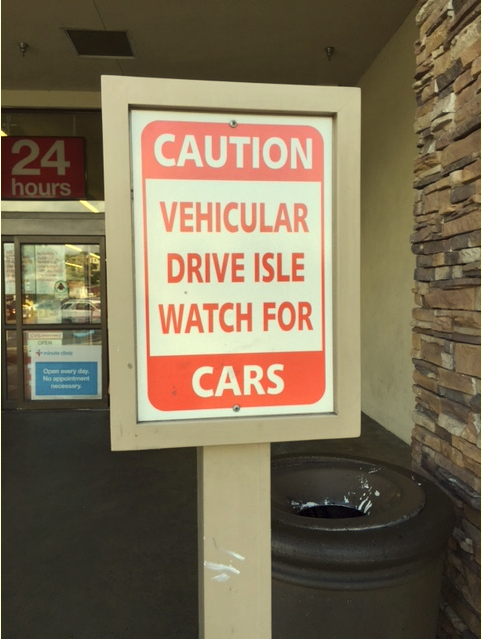
Someone probably should have thought twice about this oxymoronic acronym:

Donna Bradley Burcher | Senior Technical Editor | Symitar®

8985 Balboa Ave. | San Diego, CA 92123 | Ph. 619.278.0432 | Ext: 765432

Posted by: Jack Henry | July 3, 2018

Editor’s Corner: Speak now…

I’m not a big fan of cooking, but I try to do it so that we have healthy meals at home. In exchange, while I’m doing it, I subject the entire household to ahorrible, guilty pleasure: Bridezillas. I think part of me feels better for disliking this traditionally female activity (cooking) as I watch the most terrible, selfish, rude women in our country prepare for their weddings. After watching them, I feel like I must be a real prize for my husband. J

Anyway, on one of the last episodes of the season, the pastor said, “Speak now, or forever hold your peace,” and the groom’s sister told her brother he was making a huge mistake. Unfortunately for him, he didn’t listen. That got me wondering, why do we say that? Here to answer that question with a little history, is The Grammarist:

Speak now or forever hold your peace is an admonition to immediately share information that may not be known by others, or else keep this information to yourself for eternity. This phrase is derived from the Christian marriage ceremony. During medieval times, communication between distant communities was at best, spotty. To combat bigamy, or the practice of marrying multiple people in secret, the practice of marriage banns was enacted. When a marriage was impending it was announced for three consecutive Sundays. This would give all parishioners a chance to raise an objection to the marriage, usually on the grounds that the groom in question was already married to someone else. During the actual marriage ceremony, as a last chance to hear anyone’s information regarding the illegitimacy of the marriage about to take place, the priest was required to state that if anyone knew why the couple should not be joined in holy matrimony, let him speak now or forever hold his peace. This phrase is often, but not always, included in today’s marriage ceremonies as a formality.

The term speak now or forever hold your peace is now sometimes used in other situations as a warning that is one’s last chance to object to something or voice an opinion.

Have a happy and safe Fourth of July!

Kara Church

Technical Editor, Advisory

619-542-6773 | Ext: 766773

Symitar Documentation Services

NOTICE: This electronic mail message and any files transmitted with it are intended
exclusively for the individual or entity to which it is addressed. The message,
together with any attachment, may contain confidential and/or privileged information.
Any unauthorized review, use, printing, saving, copying, disclosure or distribution
is strictly prohibited. If you have received this message in error, please
immediately advise the sender by reply email and delete all copies.

Posted by: Jack Henry | July 2, 2018

Editor’s Corner: Food Phrases

Someone recently called me a good egg. When I hear the phrase good egg, I automatically think of the phrase bad egg and the scene from the movie Willy Wonka & the Chocolate Factory when Veruca Salt goes down the garbage chute.

Today, I thought it would be fun to review some food phrases. I gathered these phrases from various online sources.

good egg: a good person

bad egg: a bad person

have all your eggs in one basket: put too much faith in one thing

have egg on one’s face: to be caught or embarrassed

to walk on eggshells: to try hard not to upset someone or something

it’s all gravy: it’s all good

that’s the way the cookie crumbles: that is the way things happen

piece of cake: easy

icing on the cake: something added to something else that is already good

easy as pie: very easy

sell like hotcakes: to sell quickly

spill the beans: give away a secret

full of beans: lively or hyper

big cheese: an important person

use your noodle: use your brain

go bananas or go nuts: to go crazy

bring home the bacon: go earn money

a bun in the oven: pregnant

bread and butter: basic needs of life (food, shelter, clothing)

wake up and smell the coffee: to become aware of your surroundings

cup of tea: something one enjoys or does well

the best thing since sliced bread: a big deal

as keen as mustard: very enthusiastic

as cool as a cucumber: calm and unruffled

two peas in a pod: two identical items or people

a watched pot never boils: time moves slowly when you’re waiting for something to happen

cream of the crop: the best of the best

a lemon: something useless or defective

there’s no use crying over spilled milk: don’t complain about something that has already happened or that can’t be changed

peanuts: low wage

in a pickle: to be in a difficult situation

take something with a grain of salt: to be skeptical of a promise or statement; or to not take things literally or harshly

the proof is in the pudding: something is successful and useful because it has been tried before

butter someone up: to flatter or praise someone

landed in soup: to be in trouble

souped up: to change something to make it faster or more powerful

hot potato: a question or argument that is controversial and difficult to settle

to know your onions: to know a lot about a particular subject

to cherry-pick: to unfairly choose the best people or things

to use a sledgehammer to crack a nut: to do something with more force than is necessary to achieve the results you want

fish out of water: to be uncomfortable in a particular situation

to have bigger fish to fry: to have more important things to do

something is fishy: something is suspicious

a knuckle sandwich: a punch

a sandwich short of a picnic: stupid or crazy

Jackie Solano | Technical Editor | Symitar®

8985 Balboa Ave. | San Diego, CA 92123 | Ph. 619.542.6711 | Extension: 766711

Symitar Documentation Services

Posted by: Jack Henry | June 29, 2018

Editor’s Corner: Folk Etymologies

Oh boy! This post from Daily Writing Tips is right up my alley! Words, animals, etymologiessome of my favorite things all wrapped into one! I hope you find this as interesting as I did! (For the complete list, click the link above.)

Happy Friday!

This post lists words derived from words in other languages as a result of folk etymology, a process by which speakers adopt the foreign terms after revising them by using existing elements from their native language.

caterpillar: The word for a butterfly or moth larva stems from the Old French word catepelose (hairy cat); the alteration of the third and fourth syllables to -pillar (from Middle English piller, meaning plunderer) may have developed from the notion of its destructive effect on plants.

geoduck: This name for a Pacific Northwest clam, which comes from a local Native American term, has nothing to do with ducksor with the Latin prefix geo-, meaning earth; also, the spelling of the first two syllables is inexplicable, since they are pronounced like gooey.

greyhound: The first syllable of this word does not refer to the dogs color; it is from the Old English term grieg, referring to a female dog.

mongoose: The animals name stems from mamgusa in Prakrit, an Indic language. (It has nothing to do with geese, so the plural is mongooses.)

muskrat: This animal is a rodent, but its name is not derived from its scent or its kinship with rats; the word from which it derives is of Algonquian origin.

polecat: The first syllable of this name for a mammal in the weasel family (also an alternative name for the polecats relative, the skunk) is derived from the French term poul (the base of poultry), from its barnyard depredations.

popinjay: This older term for a parrot, now exclusively applied to an arrogant person, is ultimately from the Arabic word babgh.

sockeye: The name for a type of salmon does not refer to its eyes; it originates from an attempt to pronounce a Native American word for the fish.

white rhinoceros: White, in the name of this animal, is not a reference to its color; it stems from the Afrikaans adjective weit, meaning wide, a description that distinguishes its wide upper lip from the pointed lip of the black rhinoceros.

woodchuck: This alternative name for the groundhog derives from the assignment of two English words whose sounds resemble those of a Cree word.

Momma woodchuck and her wood-chucking babies.

Kara Church

Technical Editor, Advisory

Symitar Documentation Services
Posted by: Jack Henry | June 28, 2018

Editor’s Corner: More About “Fewer” and “Less”

Recently, I included the word pair “fewer and less” in an article about misused phrases. My advice was to use “fewer” for things you can count (like 140 characters) and “less” for things you cannot count (like love).

Ron H. replied with a very good question. He asked if fewer is really correct in this example:

  • Your training session should last fewer than 60 minutes.

The quick answer is no. Ron’s instincts are correct. There is more to that rule than I originally stated. With English, there is always more to the grammar rule!

The full rule states that time, money, distance, and weight are exceptions to the “if you can count it” rule.

Many of you, like Ron, probably know this instinctively, but I think it will help to provide examples. The following sentences correctly use “less” instead of “fewer” for things you can count:

Time: I can run a mile in less than 10 minutes. (Don’t laugh.)

Money: His new car cost less than $30,000.

Distance: My brother lives less than 20 miles away from me.

Weight: I weigh about 75 pounds less than my big brother.

For all other discussions of about having fewer or less of something, stick with the original rule: use “fewer” for things you can count (like the number of dogs you have) and “less” for things you cannot count (like the joy your dogs bring).

Donna Bradley Burcher | Senior Technical Editor | Symitar®

8985 Balboa Ave. | San Diego, CA 92123 | Ph. 619.278.0432 | Ext: 765432

Posted by: Jack Henry | June 27, 2018

Editor’s Corner: Tmesis

As happens at times, I receive a newsletter with something in it that makes me want to learn more. I received this email from The Grammarist about the word tmesis, and I almost didn’t open it. What an ugly looking word! But I thought, “It looks Greek. I owe it to my Greek relatives and friends to have a look.” I’m so glad I did! Here are some excerpts from the Grammarist:

A tmesis is a word that includes another word inside it. When constructing a tmesis, the speaker splits a word to insert another word inside it, usually to be humorous or to emphasize something. Some examples of a tmesis are fan-frickin’-tastic, some-other-where, zero-dark-thirty.

The word tmesis has been in use since the 1500s and is derived from the Greek word tmesis which means a cutting.

Of course, this wasn’t enough for me. I wanted more examples and I found some great information on a site about Literary Devices. I’ve cut a lot of the article out and rearranged some things to provide the examples, but if you’d like the full meal deal, just visit the site.

Tmesis is an insertion of a word between the parts of a word, a compound word, or a phrase (phrasal verbs usually). It is a practice of dividing a phrase or word into its components by inserting another word in the middle of that phrase or word. Tmesis is commonly employed in words that have more than three syllables.

Function of Tmesis

Tmesis is mainly used to create humor, and lay emphasis on a particular word or phrase. The Romans and Greeks used tmesis for special effects in literature. In comedy, it works as over-done exaggeration. In poetry, its task is to stress a point, as it forces readers to give more attention to the cut phrase or line. It is regularly used in informal speech, as well. In Australian English, it is called “tumba rumba.”

And now for the examples and additional explanation:

  1. Pygmalion, by George Bernard Shaw

Eliza Dolitttle: “Fan-bloody-tastic” or “abso-blooming-lutely

  1. Richard II, by William Shakespeare

“How-heinous-ever it be,”

  1. Romeo and Juliet, by William Shakespeare

“This is not Romeo, he’s some other where.”

In this excerpt, “somewhere” is split up by inserting the word “other.” The purpose of splitting up the word is to highlight and draw the focus of readers to the fact that Romeo is not there, but somewhere else.

  1. Hymn to Christ, by John Donne

    “In whattorn shipsoever I embark,
    That ship shall be my emblem
    Whatseasoever swallow me, that flood
    Shall be to me an emblem of thy blood.”

    This is a very good example of phrasal verb tmesis. “Whatsoever” is split into two parts by inserting the words, “torn ship.” The same is done in the third line, where the word “sea” is inserted in the middle of the compound word “whatsoever.”

  2. Troilus & Cressida, by William Shakespeare

    “That man–how dearly ever parted.”

    Shakespeare uses tmesis in his literary pieces. Here, the insertion of the word “dearly” into “however” emphasizes the fond feeling that the speaker has towards the dead person.

Kara Church

Technical Editor, Advisory

619-542-6773 | Ext: 766773

Symitar Documentation Services

NOTICE: This electronic mail message and any files transmitted with it are intended
exclusively for the individual or entity to which it is addressed. The message,
together with any attachment, may contain confidential and/or privileged information.
Any unauthorized review, use, printing, saving, copying, disclosure or distribution
is strictly prohibited. If you have received this message in error, please
immediately advise the sender by reply email and delete all copies.

« Newer Posts - Older Posts »

Categories