Posted by: Jack Henry | November 10, 2020

Editor’s Corner: Bootleggers

I was just browsing through the book Even-Steven and Fair and Square: More Stories Behind the Words by Morton S. Freeman, and I came upon an interesting entry about bootleggers. As I have mentioned before, though, I sometimes end up digging into something and I end up down a rabbit hole. Welcome to today’s journey.

As far as Mr. Freeman’s definition for bootlegger, he has this to say:

Bootlegger is an odd name for a booze peddler. The name originally was applied to those who trafficked in illegal liquor by smuggling, especially among the (indigenous Americans), flasks of firewater in the legs of their boots, a practice designed to conceal the illicit merchandise from government agents. With time, the term bootlegger came to be applied to distributors of illegal booze, whether delivered by hand or by truck or even left at a convenient place. No longer did a bootlegger operate through his boots. Remember the story of the station master who, during Prohibition, called up the Greek professor and said: “Professor, you’d better get down to the station fast because your package of books is leaking all over the platform.”

I found that interesting, but I was surprised at the brevity of the entry. And then, because they’re related by alcohol and illegality, I thought about the word speakeasy. Here is where my path followed the little white rabbit into the internet hole and went hopping.

First, I thought I’d check the definition of speakeasy with one of my favorite sites, the Online Etymology Dictionary:

speakeasy

“unlicensed saloon,” 1889 (in the New York “Voice”), from verbal phrase, from speak (v.) + easy (adv.); so called from the practice of speaking quietly about such a place in public, or when inside it, so as not to alert the police and neighbors. The word gained wide currency in U.S. during Prohibition (1920-1932). In early 19c. Irish and British dialect, a speak softly shop meant “smuggler’s den.”

My temptation was to go even further into my interests, which include architecture and history, but I can’t get too much further off track. I’ve heard tell of cool, hidden speakeasy entryways here in America, and I did a quick search to find an example of one in general. I found one in New York (an original Prohibition speakeasy, still in use) and a modern entrance from Shanghai.

New York water tower speakeasy

Shanghai Coke machine entrance to a modern speakeasy

Kara Church

Pronouns: she/her/hers

Technical Editor, Advisory

Editor’s Corner Archives: https://episystechpubs.com/

Posted by: Jack Henry | November 10, 2020

Editor’s Corner: Bootleggers

I was just browsing through the book Even-Steven and Fair and Square: More Stories Behind the Words by Morton S. Freeman, and I came upon an interesting entry about bootleggers. As I have mentioned before, though, I sometimes end up digging into something and I end up down a rabbit hole. Welcome to today’s journey.

As far as Mr. Freeman’s definition for bootlegger, he has this to say:

Bootlegger is an odd name for a booze peddler. The name originally was applied to those who trafficked in illegal liquor by smuggling, especially among the (indigenous Americans), flasks of firewater in the legs of their boots, a practice designed to conceal the illicit merchandise from government agents. With time, the term bootlegger came to be applied to distributors of illegal booze, whether delivered by hand or by truck or even left at a convenient place. No longer did a bootlegger operate through his boots. Remember the story of the station master who, during Prohibition, called up the Greek professor and said: “Professor, you’d better get down to the station fast because your package of books is leaking all over the platform.”

I found that interesting, but I was surprised at the brevity of the entry. And then, because they’re related by alcohol and illegality, I thought about the word speakeasy. Here is where my path followed the little white rabbit into the internet hole and went hopping.

First, I thought I’d check the definition of speakeasy with one of my favorite sites, the Online Etymology Dictionary:

speakeasy

"unlicensed saloon," 1889 (in the New York "Voice"), from verbal phrase, from speak (v.) + easy (adv.); so called from the practice of speaking quietly about such a place in public, or when inside it, so as not to alert the police and neighbors. The word gained wide currency in U.S. during Prohibition (1920-1932). In early 19c. Irish and British dialect, a speak softly shop meant "smuggler’s den."

My temptation was to go even further into my interests, which include architecture and history, but I can’t get too much further off track. I’ve heard tell of cool, hidden speakeasy entryways here in America, and I did a quick search to find an example of one in general. I found one in New York (an original Prohibition speakeasy, still in use) and a modern entrance from Shanghai.

New York water tower speakeasy

Shanghai Coke machine entrance to a modern speakeasy

Kara Church

Pronouns: she/her/hers

Technical Editor, Advisory

Editor’s Corner Archives: https://episystechpubs.com/

Posted by: Jack Henry | November 5, 2020

Editor’s Corner: It Is I, Your Friendly Editor

Good morning, everyone!

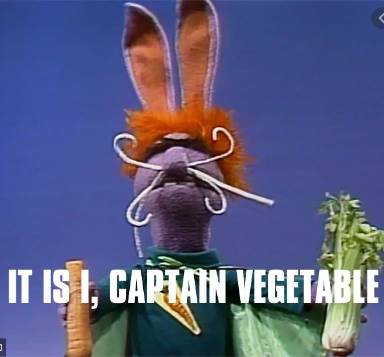
I’ve talked to a few people about whether it is correct to say, “It is me” or “It is I.” While writing this email, I took a trip down memory lane. I remember thinking about this years ago while my son and I were watching Captain Vegetable sing, “It is I, Captain Vegetable” on Sesame Street.

A lot of people incorrectly say, “It is me.” In fact, I would guess that more people say “It is me” than say “It is I.” So, what’s the scoop?

While me and I are both pronouns that we use to talk about ourselves, me is an object pronoun and I is a subject pronoun.

Let’s talk first about the object pronouns: me, her, him,and them. Object pronouns receive an action—something happens to them. Look at the following examples:

  • Give the money to me.
  • They awarded her the medal of honor.
  • When are you finally going to tell him the truth?
  • We don’t want the award to go to them.

In all the cases above, it probably seems obvious that you would use the highlighted object pronouns. Try substituting subject pronouns I, she, he,and they (respectively). Intuitively, you know it’s wrong.

Now, here are some examples of correctly used subject pronouns. Unlike object pronouns, which receive an action, subject pronouns perform the action:

  • I want even more money.
  • Do you think she will accept the medal in person?
  • I don’t think he can handle the truth.
  • They left early to watch the final episode of Stranger Things.

Those examples probably seem obvious too. So why does “It is I” seem wrong? It’s simply because of many years of incorrect usage. We’ve been hearing the incorrect phrase so long and so often that it sounds right.

Now, stick with me—there’s an easy way to determine that “It is me” is wrong. If “It is me” were correct, then we’d also be able to turn that around and say, “Me is it,” but that’s definitely not right—we’d say, “I am it.” So, that tells us that we need the subject pronoun I rather than the object pronoun me. Are you still with me?

The same goes for “This is she” vs. “This is her.” Since we would say “She is it” rather than “Her is it,” we know we need to use the subject pronoun she.

I think I’ve beaten this horseradish into a lather. Enjoy the rest of your day, and eat your vegetables!

Donna Bradley Burcher | Senior Technical Editor | Symitar®

8985 Balboa Ave. | San Diego, CA 92123 | Ph. 619.278.0432 | Ext: 765432

Pronouns she/her/hers

About Editor’s Corner

Editor’s Corner keeps your communication skills sharp by providing information on grammar, punctuation, JHA style, and all things English. As editors, we spend our days reading, researching, and revising other people’s writing. We love to spend a few extra minutes to share what we learn with you and keep it fun while we’re doing it.

Did someone forward this email to you? Click here to subscribe.

Don’t want to get Editor’s Corner anymore? Click here to unsubscribe.

Do you have a question or an idea for Editor’s Corner? Send your suggestions or feedback to Kara and <a href="mailto:DBurcher.

NOTICE: This electronic mail message and any files transmitted with it are intended
exclusively for the individual or entity to which it is addressed. The message,
together with any attachment, may contain confidential and/or privileged information.
Any unauthorized review, use, printing, saving, copying, disclosure or distribution
is strictly prohibited. If you have received this message in error, please
immediately advise the sender by reply email and delete all copies.

Posted by: Jack Henry | November 3, 2020

Editor’s Corner: Snuff

Dear Editrix,

I know what snuff is, and what “up to snuff” means, but where did the terms come from?

Sincerely,

Curious in San Diego

Good morning, Curious!

This is definitely a great word to look into. When I hear “snuff,” I think of old Western films, where Snippy or Whiskey Pete, the town drunk, is snorting “snuff.” But it has so many different definitions. Here are a few, condensed definitions (from Merriam-Webster):

Verb: snuff

1a: to crop the snuff of (a candle) by pinching or by the use of snuffers so as to brighten the light

1b: to extinguish by or as if by the use of snuffers: make extinct: put an end to: to kill, usually used with out

1c: to draw in forcibly through the nostrils

2: to perceive or detect by smelling: scent, smell

3: to sniff at in order to examine—used of an animal

4: to lightly buff (the grain side of leather) so as to remove grain imperfections

Noun: snuff

1: the charred part of a candlewick

2: the act of snuffing; sniffing, inhalation

2a: a preparation of pulverized tobacco to be chewed, placed against the gums, or inhaled through the nostrils [KC – This is what I’ve usually heard snuff referring to.]

2b: the amount of snuff taken at one time: pinch

As for the phrase, “up to snuff,” here is the explanation from our buddies at the Grammarist:

To be of good quality or up to someone’s required standards. It is also a general idiom meaning in good health. The phrase is never hyphenated unless used as a modifier (e.g., an up-to-snuff device).

Snuff was powdered tobacco inhaled through the nose. The phrase up to snuff comes from a playwright in the 1800s. He used it to describe someone as knowing what is going on or being well-informed or ‘in the know’.

Over time the definition changed and now it more closely resembles the phrase up to scratch. This means for something to meet a particular standard or requirement.

The scratch comes from marking the ground for competitions, either a line for a race or a circle for two fighters. [KC – Discussed

here
in Editor’s Corner.]

It is interesting that, with all the different definitions, the use of the phrase comes simply from an author who coined the term while writing a play. I was waiting for an exciting evolution of the term from the snuff going up the nose of Whiskey Pete in some dusty Western film!

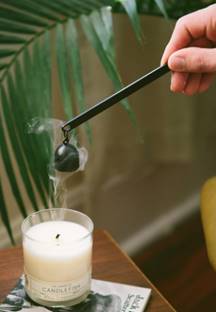
Candle snuffer

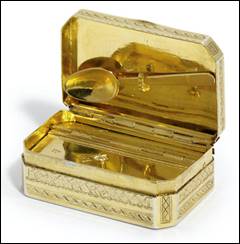
Fancy snuff box

Kara Church

Pronouns: she/her/hers

Technical Editor, Advisory

Editor’s Corner Archives: https://episystechpubs.com/

Posted by: Jack Henry | October 29, 2020

Editor’s Corner: Pumpkins, Candy, and Halloween

Hello there! Today I have “borrowed” an entire article from Daily Writing Tips. I thought this information was too interesting to keep to myself!

jack-o’-lantern
Why a “jack”-o’-lantern” and not some other given name?

Ever since the Middle Ages, a diminutive of the perennially popular man’s name John has been Jack. Because of the ubiquity of the name, it came to stand for any man in general, finding its way into a variety of expressions such as jack-of-all-trades, and jack-in-the-box.

Before jack-o’-lantern, we had jack-with-the-Lantern (1663), meaning, “night watchman.”

In addition to its literal meaning of “man carrying a lantern,” jack-o’-lantern was used to refer to the ignis fatuus or will-o’-the-wisp. Its most common meaning nowadays is “a hollowed vegetable carved with a face and lighted with a candle placed inside.” In the US, the pumpkin is the vegetable of choice, but in Ireland, turnips are used.

trick or treat
The earliest documented use of the term “trick or treat” dates from 1927, in a Canadian publication, but the custom of demanding food treats on October 31 originated in the pagan Celtic past.

In the Celtic calendar, October 31 was the last day of autumn. November 1 was the day the cattle were brought in to shelter for the winter. The time was marked by the fire festival Samhain, observing a liminal time when a weakened boundary between this world and the other permitted spirits, those of fairies and of the dead, to cross. People left gifts of food and drink outside for them. In time, the practice shifted from leaving food outside for the spirits to giving it to people who went from door to door. According to an article in the Sun, young people in Scotland and Ireland “would visit their neighbors’ house and sing a song, recite a poem or perform another sort of ‘trick’ before receiving a treat of nuts, fruit or coins.” In the Middle Ages, poor people would visit the houses of the rich to receive pastries in exchange for praying for the homeowners’ dead relations.

The noun is trick-or-treating.

Halloween
The word is a shortening of All-Hallow-Even, the eve of the Christian festival of All Hallows, in remembrance of all departed saints. Originally, the Christian feast was held in May, but was moved to November in the eighth century, where it subsumed the still-popular pagan festival.

Hallow derives from the Old English word for holy. As a verb, hallow means, “to make holy.” Lincoln uses the word in the Gettysburg Address: “But, in a larger sense, we cannot dedicate, we cannot consecrate, we cannot hallow this ground.”

Happy (almost) Halloween!

Kara Church

Pronouns: she/her/hers

Technical Editor, Advisory

Editor’s Corner Archives: https://episystechpubs.com/

Posted by: Jack Henry | October 27, 2020

Editor’s Corner: In Like Flynn

Good morning dear readers. Today I have an idiom to discuss with you: in like Flynn. It’s definitely not one I have ever used, but I find it interesting because I always thought people were saying “in like flint.” That didn’t really make much sense, since this is the definition of flint from Google®:

1. a hard gray rock

2. a piece of flint, especially as flaked or ground in ancient times to form a tool or weapon

3. a piece of flint used with steel to produce an igniting spark, e.g., in a flintlock gun, or (in modern use) a piece of an alloy used similarly, especially in a cigarette lighter

And of course, there’s Flint, Michigan, known in past news for its delicious tap water.

Rocks and a city, neither of those made sense, but I still heard the vault robbers or trespassers in movies saying, “in like flint.” When I received the following information from the Grammarist, suddenly, it made so much more sense. This is for those of you, like me, who heard the phrase or spoke the phrase incorrectly! Enjoy!

In like Flynn means to be immediately successful or to have achieved acceptance. The idiom in like Flynn carries the connotation of being in a state where one will continue to find success. The expression in like Flynn came into use in the American army in the 1940s, though its origin is murky.

Most believe it is somehow tied to the actor Errol Flynn, who always portrayed a successful swashbuckler in his movies. The fact that the word “in” and the name “Flynn” rhyme probably helped to make this phrase popular.

Another small faction believes that the “Flynn” in in like Flynn refers to New York political boss Edward J. Flynn, whose candidates never lost. Both theories might be true. Perhaps men from New York entered the army during World War II using a local, colloquial phrase alluding to a political boss, but the phrase was picked up by others with the idea of invoking Errol Flynn.

This sounds like a logical explanation to me! I remember when I was a kid, Mom told me that she always thought Errol Flynn was quite dreamy.

I hope you have a great day!

Errol Flynn in Technicolor

Kara Church

Pronouns: she/her/hers

Technical Editor, Advisory

Editor’s Corner Archives: https://episystechpubs.com/
Posted by: Jack Henry | October 22, 2020

Editor’s Corner: Starting from Scratch

I recently edited a slide show that used the term “starting from scratch,” meaning to start at the very beginning. I’ve used the phrase myself, but I’ve never really thought about what “scratch” means. I’ve heard of the devil being called Old Scratch or Mr. Scratch, but according to Wikipedia, that is most likely from “Middle English scrat, the name of a demon or goblin, derived from Old Norse skratte.”

Looking further, to Even-Steven and Fair and Square: More Stories Behind the Words by Morton S. Freeman, he has this information on “starting from scratch”:

A person who is unexpectedly scratched may start from the surprise or the pain, or both. But the expression to start from scratch is not related to any form of skin-cutting. It came from a cutting on the ground that marked the starting point for runners in a race. The runners were said to start from scratch, the usual starting point. Handicapped competitors were given an advantage. They did not start…from the scratched line, but were placed ahead of it. In current usage of the idiom, which may refer to almost any beginning, it has retained its original sense of starting with no advantage, without having a head start over others.

Merriam-Websteralso writes about the term to start from scratch, and adds the following:

A runner starting from scratch was not given a head start; applying the same idea to other sports, a scratch golfer or scratch bowler is one good enough to play without having their score adjusted with a handicap.

The idea of the scratch as a figurative starting point then gets carried over to contexts of cooking or building, giving us from scratch as a phrase for a true starting point for such projects.

That’s it for today! All this talk of scratching has made me itchy.

Kara Church

Pronouns: she/her/hers

Technical Editor, Advisory

Editor’s Corner Archives: https://episystechpubs.com/

Posted by: Jack Henry | October 20, 2020

Editor’s Corner: Animal Idioms

Hello!

You know me—I can’t help myself when it comes to dogs. I was recently reading a book of idioms and word histories called Even-Steven and Fair and Square: More Stories Behind the Words by Morton S. Freeman. (No, not Morgan Freeman, though he’d be a great narrator for the “books on tape” version.) In the book, I found two animal idioms that delighted me: To lead a dog’s life, and to get one’s goat.

Here’s what Mr. Freeman had to say about each!

To lead a dog’s life

The dog has been mercilessly vilified in proverbs. In 1542 Erasmus said: “The most parte of folks calleth it a miserable life, or a dogges life….” To lead a dog’s life is considered a bleak, wretched existence. The idiom described a person harried from morning till night, nagged constantly, and never left in peace. And so it is said to go to the dogs, meaning the lowest form of existence, and to die like a dog, a miserable end indeed. We speak of a morally base person as a dirty dog, one who is in the doghouse as far as society is concerned. [KC – OK, yes, we’re probably familiar with these phrases and idioms, but apparently this guy never met anybody in our department or their dogs. I wish I had the dog’s life that
Jackie’s dog May has. I didn’t even get a card for my birthday!]

Ms. May, Editor Jackie’s Teenager

But all this has changed, not the derisive sayings about dogs, but man’s attitude toward these animals. [KC – Ah, he does get it!] It all started a long time ago when one interloper had something nice to say about dogs. He said, “Love me, love my dog,” which was construed by some people to mean that my dog is so much a part of me that you must love us both, you can’t have me alone….

To get one’s goat

Although some city dwellers have never seen a live goat, they might nevertheless say, if they lose their temper, “That gets my goat,” or “That gets my nanny.” [KC – I can’t imagine a city dweller ever saying, “That gets my nanny,” unless there is a problem with your live-in baby sitter’s visa, and INS comes to deport her.] Both expressions have the same meaning…but this is not to say that their rural cousins do not express themselves in like terms. In fact, the notion of getting one’s goat can be traced far from urban areas—to horse country.

It was the practice some years ago to provide a high-strung racehorse with a companion, a docile animal, one that would stay close whenever the horse was in its stall. A stablemate tended to quiet the thoroughbred so that it didn’t become restive. Since thoroughbred horses, especially stallions, become competitive when near each other, and since a mare might excite them, a goat was used instead. The continued presence of the goat as a companion put the horse at ease. Then the bright but nefarious idea arose that if someone would get the goat, that is, steal it before a major race, the horse might become nervous and lose its composure and, in all likelihood, the race, too. Sure enough, once a thief got a horse’s goat, the horse became upset and irritable, which is exactly how a person feels when someone unfelicitously gets his goat.

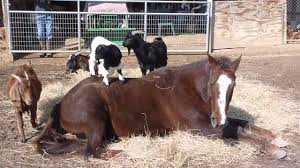
Apparently, this horse is really comfortable. He’s got three spares!

Enjoy your day.

Kara Church

Pronouns: she/her/hers

Technical Editor, Advisory

Editor’s Corner Archives: https://episystechpubs.com/
Posted by: Jack Henry | October 15, 2020

Editor’s Corner: Tone

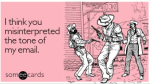
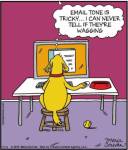
Good day to you! Following up on my Editor’s Corner article on Tuesday, today’s topic is "tone.” For most professionals, email is the primary form of communication. It is usually less disruptive than a phone call or an instant message. And writing an email allows us to take the time to organize our thoughts carefully and succinctly to be sure that our audience gets all the information we want them to have. However, tone is just as important for texts and instant messages.

But getting your tone just right, when writing, can be challenging. When we are face-to-face with someone, we can use non-verbal cues to set the tone and help deliver our message: we use facial expressions, body language, gestures, and we can modulate our voice. But when writing, we have to rely on our words to convey our meaning and our tone. So, how do we strike just the right tone when writing an email, an instant message, or any professional document? I found these important tips in an online article from Psychology Today:

  • Assess your relationship with the receiver. Adjust your level of writing formality to match the relationship. [dbb – You probably shouldn’t use the same informal tone you use with a colleague if you are emailing your company CEO—even someone as cool as our Dave Foss.]
  • Email is more than just the transmission of information. It is about managing a relationship remotely. Consider leading with a social comment like you would if you were talking face to face. For example, “I hope you enjoyed the long weekend,” or “I’m looking forward to working with you on this project.”
  • If you think there is room for misinterpretation of your message, take the time to craft the email to make sure your message is more likely to be received with your true intention. This might make the email longer. [dbb – This is so important. Please do not assume that your first draft is your final draft, especially if you are worried about being misinterpreted, or if you are aware that you are sometimes misinterpreted. Write and revise. And
    after that, you may want to revise again.]
  • Do not use text speak like "lol" or "BTW" unless you know the person really well. The same goes for using emoticons. [dbb – For a list of texting abbreviations and their meanings, see my recent
    email.]
  • Be careful with cc’s and bcc’s, as different interpretations can be made about what copying people on the email implies. Realize that a person who is blind copied may reply, forgetting that they were a blind copy.
  • Most people know by now that typing in ALL CAPS is the same as screaming at someone.
  • Don’t overuse punctuation!!!! [dbb – And on the other hand, don’t underuse punctuation either. I’ve known many people who
    never use exclamation points, which can sometimes make them seem detached or bored.]
  • If you are not sure about the tone of an email you are sending, have someone else read it and give you feedback before you send it. If no one else is available for a tone check, park the email in your draft folder and come back and re-read it a couple of hours later before sending it. [dbb – This is excellent advice! It is always a good practice when writing an important email to take a break between writing it and sending it. When you re-read it with a fresh perspective, you’ll be able
    to make important adjustments to your wording and your tone. And please feel free to send any emails to your friendly editors for a quick review.]
  • Most importantly, know when to pick up the phone or meet face-to-face to discuss an issue. [dbb – Sometimes there is nothing better than your friendly voice and kind smile.]

Donna Bradley Burcher | Senior Technical Editor | Symitar®

8985 Balboa Ave. | San Diego, CA 92123 | Ph. 619.278.0432 | Ext: 765432

Pronouns she/her/hers

About Editor’s Corner

Editor’s Corner keeps your communication skills sharp by providing information on grammar, punctuation, JHA style, and all things English. As editors, we spend our days reading, researching, and revising other people’s writing. We love to spend a few extra minutes to share what we learn with you and keep it fun while we’re doing it.

Did someone forward this email to you? Click here to subscribe.

Don’t want to get Editor’s Corner anymore? Click here to unsubscribe.

Do you have a question or an idea for Editor’s Corner? Send your suggestions or feedback to Kara and <a href="mailto:DBurcher.

NOTICE: This electronic mail message and any files transmitted with it are intended
exclusively for the individual or entity to which it is addressed. The message,
together with any attachment, may contain confidential and/or privileged information.
Any unauthorized review, use, printing, saving, copying, disclosure or distribution
is strictly prohibited. If you have received this message in error, please
immediately advise the sender by reply email and delete all copies.

Posted by: Jack Henry | October 13, 2020

Editor’s Corner: Writing Tips

Good morning!

I read an article the other day called “30 Writing Tips to Make Writing Easier.” All the writing tips were good, but some of them were specific to writing email and professional documents. That’s right up our alley! So, I’m sharing six of the tips with you today.

Keep it brief.

Brevity is important in professional communication. Respect your colleagues’ time by knowing exactly what you need to communicate before you begin writing so you can keep your message concise.

Use active voice.

Writing in active voice animates your writing so that the subject is acting on its verb. An active voice reads as being more confident and self-assured; it’s also a great way to shave superfluous words from your writing. [dbb – As a reminder, active voice starts with a subject: “Your IT department can create a specfile” as opposed to “A specfile should be created.”]

Don’t neglect context.

Does the person you’re communicating with have the same information and frame of reference you do? If not, make sure you provide context. You don’t have to give the entire backstory, just fill in the missing pieces so your message will be clear. [dbb – This is one of the most frequent issues we editors run into—writers don’t fill in the blanks. Don’t assume other people know what you know. Provide the basic information!]

Format your email properly.

Use good email formatting structure. Write an enticing subject line so your recipient is compelled to open your email. Understand proper email salutations and closings.

Don’t email angry.

Yes, you might be irked at your colleague for dropping the ball on that project and making you look bad, but don’t send emails when you’re still fuming. If you must write when emotions are hot, do it offline. Walk away for at least twelve hours, then edit with a calm head. [dbb – I wish I could say I’ve always done this. It’s definitely something we
should
do.]

Here’s a tip: Don’t treat email as anything less than an extension of your professional persona. The way you communicate in professional settings reflects on you in a potentially lasting way.

Proofread thoroughly before you hit SEND.

Typos and grammar gaffes make you look bad. Scan your email and fix errors before you send it. You’ll look your best when your correspondence is mistake-free!

Thursday, I’ll give you more in-depth information about how to find the right tone when writing an email or professional correspondence.

Donna Bradley Burcher | Senior Technical Editor | Symitar®

8985 Balboa Ave. | San Diego, CA 92123 | Ph. 619.278.0432 | Ext: 765432

Pronouns she/her/hers

About Editor’s Corner

Editor’s Corner keeps your communication skills sharp by providing information on grammar, punctuation, JHA style, and all things English. As editors, we spend our days reading, researching, and revising other people’s writing. We love to spend a few extra minutes to share what we learn with you and keep it fun while we’re doing it.

Did someone forward this email to you? Click here to subscribe.

Don’t want to get Editor’s Corner anymore? Click here to unsubscribe.

Do you have a question or an idea for Editor’s Corner? Send your suggestions or feedback to Kara and <a href="mailto:DBurcher.

NOTICE: This electronic mail message and any files transmitted with it are intended
exclusively for the individual or entity to which it is addressed. The message,
together with any attachment, may contain confidential and/or privileged information.
Any unauthorized review, use, printing, saving, copying, disclosure or distribution
is strictly prohibited. If you have received this message in error, please
immediately advise the sender by reply email and delete all copies.

« Newer Posts - Older Posts »

Categories