Posted by: Jack Henry | July 8, 2021

Editor’s Corner: Good Riddance

The other day a friend and I were discussing someone (okay, we were talking trash) and she said, “Well, good riddance to him!” She followed that with, “I don’t even know what that means.” Judging by our previous conversation, she knew exactly how to use the phrase, meaning “It’s good to be rid of him.” Let’s look a little closer at the meaning and history of this phrase.

From Merriam-Webster:

riddance (noun)

inflected form(s): plural -s

1: an act of ridding, freeing, or cleaning : clearance <the experiments showed high rates of kill with some of them showing 100 percent riddance — J. B. Robson>

2obsolete : progress with a task : dispatch of work

3: deliverance, relief —often used in the phrase good riddance <it’s gone—and good riddance too — Weston LaBarre>

The Phrase Finder provides even more detail on the history of “good riddance.” I’ve cut this down a bit to make it more bite-sized.

‘Riddance’ is now so completely associated with this little phrase that it is rarely, if ever, seen out alone. The only sort of riddance on offer these days is a good one. It wasn’t always thus. In the 16th century a riddance was a general-purpose noun and meant ‘deliverance from’ or ‘getting rid of’. The first adjectives to be linked with the word were fayre/happy/gladsome and, in Shakespeare’s Merchant of Venice, 1600, Portia wishes the Prince of Morocco ‘a gentle riddance’….

Shakespeare appears to be the coiner of ‘good riddance’, in Troilus and Cressida, 1606:

Thersites: I will see you hanged, like clotpoles [KC – Stupid people], ere I come any more to your tents: I will keep where there is wit stirring and leave the faction of fools.
[Exits]
Patroclus: A good riddance.

The phrase is often extended and emphasized as ‘good riddance to bad rubbish’ or, as that extended form was first coined, ‘good riddance of bad rubbish’. Tobias Smollett used the phrase in a none too friendly comment, in The Critical Review, 1805:

But we are sorry … to consider Mr. Pratt’s writings as ‘purely evil’ … we should really look upon this author’s departure from the world of literature as a good riddance of bad rubbish.

The American journalist and member of President Andrew Jackson’s ‘Kitchen Cabinet’, Francis Preston Blair, wrote an editorial in The Extra Globe, 1841. In this he appears to have been the first to use the precise version of the phrase that is most commonly used now:

[Following the withdrawal of members of a rival advisory group] From the bottom of our hearts we are disposed to exclaim "Good riddance to bad rubbish."

So, there you have it. It’s definitely not a nice phrase to use, but it sure is accurate. Sometimes people go away and the world gets a little brighter. Here’s hoping you don’t have people in your life you’d like to say “good riddance” to.

Kara Church

Pronouns: she/her/hers

Technical Editor, Advisory

Editor’s Corner Archives: https://episystechpubs.com/

Good morning!

Several of you sent me a comic strip several weeks ago about a kid (goat) in a candy shop. I can’t find it in my files, but the main point of it was the homonyms and homophones. There are many -nyms, -phones, and -graphs, and it can get complicated. I found a great article about this on Daily Writing Tips. Here are some definitions, a chart symbolizing how these items cross over, and I have added examples to each of them.

Homonym comes from the Greek homo which means “same” and onym which means “name.” When we talk about words, however, what should we use to define their names? The spelling or the pronunciation? Probably both. Homonyms, therefore, can be defined as two or more words that share the same spelling, or the same pronunciation, or both, but have different meanings.

Since there are several “types” of homonyms (e.g., same spelling but different pronunciation, same pronunciation but different spelling, same spelling and same pronunciation), further categorization is needed. We can say that homonyms represent the big category, from which three sub-categories emerge:

Homophones: two or more words that share the same pronunciation but have different meanings. They may or may not be spelled the same way.

  • brake/break: Use the brake when you bicycle or you may break your neck.
  • cell/sell: You can spend years in a cell if you sell illegal goods.
  • ball, bawl: Sam took Hammy’s ball and Hammy started to bawl, with sad tears running down his face.
  • caret, carat, carrot: The editor marked the document with a red caret to indicate where carrots belonged on the recipe list. As she marked the document with her red pen, her three-carat diamond shined brightly.

Homographs: homonyms that share the same spelling. They may or may not have the same pronunciation.

  • bass: type of fish OR low, deep voice
  • bow: type of knot OR to incline
  • evening: smoothing out OR after sunset
  • minute: tiny OR unit of time
  • moped: was gloomy OR motorcycle
  • wave: move the hand in greeting OR sea water coming into shore

Heteronyms: those are homonyms that share the same spelling but have different pronunciations. That is, they are homographs which are not homophones.

  • Close: CLOZE – to shut; CLOS – near
  • Console: KAHNsole – an upright case; kunSOLE – to comfort
  • Deliberate: diLIBerit – carefully considered; diLIBerATE – to consider
  • Dove: DUV – a bird; DOEV – jumped off
  • House: HAUS – a building that serves as living quarters; HOWZ – to provide with living quarters
  • Minute: MINNit – 60 seconds; myNOOT – tiny

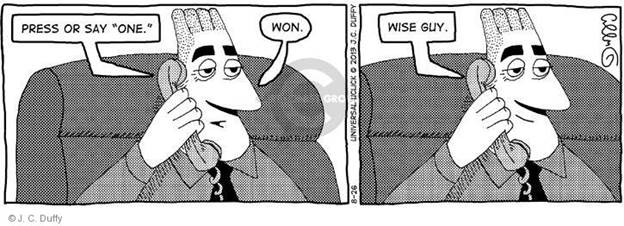
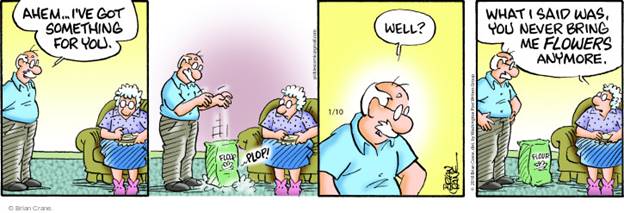
I hope the examples help. And now, some entertainment. Have a great day!

Kara Church

Pronouns: she/her/hers

Technical Editor, Advisory

Editor’s Corner Archives: https://episystechpubs.com/

Posted by: Jack Henry | July 2, 2021

Editor’s Corner: Special Edition

Good morning to the few of you who are in the office today!

I bought a book about mondegreens yesterday since I know most of you get a kick out of the misheard song lyrics. This book is called Mondegreens: A Book of Mishearings, by Jacquie Wines. I read a chapter with the Pledge of Allegiance, our national anthem, and other related topics and I thought that the Fourth of July weekend was the perfect time to share. The correct line of the song or pledge is first, followed by the misheard lines. Enjoy!

I pledge allegiance to the flag…

I pledge a lesion to the flag…

I led the pigeons to the flag…

I pledge a lesson to the frog…

And to the Republic for which it stands,

One Nation, under God, indivisible

And to the republic for Richard Stans

Once naked, under God, in a dirigible

And to the republic for witches’ dance

One potion, under guard, invisible

With liberty and justice for all.

With liver tea and dresses for all.

With Libby’s tea and just us four small

With little tea and just rice for all

And then there is the marred Star-Spangled Banner, from Francis Scott Key.

O say, can you see, by the dawn’s early light

Jose, can you see, by the dawn’s early light

O say, can you see, by the danzalay light

Whose broad stripes and bright stars, through the perilous fight

Who brought stripes and fried stars, through the barrel of Sprite

O’er the land of the free and the home of the brave?

O’er the land of the free and the home of the Braves?

Or the lamb of the free and the home of the brave?

From America the Beautiful, we have these:

And crown Thy good, with brotherhood

And crown Thy good Red Riding Hood

And crown Thy good with Robin Hood

From sea to shining sea

From sea to Chinese sea

And, this last set is actually from the Australian national anthem, but why not?

Australians all let us rejoice / For we are young and free

Australians all own ostriches / Four minus one is three

Australians all let us be boys / For we are young and three

Australians let us all meet Joyce / For she is young and free

Australians all eat ostriches / For we are young at three

Australians all eat sausages / For we are young and free

Happy holiday weekend!

Kara Church

Pronouns: she/her/hers

Technical Editor, Advisory

Editor’s Corner Archives: https://episystechpubs.com/

Posted by: Jack Henry | July 1, 2021

Editor’s Corner: New Word Thursday

Good morning! Here on the West Coast, it is still early. We’ve got the whole day ahead of us, and it feels like a good one.

I heard a word the other day that is new to me, so I’m going to share it today. If you already know this word, you get brownie points for one-upping the editor.

The word is holophrase.

This word came into English in the 1800s, and it has Greek roots: ­holos meaning “whole entire” and phrásis meaning “diction, style, speech.” Any guesses about what it means?

It’s early, don’t tax yourself too much. I’ll share what I learned. A holophrase is a single word used to express a complete, meaningful thought—the word OK is a good example.

Babies who are learning to talk start with holophrases; in fact, this stage of childhood is called the holophrastic stage. For example, a child will say “Up” instead of “Please pick me up.” Children use holophrases when they are not yet able to put together different parts of speech to make grammatical sentences. Other examples of common childhood holophrases are more, again, down, out, off, food, etc.

These one-word phrases are understood by adults because of the context of the situation along with the child’s body language and tone of voice. After the holophrastic stage, babies begin to use telegraphic speech, which usually consists of two words, for example, “Doggy bark” for “The dog is barking.”

You may see these two stages again during the teen age years. J

Donna Bradley Burcher | Senior Technical Editor | Symitar®

8985 Balboa Ave. | San Diego, CA 92123 | Ph. 619.278.0432 | Ext: 765432

Pronouns she/her/hers

About Editor’s Corner

Editor’s Corner keeps your communication skills sharp by providing information on grammar, punctuation, JHA style, and all things English. As editors, we spend our days reading, researching, and revising other people’s writing. We love to spend a few extra minutes to share what we learn with you and keep it fun while we’re doing it.

Did someone forward this email to you? Click here to subscribe.

Don’t want to get Editor’s Corner anymore? Click here to unsubscribe.

Do you have a question or an idea for Editor’s Corner? Send your suggestions or feedback to Kara and <a href="mailto:DBurcher.

NOTICE: This electronic mail message and any files transmitted with it are intended
exclusively for the individual or entity to which it is addressed. The message,
together with any attachment, may contain confidential and/or privileged information.
Any unauthorized review, use, printing, saving, copying, disclosure or distribution
is strictly prohibited. If you have received this message in error, please
immediately advise the sender by reply email and delete all copies.

Posted by: Jack Henry | June 29, 2021

Editor’s Corner: Feeling Old

Most days, I feel pretty spry and up for conquering the world. But there are some days, I just feel old. My husband loves to talk about movies or something that happened in the past and then say, “Do you realize that was 20 (or 30 or 40) years ago?”

Well, I might have something for anyone out there who’s feeling slightly senior. Apparently, May was “Older Americans Month,” and Richard Lederer, our local verbivore, wrote an article on getting older for his 83rd birthday. I’ve cut bits and pieces to make it smaller, but the full article is here.

Fullness of years makes for fullness of life. For one thing, you’re surrounded by a lot of friends: As soon as you wake up, Will Power is there to help you get out of bed. Then you go and visit John. When you play golf, Charley Horse shows up to be your partner. As soon as he leaves, along come Arthur Ritis and his six aunts — Aunt Acid, Auntie Pain, Auntie Oxidant, Auntie Biotic, Auntie Coagulant, and Auntie Inflammatory — and you go the rest of the day from joint to joint. After such a busy day, you’re Petered and Tuckered out and glad to go to bed — with Ben Gay, of course!

Another benefit of great maturity is that you’re worth a fortune. You have silver in your hair, gold in your teeth, stones in your kidneys, lead in your feet, mineral deposits in your joints and natural gas in your stomach.

Here’s another medical fact (and I’m not making this up): Studies show that one’s body temperature declines from decade to decade and that the drop becomes particularly pronounced in the elderly. Therefore, old folks are the coolest people on earth.

But wait! There’s more — many more advantages to attaining old age:

§ You are the age you are, but you are also all the ages you have been.

§ Your investment in health insurance is finally paying off.

§ Whatever you buy now won’t wear out.

§ You tolerate pain better than younger people because you know that pain is better than no sensation at all.

§ Adult diapers are actually kind of convenient.

§ If you are taken hostage, you will be among the first to be released.

§ Senior discounts.

§ You can brazenly spoil the grandkids and then send them back home to the common enemy.

§ No more zits, no more pregnancy scares; no more Phys Ed, ugly gym uniforms, Algebra, diagramming sentences, pop quizzes, final exams, SATs, study halls or detentions.

§ Fewer things seem worth waiting in line for.

§ The speed limit is no longer a challenge to you.

§ Your joints are now more accurate than the National Weather Service.

§ You no longer have to spend big bucks to get your teeth whitened.

§ Nobody expects you to run into a burning building.

§ All those things you couldn’t have as a youth you no longer want.

§ You feel righteous because memory loss passes for a clear conscience.

§ The older you get, the better you were!

§ You are in possession of a gift that so many others have been denied.

Whether you identify as a spring chicken or an old coot, I hope you have a fantastic day.

Kara Church

Pronouns: she/her/hers

Technical Editor, Advisory

Editor’s Corner Archives: https://episystechpubs.com/

Posted by: Jack Henry | June 24, 2021

Editor’s Corner: Bunker Malapropisms

Hello, dear readers.

Last week I returned from vacation to an envelope full of articles from our local paper. My dear coworker, Ron, has been busily gathering them for me, while we haven’t been going to the office. Today is material from Richard Lederer’s column, and this time it is about an early 1970s TV character, Archie Bunker. I think I was still watching Sesame Street when All in the Family came out, but I remember my dad loved it. Even if you didn’t see it, you can certainly appreciate some of his malapropisms.

As a reminder, a malapropism is “the mistaken use of an incorrect word in place of a word with a similar sound, resulting in a nonsensical, sometimes humorous utterance. An example is the statement by baseball player Yogi Berra, ‘Texas has a lot of electrical votes,’ rather than ‘electoral votes’.” (Wikipedia)

The full article is here, but these are the excerpts that give great examples of Archie’s malapropisms.

  • It’s a proven fact that capital punishment is a known detergent for crime.
  • This woman could be a kidnapper, making you an excessity after the fact.
  • There’s something rotten in Sweden, Edith. Call it a father’s intermission.
  • Forget it. It’s irreverent. It ain’t German to this conversation.
  • Don’t you never read the papers about all them unflocked priests running around? This here priest ain’t kosher and never was.
  • (about Meathead) Listen to our world traveler, will ya. Ain’t never been past the Chicago stock yards, and now he’s a regular Marco Polish.
  • She’s hanging around my neck like an albacross.
  • Just who the hell are we entertaining here tonight? The Count to Monte Crisco?
  • Whoever sent ’em obviously wanted to remain unanimous.
  • The Mets winning the pennant, that would be a miracle. Yeah, like the immaculate connection.
  • If you was half as sick as me, you’d be laying on that floor waiting for Rigor Morris to set in.
  • You’ve been standing on that phone like a pillow of salt.
  • “Sorry” ain’t gonna clench my thirst.
  • The Bunkers is going to Florida as pre-deranged.
  • I don’t see why you had to drag me to her doctor, this groinocologist guy.
  • (Sniffing a cigar) Edith, this is the nectarine of the gods.
  • It smells like a house of ill refute.
  • You think he’s nice after coming in here, making suppository remarks about our country. And calling me prejudiced while I was singing, “God Bless America,” a song written by a well-known and respected Jewish guy, Milton Berle.

Kara Church

Pronouns: she/her/hers

Technical Editor, Advisory

Editor’s Corner Archives: https://episystechpubs.com/

Posted by: Jack Henry | June 22, 2021

Editor’s Corner: Bore Tide

Good morning, everyone!

It has been a fantastic month so far! After 15 months being physically distanced and masked from the world, it was finally time for vacation! We were invited to a wedding in Alaska, so my husband and I made our way to the great white north, and then even farther.

Alaska is an amazing and beautiful place, the wedding was great, and I brought home a new term I thought I’d share with you.

While we were on a mighty fine train ride, we heard about something called a bore tide that Alaskan surfers ride. Yes, Alaskan surfers. I had to find out more about this. From the Alaska.org website:

The bore tide is a rush of seawater that returns to a shallow and narrowing inlet from a broad bay. Bore tides come in after extreme minus low tides created by the full or new moon.

Bore tides occur all over the world—there are around 60 of them—but only a few are large enough to make a name for themselves. One in China, for example, stretches almost 30 feet tall and travels more than 20 miles per hour. Alaska’s most famous bore tide occurs in Turnagain Arm, just outside Anchorage. It builds up to 6–10 feet tall and can reach speeds of 10 to 15 miles per hour. It takes not just a low tide but also about a 27-foot tidal differential (between high and low tide) for a bore to form in Turnagain Arm.

Turnagain Arm Bore Tide (Tidal Bore) in Girdwood, AK

We did not see the strikingly fast and large tide, but we did see a slower, shallower version moving in as a backdrop to the wedding we went to at the Alaska Wildlife Conservation Center. And on that note, I have a couple of things I found entertaining at the center.

First, we saw this sign as we walked across a bridge that took us over the black bear enclosure, which is littered with lost hats, sunglasses, and what looks like thigh bones:

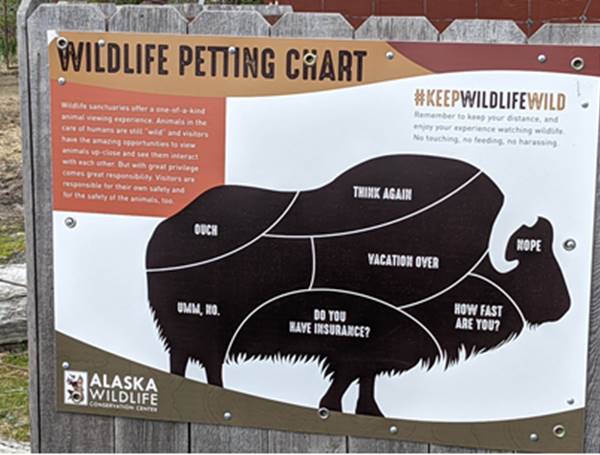
Then, we saw this sign next to the gate of the buffalo paddock, which defines what happens if you dare reach in and try to pet a buffalo:

And finally, one of the tour guides told us a little about the state. He said that the population a few years ago was 75% men, 25% women. His nieces heard these odds, and then found out about an annual “bachelor fundraiser,” with proceeds going to the fire department. The young women thought it sounded great. All those lonely men, fishing, hunting, staking their claims…without women at their sides. As they got all giddy, their aunt told them: “Girls, up here, the odds are good—but the goods are odd.”

Kara Church

Pronouns: she/her/hers

Technical Editor, Advisory

Editor’s Corner Archives: https://episystechpubs.com/

Posted by: Jack Henry | June 17, 2021

Editor’s Corner: Into or in to?

Is it into or in to? It’s been a while since we covered this topic, and it’s a tricky one for many. So today, I’ll refresh your memory on the rules and then, if you’re into it, you can take a quiz (courtesy of GrammarBook.com) to test your understanding.

Let’s start with the refresher. Intois a preposition that expresses movement toward something else; it can specify that something is going inside or within something else or becoming something else.

  • She jumped into the deep end of the pool.

Into can also suggest involvement:

  • She’s really into swimming.

In to, on the other hand,is an adverb/preposition combination. These two words sometimes just end up next to each other in a sentence.

  • She jumped in to find the ring that slipped off her finger.

I found this helpful trick at the Writer’s Digest website; and I think it will help you determine whether you want intoor in to:

One trick to help you decipher which word (or word pairing) is correct is to think of it this way: “Into” usually answers the question “where?” while “in to” is generally short for “in order to.” So look at your sentence and replace “into” or “in to” with “where?” If the second half of your sentence answers it, use “into.” If it doesn’t, replace “where” with “in order to.” If that works, use “in to.”

Using that trick and looking back at my first example, I see that intois correct because it answers the question “Where did she jump?” She jumped into the pool.

Looking at my second example, I see that I can easily replace in towith in order toand the sentence makes sense. She jumped in order to find the ring.

Now, I want to give you one final example of a mistake people often make. When you are talking about logging in, the correct form is log in to.

  • You will need to enter your user name and password to log in to the program.

Why? Because log in is a phrasal verb and the word to just happens to follow log in. Yeah, I know. English is a confusing language. It does kind of seem like you’re going into a website, so people get confused. Just remember that you are logging in (not logging into). You would tell a person, “You must log in.” You wouldn’t say, “You must log into.”

So, with those examples and the helpful trick in mind, it’s time to see how you do on the following quiz. After you answer all the questions, scroll down to see the answers. Good luck!

Into vs. In to Quiz

For each of the following, choose the correct sentence.

1. A. Aunt Jean is into collecting shells and found some unusual ones on the beach today.

B. Aunt Jean is in to collecting shells and found some unusual ones on the beach today.

2. A. Grandma really put a lot of time and effort into planning Grandpa’s surprise party.

B. Grandma really put a lot of time and effort in to planning Grandpa’s surprise party.

3. A. Make sure you log into the bank’s website to check your account today.

B. Make sure you log in to the bank’s website to check your account today.

4. A. Mix the dry ingredients into the egg and milk mixture and stir well.

B. Mix the dry ingredients in to the egg and milk mixture and stir well.

5. A. The stray kitten was anxious to come into get warm.

B. The stray kitten was anxious to come in to get warm.

6. A. You must turn all the forms into the human resources department by Friday.

B. You must turn all the forms in to the human resources department by Friday.

7. A. We are well into the month of January and have seen very little snow.

B. We are well in to the month of January and have seen very little snow.

8. A. The fawn disappeared quickly into the forest.

B. The fawn disappeared quickly in to the forest.

9. A. Bruno gave into the wishes of the group and agreed to go fishing.

B. Bruno gave in to the wishes of the group and agreed to go fishing.

10. A. The boys’ “magic egg” turned into a dinosaur after soaking in water.

B. The boys’ “magic egg” turned in to a dinosaur after soaking in water.

Following are the correct answers and the explanations:

1. A. Aunt Jean is into collecting shells and found some unusual ones on the beach today.

Explanation: use into suggesting involvement.

2. A. Grandma really put a lot of time and effort into planning Grandpa’s surprise party.

Explanation: use into suggesting involvement.

3. B. Make sure you log in to the bank’s website to check your account today.

Explanation: the phrasal verb is log in.

4. A. Mix the dry ingredients into the egg and milk mixture and stir well.

Explanation: use into indicating introduction, insert, or inclusion. [dbb – You are putting the dry ingredients inside or within the wet mixture.]

5. B. The stray kitten was anxious to come in to get warm.

Explanation: the phrasal verb is come in.

6. B. You must turn all the forms in to the human resources department by Friday.

Explanation: the phrasal verb is turn in.

7. A. We are well into the month of January and have seen very little snow.

Explanation: use into indicating a point within time or space. [dbb – We are inside or within the month of January.]

8. A. The fawn disappeared quickly into the forest.

Explanation: use into meaning toward or in the direction of. [dbb – The fawn went inside the forest.]

9. B. Bruno gave in to the wishes of the group and agreed to go fishing.

Explanation: the phrasal verb is give in.

10. A. The boys’ “magic egg” turned into a dinosaur after soaking in water.

Explanation: use into indicating the result of a transformation or change. [dbb – The magic egg is becoming (turning into) something else.]

Donna Bradley Burcher | Senior Technical Editor | Symitar®

8985 Balboa Ave. | San Diego, CA 92123 | Ph. 619.278.0432 | Ext: 765432

Pronouns she/her/hers

About Editor’s Corner

Editor’s Corner keeps your communication skills sharp by providing information on grammar, punctuation, JHA style, and all things English. As editors, we spend our days reading, researching, and revising other people’s writing. We love to spend a few extra minutes to share what we learn with you and keep it fun while we’re doing it.

Did someone forward this email to you? Click here to subscribe.

Don’t want to get Editor’s Corner anymore? Click here to unsubscribe.

Do you have a question or an idea for Editor’s Corner? Send your suggestions or feedback to Kara and <a href="mailto:DBurcher.

NOTICE: This electronic mail message and any files transmitted with it are intended
exclusively for the individual or entity to which it is addressed. The message,
together with any attachment, may contain confidential and/or privileged information.
Any unauthorized review, use, printing, saving, copying, disclosure or distribution
is strictly prohibited. If you have received this message in error, please
immediately advise the sender by reply email and delete all copies.
Posted by: Jack Henry | June 15, 2021

Editor’s Corner: Blonds and Brunets

Hello out there! I hope this finds you happy, healthy, and ready to enjoy the summer.

I like preparing for the summer by reading meaty Q&As on the Chicago Manual of Style website. Since we’ve been talking about more inclusive language at work and in the society at large, I thought this was a timely topic.

The question from the writer was about the word blond, and whether we should follow the traditional French and use blond to describe a man with blond hair, and blonde (with an “e”) for a woman with blond hair.

The article’s first advice was to stop referring to a person as their hair color. For example, “Did you hear the joke about the three blondes?” The second advice was to stop using blonde with an “e” to refer to women with golden hair.

While CMOS doesn’t actually have a rule about hair color, the AP Stylebook recommends using gender-neutral language and switching to blond for all flaxen-haired folks. Similarly, AP recommends that we use brunet for brown or dark-haired people, rather than using brunette for women and brunet for men. CMOS agreed with that logic.

One other word I thought of that we spell differently in English, depending on the person’s gender, is fiancé. A male is a fiancé with one “e,” and a female is a fiancée with two “e’s.” I suppose we can follow the logic above and use the simplest spelling for both (fiancé), or you can avoid it altogether by referring to the marrying couple as betrothed.

As you know, English is always changing. In this case, we’re simply neutralizing gendered words from France, and making them our own in a friendly, all-encompassing way.

Kara Church

Pronouns: she/her/hers

Technical Editor, Advisory

Editor’s Corner Archives: https://episystechpubs.com/

Posted by: Jack Henry | June 10, 2021

Editor’s Corner: Clipped Words

Good morning and welcome to a new day. Today’s topic is “clipped words.” I’m talking about words that we shorten to save ourselves the inconvenience of saying or writing extra syllables. For example, we have all gotten used to the clipped word bot as a stand-in for robot. And you’re all too familiar with the clipped word flu, which is short for influenza.

You get the picture.

There are four types of clipped words: final clipping (also known as back clipping), initial clipping (also known as fore clipping), middle clipping (also known as medial clipping or syncope), and complex clipping. I’ll explain each one and provide examples.

  • Final clipping:This is the most common type of clipping. We keep the first part of the word and clip the final part. Examples include ad (advertisement), exam (examination), and gas (gasoline).
  • Initial clipping:As expected, initial clipping clips syllables from the beginning of a word. Some examples are phone (telephone), gator (alligator), bot (robot), and Beth (Elizabeth).
  • Medial clipping: This type of clipped word is less common. It usually occurs when you remove some letters from the middle of a word. You are familiar with the word ma’am, which is a clipped form of madam. This type of clipping is common in poetry where you might see heav’n stand in for heaven or ne’er used in place of never.
  • Complex clipping: This kind of clipping happens with compound words that have two or more components. These words are clipped in lots of different ways. Here are some examples: motel (motor hotel), sitcom (situation comedy), and op art (optical art).

English is full of these kinds of words. And now you know what to call them. After this past year of isolation, I don’t know about you, but I feel like my chitchat skills are a little rusty. Now that I have some quirky information to share, I feel a lot more confident. Oh yes, I plan to take the rest of 2021 by storm!

Donna Bradley Burcher | Senior Technical Editor | Symitar®

8985 Balboa Ave. | San Diego, CA 92123 | Ph. 619.278.0432 | Ext: 765432

Pronouns she/her/hers

About Editor’s Corner

Editor’s Corner keeps your communication skills sharp by providing information on grammar, punctuation, JHA style, and all things English. As editors, we spend our days reading, researching, and revising other people’s writing. We love to spend a few extra minutes to share what we learn with you and keep it fun while we’re doing it.

Did someone forward this email to you? Click here to subscribe.

Don’t want to get Editor’s Corner anymore? Click here to unsubscribe.

Do you have a question or an idea for Editor’s Corner? Send your suggestions or feedback to Kara and <a href="mailto:DBurcher.

NOTICE: This electronic mail message and any files transmitted with it are intended
exclusively for the individual or entity to which it is addressed. The message,
together with any attachment, may contain confidential and/or privileged information.
Any unauthorized review, use, printing, saving, copying, disclosure or distribution
is strictly prohibited. If you have received this message in error, please
immediately advise the sender by reply email and delete all copies.

« Newer Posts - Older Posts »

Categories