Posted by: Jack Henry | October 5, 2021

Editor’s Corner: Calque

Recently I sent out a couple of idiomatic phrases to you and briefly explained why they are sometimes difficult to understand. For example, when someone says it’s “raining cats and dogs” that means it is raining really hard; it has nothing to do with dogs and cats falling from the air. Today I’d like to talk about something different. Today’s words and phrases are called calques. A calque is a word or phrase from another language that is translated word-for-word in English. Calque is the French word for a copy of something. The word calquer means “to trace” in French.

An article from Daily Writing Tips gives us several examples. Here are two that I liked:

Another calque for writers comes from Czech psát do šupliku, “write for the drawer.” This is an expression that developed along with the Russian word samizdat, which refers to the practice of underground publishing of state-proscribed materials, often by hand, and passed around from reader to reader. In English, writing for the drawer can refer to any writing not intended for immediate publication.

Crab mentality is a calque from Tagalog isip talangka. It derives from the behavior of crabs in a pot. As one tries to escape over the side, it’s pulled down by the others in the pot. Applied to people, it refers to the unfortunate tendency of group members to resent or obstruct the progress of a colleague seen to be rising above the performance of the others.

Wikipedia provides calque examples from several languages. Here are some of the German ones they list. You should be able to see the relationship between the original German word and its translation to English.

· Beer garden calques Biergarten

· Concertmaster and concertmeister calque Konzertmeister

· Earworm calques Ohrwurm

· Flamethrower calques Flammenwerfer

· Intelligence quotient calques Intelligenzquotient

· Loanword calques Lehnwort

· Nostalgia calque Heimweh "home sore"

· Overman and superman (i.e., self-transcending human) calque Übermensch

· Rainforest calques Regenwald

· Stormtroopers calques Sturmtruppen

· Watershed calques Wasserscheide

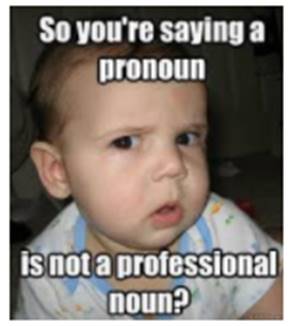
This is one of the pictures I found when searching for a funny calque meme. I have no idea what the connection is, but a hot dog sounds delicious right now. (Okay, I’m fasting. Anything sounds good right now!)

Kara Church

Pronouns: she/her/hers

Technical Editor, Advisory

Editor’s Corner Archives: https://episystechpubs.com/

Posted by: Jack Henry | September 30, 2021

Editor’s Corner: Lollapalooza

A couple of months ago, my mom asked me what the definition and history of the word lollapalooza was. My response was, “You mean the music festival, like Coachella?” She laughed and said, “There’s a music festival called Lollapalooza? No, I mean the word. We used it when I was a kid in Pennsylvania.”

Well, it’s taken me a while (okay, I forgot to put it on my list) but here’s what I found. First, from Merriam-Webster:

lollapalooza

or less commonly lalapalooza or lollapaloosa or lallapalooza

: something extraordinarily impressive: an outstanding example

And then from the Online Etymology Dictionary:

lollapalooza (n.)

"remarkable or wonderful person or thing," 1901, American English, fanciful formation. The annual North American alternative pop music concert of the same name dates from 1991. [KC – A different resource said it was first used in 1896.]

And yet another definition from Dictionary.com:

an extraordinary or unusual thing, person, or event; an exceptional example or instance.

Here are some examples:

  • Rocco is a real lollapalooza of a dancer—he does everything from the Argentine Tango in the ballroom, to breakdancing on cardboard in the street.
  • The engagement ring that Troy gave to Alex was a titanium and diamond lollapalooza; it was more expensive than their thirty-day European honeymoon.
  • Antoni Gaudi rarely designed anything that wasn’t a lollapalooza of a building.

As far as the music festival, there is a history of it on Wikipedia, but here is a condensed version:

Lollapalooza is an annual four-day music festival held in Grant Park in Chicago, Illinois. It started as a touring event in 1991. Music genres include but are not limited to alternative rock, heavy metal, punk rock, hip hop, and electronic music. Lollapalooza has also featured visual arts, nonprofit organizations, and political organizations. The festival in Chicago’s Grant Park hosts an estimated 400,000 people each July and sells out annually. Lollapalooza is considered one of the largest and most iconic music festivals in the world and one of the longest running in the United States.

Sounds like a lollapalooza of a time! Sign me up for a couple of days, a riverboat ride, and some deep-dish pizza!

Antoni Gaudi’s Lollapalooza: Casa Batllo in Barcelona

Kara Church

Pronouns: she/her/hers

Technical Editor, Advisory

Editor’s Corner Archives: https://episystechpubs.com/

Posted by: Jack Henry | September 28, 2021

Editor’s Corner: Apostrophe Reboot

My friend Samuel D. and I were discussing apostrophe usage recently. Sam is seeing more and more people using the term “driver license” rather than the correct term “driver’s license.” The latter is considered correct because of the apostrophe rule about possessive nouns: the license belongs to the driver, so an apostrophe is necessary to show possession. It is a driver’s license.

We’ve covered apostrophe usage a few times, but I still get a lot of questions, so I think it’s time for a refresher.

The rules about apostrophes are easier than you might think. There are only two uses: to form contractions and to form possessions. Let’s look at each.

Apostrophes with Conractions

Contractions are used to shortened words or groups of words. You simply use the apostrophe in place of missing letters:

  • Cannot becomes can’t
  • She would becomes she’d
  • They are becomes they’re
  • Let us becomes let’s
  • You all becomes y’all

It works the same for numbers:

  • The 1990s becomes the ‘90s

Apostrophes with Possessives

I think this is where most people get confused because there is some variation. Here are the rules:

  • For most singular nouns, add the apostrophe and an s:
    • That is my brother’s bike. [dbb – I’m talking about one brother and his bike.]
  • For most plural nouns, add only an apostrophe:
    • Those are my brothers’ bikes. [dbb – I’m talking about two or more brothers and their bikes.]
  • For plural nouns that do not end in s (irregular plural nouns) add the apostrophe and an s:
    • Pick up the children’s toys.
  • For singular nouns that end in s, the rule varies depending on what style guide you follow. We follow the Chicago Manual of Style, which says to add the apostrophe and an s:
    • Kansas’s claim to fame is its sweet, tangy barbecue sauce.
    • Chris’s jacket is plaid.

That’s the crux of it, folks. There is just one more thing you need to remember—you do not need an apostrophe for plural nouns that are not possive:

  • The Burchers are in.
  • Her dogs have a lot of toys.
  • Some editors are introverts.

And now for a cartoon and some apostrophe fails:

Donna Bradley Burcher | Senior Technical Editor | Symitar®

8985 Balboa Ave. | San Diego, CA 92123 | Ph. 619.278.0432 | Ext: 765432

Pronouns she/her/hers

About Editor’s Corner

Editor’s Corner keeps your communication skills sharp by providing information on grammar, punctuation, JHA style, and all things English. As editors, we spend our days reading, researching, and revising other people’s writing. We love to spend a few extra minutes to share what we learn with you and keep it fun while we’re doing it.

Did someone forward this email to you? Click here to subscribe.

Don’t want to get Editor’s Corner anymore? Click here to unsubscribe.

Do you have a question or an idea for Editor’s Corner? Send your suggestions or feedback to Kara and <a href="mailto:DBurcher.

NOTICE: This electronic mail message and any files transmitted with it are intended
exclusively for the individual or entity to which it is addressed. The message,
together with any attachment, may contain confidential and/or privileged information.
Any unauthorized review, use, printing, saving, copying, disclosure or distribution
is strictly prohibited. If you have received this message in error, please
immediately advise the sender by reply email and delete all copies.

Posted by: Jack Henry | September 23, 2021

Editor’s Corner: A Lick and a Promise

Idioms are such tricky phrases when you are learning a new language, and in English, we have many idioms. An idiom is a phrase that means something completely different from what the individual words might indicate. For example, instead of saying “Building my new bookshelf was easy,” I could say, “Building my new bookshelf was a piece of cake.” The idiom “piece of cake” means “easy,” but none of those four words (a piece of cake) have anything to do with being simple or easy. That is the difficulty of deciphering idioms—the words in the idioms don’t really help you translate the meaning. Here are two that I like and their explanations. Both are from The Grammarist. Enjoy!

Dyed in the wool

When wool is dyed before being spun into thread (as opposed to after it is spun or woven into fabric), the color is profound and likely to last a very long time. From this we can infer the metaphorical meaning of the idiom dyed in the wool, which means profoundly, deeply ingrained, or to an extreme degree. It’s usually used in describing a person’s political, cultural, or religious beliefs or to emphasize their commitment to something.

The phrase is usually hyphenated, especially when it comes before what it modifies (e.g., he is a dyed-in-the-wool Yankees fanatic), but it can go unhyphenated when it comes after what it modifies (e.g., as a Yankees fanatic, he is dyed in the wool).

Example: I’ll be among those dyed-in-the-wool Royal enthusiasts waving my flag in front of Her Majesty herself outside the gates of Buckingham Palace. [Manchester
Evening News
]

A lick and a promise

A lick and a promise is an idiom that has been around at least since the middle of the 1800s. We will examine the definition of the phrase a lick and a promise, where it came from and some examples of its use in sentences.

A lick and a promise means to do something with a minimum amount of effort, to do something quickly and haphazardly. The term a lick and a promise plays on a secondary meaning of the word lick popular several hundred years ago, meaning to clean something quickly. The promise portion of this idiom most probably refers to a promise one makes to oneself to do a more thorough job when more time is available. Interestingly, the idiom a lick and a promise is most probably derived from an older idiom, a lick and a prayer, which means a quick, haphazard cleaning. Today, a lick and a promise may refer to any situation where something is done quickly and not very well. When used as an adjective before a noun, the term is hyphenated as in a lick-and-a-promise.

Example: Gainey’s brisk adaptation gives the first two parts of Shakespeare’s trilogy a lick and a promise before devoting most of the evening to the abundant armed conflicts in Part Three. (The Independent Weekly)

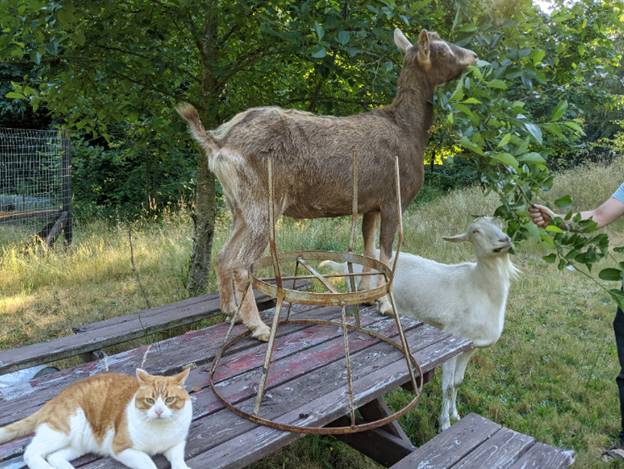
My brother’s goats, Lewis (on table) and Clark (politely on the ground), are happy to give you a lick, but they certainly never make promises.

Kara Church

Pronouns: she/her/hers

Technical Editor, Advisory

Editor’s Corner Archives: https://episystechpubs.com/

When I go up to the Pacific Northwest, I love seeing all of the place names change from Spanish (in California) to the indigenous names I grew up with, such as Tlingit, Tukwila, Muckleshoot, and Klickitat. I know I’ve covered different words we have adopted into English from indigenous languages, but this article I found goes deeper than just a list of words. The article, from Mental Floss, provides some etymologies, history, a little myth-busting, and some very interesting information. (KC – I cut the list short, but the link above will take you to all 11.)

11 Common English Words from Native American Languages

You’re probably well aware that tepee, totem, and toboggan are all Native American names for familiar objects, but what about hickory, jerky, and tobacco? Native American languages gave us scores of words for things we frequently use—not to mention the many states, rivers, and towns that evolved from Native American names. Here are 11 words commonly used in English that were coined by Indigenous groups across the Americas.

1. OPOSSUM

The Native American name of North America’s resident marsupial comes from the Virginia Algonquian word opassum (alternately spelled aposoum), which means “white dog” or “white beast” in the Powhatan language. Skunk, coyote, raccoon, moose, woodchuck, and caribou are a few of the other animals that owe their names to Native American tribes.

2. SQUASH

When English settlers first arrived in North America, they used squash as a verb (meaning to crush something) and, more arcanely, to refer to an unripe pea pod. However, they were unfamiliar with the fruit we now know as squash, according to Merriam-Webster. The Narragansett tribe from present-day New England called it askútasquash, which was eventually shortened to squash in English.

3. CHOCOLATE

This delicious treat comes to us from nature, but we can thank Indigenous Mesoamericans for this Native American name. The word chocolate comes from Nahuatl, a language spoken by the Aztecs (many Indigenous people in Mexico speak dialects of Nahuatl today). The Aztecs would make a drink from ground cacao seeds called chikolatl.

4. AVOCADO

Sorry, avocado trivia lovers, but the story that this word originally meant testicle isn’t quite right. According to Nahuatl scholar Magnus Pharao Hansen, the Nahuatl name for the fruit, ahuacatl, was also slang for testicle, but only ever slang. The word ahuacatl chiefly described the fruit. It entered Spanish in the late 1600s as aguacate, and was eventually Anglicized as avocado.

5. GUACAMOLE

In a similar vein, guacamole stems from two Nahuatl words: ahuacatl (avocado) and molli (sauce). Mix them together and they make ahuacamolli. Molli, as fans of chicken mole enchiladas will know, was later spelled mole in Mexican Spanish. Tomato (tomatl), chili (chilli), and chipotle (chilli + poctli, meaning something smoked) are a few other food words that come to us from Nahuatl.

6. PONCHO

Indigenous peoples in central Chile who speak Araucanian languages dubbed their shawl-like “woolen fabric” a pontho. They were often worn by huasos, or cowboys, who lived in central and southern Chile. Nowadays, ponchos are commonplace throughout Latin America.

7. HURRICANE

The Maya believed in a “god of the storm,” and they called it Hunraken. This same word was picked up throughout Central America and the Caribbean to refer to an evil deity. Spanish explorers in the Caribbean changed the spelling to huracán and used it to describe the weather phenomenon, and it was finally introduced into English by the 16th century.

Mt. St. Helens behind the clouds.

Castilleja (The orange flowers above, commonly known as scarlet paintbrush or prairie-fire; not sure about the purple flowers.)

Kara Church

Pronouns: she/her/hers

Technical Editor, Advisory

Editor’s Corner Archives: https://episystechpubs.com/

Posted by: Jack Henry | September 16, 2021

Editor’s Corner: Classes of Pronouns

Good morning, friends! Today’s topic is pronouns. We’ve talked about pronouns quite a few times before. As Kara explained in a previous Editor’s Corner article, “A pronoun’s duty in life is to step in and take the place of a noun. Pronouns allow us to add variety and avoid sentences like this: ‘Mark hates hospitals because Mark hates getting shots.’”

In short, using pronouns saves time.

Pronouns come in different classes. To help you get the gist, I’ll tell you the classes and show you how each one works in a sentence.

Classes of pronouns:

  • Personal: I, you, she, it, we, they, etc.

Example: I want to go to the zoo. [dbb – I takes the place of the noun Donna.]

  • Demonstrative: that, this, these, those

Example: That is where I want to go. [dbb – That takes the place of the noun phrase
the zoo.]

  • Interrogative: what, which, who, where, and how

Example: Who told you that I often go to the zoo? [dbb – Who represents the person that said I go to the zoo.]

  • Relative: that which, that, where, who, etc.

Example: I want to go to the San Diego Zoo, which is world famous. [dbb – Which
takes the place of the San Diego Zoo. These relative pronoun phrases usually add more information to your sentence.]

  • Indefinite: all, another, any, each, either, none, some, someone etc.

Example: Someone must want to go with me. [dbb: Someone takes the place of the name of the charming person who might want to go with me.]

  • Possessive: My, your, his, its, their, and also mine, yours, etc.

Example: It’s my favorite zoo. [dbb – My takes the place of Donna’s.]

  • Reciprocal: each other, one another

Example: The San Diego Zoo and the Zoo Safari Park are different from one another. [dbb – One another
takes the place of
the San Diego Zoo and the Zoo Safari Park.]

  • Reflexive and Intensive: myself, yourself, himself, itself, etc.

Example: The San Diego Zoo takes it upon itself to breed a lot of endangered animals. [dbb: Itself in this example is an intensive pronoun.
Itself refers back to the San Diego Zoo to emphasize it.]

Donna Bradley Burcher | Senior Technical Editor | Symitar®

8985 Balboa Ave. | San Diego, CA 92123 | Ph. 619.278.0432 | Ext: 765432

Pronouns she/her/hers

About Editor’s Corner

Editor’s Corner keeps your communication skills sharp by providing information on grammar, punctuation, JHA style, and all things English. As editors, we spend our days reading, researching, and revising other people’s writing. We love to spend a few extra minutes to share what we learn with you and keep it fun while we’re doing it.

Did someone forward this email to you? Click here to subscribe.

Don’t want to get Editor’s Corner anymore? Click here to unsubscribe.

Do you have a question or an idea for Editor’s Corner? Send your suggestions or feedback to Kara and <a href="mailto:DBurcher.

NOTICE: This electronic mail message and any files transmitted with it are intended
exclusively for the individual or entity to which it is addressed. The message,
together with any attachment, may contain confidential and/or privileged information.
Any unauthorized review, use, printing, saving, copying, disclosure or distribution
is strictly prohibited. If you have received this message in error, please
immediately advise the sender by reply email and delete all copies.

Posted by: Jack Henry | September 14, 2021

Editor’s Corner: Prepone

Dear Editrix,

While engaging in the hot-potato process of rescheduling a meeting, a teammate accepted an earlier time proposal and stated, "I’ll prepone the meeting." My eyes locked on the word prepone and after considering whether it was a typo, it hit me, "Duh! Prepone must be the opposite of postpone (pre vs. post). It makes so much sense!" Then I found the Merriam-Webster definition:

An Indian English word which means "to move to an earlier time"

Looks like MW has it pegged in Words We’re Watching and it hasn’t met criteria for entry. Can we make prepone happen?!

Excited Meeting Attendee

Dear Excited,

Wow! When I started looking into this, I stumbled onto some interesting points of view. Indeed, the resources I found referred to it as “Indian English,” which I wasn’t aware of. We hear of British English and American English…but Indian English? That was new to me.

The thing that interested me outside of the term “Indian English” was how many of the references to the term prepone were not very complimentary. They referred to it as slang and said it wasn’t to be used in mixed company; DailyWritingTips described it as a word “too strange and unlovely to my ear for me to want to use it.” What is the story behind this word?

This article has information on prepone and its interesting history. From Quartz India:

Snobbery seems to be costing the world a useful word.

While most English speakers in South Asia are familiar with the word prepone, its use will still draw blank looks elsewhere. Even in India, many well-read, well-travelled intellectuals wouldn’t be caught dead using it, unless in jest. But there isn’t really any other word in the English language that can qualify as a respectable synonym.

For the uninitiated, prepone means to bring something forward to an earlier date or time. Or very simply, it is the opposite of postpone.

The word has been a part of Indian English for decades, but it is shunned in many formal settings.

Sadly, prepone’s lack of acceptance in highbrow Indian circles has clearly tarnished its chances of gaining international recognition.

And that’s part of a larger problem—Indian English is as storied, authentic, and valid an offshoot as American English, Hong Kong English, or Jamaican English, but we don’t celebrate it as such.

If these prepone naysayers can’t embrace Indian English, maybe they should take note of this surprising fact: Prepone exists in Oxford English Dictionary (OED), aka, “the definitive record of the English language.”

According to the dictionary, the word is mostly attributed to Indian English, but it was first used in the 16th century, long before English spread in India. At that point, it meant “to place in front of.” It comes from the Latin praeponere.

There you have it, Mr. Excited. Donna and I both like it and think maybe with a little push, we could make it more than just a word that Merriam-Webster is watching. Let’s do it! Shamelessly prepone that next meeting and see what happens!

Kara Church

Pronouns: she/her/hers

Technical Editor, Advisory

Editor’s Corner Archives: https://episystechpubs.com/

Posted by: Jack Henry | September 9, 2021

Editor’s Corner: Out of Office Notes

Good morning, everyone. I hope your summer has treated you well and that you had the opportunity to use some vacation time. I know that I certainly enjoyed feeling free for about a month between both COVID shots and the Delta variant running rampant.

I ran across today’s topic recently. I know, it would’ve been more helpful a few months ago, but better late than never, as they say. In this department, we often get requests about how to start or end emails, and I thought this article seemed related and practical for everyone: the out-of-office (OOO) message.

Grammarly offers great advice about when to use an OOO message, how to write one, and then they provided several samples. Here are the pertinent parts of the article, along with the sample templates.

When to use an out-of-office message

It’s best to set up an out-of-office message whenever you’re unable to respond to emails during regular business hours. OOO messages are appropriate for short periods of time, such as doctor’s appointments or leaving work early for the day, as well as for longer absences, such as multiple-day vacations or parental leaves.

How to write an out-of-office message

Out-of-office messages don’t need to be elaborate; as long as they contain the essential information, that’s good enough. Some people like to jazz up their messages with details and light humor, but those are optional.

Specifically, a good out-of-office message includes three pieces of information:

  1. The dates you’ll be gone
  2. A succinct reason for your absence
  3. Points of contact for further assistance in case the matter is urgent; if you have multiple points of contact, identify who should be contacted for particular matters

These are the necessities to help your colleagues or external contacts get by while you’re gone. It gives the receiver the option of waiting for your return or proceeding without you, and it satisfies their curiosity so they don’t assume you’re gone for other reasons.

You can cover all this information in just a few sentences, so out-of-office messages are usually quite short. On top of the facts, it helps to add some friendly greetings and polite gestures, such as “thanks for your message,” or “let’s talk soon!”

How NOT to write an out-of-office message

Vacations and work leaves can bring out the silliness in people, but keep in mind that out-of-office messages are still work messages.

Be professional, and don’t say anything too informal. Even if you talk casually with your coworkers, people from outside your workplace might be emailing you, maybe even with new work opportunities you hadn’t expected. You don’t want to make a bad first impression when you’re not even there!

Moreover, avoid putting too much pressure on yourself or the colleague you’re sending people to if they need help. Don’t say things like, “They’ll help you right away” or “I’ll respond as soon as I get back.” Set realistic expectations for a time frame so people can properly organize their schedules, but don’t set them up for disappointment.

Best out-of-office message examples

Let’s take a look at some out-of-office message examples so you know what to aim for. These double as out-of-office templates or boilerplates, so feel free to copy and paste them with your own information added.

Ol’ reliable

[Your personal greeting],

Thank you for your email. I am currently out of the office until [return date] for [reason]. I will be happy to reply to your message when I return.

If you need assistance in the meantime, please contact [name of colleague + their job title] at [email,
phone, etc.]
.

[Your personal closing and signature]

All business

[Your personal greeting],

I will be away from the office until [return date] for [reason] with no access to email. If your request is urgent, please contact [name of colleague + their job title] for assistance at [email, phone, etc.]. Otherwise, I’ll get back to you as quickly as possible when I return.

[Your personal closing and signature]

Lil’ charmer

[Your personal greeting],

Thanks for your message! Unfortunately, I’m away from the office for [reason] and won’t be back until [return date]. I’ll be happy to respond to your message when I return, but if you need urgent assistance, feel free to contact [name of colleague + their job title] at [email, phone, etc.].

Thanks again, and sorry for any inconvenience!

[Your personal closing and signature]

Kara Church

Pronouns: she/her/hers

Technical Editor, Advisory

Editor’s Corner Archives: https://episystechpubs.com/

Posted by: Jack Henry | September 7, 2021

Editor’s Corner: Happy Rosh Hashanah

Good morning, or gutn morgn (גוטן מארגן) in Yiddish.

In honor of Rosh Hashanah (the Jewish New Year and the clebration of the creation of the world as well at the day of judement), Im going to share some information about the Yiddish language today. Weve shared some Yiddish words with you in the past, but Ive been reading a little bit more about this rich and emotive language in a book called Wicked Good Words by Mim Harrison.

Yiddish is not the same as Hebrew, but like Hebrew, it is spoken by many Jewish people. It got its start around the 10th century when it was spoken by Jews living in Germany and then later in eastern Europe. Like English, Yiddish borrows words from many other languages. And as you already know, English borrows plenty of words from Yiddish. Here are just a few:

  • bubkes (noun): literally means beans or goat droppings, but its a synonym for nothingor a disapointing amountof something.
  • chutzpah/chutzpa/hutzpa (noun): supreme self confidence
  • geshmak (adjective): tasty, delightful (can refer to food or something meaningful that you want to eat up)
  • heymish (adjective): homey, cozy
  • kvell (verb): to swell or beam with pride
  • kvetch (verb or noun): to complain, or a complainer
  • mensch (noun): a person of integrity and honor
  • meshuga (adjective): crazy, idiotic
  • nachas (noun): joy from the achievements of someone close to you
  • nokhshleper (noun): a peron who tags along when theyre not wanted
  • schmaltz (noun): excessive sentimentality
  • schmear (noun): a bribe; a smear or spread
  • shtick (noun): a gimick or comedy routine; anything a person is known for (a habit, an idiosyncrasy, a talent, etc.)
  • tchotchke (noun): a small object that is decorative but not really useful; promotional items

A common Yidish greeting on Rosh Hashanah is a gut yor (א גוט יאר), which means [Have] a good year. And a very common ritual at the end of Rosh Hashanah is the blowing of the shofar, a musical instrument made from an animal horn.

I wish all my Jewish friends a very happy Rosh Hashanah. Enjoy the celebration!

Donna Bradley Burcher | Senior Technical Editor | Symitar®

8985 Balboa Ave. | San Diego, CA 92123 | Ph. 619.278.0432 | Ext: 765432

Pronouns she/her/hers

About Editors Corner

Editors Corner keeps your communication skills sharp by providing information on grammar, punctuation, JHA style, and all things English. As editors, we spend our days reading, researching, and revising other peoples writing. We love to spend a few extra minutes to share what we learn with you and keep it fun while were doing it.

Did someone forward this email to you? Click here to subscribe.

Dont want to get Editors Corner anymore? Click here to unsubscribe.

Do you have a question or an idea for Editors Corner? Send your suggestions or feedback to Kara and <a href="mailto:DBurcher.

NOTICE: This electronic mail message and any files transmitted with it are intended
exclusively for the individual or entity to which it is addressed. The message,
together with any attachment, may contain confidential and/or privileged information.
Any unauthorized review, use, printing, saving, copying, disclosure or distribution
is strictly prohibited. If you have received this message in error, please
immediately advise the sender by reply email and delete all copies.

Posted by: Jack Henry | September 2, 2021

Editor’s Corner: Widow’s Walk

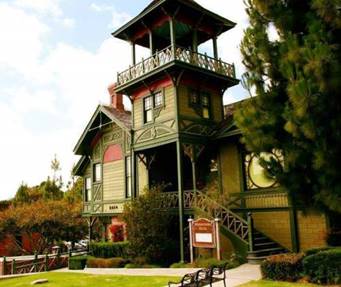
A few weeks ago, I answered a question about the term widows peak. A serendipitous occurrence has since brought another widow term to discuss. One of our readers just happened to mention that he found the term widows walk, just days after my mom and I were admiring a widows walk on a Victorian home in Old Town San Diego, at Heritage Park.

What is a widows walk? A widows walk (also called a widows watch or a roofwalk, is an architectural feature. Heres more on the name, the feature, and then a picture of the beauty we saw at the park. From Wikipedia, a widows walk is a

railed rooftop platform often having an inner cupola/turret frequently found on 19th-century North American coastal houses. The name is said to come from the wives of mariners, who would watch for their spouses’ return, often in vain as the ocean took their lives, leaving the women widows. In other coastal communities, the platforms were called captain’s walks, as they topped the homes of the more successful captains; supposedly, ship owners and captains would use them to search the horizon for ships due in port.

However, there is little or no evidence that widow’s walks were intended or regularly used to observe shipping. Widow’s walks are in fact a standard decorative feature of Italianate architecture, which was very popular during the height of the Age of Sail in many North American coastal communities. The widow’s walk is a variation of the Italianate cupola. The Italianate cupola, its larger instance being an archetypal belvedere, was an important ornate finish to this style, although it was often high maintenance and prone to leaks.

Beyond their use as viewing platforms, they are frequently built around the chimney of the residence, thus creating access to the structure. This allows the residents of the home to pour sand down burning chimneys in the event of a chimney fire in the hope of preventing the house from burning down.

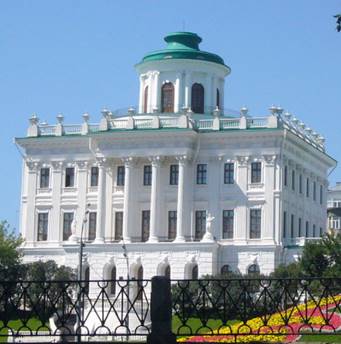
Side note: cupolas and belvederes look similar to me when Goolging images, but WikiDiff says a cupola is a dome-shaped ornamental structure located on top of a larger roof or dome, while belvedere is a turret or other raised structure offering a pleasant view of the surrounding area. There are several photos of cupolas that are not dome-like, so I might call them something else. The etymology from Wikipedia indicates that the word cupola is Borrowed from Italian cupola, from Latin cpula (little tub); from Latin cpa, cuppa (cup); named for its resemblance to a cup turned over.

Here are some photos from around the world with examples of each:

Widows Walk: Sherman-Gilbert House (1887) San Diego, CA

Belvedere: Pashkov House, Moscow Russia

Cupola: Cardiff City Hall, Wales, UK

Kara Church

Pronouns: she/her/hers

Technical Editor, Advisory

Editors Corner Archives: https://episystechpubs.com/
« Newer Posts - Older Posts »

Categories