Posted by: Jack Henry | March 22, 2013

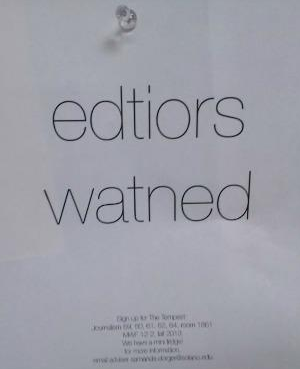
Editor’s Corner: A few problem words and phrases

The following is a partial list of what the author calls “problem words and phrases.” There are several on here that I’d classify as shredder-worthy, and at the top of that list would be “due to the fact that.” Here are ten of the uglier ones, from DailyWritingTips.com:

Tried-and-true words and phrases are convenient, but they are also truly trying—as with clichés, when a writer relies too heavily on stock usage, the resulting prose is tired and uninspired. Watch out for the following deadly usages.

· And also: And and also are redundant; use one or the other.

· As to whether: As to is extraneous; use whether only.

· At this point in time: Omit this meaningless filler.

· Basically, essentially, totally: Basically, these words are essentially nonessential, and you can totally dispense with them.

· Could care less: No, you couldn’t. You want to convey that it’s not possible for you to care
less, so you couldn’t care less. [KC – Richard S., this one’s for you!]

· Due to the fact that: Replace this phrase with because.

· Equally as: As is superfluous; write equally only.

· In the process of: This extraneous phrasing is acceptable in extemporaneous speaking but unnecessarily verbose in prepared oration and in writing.

· Lots/lots of: In formal writing, employ many or much in place of one of these colloquialisms.

· On account of: Replace this awkward phrase with because.

Kara Church

Senior Technical Editor

Posted by: Jack Henry | March 20, 2013

Editor’s Corner: March Madness for Language Lovers

Our language is inundated with sports metaphors. I thought this was an amusing attempt at “revenge” by taking a basketball tradition and turning it into serious word nerdery. Enjoy!

The Quest for the Best Word Ever by Mark Nichol

(From http://www.dailywritingtips.com/the-quest-for-the-best-word-ever/)

Last year, an advertising executive named Ted McCagg embarked on a whimsical endeavor: Using a bracketing schematic like that employed to record the outcome of athletic tournaments—in which, in each iteration, the number of selections displayed is reduced by half according to some criterion, until only one choice remains—McCagg subjectively selected the best word ever. [KC – Not sure what a bracketing schematic looks like? Have a look here: http://www.ncaa.com/interactive-bracket/basketball-men/d1%5D

McCagg’s Final Four?

· diphthong (two vowel sounds in one syllable)

· gherkin (a type of cucumber, or the vine from which it grows)

· hornswoggle (a hoax, or to hoax)

· kerfuffle (a disturbance)

Is there any practical use for this exercise? I see it as an entertaining vocabulary-building activity: Brainstorm any number of interesting words, whether you know their meaning or not. Subject them to match-ups, two words at a time, and select the one you favor on whatever merits—definition, euphony, or some ineffable quality (I like euphony and ineffable). Repeat until you have a winner, then resolve to learn the word’s meaning if you don’t know it already, and use it in your writing.

There are no losers in this game: The runner-up simply takes its place in line, followed by the favored term in the duel between the no. 3 and no. 4 seeds and then by the runner-up in that contest. Try to use each new front-runner as it is identified.

Organize a tournament with a circle of friends (in real life or online), a writing group, or a class. Make submissions anonymous, match them up randomly, and have the participants vote on their favorite word in each pair, which then advances to a run-off with another favored word.

Perhaps this activity seems silly. After all, maybe the writing you’re paid for is about finance or technology, or you produce marketing content. However, I doubt you work in a kerfuffle-free milieu, and hornswoggling may occur betimes (I like milieu and betimes), but you can apply your best-word-ever efforts to specific jargon and vocabulary.

Oh, and McCagg’s best word ever? Diphthong.

NOTICE: This electronic mail message and any files transmitted with it are intended
exclusively for the individual or entity to which it is addressed. The message,
together with any attachment, may contain confidential and/or privileged information.
Any unauthorized review, use, printing, saving, copying, disclosure or distribution
is strictly prohibited. If you have received this message in error, please
immediately advise the sender by reply email and delete all copies.

Posted by: Jack Henry | March 19, 2013

Daily Memo: M is for Meerkat

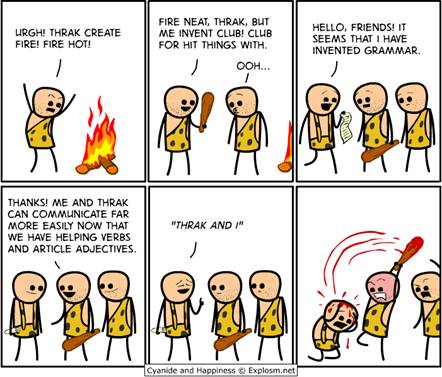
Good morning to you all! I hope your week started off well. Today’s fare is from grammarbook.com, with a great photo and some word play from Jill Beauvillia.

Mach ratio with the speed of sound: Mach 1 = the speed of sound, Mach 2 = twice the speed of sound
mock (adjective, verb) artificial; ridicule
Posted by: Jack Henry | March 18, 2013

Editor’s Corner: L is for Lunes

In college, I rented a room in a house that was owned by a retired schoolteacher. He and his son lived upstairs; three of us girls rented rooms downstairs. His son was my age, but he should’ve been a teenager in the ‘50s and ‘60s. We used to cruise around looking for classic cars in our friend George’s ’65 Chevy.

Anyway, every Monday—winter, summer, rain, or shine—Eric would have The Mamas & The Papas on the record player and I’d be awakened to the “la, la…la, la, la, la” of the song “Monday, Monday.” Being a little obsessive, he wouldn’t play it just once. No, he’d set it to replay and it would go on and on until I was on my way to work or school.

Today, that earworm is still with me, and every Monday when I try to think of an Editor’s Corner title, I get stuck with it for the rest of the day. Thanks a lot, buddy.

Here is the rest of the “L” list as I promised Friday (from grammarbook.com):

lacks is deficient in
lax slack, easy-going
Posted by: Jack Henry | March 15, 2013

Editor’s Corner: Lie versus Lay

Today’s list of frequently confused and misspelled words includes lie and lay. I separated these two troublemakers from the other “L” words because they deserve special attention. The following chart is from the Purdue OWL, with examples from the grammarbook.com website below.

LIE versus LAY

Lie vs. Lay Usage
Present Past Past Participle
lie, lying (to tell a falsehood) I lied to my mother. I have lied under oath.
lie, lying (to recline) I lay on the bed because I was tired. He has lain in the grass.
lay, laying (to put, place) I laid the baby in her cradle. We have laid the dishes on the table.

Examples in the Present Tense:

I am tempted to lie about my age.
I am not lying about my age.

I like to lie down for a nap at 2:00 p.m.
I am lying down for a nap today.
The hens lay eggs.
The hen is laying eggs.

Examples in the Past Tense:

He lied on the witness stand.

I lay down for a nap yesterday at 2:00 p.m.
The hen laid two eggs yesterday.

Examples with a Participle (has, have):

He has lied each day on the witness stand.

I have lain down for a nap every day this week.
The hen has laid two eggs every day this week.

Have a great weekend!

Kara Church

Senior Technical Editor

Posted by: Jack Henry | March 14, 2013

Quiz Answers/Explanations

Well, the moral to this story is that pronouns are difficult. We’ll have to return to this topic in the weeks to come. Here are the results:

ABBBA – 46

ABABA – 11

BAABA – 5

BABAB – 37 (Congratulations!)

BACAB – 4

Question 1

A) If you don’t mind me asking, why are you so angry?
B) If you don’t mind my asking, why are you so angry?

Explanation: Use possessive case pronouns in front of gerunds ("ing" words).

Question 2

A) My friend, unlike me, is very artistic.
B) My friend, unlike myself, is very artistic.

Explanation: "Me" is the object of the preposition "unlike."

Question 3

A) Please talk to Daniela or I next time you have a concern.
B) Please talk to Daniela or me next time you have a concern.
C) Please talk to Daniela or myself next time you have a concern.

Explanation: "Me" is the object of the preposition "to." You could leave out the proper noun and "hear" the correct answer: Please talk to me next time you have a concern.

Question 4

A) She is as stubborn as he, but that’s no surprise given they are sister and brother.
B) She is as stubborn as him, but that’s no surprise given they are sister and brother.
Explanation: Mentally complete the clause: She is as stubborn as he is.

Question 5

A) I weigh more than him.
B) I weigh more than he.
Explanation: Mentally complete the sentence: I weigh more than he does.

Here are some additional tips and examples from the site where the quiz came from: http://www.grammarbook.com/grammar/pronoun.asp

NOTICE: This electronic mail message and any files transmitted with it are intended
exclusively for the individual or entity to which it is addressed. The message,
together with any attachment, may contain confidential and/or privileged information.
Any unauthorized review, use, printing, saving, copying, disclosure or distribution
is strictly prohibited. If you have received this message in error, please
immediately advise the sender by reply email and delete all copies.

Posted by: Jack Henry | March 14, 2013

Editor’s Corner: Pronoun Quiz

It has been forever since we last had a quiz! To test your knowledge of pronouns, I have five questions for you.

The way this works:

· You choose the correct sentence from each group below

· Write down your answers (please do not send them to me)

· Look for the voting buttons at the top of this e-mail

· Select the voting button corresponding to the set of answers that you think is correct

· Wait until noon (or later, depending where you are) and all will be revealed!

Choose the correct sentence from each group:

Question 1

A) If you don’t mind me asking, why are you so angry?
B) If you don’t mind my asking, why are you so angry?

Question 2

A) My friend, unlike me, is very artistic.
B) My friend, unlike myself, is very artistic.

Question 3

A) Please talk to Daniela or I next time you have a concern.
B) Please talk to Daniela or me next time you have a concern.
C) Please talk to Daniela or myself next time you have a concern.

Question 4

A) She is as stubborn as he, but that’s no surprise given they are sister and brother.
B) She is as stubborn as him, but that’s no surprise given they are sister and brother.

Question 5

A) I weigh more than him.
B) I weigh more than he.

NOTICE: This electronic mail message and any files transmitted with it are intended
exclusively for the individual or entity to which it is addressed. The message,
together with any attachment, may contain confidential and/or privileged information.
Any unauthorized review, use, printing, saving, copying, disclosure or distribution
is strictly prohibited. If you have received this message in error, please
immediately advise the sender by reply email and delete all copies.

Posted by: Jack Henry | March 13, 2013

Editor’s Corner: Myself

Good morning! I may be a bit unpredictable with the Editor’s Corner for the next couple of weeks. My faithful friend, cohort, and editor (yes, even editors need an editor), Honey Badger, is on vacation. Twice the work, twice the fun, half the time! Extra credit if you can work out that math. 🙂

The question is: When should I use the reflexive pronoun myself? You may hear people say something such as “Please send your response to Minnie Pearl, Jocko, or myself,” which is incorrect. Let’s have a look at why.

If you were to say the sentence without the other people, how would you say it? “Please send your response to me,” not “Please send your response to myself.” When you add the other people back into the mix, you have the correct answer: “Please send your response to Minnie Pearl, Jocko, or me.”

As I mentioned above, the word myself is a reflexive pronoun. Picture—if you will—a mirror. You are standing in front of it, and you say, “I see myself in the mirror, and what a lovely reflection it is!” You are reflecting (reflexive) upon yourself (pronoun).

From Grammar Girl (www.quickanddirtytips.com):

Other reflexive pronouns include himself, herself, yourself, itself, and themselves. A reflexive pronoun is always the object of a sentence; it can never be the subject. A subject is the one doing something in a sentence, and the object is the one having something done to it. If I step on Squiggly, I am the subject and Squiggly is the object.

You would never say, “Myself stepped on Squiggly,” so you would also never say, “Aardvark and myself stepped on Squiggly.”

Another case where it is correct to use myself is when you are both the subject and the object of a sentence. For example, “I see myself playing marimbas,” or, “I’m going to treat myself to a mud bath.” In both of these cases you are the object of your own action, so myself is the right word to use.

Use Reflexive Pronouns to Add Emphasis

Reflexive pronouns can also be used to add emphasis to a sentence. For example, if you had witnessed a murder, you could say, “I myself saw the madman’s handiwork.” Sure, it’s a tad dramatic, but it’s grammatically correct. If you want to emphasize how proud you are of your new artwork, you could say, “I painted it myself.” Again, myself just adds emphasis. The meaning of the sentence doesn’t change if you take out the word myself; it just has a different feeling because now it lacks the added emphasis.

The quick and dirty tip is to think about how you would write the sentence if you were the only one in it, and then use that pronoun.

I hope you are not thoroughly confused now! At the risk of running a little long, here is another hint and some examples from GrammarBook.com:

Reflexive pronouns – myself, himself, herself, itself, themselves, ourselves, yourself, yourselves– should be used only when they refer back to another word in the sentence.

Incorrect:
My brother and myself did it.
The word myself does not refer back to another word.

Correct:
My brother and I did it.

Posted by: Jack Henry | March 8, 2013

Editor’s Corner: The J’s and K’s

Hello everyone!

I send my apologies for being so neglectful this week.

Don’t forget to “spring forward” on Sunday.

Kara

jewel gem
joule in physics, a unit of work or energy
Posted by: Jack Henry | March 5, 2013

Editor’s Corner: I is for Inguinal

We’re up to the I’s, guys! Today’s list of homonyms and confusing word (from grammarbook.com) follows:

idle not active; unemployed
idol someone admired
idyll or idyl interlude, breathing space; romance, fairy tale

« Newer Posts - Older Posts »

Categories