Posted by: Jack Henry | October 30, 2014

Editor’s Corner: Hallowe’en

The kids in the neighborhood (and at work) are busily preparing for a free candy feast and I am letting Grammar Girl do all of the work today. From Mignon Fogarty’s Quick and Dirty Tips:

Why Do You Sometimes See an Apostrophe in Hallowe’en?

One early spelling of Halloween was All Hallows’ Even, in which even meant "evening." The all and s got dropped, hallows’ and even became a closed compound, and the apostrophe took the place of the v, giving us Hallowe’en—just one of many transitional spellings along the way to Halloween, which the Oxford English Dictionary shows as first appearing in 1786. Other spellings before Halloween included Hallow-e’en, Alhollon Eue, and Halhalon evyn.

Kara Church

Technical Editor, Advisory

619-542-6773 | Ext: 766773

www.symitar.com

NOTICE: This electronic mail message and any files transmitted with it are intended
exclusively for the individual or entity to which it is addressed. The message,
together with any attachment, may contain confidential and/or privileged information.
Any unauthorized review, use, printing, saving, copying, disclosure or distribution
is strictly prohibited. If you have received this message in error, please
immediately advise the sender by reply email and delete all copies.

Posted by: Jack Henry | October 29, 2014

Editor’s Corner: Because

I imagine some of you are getting tired of my daily lessons mixed with vacation talk. So today, instead of telling you about a method of torture I learned about at the Tower of London, I am going to share a frequently asked grammar question (and the answer) with you.

Today’s tidbit is courtesy of the Chicago Manual of Style.

Q. Is it grammatically correct to start a sentence with the word because?

A. Yes, it’s correct. It’s correct in formal prose when because is the beginning of a complete sentence, e.g.,

Because of the wind, it felt colder.

Because I was late, they towed my car.

Sticklers object to the use of because because it sometimes introduces a sentence fragment, and they think that sentence fragments are not allowed in writing. But they are wrong—sentence fragments are found in the very best of classic English prose. Because they work.

KC – Of course, our technical documentation does not claim to be the “very best of classic English prose,” so we use more formal English and generally shy away from sentences that begin with “because.”

For those of you who are interested in the gruesome side humans or who are preparing a stellar Halloween scene at your house, there is an article about the Scavenger’s Daughter here.

Kara Church

Technical Editor, Advisory

619-542-6773 | Ext: 766773

www.symitar.com

NOTICE: This electronic mail message and any files transmitted with it are intended
exclusively for the individual or entity to which it is addressed. The message,
together with any attachment, may contain confidential and/or privileged information.
Any unauthorized review, use, printing, saving, copying, disclosure or distribution
is strictly prohibited. If you have received this message in error, please
immediately advise the sender by reply email and delete all copies.

Posted by: Jack Henry | October 28, 2014

Nifty Nuggets: Bring Versus Take

Someone asked me about the correct usage of the words bring and take. Specifically, do you take the system down or do bring the system down? According to Grammar Girl, the answer depends on your point of reference for the action.

Take means to leave with something and bring means to arrive with something.

The words bring and take can get tricky when referring to a system because you aren’t physically leaving with it or arriving with it. For Episys, we use the words bring and take as follows:

· Take the system down.

· Bring the system up.

· Take Episys off host before continuing the process.

· Bring Episys on host before continuing the process.

Jackie Solano | Technical Editor | Symitar®

8985 Balboa Ave. | San Diego, CA 92123 | Ph. 619.542.6711 | Extension: 766711

NOTICE: This electronic mail message and any files transmitted with it are intended
exclusively for the individual or entity to which it is addressed. The message,
together with any attachment, may contain confidential and/or privileged information.
Any unauthorized review, use, printing, saving, copying, disclosure or distribution
is strictly prohibited. If you have received this message in error, please
immediately advise the sender by reply email and delete all copies.

Posted by: Jack Henry | October 28, 2014

Editor’s Corner: Gargoyles and Grotesques

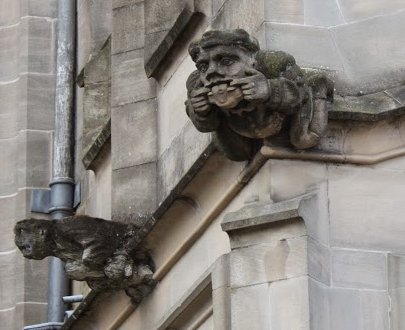
Today I have something brief for you: the difference between gargoyles and grotesques. While both are stone elements on a building, they have different purposes and etymologies. The definitions and etymologies are from Merriam-Webster, except where noted:

· gargoyle (noun)

1a: a spout often having the form of a grotesque figure or animal and projecting from a roof gutter to throw rainwater clear of a building

Middle English: from Old French gargouille ‘throat,’ also ‘gargoyle’ (because of the water passing through the throat and mouth of the figure); related to Greek gargarizein ‘to gargle’ (imitating the sounds made in the throat).[KC – Etymology from

Google
.]

Oxford Gargoyles

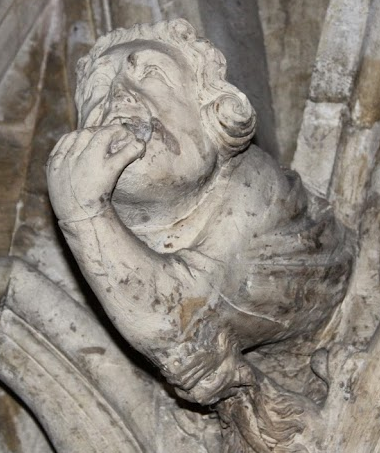
· grotesque (noun)

1a : decorative art (as in sculpture, painting, architecture) characterized by fanciful or fantastic representations of human and animal forms often combined with each other and interwoven with representations of foliage, flowers, fruit, wreaths, or other similar figures into a bizarre hybrid composite that is typically aesthetically satisfying but that may use distortion or exaggeration of the natural or the expected to the point of comic absurdity, ridiculous ugliness, or ludicrous caricature

b (1): a piece of decorative art done in this style

(2): one of the figures or designs in such a piece of decorative art

(3): something suggestive of or resembling such art or the figures or designs of such art

Middle French and Old Italian; Middle French grotesque, crotesque, from Old Italian grottesca, from (pittura) grottesca, literally, cave painting, ancient painting found in the ruins of Rome; grottesca, feminine of grottesco, adjective

York Minster Grotesque

Kara Church

Technical Editor, Advisory

619-542-6773 | Ext: 766773

www.symitar.com

NOTICE: This electronic mail message and any files transmitted with it are intended
exclusively for the individual or entity to which it is addressed. The message,
together with any attachment, may contain confidential and/or privileged information.
Any unauthorized review, use, printing, saving, copying, disclosure or distribution
is strictly prohibited. If you have received this message in error, please
immediately advise the sender by reply email and delete all copies.

Posted by: Jack Henry | October 24, 2014

Nifty Nuggets: Crazy Capitalization

One of the most common errors in writing is the misuse of capital letters. Symitar’s editors see a lot of what I call “crazy capitalization” because it drives me crazy. Writers tend to capitalize words that they feel are important or that they want to stand out. We discourage the use of excessive capitalization because it distracts and confuses readers more than it clarifies.

We’ve covered the capitalization standards in the JHA Style Guide for Technical Communication and Training. Click the link for a refresher.

Use caution when you are tempted to capitalize a word that is not a proper noun. Do some research to determine if capitalization is necessary. Usually, the word is treated generically and capitalization isn’t required.

Jackie Solano | Technical Editor | Symitar®

8985 Balboa Ave. | San Diego, CA 92123 | Ph. 619.542.6711 | Extension: 766711

Posted by: Jack Henry | October 24, 2014

Editor’s Corner: Mondegreens from the UK

It’s Friday! Let’s ease into the weekend with some mondegreens from UK bands. Today’s selection of mondegreens is brought to you by Hit Me with Your Pet Shark: Misheard Lyrics of the 1980s, by Charles Grosvenor Jr.

Song Title Artist/Group Mondegreen Actual Lyrics
The Reflex Duran Duran The reflex is in charge of finding treasure in the dog The reflex is in charge of finding treasure in the dark
Hungry Like the Wolf Duran Duran Seen in the subway:

Earth, Wind, and Fire

Steam in the subway
Earth is afire
Rio Duran Duran The end of the drive, a llama to ride At the end of the drive, the lawmen arrive
Baby’s Coming Back Eurythmics It’s all right, babies come in bags It’s all right, baby’s coming back
Here Comes the Rain Again Eurythmics Falling on my head like a mule in motion Falling on my head like a new emotion
Red Skies at Night The Fixx Rich guys with knives Red skies at night
No Reply at All Genesis There’s soda, pie, and all There’s no reply at all
Invisible Touch Genesis She has built-in amenities She’s got a built-in ability
Father Figure George Michael To be bowling naked
At your side
To be bold and naked
At your side
Faith George Michael My Buddhist ocean My foolish notion
Mirror Man Human League Here comes the mirror man,
Says he’s a meatball fan
Here comes the mirror man,
Says he’s a people fan

Kara Church

Technical Editor, Advisory

619-542-6773 | Ext: 766773

www.symitar.com

NOTICE: This electronic mail message and any files transmitted with it are intended
exclusively for the individual or entity to which it is addressed. The message,
together with any attachment, may contain confidential and/or privileged information.
Any unauthorized review, use, printing, saving, copying, disclosure or distribution
is strictly prohibited. If you have received this message in error, please
immediately advise the sender by reply email and delete all copies.

Posted by: Jack Henry | October 23, 2014

Editor’s Corner: Auld Reekie

Good morning! Today I have a few words for you from Scotland. The etymological information is from the unabridged version of the Merriam-Webster dictionary.

auld old

loch lake

Auld Reekie An old name for Edinburgh. Yes, Reekie as in bad smell because of all of the fires and the lake of raw sewage and dead bodies that sat in the valley below the castle and the city.

  • kilt: (Scottish) a knee-length skirt of pleated tartan cloth, traditionally worn by men as part of Scottish Highland dress. Not to be confused with the slang past tense of the verb to kill, as in, The possum was chargin at me so I kilt it.

philibeg (or filibeg): small kilt (from Scottish Gaelic file-beag, from fileadh kilt + beag little)

rood crucifix (The Palace of Holyroodhouse is the home of the Queen two weeks each summer, and there are ruins of an abbey there that are really cool.)

wynd (rhymes with kind) A narrow winding lane

pend An arch or archway; covered passage

gate Street (from Middle English, from Old Norse gata road, path)

close An alley between two buildings, usually leads to a court or courtyard (Middle English clos, from Old French clos, from Latin clausum enclosure)

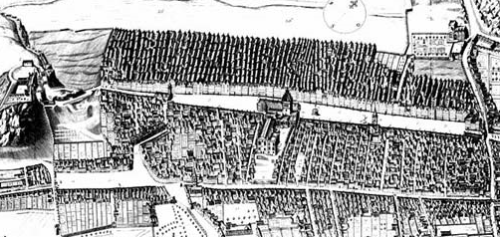
A note on closes: Edinburgh today has a few closes you can explore, but during the 1600s there were so many tall buildings crammed together, there were closes everywhere. The town, from the castle to the abbey, was said to resemble a fish skeletonwith the spine down the middle (Royal Mile) and the rib bones on either side (the closes).


Royal Mile in Medieval Edinburgh (rows of buildings and closes between them)

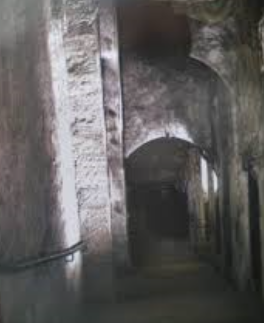
Mary Kings Close is a very well-preserved series of homes and walkways, now underground because after fires and the black plague, the new city was built on top of the old. The buildings were so close together that they created these closes (alleys) between them.

Mary Kings Close (Looking down the old alleyway between two buildings, now underground)

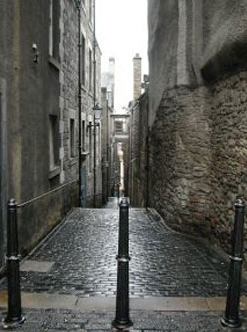
An Edinburgh close today

Kara Church

Technical Editor, Advisory

Posted by: Jack Henry | October 22, 2014

Nifty Nuggets: Colons

I’m back! Let’s get this party started!

Today I’m going to talk about colons. We use colons to introduce quotations, explanations, examples, and lists. What follows a colon can also be an explanation or summary of what precedes the colon. When not introducing a list, a colon indicates "this is what I am talking about" or "here is an example."

When using a colon, remember that the phrase preceding the colon must be a complete sentence.

Use colons in these circumstances:

· To introduce a clause or phrase that explains or restates what went before the colon

Example:

o This is the Synapsys interface: it is a customer relationship management product that presents complete profile information for members.

· To introduce a list

Example:

o The Acquire Option parameter has three possible settings: (0) None, (1) Individual, and (2) Consolidate.

· To introduce a bulleted list

Example:

o Choose one of these options:

§ Select (0) None if this service is a non-loan product which does not require information from the credit report.

§ Select (1) Individual if this service is designed to replace loans found on the credit report on a one-to-one basis.

§ Select (2) Consolidate if this service is designed to replace loans found on the credit report on a one-too-many basis.

· To separate title and subtitle (preferred instead of a hyphen)

· To express time and ratios when used between numbers

Per the JHA Style Guide for Technical Communication and Training, when using a colon to introduce a list, eliminate the words the following.

Example:

Incorrect: Entries include the following:

Correct: Entries include:

Symitar technical writers, please don’t give me the stink eye when I pass you in the hall. Do your best to avoid using the words the following when introducing a list.

Jackie Solano | Technical Editor | Symitar®

8985 Balboa Ave. | San Diego, CA 92123 | Ph. 619.542.6711 | Extension: 766711

Posted by: Jack Henry | October 22, 2014

Editor’s Corner: A Shambolic Holiday

The first time I heard the word “shambles” was in reference to my room, when Mom looked in and saw it needed a cleaning. More recently, we stayed at someone’s house and she referred to it as “shambolic,” and two days later we were in York, England, and ran into an entire area called “The Shambles,” pictured below. We were told, during our evening tour of York, that people weren’t very inventive with their names of streets in the 1400s. Castlegate is the street leading to the castle, Fishergate is where the fishmongers are, Swinegate is where you could buy three little piggies, and Grope Street (now Grape Street) was where you could buy…well, company for the evening.

So why “The Shambles”? Was this street particularly messy?

The Shambles, York, England

The answer is this: the word has evolved to mean a chaotic scene, a mess, or a disaster (like my room as a kid), but it does have an older meaning which will tie this all together. First, here are the newer definitions of shambles, from Merriam-Webster:

shambles

(noun, plural but usually singular in construction)

· a (1):a scene of great destruction <the imposing entrance … is a shambles and inside the quadrangle the great aula is demolished from a direct bomb hit — J. G. Gray>

(2)
: the result of great destruction: wreckage, wreck <have not cleaned up the shambles of bombing — Ruth Benedict><this buxom ball of fire makes a shambles of decorum — Irving Kolodin>

(3)
: the state of being wrecked <the bombers left the city in shambles>

· b: a place of mass slaughter or bloodshed <the bridge instantly became a shambles, every officer and man on that key position being either killed or wounded — Russell Grenfell>

· c (1): a scene of great disorder <the apartment became a shambles — S. J. Perelman><conference this year was an utter shambles chaired by an elderly lawyer who apparently could neither speak nor hear — A. F. Buchan>

(2): great confusion: mess <their ideals are vanity and illusion and their pretended moralities a shambles — Irwin Edman>

Before I tell you what “shambles” used to mean, I will give you one more hint. As you walk along this street you may notice hooks along the overhangs of the different stores. These are from the time the street was named, when “shambles” meant slaughterhouse. The word “shambles” also came to mean meat market and “shamble” was the name of the table where meat was exhibited for sale.

If you look back at the photo, you can see that in the middle of the street there are some trough-like low points: this was so the blood from the shops could easily flow downhill and away from the shops. It ended up in the river and at the Golden Fleece pub. The river and pub are still there—thank goodness the meat and the smells are gone!

Kara Church

Technical Editor, Advisory

Posted by: Jack Henry | October 21, 2014

Editor’s Corner: Dancing with Druids

Cheers all! Thank you Donna, Jackie, and Laura for sitting in the Editor’s Corner so I could go on vacation. While you entertained the audience and shared your wisdom on grammar and other things English, I was in England (and Scotland). Let me just say that at times, I really wondered if we all share a common language.

Right now my brain is still in a different time zone, but over the next couple of weeks I will share some of the new vocabulary I learned and maybe a few insights and stories about the land our language came from. Today I will share a few terms I learned on my trip to Stonehenge.

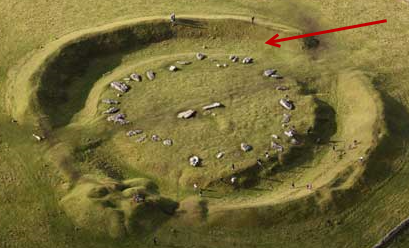
henge: A henge is a Neolithic earthwork, usually consisting of a circular or oval-shaped bank with an internal ditch. Maybe this would be easier to show you?

Arbor Low Henge

cursus: Cursus is the name given to large parallel lengths of banks with external ditches. They were originally thought to be Roman race courses and were therefore named cursus.

Stonehenge Cursus

lintel: (Not to be confused with lentil, the delicious legume used to make dal.) From Wikipedia: “A lintel can be a load-bearing building component, a decorative architectural element, or a combined ornamented structural item. It is often found over portals, doors, windows, and fireplaces.”

Post and Lintel Construction

sarsen: Sandstone blocks used in the construction of Stonehenge; found in quantity in the United Kingdom.

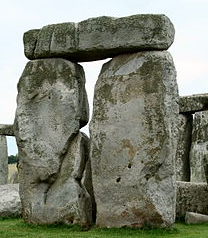
trilithon: A trilithon (or trilith) is a structure consisting of two large vertical stones (posts) supporting a third stone set horizontally across the top (lintel).

Stonehenge Trilithon

barrow: Term used in England to describe a large mound of earth (or stones) over the remains of the dead. Stonehenge is surrounded by many barrows.

Barrow near Stonehenge

For more information on Stonehenge, you can check out the Wikipedia page here.

Kara and Ray: happy, but freezing at Stonehenge.

Kara Church

Technical Editor, Advisory

« Newer Posts - Older Posts »

Categories